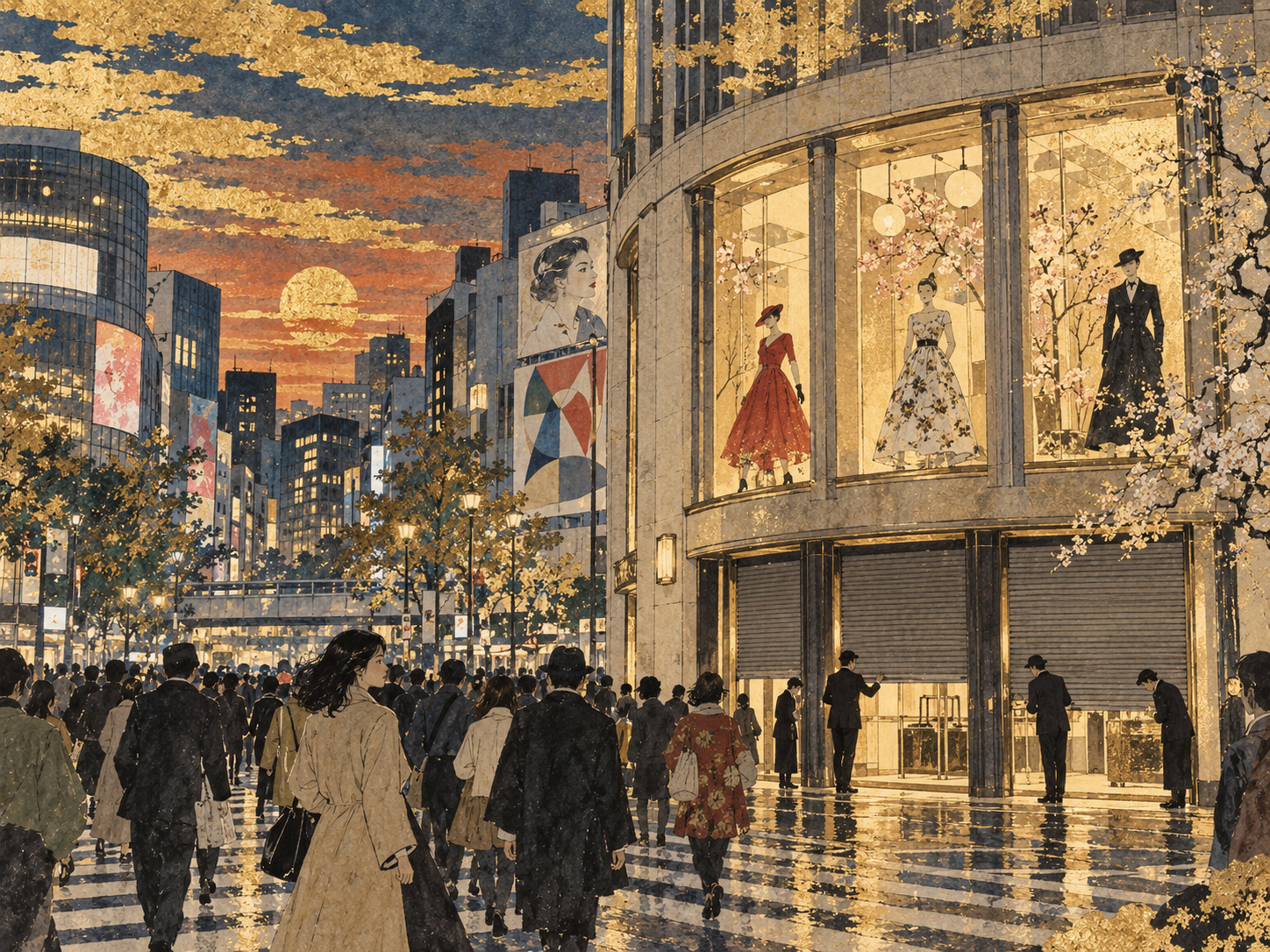
At 8 p.m. on September 30, 2026, the main A and B buildings of Seibu Shibuya ended operations.
The department store had opened on April 19, 1968. For 58 years, just beyond Shibuya's famous crossing, it placed imported fashion, Japanese designers, household objects and contemporary art somewhere between merchandise and culture.
On the final morning, roughly 150 people lined up before opening. Some photographed the building. Others came for familiar restaurants or to revisit a place connected to parents, childhood and decades of shopping. There was no formal closing ceremony at 8 p.m.; the store said it omitted one for public-safety reasons.
In 1968, Shibuya was not yet “Seibu territory”
When Seibu Shibuya opened, the image of Shibuya as a global youth-culture district was still being constructed.
Tokyu had long shaped the district through railways, real estate and department stores. Seibu Department Store's historic base was Ikebukuro.
Entering Shibuya therefore meant more than adding another place to buy clothing.
The store became an anchor from which Seibu-related businesses pulled customers farther into Udagawacho and up the hill toward what became Koen-dori. Stores, theaters, fashion and culture were distributed along that route. Over time, walking between them became part of the product.
It began as a classic Showa department store too
The later image of avant-garde fashion can obscure Seibu Shibuya's conventional beginnings.
At opening, two floors were devoted to kimono. The rooftop had an amusement area remembered as “Otogi no Kuni.” Families could spend most of a day inside a department store: shop, eat, entertain children and browse household goods.
When Seibu mounted its farewell history exhibition in 2026, visitors contributed memories of playing on that rooftop.
The 58-year story is therefore partly the story of the Japanese department store itself—moving from family leisure palace toward fashion and cultural media, and then struggling in an era of specialist retail and digital commerce.
Importing fashion once meant importing information
Seibu's own history emphasizes the role of its Paris office and early introduction of international fashion, including brands such as Hermès and Yves Saint Laurent.
This was before global luxury brands operated dense networks of directly controlled boutiques across Japanese cities, and long before collections could be watched instantly online.
A department-store buyer's selection was itself information.
The store did not merely make foreign products available. It framed them, displayed them and told customers what “now” looked like elsewhere in the world.
Capsule did the same thing for Japanese designers
Seibu Shibuya also turned that curatorial logic toward Japanese fashion.
The store's own institutional history remembers “Capsule” as a legendary edited fashion floor that promoted Japanese designers who would become associated with the DC-brand boom.
By the 1980s, Japanese designer and character brands were central to youth consumption. Clothing increasingly arrived as part of a larger system of identity—music, magazines, graphics, interiors, hair and advertising.
Names including Kansai Yamamoto, Issey Miyake and Kenzo Takada appear in recollections of the store's fashion history.
The department store began to sell a city
Shibuya PARCO opened in 1973, preceded by the Seibu Theater, now PARCO Theater.
PARCO's own history uses three words to describe the model that developed there: incubation, city-making and information dissemination.
The aim was not to keep the consumer inside one box. It was to pull people up a hill and through the neighborhood. The transformation of the old Kuyakusho-dori into the identity of Koen-dori became the spatial symbol of that strategy.
There is an important distinction here. It would be inaccurate to credit every PARCO theater, museum or publishing activity directly to Seibu Shibuya department store.
Seibu Department Store, PARCO, Seiyu, Muji and the theater and museum businesses were separate organizations inside the wider Seibu distribution/Saison ecosystem. Seibu Shibuya was one major gateway into that cultural economy, not its sole author.
“Seibu Village” was a network, not a mall
Over time, a cluster of Seibu/Saison-related buildings extended from the A and B buildings toward Shibuya PARCO.
SEED opened in 1986. Loft followed in 1987. The building that became Movida, theater spaces and multiple PARCO buildings helped produce an area sometimes called “Seibu Village.”
The important point is what lay between the buildings: ordinary streets.
Rather than trapping all spending inside one enclosed mall, the system encouraged movement through the neighborhood. Customers encountered cafes, independent shops, theaters and other businesses on the way.
Today urban developers call that “circulation.” In 1970s and 1980s Shibuya, it became culture.
SEED treated retail as a laboratory
The SEED building, opened in 1986, embodied Seibu Shibuya's experimental side.
It operated as an independently edited fashion building focused on original merchandising and emerging creators.
SEED Hall hosted programming ranging from experimental film to contemporary art.
The idea was not to wait until something was already popular and then stock it. It was to find something not yet fully legible as a market, place it in context, and help create the customer for it.
That logic now seems familiar in concept stores and curated retail. At the time, it pushed against the traditional department-store model.
In 1987, Loft built a business around things people did not “need”
Loft began in 1987 as an annex of Seibu Shibuya, growing out of the department store's hobby and lifestyle-goods business.
One early idea was hitsuyohin transformed into hitsuyokuhin—not simply necessities, but things one strongly wants: stationery, designed household goods, clocks, cards, party goods, small objects that make everyday life more interesting.
Loft later became a national retail format.
That expansion matters historically. It means an experiment launched inside Seibu Shibuya became an independent answer to how Japanese consumers wanted to shop for lifestyle goods.
Saison culture deliberately blurred shopping and culture
Any account of the broader Seibu/Saison cultural project eventually reaches Seiji Tsutsumi, the executive who also wrote poetry and fiction under the name Takashi Tsujii.
The Seibu Museum, Libro bookstore, Art Vivant, Seibu Theater, Studio 200, Saison Museum of Art, PARCO and the wider retail businesses placed literature, performance, contemporary art and shopping unusually close together.
This was cultural patronage, but it was also commercial strategy.
Culture built brand distinction. Brand distinction brought people. Those people created markets for new forms of culture.
In Shibuya, that feedback loop expanded out of buildings and into the street.
Contemporary art entered the selling floor
Sogo & Seibu says the Shibuya store strengthened contemporary-art exhibitions and sales from the 1980s, working in dialogue with the broader Saison art ecosystem.
The store sought out younger artists rather than limiting itself to already established names and traditional department-store art categories.
That made the store different from a museum. It was not a public collection preserving art for future generations. It was a marketplace connecting artists, collectors and a fashion-oriented public.
Yet the curatorial act—deciding who was worth seeing before consensus formed—was central to both.
“Art meets Life” revived the old method in a new era
After the bubble burst, the Saison group fragmented and Japan's department-store sector entered a long contraction. Seibu Shibuya nevertheless continued to define itself through culture.
In 2011 it adopted “Art meets Life,” expanding contemporary-art programming across the store. A 2015 renovation strengthened spaces where art and design were integrated into the retail environment, including Carsten Nicolai's changing-light installation at the A-building entrance.
Projects such as Shibuya Style, contemporary-art exhibitions and participation in Art Fair Tokyo kept the store's role as an art seller and talent scout alive.
In a sense, it applied to art the same editorial habit it had once applied to fashion: find something before everyone knows it, then give it meaning through presentation.
CHOOSEBASE was the digital-era version of the experiment
In 2021 Seibu opened CHOOSEBASE SHIBUYA, described as a media-oriented OMO store blending online and offline retail.
Customers could discover information digitally, encounter products physically and move between commerce and media.
The comparison across half a century is striking. In 1968, information arrived through buyers and a Paris office. By 2021, the same institution was trying to redesign the store around smartphones and e-commerce.
The technology changed. The assumption that a store should edit information rather than merely hold inventory did not.
The closure does not erase every trace of the Seibu/Saison district
The September 30 closure covered the core A and B buildings and the parking building.
Local reporting says the Loft and Movida buildings continue operating. Shibuya PARCO, of course, operates separately.
So it would be inaccurate to say the closure removes all traces of Saison-era retail culture from Shibuya.
What disappears is the original department-store anchor—the institution that stood at the beginning of the route from the station toward the later cultural cluster.
Why couldn't the store simply be rebuilt?
The immediate closure mechanism was property ownership and lease control.
Sogo & Seibu says it discussed redevelopment with the landowners for nearly two decades without reaching agreement. In 2024 the owners notified the company that redevelopment would proceed and later sought lease termination and return of the properties.
The retailer continued negotiations but says its requests could not be accommodated.
As of this article's preparation, publicly confirmed detail about the eventual redevelopment remained limited. It would therefore be premature to state exactly what will replace the store, when a new project will open or whether Seibu retail will ever return to the site.
Shibuya is losing the department-store form
Seibu's departure also belongs to a broader restructuring of central Shibuya.
Tokyu Department Store's Toyoko store ended operations in 2020. Tokyu Department Store's flagship main store closed in January 2023.
The two department-store groups that once competed to shape the district no longer occupy it in the same form.
At the same time, Shibuya Scramble Square, the rebuilt Shibuya PARCO, Miyashita Park and Shibuya Sakura Stage represent a different commercial city: taller, mixed-use, tenant-based and integrated with offices, hotels, public space, technology and transit redevelopment.
Shopping has not disappeared. What is disappearing is the department store as one company capable of editing fashion, food, furniture, art and culture under a single institutional voice.
What Seibu Shibuya left behind
| Period | Experiment | Legacy |
|---|---|---|
| 1968 onward | Imported fashion and urban department-store retail | Global fashion presented as edited information |
| 1970s | PARCO/theater-centered city-making | Cultural circulation from station toward Koen-dori |
| 1980s | Capsule, SEED, contemporary art | Incubating designers and artists inside retail |
| 1987 onward | Loft | Lifestyle goods become an independent retail culture |
| 2011 onward | Art meets Life | Contemporary art integrated into whole-store merchandising |
| 2021 onward | CHOOSEBASE | Experiment in digital/physical OMO retail |
Seibu did not create youth Shibuya alone
Turning Shibuya's cultural history into the story of one corporation would be misleading.
Tokyu's transport and development, NHK, public halls, record stores, live houses, cinemas, magazines, Center-gai, Harajuku, independent boutiques and young people themselves all made the district.
Seibu was not the author of all of it.
Its distinctive contribution was to behave like a large corporation that treated the city as unfinished—somewhere to run experiments. It placed attractions outside the main store, made customers walk between them and allowed the streets between corporate properties to become part of the experience.
Did the internet defeat the department store's editorial power?
In the late twentieth century, department stores possessed a genuine information advantage.
Foreign fashion, unusual furniture, specialty foods and unknown artists were difficult for ordinary consumers to discover independently. A department store could tell people what deserved attention.
Today social media, e-commerce, video and direct-to-consumer brands bypass that gatekeeping role.
In that sense, the department store lost its monopoly on curation.
But curation did not disappear. It fragmented into concept stores, specialist e-commerce, influencers, newsletters and niche media.
Seibu Shibuya's history feels contemporary precisely because it was practicing that editorial model before the digital tools existed.
In its final summer, the store exhibited itself
Before closing, Seibu Shibuya staged the “#Shibuya Memories” exhibition in the B building.
Archival exterior photographs, opening advertisements, the rooftop amusement park, old sales floors and event imagery turned the department store itself into the subject of an exhibition.
Customers were invited to contribute their own memories, later displayed in the A-building windows.
At the end, the store was selling more than a final season of merchandise.
It was exhibiting the argument that it had become part of the city's memory.
April 19, 1968: Seibu Shibuya opens.
1973: Seibu Theater and Shibuya PARCO open, extending the cultural-commercial route toward Koen-dori.
1980s: The store expands designer-fashion and contemporary-art programming.
1986: SEED opens with experimental merchandising and SEED Hall programming.
1987: Loft opens in Shibuya, birthplace of the lifestyle-goods format.
1990s: The A and B buildings are physically and commercially updated, including elevated connections.
1999: Movida opens from the SEED lineage.
2011: “Art meets Life” becomes the store's art-and-retail concept.
2015: Major renovation expands art and design through the store environment.
2021: CHOOSEBASE SHIBUYA opens.
March 25, 2026: September closure is announced.
Sept. 30, 2026: A and B buildings close at 8 p.m., ending 58 years of department-store operation.
A department store that ended without a closing ceremony
Many old Japanese department stores end with a familiar scene: the manager speaks at the shutter, employees line up and bow, customers applaud.
Seibu Shibuya did not stage that ritual.
The official explanation was safety for customers and the surrounding community.
Yet people still created their own goodbye—queuing before opening, photographing the facade and revisiting restaurants and floors associated with decades of personal history.
The institution declined the ceremony. The city supplied one informally.
The building closes; the method remains
Seibu Shibuya's most durable legacy may be less a particular brand, art exhibition or famous sales floor than an idea: commerce can make culture.
That was never culturally pure. The purpose was also to sell products, attract customers and build corporate identity.
That is precisely why it mattered.
Art and design were not confined to museums and theaters. They entered clothes, stationery, advertising, windows, cafes and the route a shopper walked through the city.
On September 30, 2026, Seibu Shibuya the department store ended.
But walk through today's Shibuya—the edited retail of PARCO, Loft's object culture, the idea that a commercial district should constantly produce new scenes—and traces of the method remain.
Of everything Seibu Shibuya sold over 58 years, the thing likely to last longest may be an urban expectation: in Shibuya, it should always be possible to try something new.
Sources & Reporting Notes
- Sogo & Seibu: 2026 news releases — Primary company source for the March 25 announcement that Seibu Shibuya would cease operations on Sept. 30 after long redevelopment and lease negotiations.
- Seibu/Sogo: THE LAST — Thank You, Shibuya — Primary source for the Sept. 30 closure date and farewell programs marking 58 years.
- Seibu Shibuya: Sept. 30 final-day hours — Primary source confirming A and B buildings closed at 8 p.m. and no formal closing ceremony was held.
- Sogo & Seibu corporate history — Official record of Seibu Shibuya opening in April 1968.
- Sogo & Seibu: Seibu Shibuya Art Meets Life — Primary institutional history of imported luxury brands, the Capsule fashion floor, SEED, Loft and later art strategy.
- Sogo & Seibu: Shibuya Alternative Space — Primary background on contemporary-art programming and young-artist incubation from the 1980s onward.
- Sogo & Seibu: Loft — Primary history of Loft beginning in 1987 as an annex of Seibu Shibuya and developing from the broader Saison cultural environment.
- PARCO corporate history — Official record of Shibuya PARCO and Seibu Theater opening in 1973.
- PARCO: Origins of Shibuya PARCO — Official context on Shibuya PARCO's incubation, city-making and information-dissemination model.
- Saison Foundation: history — Institutional history of Seiji Tsutsumi/Takashi Tsujii-era cultural businesses including Seibu Museum, theater and broader Saison culture.
- Shibuya Keizai Shimbun, Mar. 25, 2026 — Detailed local reporting on the closure decision, building configuration, landowner negotiations and postwar Shibuya context.
- Shibuya Keizai Shimbun, Sept. 30, 2026 — Final-day reporting: morning queue, farewell atmosphere, and continuing Loft/Movida operations.
- Shibuya Keizai Shimbun: #ShibuyaMemories exhibition — Local account of the store's farewell history exhibition, including archival advertising, rooftop amusement park and customer memories.
This article is based on public material available through October 1, 2026. Because Seibu Shibuya's A and B buildings ended operations at 8 p.m. on September 30, the Oct. 2 article describes the closure in the past tense. The immediate cause is reported from Sogo & Seibu's account of redevelopment and lease negotiations with the landowners; department-store economics are treated as broader context rather than asserted as the direct cause. Publicly confirmed detail about the site's future redevelopment, schedule or any eventual Seibu return remains limited and is not presented as settled. PARCO, Loft, Muji and other Saison-era institutions are distinguished from the Seibu Shibuya department store itself.
Image rights: © 2026 Japan.co.jp. AI-assisted editorial illustration. Permission is required for reuse. Contact.