Sapporo, Nagoya, Osaka and Fukuoka Move Into Japan’s New Secondary-Capital Framework
Draft rules put four metropolitan regions at the front of Japan’s new secondary-capital system, combining disaster backup with an attempt to reduce the country’s dependence on Tokyo.
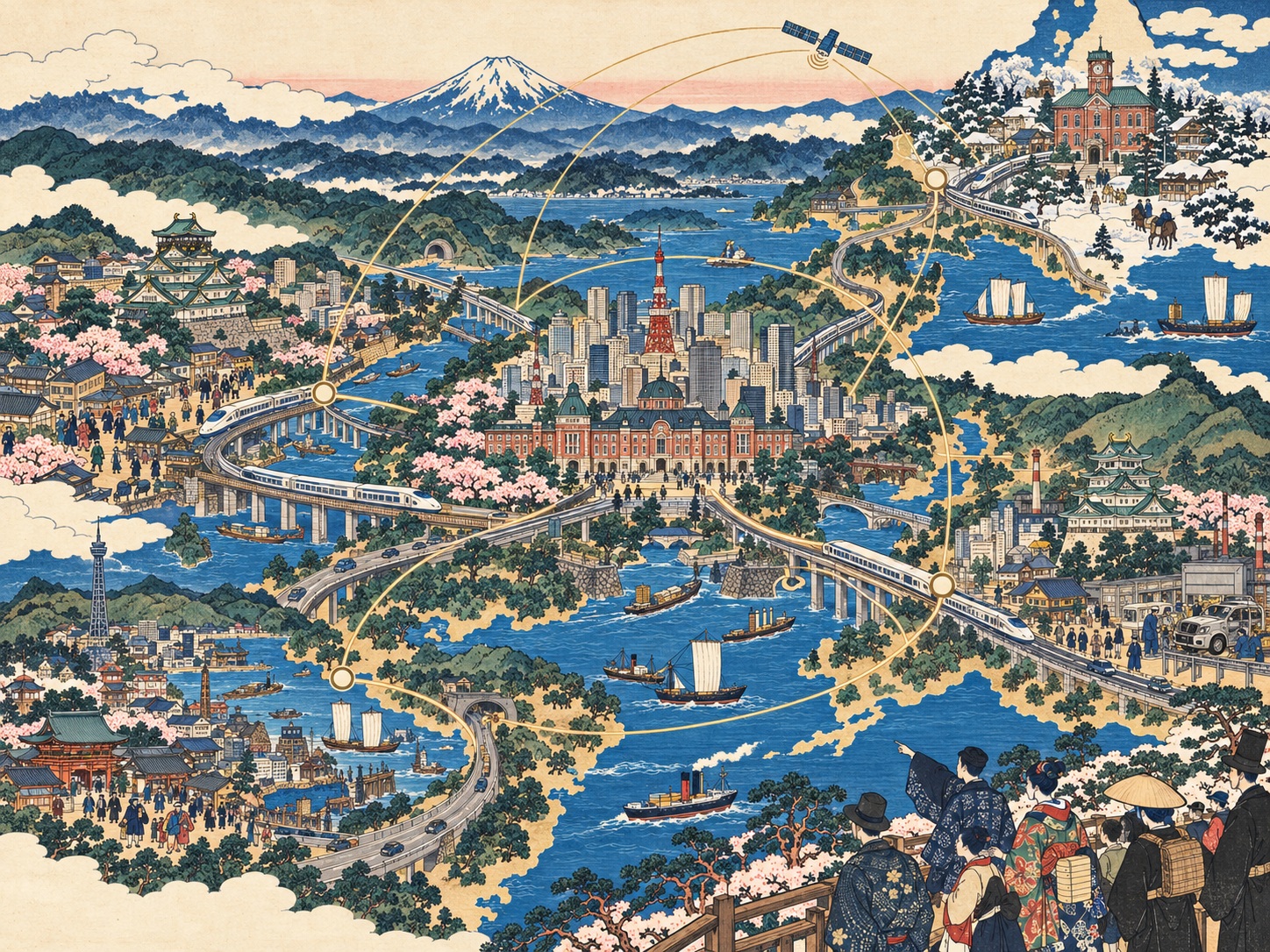
TOKYO. Japan’s decades-old concern about putting too much of the country in Tokyo is moving from policy debate into law. On October 3, the Cabinet Secretariat published draft ordinances setting out how prefectures can qualify to become a secondary capital—a region capable of temporarily replacing most central functions of Tokyo after a major disaster while also serving as a core of a more decentralized national economy.
Under the draft criteria, Hokkaido with Sapporo, Aichi Prefecture with Nagoya, Osaka Prefecture and Fukuoka Prefecture are the four regions reported to meet the main population, economic and central-government-office thresholds. All four have indicated interest in seeking designation.
They have not been selected. The ordinances are still open for public comment through October 16, and the candidate prefectures must also satisfy a final requirement involving the administrative relationship between the prefecture and its ordinance-designated city before formally applying.
This is not simply a plan to build “another Tokyo”
The law gives the secondary-capital concept two jobs. The first is continuity of government and society: if a major disaster makes it impossible for Tokyo to maintain the country’s core political, administrative or economic functions, the secondary capital must be able to substitute for all or most of those functions for a period.
The second is economic decentralization. The law links the backup role to the creation of a “multipolar and decentralized economic zone,” making the policy broader than emergency management.
Nagoya City’s official explanation describes a secondary capital as a region that can temporarily assume all or most of Tokyo’s central functions when a large disaster makes their continuation difficult, while also helping reduce the excessive concentration of population, companies and economic activity in Tokyo.
The distinction matters. Japan is not merely choosing a place for emergency cabinet meetings. The policy is intended to build enough administrative, transport, communications and private-sector capacity outside Tokyo that a major metropolitan region can function as a national alternative in a crisis—and remain economically important in normal times.
The roots run through the 2011 disaster
Debate over relocating or backing up Japan’s capital functions stretches back decades, but the March 2011 Great East Japan Earthquake gave the issue a new urgency. The disaster exposed the vulnerability of systems in which political authority, corporate headquarters, finance, media, data and transportation nodes are heavily concentrated in one metropolitan region.
In late 2011, the Ministry of Land, Infrastructure, Transport and Tourism examined capital-function backup explicitly as a lesson from the earthquake. Later government business-continuity plans developed temporary backup arrangements within the greater Tokyo region.
During parliamentary debate in July 2026, sponsors of the new law argued that existing arrangements still centered too heavily on backup inside Tokyo’s wider metropolitan area. A major Tokyo earthquake or a Mount Fuji eruption could affect a much broader zone, they said, making a prearranged national-scale backup outside the capital region necessary.
The legislation also addresses another long-running concern: Tokyo’s economic gravity. Ministries, major corporate headquarters, finance, media, professional services and elite labor markets reinforce one another. The secondary-capital law treats that concentration as an economic-policy issue as well as a disaster risk.
Why these four regions?
The draft criteria are designed to measure more than city size. A candidate must already possess enough state administrative infrastructure and economic scale to absorb national functions.
According to the October 3 reporting on the draft, a candidate prefecture must contain at least 14 regional offices of central-government organizations. The logic is practical: a backup capital should build on national institutions that already operate locally rather than create an entire administrative apparatus from scratch after a disaster.
The draft also uses scale thresholds. The ordinance-designated city must account for at least 1.2% of Japan’s national population, and the prefectural economy must represent at least 2.1% of national GDP.
Combined with the requirement that the region be unlikely to suffer the same disaster as Tokyo, these provisions narrow the field sharply. The four regions reported to pass the main thresholds are Hokkaido-Sapporo, Aichi-Nagoya, Osaka and Fukuoka.
Legally, however, the applicant is the prefecture, not merely the city. That is why the administrative relationship between each prefectural government and its major city is central to the scheme.
| Region | Current local-government position | Strategic profile |
|---|---|---|
| Hokkaido / Sapporo | Hokkaido and Sapporo are jointly studying designation | Strong geographic separation from Tokyo; northern national-administration hub |
| Aichi / Nagoya | Aichi and Nagoya are pursuing the designation jointly | Manufacturing concentration and central position in national transport networks |
| Osaka | Prefecture and city have promoted a secondary-capital program for years | Large western-Japan metropolis with dense administrative and business functions |
| Fukuoka | Prefecture is coordinating with Fukuoka and Kitakyushu | Kyushu administrative center with strong links to East Asia |
Hokkaido and Sapporo: distance as resilience
Hokkaido and Sapporo accelerated their work after passage of the law. Sapporo’s official policy page lists decentralized placement of population and national functions, backup of central functions, support for business-continuity planning, stronger transport and communications, and development of a multipolar economic center as core principles.
The region’s most obvious advantage is physical separation from Tokyo. A Tokyo-centered earthquake or Mount Fuji eruption is less likely to strike Sapporo at the same time.
Distance is also a constraint. A credible backup plan must answer how ministers, officials and corporate personnel would move rapidly to Hokkaido; how aviation and communications would remain available; and how the region’s winter weather and energy systems would be made resilient enough for national emergency operations.
In August, the governors of Hokkaido and Osaka met and agreed to cooperate on development of the secondary-capital system. That points to an important possibility: resilience may ultimately depend less on naming one permanent “No. 2 city” than on building complementary backup capabilities in multiple regions.
Aichi and Nagoya: industrial strength meets national continuity
Aichi Prefecture and Nagoya City are also preparing jointly. Nagoya’s October 1 official page confirms that the prefecture and city are examining how Aichi-Nagoya could seek designation following passage of the law on July 24.
The region brings an unusual asset to the policy: one of the world’s largest manufacturing clusters. Automobiles, aerospace, machine tools and advanced components are concentrated across central Japan, supported by the Tokaido transport corridor, ports and Chubu Centrair International Airport.
Yet central Japan has its own disaster exposure, particularly to a major Nankai Trough earthquake. The law’s basic test is not that a secondary capital be free of natural hazards; no Japanese metropolis can meet that standard. It is that the region be less likely to fail at the same time as Tokyo and that its own vulnerabilities be addressed in the secondary-capital development plan.
Osaka: the city that spent years campaigning for the idea
No candidate has invested more political capital in the secondary-capital concept than Osaka. Osaka Prefecture and Osaka City have operated a joint secondary-capital promotion structure for years. In February 2026, they compiled a new “Osaka Secondary Capital Concept,” and after the national bill advanced, they created a team to formulate infrastructure, regulatory and investment proposals.
Osaka Gov. Hirofumi Yoshimura told the prefectural assembly in September that the law assigns two functions to a secondary capital: driving national growth as a core of a multipolar economy and replacing Tokyo’s central functions during a major metropolitan disaster. He said Osaka did not seek to become a “mini Tokyo,” but to use its own strengths.
Osaka is also where the legislation’s most politically contentious provision becomes concrete. A prefecture seeking designation must establish an administrative structure capable of implementing key metropolitan policies in an integrated way. Osaka is discussing a plan to reorganize Osaka City into four special wards and consolidate broad functions such as growth strategy, major infrastructure and disaster management at the prefectural level.
Opposition lawmakers questioned that connection during parliamentary deliberations. They argued that a national resilience law should not become a vehicle for reviving Osaka’s long-running metropolitan-government restructuring project, and raised concerns about tax authority, policing, services and the effects on surrounding municipalities. Bill sponsors responded that a secondary capital needs unified decision-making on matters such as economic policy, urban planning and infrastructure, and that either special wards or another formal prefecture-city arrangement can satisfy that need.
Fukuoka: a Kyushu-wide interpretation of the role
Fukuoka Prefecture is approaching the bid in regional rather than city-only terms, coordinating with both Fukuoka City and Kitakyushu. Its official policy page describes the secondary-capital role as both continuity of national functions during a major disaster and creation of a multipolar economy.
Fukuoka already hosts many national regional bureaus and corporate branch offices serving Kyushu. Fukuoka Airport’s proximity to the city center and Hakata’s rail links make movement unusually convenient, while Kitakyushu adds port and industrial capacity. The prefecture also emphasizes its position as Japan’s gateway to the growth economies of Asia.
Like every candidate, Fukuoka carries its own hazards, including typhoons and extreme rainfall. The actual contest will therefore be about detailed resilience—energy, communications, transport, medical capacity, secure government facilities and private-sector continuity—not simply which city is furthest from Tokyo.
The law passed by two votes in the Upper House
The framework did not emerge by broad political consensus. The bill was amended in the House of Representatives and passed the House of Councillors on July 24. Contemporary reporting put the Upper House vote at 123 in favor and 121 against.
The House of Representatives legislative record shows support from the Liberal Democratic Party and allied independents, the Japan Innovation Party and Team Mirai, while several major opposition groups voted against it. The parliamentary session was extended in part to complete debate on the measure.
Criticism took several forms. Opposition lawmakers questioned why Japan should create a statutory “secondary capital” without first defining “capital” in law; argued that the legislation was being rushed; and objected to linking national continuity planning with far-reaching changes to local-government structure. Some also argued that the law was designed around Osaka and the Japan Innovation Party’s long-standing agenda.
Supporters argued that Tokyo’s concentration creates a national continuity risk that existing measures do not adequately solve, especially if a disaster affects the wider metropolitan area. They also said selecting regions with substantial existing economic and administrative resources would make backup investment more efficient.
What designation could actually change
The law provides a framework for national legal, fiscal and tax measures to support designated regions. Local governments are expected to prepare development plans covering alternative government functions, transport and communications, business-continuity support and measures to attract private investment.
Osaka has already said it wants to propose national-government facilities, infrastructure projects, regulatory reforms and tax measures designed to draw private capital. Other candidates will have to demonstrate their own combinations of government continuity and economic specialization.
Designation alone, however, does not move ministries or companies. The harder decisions come afterward. Which central-government functions should have permanent staff outside Tokyo? Which should relocate only during an emergency? How much backup office, data-center, power, housing, medical and education capacity should exist before a crisis? What incentives would make companies establish genuine second headquarters rather than ceremonial satellite offices?
Decentralization requires more than disaster planning
Tokyo’s concentration is partly the result of policy, but it is also self-reinforcing economics. Companies locate close to customers, capital, regulators, professional services and skilled workers; those workers in turn move where the companies and institutions are.
If the secondary-capital policy is to change that equilibrium, candidate regions will need more than emergency cabinet rooms. International airports, universities, housing, finance, research, startup ecosystems, schools, digital infrastructure, corporate services and quality of life all shape whether businesses move high-value functions.
That is why the law joins two goals that are related but not identical: disaster resilience and economic decentralization. Supporters see that combination as the policy’s strength. Critics have questioned whether emergency continuity and regional-development policy should be tied to the same designation.
What happens next
The immediate deadline is October 16, when the public-comment period on the Cabinet Secretariat’s draft ordinances closes. The government will then finalize the eligibility rules.
According to current reporting, the government plans to set out its basic position on secondary-capital designation in November and establish a schedule for applications. Only then will the four likely contenders move from broad expressions of interest to detailed proposals.
The correct reading today is therefore not that Sapporo, Nagoya, Osaka and Fukuoka have “won.” They appear to have cleared the main entrance thresholds under a draft rule. The decisive stage—what each region proposes to build, how much the national government will fund, and how credible the backup functions will be—has barely begun.
Ultimately, the test of the law will come not from the prestige of designation but from whether Japan can continue governing, communicating and doing business after a catastrophe large enough to disable Tokyo.
Sources
- Cabinet Secretariat, public comment on draft ordinances under the Secondary Capital Law, October 3, 2026
- House of Representatives legislative record for the Secondary Capital Law
- House of Representatives committee proceedings, July 13, 2026
- Sapporo City, Hokkaido-Sapporo secondary-capital initiative
- Nagoya City, secondary-capital designation initiative
- Osaka Prefecture, Secondary Capital Vision
- Osaka Gov. Hirofumi Yoshimura, prefectural assembly policy statement, September 17, 2026
- Fukuoka Prefecture, initiative toward secondary-capital designation
- MLIT, “Backup of Capital Functions — Lessons of the Great East Japan Earthquake”, 2011
- The Japan Times / Jiji, “Sapporo, Nagoya, Osaka and Fukuoka meet secondary capital criteria”, October 3, 2026