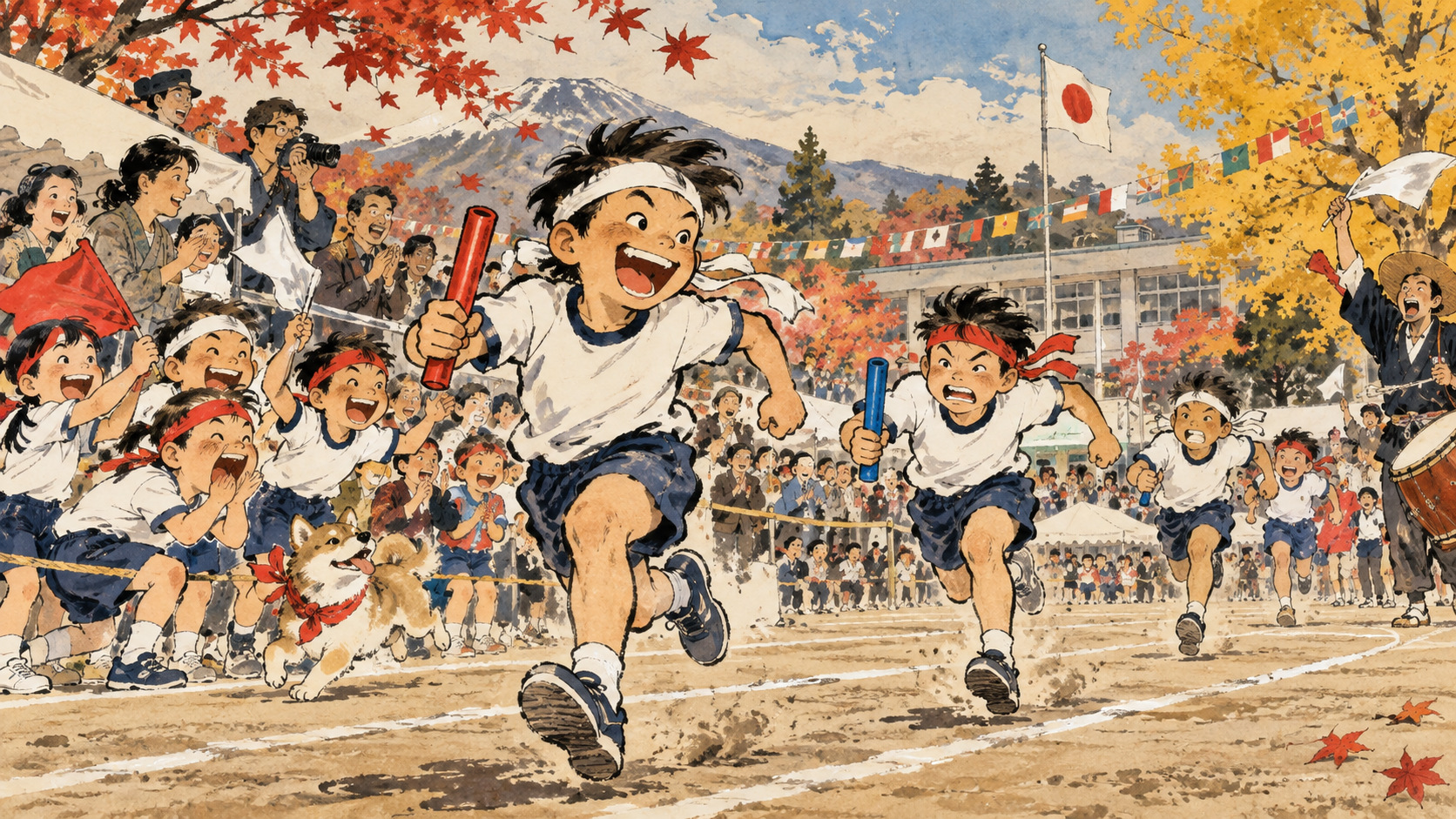
A schoolyard in Japan can become a miniature stadium. Children wear colored caps, parents gather at the fence, teachers direct relays and whole classes cheer the final runners toward the finish. The occasion is undokai, the school sports festival—part competition, part public performance and part community ritual. It is also increasingly a test of what schools believe physical education should accomplish.
The questions are practical as well as philosophical. How much rehearsal is too much? What happens to children who cannot comfortably join the same event as everyone else? When does heat make the day unsafe? And if the program is shortened, which parts of its educational purpose are lost with the spectacle? The future of undokai turns on these choices rather than any single argument about whether children should be allowed to win or lose.
The timing is appropriate. Japan marks Sports Day on Monday, October 12, 2026. October 10 is the date of the 1964 Tokyo Olympics opening ceremony and the original fixed-date national holiday known as Health and Sports Day. In 2020, the holiday was renamed Sports Day, reflecting a formal emphasis on enjoyment, respect and a healthy society.[6]
A festival built during Japan’s modernization
One pivotal predecessor was held on March 21, 1874 at the Naval College in Tsukiji, Tokyo. The Japan Association of Athletics Federations traces the early history of Japanese track and field to the event known as kyōtō yūgi, or competitive games. Its program featured events recognizable as sprints, jumps and even piggyback races, though their fanciful Japanese titles belonged to another era.[1]
From there, athletic gatherings expanded through educational institutions: Sapporo Agricultural College held an event in 1878 and the University of Tokyo in 1883. Their forms changed as schools adopted organized exercise, collective discipline and public demonstrations of learning. But the claim of a single indisputable “first undokai” requires care. Japanese library reference research also identifies earlier recreational contests and different definitions of what constituted a sports festival.[7][8]
Over generations, the school festival developed a cultural identity all its own. Short races and relays shared the program with tug-of-war, ball-tossing games, coordinated performances and activities requiring collective preparation. For families, it offered a rare view of children outside the classroom. For schools, it gave a visible form to cooperation and communal belonging.
What Japan’s curriculum actually asks of a sports day
The Ministry of Education, Culture, Sports, Science and Technology—MEXT—places sports festivals among the special school activities called “health, safety and physical-education events” (kenkō anzen / taiikuteki gyōji). The elementary curriculum guidance describes several goals: understanding health and safety, gaining enjoyment from movement, acquiring habits of cooperative action and improving physical fitness.[2][3]
That is a broader mandate than finding the fastest class or delivering a perfectly synchronized display. A child who assists with timing, plans the program or joins an adapted activity may be learning something valuable. Equally, not every child experiences public performance as enjoyable. Physical ability, disability, illness, sensory needs and individual confidence may call for changes in how participation is organized.
Such adjustments should not become a euphemism for excluding children from meaningful activity. The test is whether students have genuine opportunities to participate and whether adults listen to the students and families affected. Nor should participation be measured solely by whether every child stands on the field for the same number of minutes.
Heat has changed the calculation
Japan’s schools cannot treat heat as an unfortunate inconvenience that can always be overcome with extra water breaks. The Japan Sport Association’s heatstroke-prevention guideline uses wet-bulb globe temperature, or WBGT, which incorporates environmental factors beyond ordinary air temperature. At a WBGT of 31°C or more, exercise should generally be stopped; the guidance is especially firm about stopping activities for children. At 28°C or more, strenuous and endurance exercise should be avoided.[5]
A May 2025 MEXT notice urges schools to monitor WBGT before and during activities, allow gradual heat acclimatization and coordinate staff responsibilities and emergency responses. It explicitly identifies sports festivals as events where normal staffing arrangements may change. The ministry also warns that heat-related incidents can occur even when ordinary air temperatures are only around 25–30°C.[4]
This has consequences for dates, rehearsal schedules, waiting areas, access to shade, indoor alternatives and parent communications. A morning event or a spring festival may sometimes reduce exposure, but no season or time of day guarantees safety. Schools must assess conditions where children actually spend their time. WBGT is not interchangeable with the reading on a conventional thermometer.
What is gained—and lost—by a shorter festival?
Many of the strongest arguments for a compact program concern the time surrounding the event rather than the event itself. A shorter day may reduce extended waiting periods, setup work and family scheduling burdens. But length is a poor substitute for quality. Eliminating activities can also remove opportunities for older students to mentor younger ones, for classmates to organize a common project and for a neighborhood to gather around its school.
A more useful framework asks schools to account for the full cost: hours of rehearsal, disruption of other teaching, heat exposure, equipment and staffing needs, accessibility planning and the value students themselves find in the program. There is no verified nationwide dataset establishing how many Japanese schools have moved to half-day events or how much educational benefit any single reform produces. Claims of a uniform national retreat should therefore be treated cautiously.
Competition, inclusion and the right to enjoy sport
One false choice deserves to be challenged. A school need not choose between celebrating sporting excellence and protecting dignity. There is educational value in trying hard to win, coping with defeat and congratulating an opponent. There is also value in designing a range of tasks so that speed and strength are not the only qualities recognized.
Possible programs might include traditional relays alongside cooperative challenges, accessible throwing or target games, student-produced commentary and voluntary performance roles. These are options for consideration, not verified claims about practices at particular schools. The point is to make intentional decisions about what students should learn rather than repeating a format simply because previous generations did.
The schoolyard belongs to more than the school
Undokai is often one of the year’s clearest opportunities for families and neighbors to meet. But opening the gates creates responsibilities, from visitor management and photography policies to accessibility, transport and neighborhood disruption. Some communities may benefit from wider participation; others may need smaller and more carefully managed gatherings.
The historic strength of the festival is that it brings several kinds of achievement into public view: a child’s first race, a class that finally cooperates, an anxious student who decides to try, or a teacher who makes the event safer without draining it of joy. Those experiences are harder to count than the finish-line rankings, but they are central to the institution’s survival.
A tradition that stays alive by changing
The Japanese sports festival has never been fixed. It began amid an international exchange of athletic practices and evolved alongside the country’s schools. Its next version will be shaped by climate, demographics, teachers’ workloads, disabilities and changing family life. Those pressures need not mean the death of tradition.
The most enduring version of undokai will preserve the thrill of shared effort while granting children room to participate in different ways. If students leave the schoolyard safer, more confident and eager to move again, the festival has achieved something that no medal table can fully capture.
Sources and references
- Japan Association of Athletics Federations, early history
- MEXT, Elementary Curriculum Commentary: Special Activities
- MEXT, Special Activities curriculum
- MEXT, school heatstroke prevention notice, May 8 2025
- Japan Sport Association, Exercise and Heatstroke Prevention Guidelines
- Government Public Relations, 2026 public holidays
- National Diet Library cooperative reference database, undokai origins
- Matsue City, history of sports meets and physical education