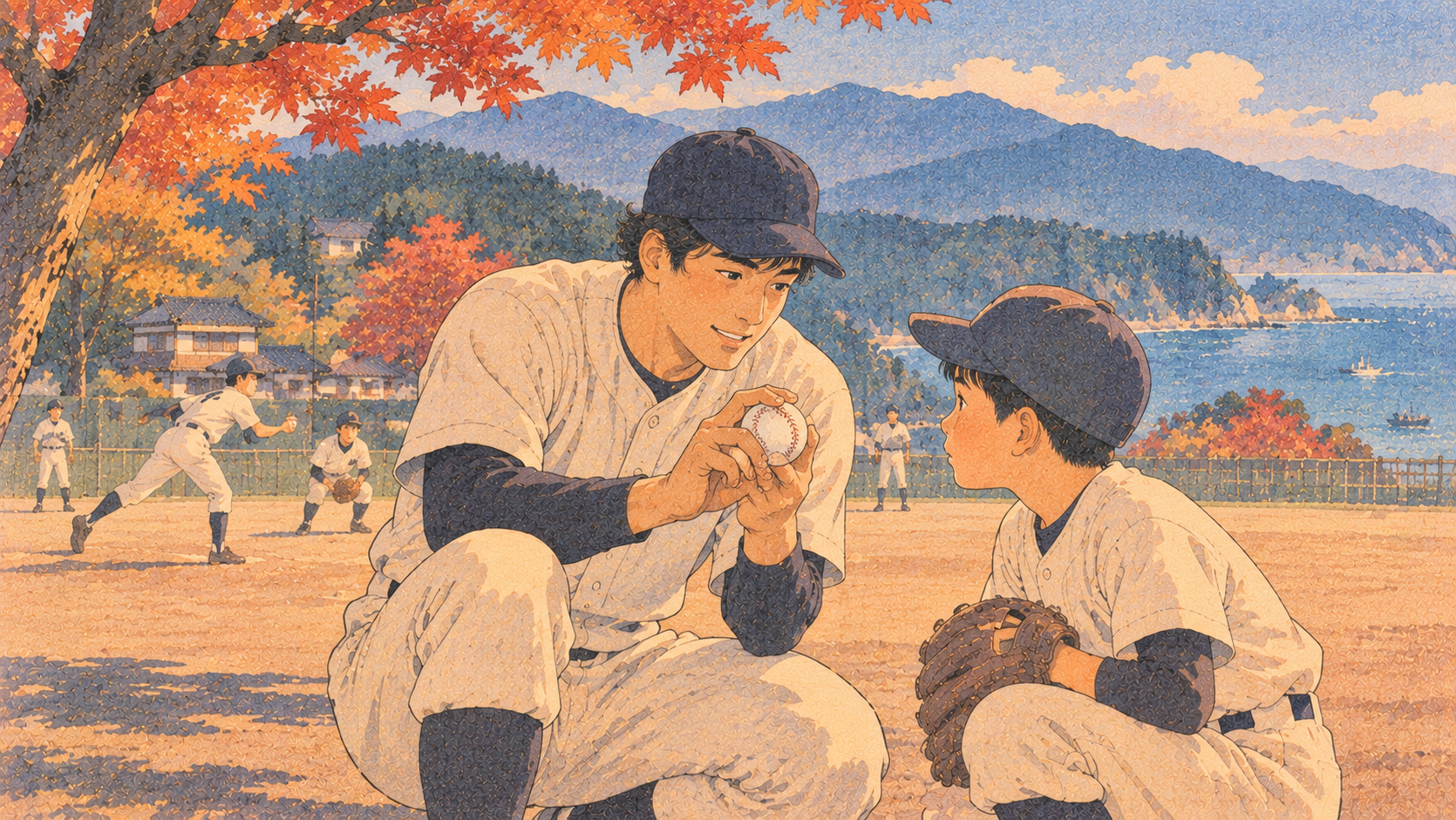
- A championship celebration built for children
- Why two coastal cities matter
- The infrastructure behind a weekend of baseball
- From a regional high school to professional baseball
- The perfect game that made him internationally known
- Learning a different baseball culture in Los Angeles
- What a hometown tournament can achieve beyond the scoreboard
- A new tradition, not a finished story
A championship celebration built for children
A ring is normally the reward for reaching the summit of professional baseball. On November 23 in Rikuzentakata, Iwate Prefecture, children received their own version of that tradition. The inaugural Roki Series, organized by Los Angeles Dodgers pitcher Roki Sasaki, ended with the Hachimantai city combined team defeating its Ninohe opponent 5–2. Local broadcaster IAT documented the presentation of specially made rings and shirts and a celebration using sparkling water instead of champagne. [3]
The festivities were deliberately modeled on the atmosphere of professional baseball, but the players at the center of them were elementary-school children. Dodgers interpreter Will Ireton took part in the ceremonial first pitch. Sasaki explained to reporters that he wanted to build an event children would aspire to enter. [5]
The meaningful innovation here is not an expensive prize or a celebrity appearance. It is the decision to create an actual competition, where children can develop a shared goal with their teammates. A professional athlete can lend visibility to such an event; the achievement on the field belongs to the participants themselves.
Why two coastal cities matter
The three-day tournament began on November 21, with 32 teams drawn from six prefectures. Sponsor Keisei Electric Railway identified four planned playing venues: two in Ofunato and two at Takata Matsubara Sports Park in Rikuzentakata. Both cities and Sasaki's supporters' association endorsed the event. [2][5]
Those locations trace Sasaki's own childhood. Born in Rikuzentakata on November 3, 2001, he experienced the Great East Japan Earthquake and tsunami at nine. MLB's biography records the loss of his father and paternal grandparents. He subsequently grew up in Ofunato, where he attended high school. [11][14]
The disaster is important context, but it should not become the only lens through which either Sasaki or his hometown is understood. These are living communities with ordinary aspirations, institutions and young people whose lives extend beyond the history of March 2011. A tournament that uses their playing fields and brings families together recognizes that present-day reality.
The infrastructure behind a weekend of baseball
Rikuzentakata's municipal description of Takata Matsubara Sports Park lists two baseball grounds, an indoor training facility, soccer fields and a children's recreation area. Its principal baseball stadium accommodates approximately 4,500 people. [7] Such facilities provide a physical foundation for sports, education and everyday social life.
Weather illustrated the practical side of the inaugural event. On opening day, IAT reported that poor field conditions required adjustments to the Rikuzentakata schedule, including a 45-minute game limit and changes to field use. [4] Organizers of youth competitions must be able to adapt without compromising the experience or safety of the participants.
Professional baseball celebrations are highly visible; the work that makes a community tournament possible is less so. Field maintenance, officiating, transport, scheduling and cooperation among adults are all essential. Keisei's participation also illustrates a way for an existing commercial relationship with a professional athlete to support a local initiative. The sponsor has not disclosed the tournament's financial accounts in the materials reviewed.
From a regional high school to professional baseball
Sasaki's rise did not follow the familiar route of a high-school star whose reputation was built at the national Koshien tournament. He attended Ofunato High School and entered professional baseball after Chiba Lotte selected him first in its 2019 draft. His first top-division appearances came in 2021. NPB records show 11 appearances, three wins and an earned-run average of 2.27 in that season. [8]
His career offers a useful reminder that athletic development is not linear. The transition from a school team to professional baseball requires more than throwing hard: conditioning, command, recovery and the ability to handle increasingly demanding competition all matter. Young athletes have different development schedules, and a professional benchmark is not a suitable target for every child.
In a 2023 Marines profile, Sasaki credited his older brother with inspiring him to start playing baseball. [10] The hometown tournament offers another illustration of how proximity to someone who enjoys a sport can make it feel accessible. The value of a role model need not depend on a child ultimately choosing the same profession.
The perfect game that made him internationally known
On April 10, 2022, Sasaki completed a perfect game against the Orix Buffaloes at ZOZO Marine Stadium. NPB records show that he needed 105 pitches and struck out 19 batters, becoming the 16th pitcher to achieve a perfect game in Japanese professional baseball. [9] His club also records 13 consecutive strikeouts. [10]
For readers unfamiliar with baseball, a perfect game requires retiring every opposing batter without allowing anyone to reach base. A no-hitter, by contrast, can include walks or other forms of reaching base. The feat depends on much more than velocity: location, pitch selection, catching and fielding all contribute.
Across four seasons of first-team competition with Chiba Lotte, Sasaki recorded 29 wins and 15 losses, a 2.10 ERA and 505 strikeouts in 394 and two-thirds innings. [8] Those figures explain the international interest in his pitching. They are also the product of an adult professional career, not a performance standard that children should be expected to imitate.
Learning a different baseball culture in Los Angeles
The Dodgers signed Sasaki in January 2025. Moving to Major League Baseball placed him in a new competitive environment and brought new demands. His first season included a shoulder-related absence, followed by a return in a relief role. He contributed to the Dodgers' 2025 championship postseason, recording three saves. [12][13]
His second regular season was a more extensive test: 26 appearances, 122 and one-third innings, a 5–5 record and a 4.49 ERA, according to MLB's completed 2026 statistics. [11] The numbers suggest an ongoing adjustment rather than an effortless transfer of his Japanese dominance to the major leagues.
The Roki Series carries elements of the baseball culture Sasaki encountered in America back to his home region. The rings and sparkling-water celebration are examples of how a sporting ritual can be reimagined for a younger audience. It is important, however, to distinguish inspiration from affiliation: this was a youth tournament organized by Sasaki, not an official MLB competition.
What a hometown tournament can achieve beyond the scoreboard
A famous athlete can attract attention to an event, but the long-term benefit of youth sport depends on the conditions under which children participate. Equipment, travel, coaching, access to fields and the time available to families can determine whether playing regularly is feasible. These practical barriers deserve attention when designing a tournament intended to become a recurring community institution.
A competition can provide a common goal for children from different towns, opportunities to learn from unfamiliar opponents, and a reason for volunteers and families to cooperate. These are plausible benefits, not measured outcomes of the first Roki Series. No independent assessment of attendance, household costs or lasting participation was available for this report.
If the tournament grows, its organizers will face familiar questions: how to accommodate different ability levels, manage workload and weather, ensure fair access, and preserve the enthusiasm of those who do not win a trophy. The most valuable legacy would be a sustainable opportunity for children to play, rather than an expectation that every participant must pursue elite sport.
A new tradition, not a finished story
Sasaki has expressed a desire for the competition to become something children look forward to. [5] The inaugural championship establishes a foundation, but a future edition's dates, funding and scale have not been confirmed in the sources reviewed.
For readers in Los Angeles, Iwate is more than the place where a Dodgers pitcher was born. It is the region where he first encountered baseball, continued his education and developed a connection to the people around him. His decision to organize an event there gives that relationship a concrete expression.
Fifteen years after the disaster of 2011, the children on these fields are making memories of their own. Whether they become professional players, recreational athletes, coaches or simply lifelong fans is for them to decide. The significance of the Roki Series lies in giving them a stage on which to begin that story.
Sources and further reading
- Keisei Electric Railway: tournament sponsorship and venues
- Keisei: detailed tournament announcement
- IAT: final and awards ceremony
- IAT: opening day
- Nikkan Sports / Kyodo: tournament results
- Iwate Menkoi Television: final
- Rikuzentakata: Takata Matsubara Sports Park
- NPB: career statistics
- NPB: 2022 pitching records
- Chiba Lotte Marines: player profile
- MLB: player biography and statistics
- Dodgers: September 2026 roster announcement
- MLB: 2025 postseason relief role
- Nikkan Sports: announcement of hometown tournament