This article is based on government statistics, industry surveys and corporate disclosures available by 6:00 a.m. Japan time on August 1, 2026. Teikoku Databank’s 59.1% figure is the share of responding restaurant companies that reported a shortage of nonregular employees in April 2026; it is not a vacancy rate or the share of every restaurant in Japan. The Ministry of Health, Labour and Welfare’s foreign-worker data are employer notifications as of October 2025 and include many residence categories, not only Specified Skilled Workers. The April 13 suspension applies to newly received Certificates of Eligibility for Specified Skilled Worker No. 1 in food service; it is not a shutdown of all foreign employment in Japanese restaurants.
The future of Japanese dining is already moving through the lunch rush
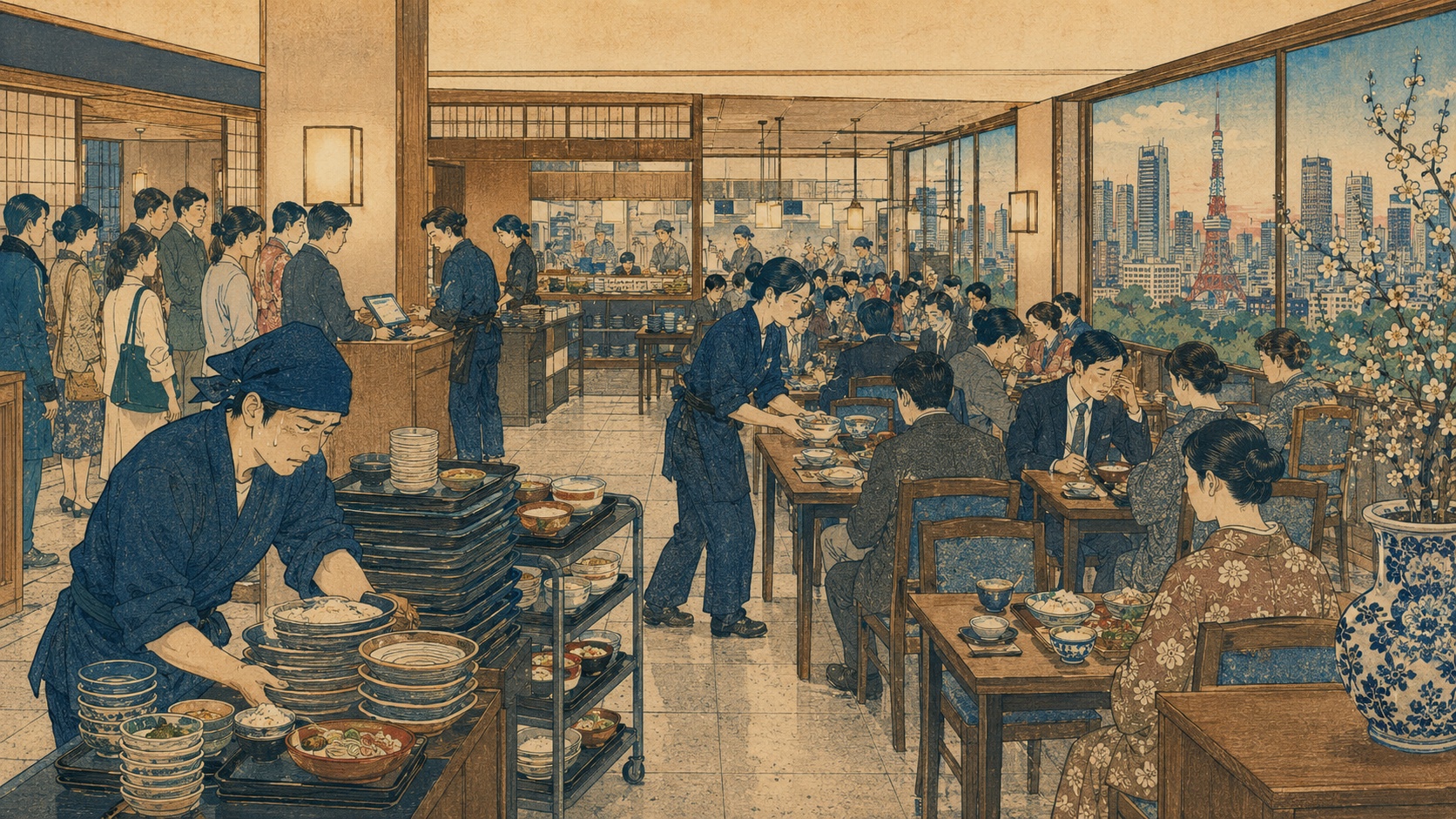
Look across a restaurant at noon and Japan’s demographic problem becomes a single room. A kiosk assigns the table. A tablet takes the order. In the kitchen, a Japanese manager, a Vietnamese cook and an international student on the floor exchange dish names in compressed Japanese. A cat-faced delivery robot rolls between the tables. Diners return empty plates to a collection shelf. A lunch service that once required five people is being made to work with three people and several machines.
This is not a distant technology demonstration. Chains and independent operators are quietly rebuilding ordering, serving, checkout, preparation, reservations, purchasing and scheduling. Some abandon late-night service. Some cut dozens of low-volume dishes. Some make water, condiments or payment self-service. When a higher hourly wage still fails to produce applicants, the restaurant has to redesign the work around the people it can actually employ.
Yet a restaurant is not a factory. A screen cannot solve every encounter with an angry guest, a child with an allergy, a first-time visitor to Japan or a family marking a birthday. The real question is not whether machines can replace people. It is where a restaurant should preserve the scarce minutes that only a person can use well.
Fifty-nine percent is an improvement, not a solution
In Teikoku Databank’s April 2026 survey, 59.1% of restaurant companies said they lacked sufficient nonregular employees. That was down from 74.8% in April 2024 and 65.3% in April 2025. The direction is encouraging, and it would be misleading to describe the shortage as continuously worsening.
But 59.1% remained the second-highest result among 51 industries. The improvement did not mean that abundant labor had returned. Teikoku Databank attributed part of it to productivity gains from digital transformation and spot-work platforms, while also noting softer customer traffic under inflation and changes in some inbound demand. Restaurants have adapted to fewer people, and demand has occasionally cooled; both effects can make the shortage ratio fall.
Across all industries, 50.6% of companies reported insufficient regular employees. Japan recorded 441 “labor-shortage bankruptcies” in fiscal 2025, a third consecutive record. Those bankruptcies were not confined to restaurants, but they reveal the limit facing labor-intensive businesses: revenue and orders cannot be converted into business if no one can perform the work. In dining, the limit appears in shorter hours, temporary closures, delayed openings and permanent dark storefronts.
The customers came back faster than the workforce
In the Japan Foodservice Association’s member-company survey, total restaurant sales rose 7.3% in 2025. Customer counts increased 2.9% and spending per customer 4.3%. Expo 2025 Osaka, record inbound tourism and repeated price revisions helped every major format finish above the previous year. Demand had unmistakably moved beyond the years of pandemic restrictions.
Sales recovery, however, was not the same as financial ease. Rice, meat, oil, electricity, logistics and wages all became more expensive. Revenue created by menu-price increases did not flow directly to profit. Consumers separated low-cost routine meals from higher-value occasions more carefully. Raise prices too far and traffic can disappear; hold them too low and there is no money to improve pay.
Food service has a hard physical relationship between demand and labor. Ten percent more diners means more ingredients to cut, tables to clear, dishes to wash, payments to process and floors to clean. A meal cannot be reproduced infinitely after one software build. The moment demand returned, labor scarcity pushed against the weakest part of each operation.
The 1970 family restaurant was designed for an age of abundant labor
Modern Japanese food service built much of its structure while population and cities were expanding. The company that became Skylark began as a small food store in the Hibarigaoka area in 1962 and opened its first Skylark family restaurant in Kunitachi in 1970. The Japan Foodservice Association was established in 1974. Rapid growth, motorization, suburban housing and the nuclear family created a huge market for a new proposition: drive to a restaurant and receive familiar food, consistent cleanliness and moderate prices.
Standardization and division of labor made the model scalable. Central kitchens concentrated preparation. Store crews finished dishes through defined steps. Photographic menus, common tableware and written service procedures reduced dependence on a small number of veteran chefs. A deep pool of students, homemakers and young part-time workers filled long opening hours from breakfast through late night.
The model transformed Japanese life. Its success also left behind assumptions: people will appear when a help-wanted sign is posted; longer hours always mean better convenience; a larger menu always means more hospitality. As the population contracts and workers compare restaurant jobs with logistics, retail, care, offices and platform work, those assumptions now run in reverse.
From a ¥29.1 trillion peak to a ¥16.9 trillion valley
According to the Ministry of Agriculture, Forestry and Fisheries, Japan’s food-service market reached a peak of ¥29.1 trillion in 1997. It remained supported by urban life and population scale, but measured ¥26.3 trillion in 2019. The pandemic drove it down to ¥18.2 trillion in 2020 and ¥16.9 trillion in 2021.
The collapse destroyed more than sales. Hours vanished and employees moved into logistics, manufacturing, retail, care and other sectors. Training pipelines for assistant managers and experienced cooks broke. Recruitment at the entry level narrowed. When customers returned, former restaurant workers had no obligation to return to the same schedules and conditions.
The rebound after 2022 is therefore not a replay of 1990s expansion. It is a different market built from population decline, inflation, inbound tourism, digital ordering and foreign employment. Simply restoring every store and every operating hour would spread a workforce that did not return across too much floor space.
The population clock tightens the kitchen a little every month
Japan’s Statistics Bureau estimated the total population at 122.93 million on July 1, 2026, down 440,000 from a year earlier. The population aged 15–64 stood at 73.427 million in February, down 121,000 year on year. Monthly movement looks gradual; accumulated year after year, it changes the economics of every shift.
Restaurants are not competing only with other restaurants. Hotels, logistics, care, construction, retail, manufacturing, tourism and technology support all recruit from the same limited population. As other industries raise wages, increase holidays and offer climate-controlled or remote work, a sector built around standing, heat, nights and weekends has to improve the job itself, not merely the advertisement.
The same statistics placed Japan’s foreign population at 3.896 million in February, up 422,000 from a year earlier. Population decline and foreign population growth are not separate stories. Schools, housing, municipal services, health care and neighborhoods determine whether new residents can build stable lives—and whether a local restaurant can retain them as colleagues.
268,769 people: foreign staff have moved from the margin to the core
Japan had 2,571,037 foreign workers and 371,215 workplaces employing them at the end of October 2025, both records under the Ministry of Health, Labour and Welfare notification system. “Accommodation and food service” employed 319,999 foreign workers. Within that category, restaurants employed 268,769.
The category contains very different lives. Some are international students working limited hours with permission for activity outside their residence status. Some are permanent residents or spouses of Japanese nationals. Some hold professional and technical statuses at headquarters or in product development. Others passed skill and Japanese-language requirements for Specified Skilled Worker status. Their permissible hours, family situations, career horizons and expected length of stay are not interchangeable.
That distinction should shape restaurant design. A business that builds its hardest shifts around students will lose much of the team at graduation. A business that develops Specified Skilled Workers through cooking, service and store management can build a longer pipeline, but it must invest in language, instruction and daily-life support. Permanent residents and family-based workers already have roots in the community. A recruiter who understands residence status as a life timeline rather than a compliance box is more likely to retain people.
The 50,000-person ceiling exposed a lag in policy
The Specified Skilled Worker system began in April 2019 to admit work-ready foreign nationals in industries that could not secure enough people even after productivity and domestic recruitment efforts. Food service opened a route for trained workers to perform food preparation, customer service and store-management functions.
By the end of February 2026, the preliminary number of Specified Skilled Worker No. 1 residents in food service had reached about 46,000. The government’s five-year intake estimate—operated as a ceiling—was 50,000. Expecting the count to exceed that level around May, the Immigration Services Agency stopped issuing Certificates of Eligibility for newly received food-service applications from April 13.
The contradiction is stark. Restaurants needed people. The program was used quickly because it met a real need. Its success then closed the main overseas entry route. A ceiling is intended to prevent uncontrolled intake, but when actual demand moves faster than the policy forecast, employers with hiring plans and workers preparing to move bear the timing risk.
The measure is not a ban on every foreign restaurant worker. Renewals for people already in Japan, changes of status within Japan, other residence categories and individual procedural circumstances are not identical. Employers should neither abandon all recruitment through a misunderstanding nor promise candidates that entry remains simple.
Migration policy is not a staffing app
Organizations employing Specified Skilled Workers must offer appropriate contracts, including pay and working hours equal to or better than those of Japanese workers in comparable roles. For No. 1 workers, the system also requires a support plan covering prearrival guidance, airport transfer, housing, daily-life orientation, public procedures, Japanese study, consultation, community participation, job-change support and regular interviews.
That is not ornamental paperwork. It is retention infrastructure. A worker may struggle to open a bank account, obtain a mobile contract, rent an apartment, understand a medical explanation or see any path to promotion. Those problems occur outside the schedule, then return to the restaurant as absence, stress and resignation.
Food service also has a Specified Skilled Worker No. 2 path for more experienced personnel. No. 2 status can be renewed and can make a spouse and children eligible for dependent residence. A restaurant that shows a route from cook or server to trainer, manager and community resident has a chance to compete for talent against countries offering higher nominal wages.
If the workplace instead preserves low pay, unclear overtime, inaccessible grievance channels and nationality-based job ceilings, a larger immigration quota will not create retention. Foreign recruitment is a solution to labor scarcity only after it becomes a test of management quality.
A serving robot primarily carries footsteps, not hospitality
Japan’s Ministry of Economy, Trade and Industry identifies restaurant delivery as a representative use of service robots. ISO 31101, a Japan-led international standard for safe service-robot operation, was issued in 2023. Machines moving among the public require more than collision sensors; operators need risk assessment, training and incident procedures.
The deepest value of a serving robot is not its imitation of a waiter. It absorbs repeated trips between kitchen and dining room, preserving human energy and minutes. Ordering terminals reduce misheard requests. Multilingual screens assist both international guests and staff. Self-checkout reduces payment queues. Demand forecasting aligns preparation with likely traffic and food waste.
Behind the dining room, the transformation is larger: cloud purchasing, electronic invoices, temperature records, automated schedules, video instruction, translation, central kitchens, partially prepared ingredients and image-based plating checks. A minute saved where the customer cannot see it can become hundreds of labor hours across a month or a large chain.
Machines remain weak at understanding why a guest is angry, integrating allergy risk, noticing dangerous intoxication or recognizing a trainee’s anxiety. If management cuts staffing to the minimum after installing technology, one breakdown or sudden rush can stop the entire room. Technology creates operating margin; it is not the margin itself.
The scale of a chain and the decisions available to a small restaurant
As of June 2026, the Skylark group operated 3,082 restaurants in Japan and 3,203 worldwide, with 7,053 regular employees and 108,908 crew members. At that scale, one minute removed from a repetitive task can have an enormous network effect. Central kitchens, digital ordering, service assistance and common training are investments that large groups can spread across thousands of stores.
An independent restaurant cannot match that capital. Smallness, however, can mean faster choice. Remove dishes that rarely sell. Concentrate opening days. Make one period reservation-only. Shift toward a course. Share preparation with a partner kitchen. Move water or payment to self-service. An owner can directly decide which work deserves a human touch.
The danger comes from preserving the old service package while forcing fewer people to reproduce it: a hundred-item menu, year-round opening, late-night hours, endless free customization, telephone-only reservations and paper administration. Courtesy then becomes employee exhaustion. Simplification is not necessarily the abandonment of service. It is the management act of choosing what is worth protecting.
What the 2026 restaurant changes—and what it can lose
| Function | Older model | Redesigned model | Loss to guard against |
|---|---|---|---|
| Ordering | A server records the order at the table and sends a paper ticket. | Tablet, QR code, kiosk and multilingual display, with human help when needed. | Do not abandon older guests or people with disabilities. |
| Serving | Staff walk every dish from kitchen to table. | Robot or pickup point reduces transport; people complete the final handoff. | Preserve explanation, expression and awareness of trouble. |
| Cooking | Each store prepares a broad menu from the beginning. | Central kitchen, partial preparation, demand forecasting and fewer dishes. | Protect local identity, craft development and freshness. |
| Staffing | Recruit large numbers of Japanese part-timers and train quickly. | Combine Japanese and foreign staff, seniors and spot workers, with longer development. | Do not freeze promotion or duties by nationality or contract type. |
| Hours | Longer and year-round opening equals convenience. | Shorter hours, concentrated days and reservation periods matched to staffing. | Monitor food-access gaps in regional and late-night communities. |
| Price | Absorb free service and low prices through labor. | Explain and price the cost of pay, training and technology. | Maintain a diversity of formats that includes affordable everyday food. |
Who pays the real price of omotenashi?
Japanese restaurants are admired for price, cleanliness and service. Part of that achievement came from productivity and disciplined operations. Part was financed by long hours, modest wages, unpriced extras and a culture in which refusing a customer request was difficult.
Labor scarcity brings the hidden bill to the table. Higher hourly pay, real holidays, Japanese training and daily-life support for foreign employees, robots and software all require money. Either the menu price or the service format changes. When a customer demands yesterday’s price and even more service, the difference becomes someone’s fatigue.
The future restaurant therefore needs explanatory power. Why is water self-service? Why did midnight service end? Why are there fewer menu items? Why did the price rise? Where does the money go—to pay, quality, sourcing, holidays and training? With transparency, simplification can become a compact for survival rather than a sign of coldness.
From 1962 to 2026: the labor model changes
| Year | Turning point | Meaning for restaurant labor |
|---|---|---|
| 1962 | The predecessor of Skylark begins as Kotobuki Foods. | Suburbanization and mass consumption create the base for chain dining. |
| 1970 | The first Skylark family restaurant opens. | Standard food and service can be delivered through a large part-time workforce. |
| 1974 | The Japan Foodservice Association is established. | Food service develops institutions, statistics and professional identity as a modern industry. |
| 1997 | The food-service market peaks at ¥29.1 trillion. | Expansion maximizes stores and opening hours under population-growth assumptions. |
| 2019 | Specified Skilled Worker status begins, including food service. | Foreign staff gain a formal route as skilled core labor, not only supplemental student work. |
| 2020–21 | The market falls to ¥18.2 trillion and then ¥16.9 trillion. | Labor exits, hours contract, and digital ordering and takeaway accelerate. |
| 2023 | ISO 31101 for safe service-robot operation is issued. | Restaurants gain a framework for humans and robots sharing customer space. |
| 2025 | Japan records 2.57 million foreign workers; restaurants employ 268,769. | The multinational workplace becomes everyday infrastructure. |
| April 2026 | New overseas COEs for food-service SSW No. 1 are suspended. | Actual labor demand reaches the policy ceiling and forces a rethink of intake design. |
Seven signals to watch next
- What drives the shortage ratio:When 59.1% falls, separate better recruitment from closures, shorter hours and weaker demand.
- Real pay and retention:Look beyond advertised hourly rates to raises, holidays, turnover and time to management.
- The SSW restart conditions:The treatment of the 50,000 ceiling and the next intake estimate will shape overseas hiring.
- Progression to No. 2:Can foreign staff move from cooking and service into management, training and multiunit responsibility?
- Results per machine:Count reductions in walking, overtime, accidents, order errors and departures—not installed robots.
- Hours and geographic access:Does industry sales growth conceal disappearing late-night, rural and independent food service?
- Customer consent:Can restaurants show that self-service and prices support better jobs and continued operation?
Can Japan build a restaurant with fewer hands but undiminished depth?
Restaurants are accustomed to editing food. They adjust to season, region, fashion and cost every day. The next capability is to edit the work itself.
Hiring foreign workers, buying robots, shortening hours and reducing menus will not individually stop population decline. Together, however, they can form a durable model when foreign colleagues receive careers, machines remove low-value movement, pricing funds training and the customer understands the reason for change.
The opposite model is also possible. Treat foreign staff as cheap temporary plugs, use technology only to cut headcount, and concentrate more work on whoever remains. Measured productivity may rise while the room loses its temperature. The food arrives, but the feeling of being welcomed does not.
The family restaurant of 1970 standardized an abundant young workforce and changed Japanese life. The task in 2026 is almost the reverse: respect scarce human time, combine a multinational team with machines, and still recognize one guest. If Japanese dining has another golden age, it will begin not with the number of outlets but with the quality of this redesign.
Sources and methodology
Japan.co.jp reviewed materials available through 6:00 a.m. Japan time on August 1, 2026. Company sentiment surveys, employer notifications, population estimates and member-company sales surveys have different definitions and populations; they are not added together as if they were one dataset. Forward-looking operating conclusions in this article are analysis based on the cited evidence, not immigration, recruitment or investment advice for any particular company.
- Teikoku Databank: Corporate Labor Shortage Survey, April 2026
- Ministry of Health, Labour and Welfare: Foreign Employment Notifications, October 2025
- Immigration Services Agency: Operation of the Food-Service SSW Intake Ceiling
- Immigration Services Agency: Temporary Suspension of Food-Service Certificates of Eligibility
- Immigration Services Agency: Employer Requirements for Specified Skilled Workers
- Immigration Services Agency: Mandatory Support for SSW No. 1
- Ministry of Agriculture, Forestry and Fisheries: SSW No. 1 and No. 2 in Food Service
- Immigration Services Agency: Eligibility for Dependent Residence
- Statistics Bureau of Japan: Population Estimates, released July 2026
- Japan Foodservice Association: Food-Service Market Trend Surveys
- Agriculture & Livestock Industries Corporation: Review of 2025 Restaurant Sales
- Ministry of Agriculture, Forestry and Fisheries: Historical Food-Service Market Size
- Skylark Holdings: Corporate History, Employment and Store Counts
- Ministry of Economy, Trade and Industry: ISO 31101 for Safe Service-Robot Operation
