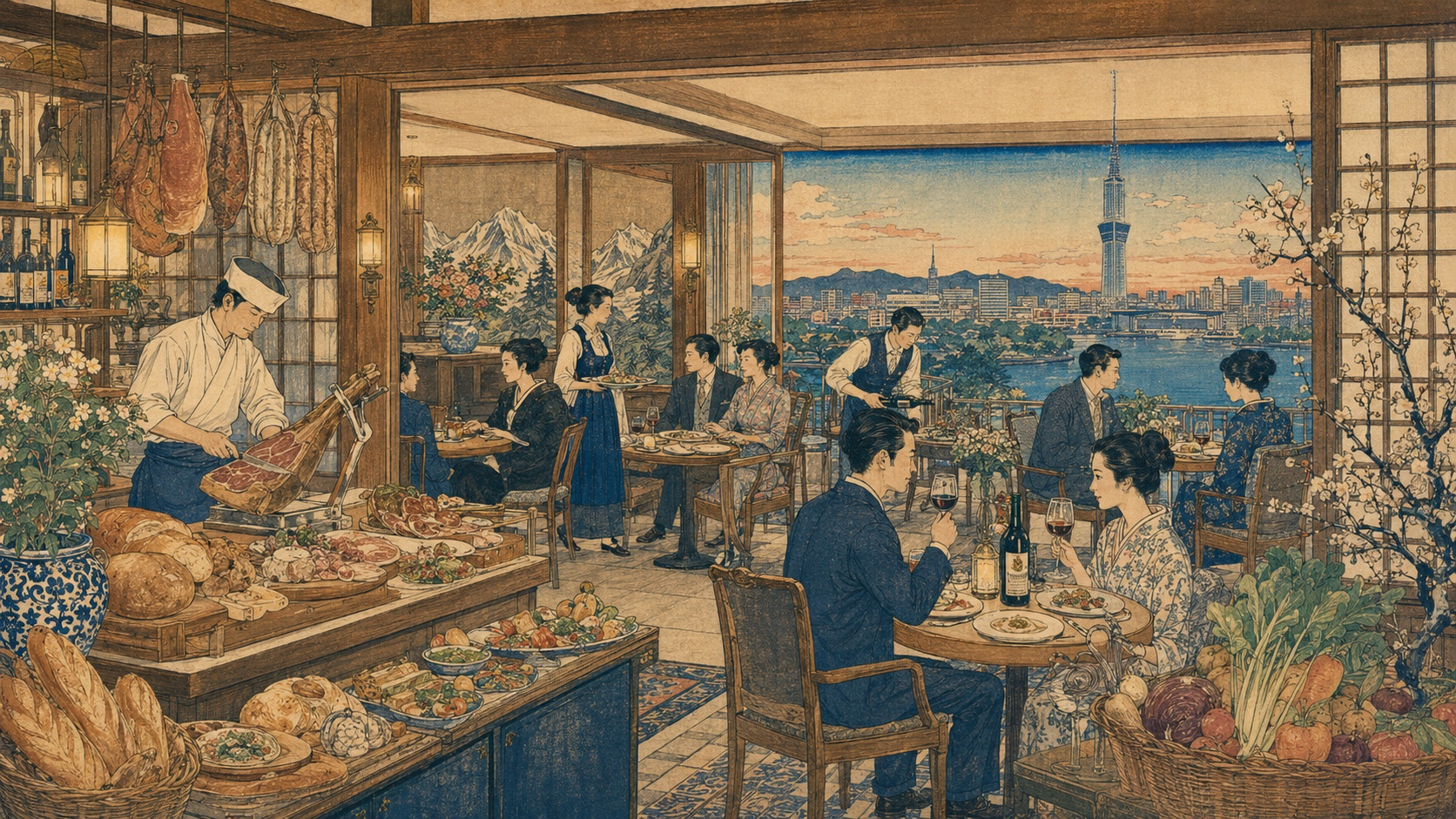
Käfer ALPS KITCHEN is scheduled to open in Tenjin, Fukuoka, on August 4, 2026. This pre-opening feature is based on company, developer and municipal information available by 6:00 a.m. Japan time on August 1; it is not a dining review. The launch announcement calls the location Käfer’s first opening in Japan, while Käfer’s own corporate history records branded shops created through a Mitsukoshi partnership beginning in 1992. Japan.co.jp therefore describes this as the first Käfer ALPS KITCHEN in Japan and the brand’s full restaurant-format debut in the country.
At eight in the morning, Tenjin opens a door to the Alps
Fukuoka mornings move quickly. Commuters rise from the subway, office lights come on, and travelers and workers merge at Tenjin’s crossings. On August 4, a different rhythm is due to enter that daily current: timber, warm lamps, shared boards of meat and cheese, and the food of the Alpine regions. Käfer ALPS KITCHEN, on the ground floor of Tenjin Business Center II, plans to serve from 8 a.m. until 10 p.m.
This is more ambitious than arranging beer and sausages inside a German-themed room. The stated subject is Alpine cuisine across Bavaria, Austria, Switzerland and northern Italy. The restaurant looks beyond modern borders toward a food culture shaped by altitude, pasture, winter, preservation, movement and the exchange of recipes through mountain regions. It is also an attempt to transfer nearly a century of Käfer hospitality from Munich into the everyday timetable of Fukuoka.
The interior was developed with a German designer, and selected furniture was imported directly from Germany. Yet chairs and lamps are the easy part of cultural transfer. The harder question is whether one restaurant can welcome a solitary breakfast guest, a time-pressed office worker, an afternoon dessert customer, a group sharing beer after work and a late dinner table—without becoming five unrelated businesses. Käfer is bringing not only Alpine flavors but an Alpine idea of convivial time.
Eating a mountain range, not a national flag
Calling this simply “German food” would erase the most interesting part of the concept. The Alps form an arc across Europe, and the new restaurant concentrates on a culinary zone extending through southern Germany, Austria, Switzerland and northern Italy. Short summers, severe winters, differences in elevation, pasture farming, forests and old trade routes helped shape cheeses, cured meat, sausages, breads, potatoes, dumplings, preserves and fruit-based accompaniments.
Much of this food began as practical nourishment rather than luxury. Milk became cheese and butter; meat became smoked cuts and sausages; bread anchored the table. Farmhouses, mountain huts, town beer halls and imperial kitchens served different social worlds, but they drew on overlapping regional ingredients and techniques. Alpine cuisine therefore holds rusticity and celebration in the same hand: a cold board shared casually can sit beside a thin fried cutlet or a sweet dish bearing an emperor’s name.
Käfer ALPS KITCHEN’s announced menu makes that geography visible. Bavarian Brotzeit, bratwursts and Leberkäse appear beside an Austrian-influenced schnitzel and Kaiserschmarrn, with Paulaner beer carrying Munich’s brewing identity. The menu is not a display of flags. It is an itinerary across a mountain system.
A wooden board turns food into conversation
One announced signature is the Brotzeitbrettl, described as a Käfer favorite at Oktoberfest and a German-style shared appetizer board. Brotzeit literally evokes “bread time”: a Bavarian meal or substantial snack built from bread, cold cuts, sausage, cheese, pickles and spreads, often eaten with beer.
The social design matters. A finished plate is not placed in front of each diner; a board sits at the center and lets people choose sequence, quantity and pace. Conversation determines the meal rather than the kitchen determining every bite. Käfer’s growth through restaurants, catering and festival hospitality has depended on mastering this shared stage. In Tenjin, the Brotzeit board can function as food, ritual and furniture at once.
The Choice of Brats allows guests to combine original, chili and mountain-cheese sausages. The Leberkäse Semmel sandwich places a baked, finely ground seasoned meat loaf inside a Kaiser roll. The Vienna-style schnitzel uses thin pork in fine breadcrumbs with lingonberry jam. Kaiserschmarrn finishes the journey with torn pieces of pancake-like batter and rum, a generous sweet associated with Austria and Bavaria.
| Announced item | Cultural position | How the restaurant describes it |
|---|---|---|
| Brotzeitbrettl | Bavarian culture of sharing bread, meat and cheese | A Käfer favorite associated with Oktoberfest. |
| Choice of Brats | Central European sausage tradition | Original, chili and mountain-cheese varieties to combine. |
| Leberkäse Semmel Sandwich | Everyday food familiar in Bavaria and Austria | Baked seasoned meat served inside a Kaiser roll. |
| Vienna-style Schnitzel | Part of Austria’s thin-cutlet tradition | Breaded pork served with lingonberry jam. |
| Kaiserschmarrn | Sweet dish loved in Austria and Bavaria | Torn pancake pieces finished with rum. |
| Paulaner | Munich brewing culture | One of the six Munich breweries entitled to make official Oktoberfest beer. |
In 1930, the story began with wine and bottled beer
Käfer did not begin in a festival tent or a parliament building. Its official history starts on May 16, 1930, when Elsa and Paul Käfer opened a Munich shop on Amalienstrasse selling groceries, wine, liqueurs and bottled beer. Three years later the business moved to the corner of Prinzregentenstrasse and Schumannstrasse, the site that remains the company’s flagship address.
The original category was a Kolonialwarengeschäft, a historical European retail form that gathered products from distant regions. The term carries the imperial history of European trade and deserves critical context today. As a retail function, however, it also meant that the shop introduced customers to products outside their everyday experience. Käfer’s earliest promise was not merely availability. It was discovery.
In the 1960s, sons Gerd and Helmut developed the established delicatessen and lunch counter into a destination centered on quality and service. Third-generation Michael Käfer joined management in 1988 and took charge in 1992. The business now describes four pillars: retail, restaurants, catering and licensing. The Fukuoka restaurant sits where all four meet—brand, food, space, service and a local operating partner.
Oktoberfest taught Käfer how to operate celebration
One of the stages that made Käfer distinctive in Germany is Munich’s Oktoberfest. Käfer Wiesn-Schänke began in 1971 with only 40 seats. It has grown to roughly 3,000 places across indoor and outdoor areas, using the atmosphere of a Bavarian farmhouse, elaborate flowers and antiques, food, drink and music to create a recognizable world within the larger festival.
At that scale, cooking is only one part of the challenge. Thousands of guests can arrive within the same period and must still feel that the evening is special. Reservations, entrance, seating, kitchens, beverages, decoration, bands and staff movement have to become one experience. That operational ability also helped Käfer grow in premium catering.
Fukuoka’s 71 seats are tiny beside an Oktoberfest venue. The purpose, however, is related. From the moment a guest enters until the shared dessert is finished, the restaurant has to make service feel like one continuous story. Imported furniture supplies the backdrop. The true product is choreography—how people, food and time move through the room.
From the roof of parliament to the ground floor of Tenjin
Käfer also operates the public roof-garden restaurant at Germany’s Bundestag in Berlin. That location has to reconcile historic architecture, parliamentary security, tourism, political work and a panoramic city view. An Oktoberfest tent and a parliament roof appear to be opposites, but both depend on the meaning of eating in a particular place. The food cannot be separated from its setting.
The Tenjin location is equally site-dependent. Tenjin Business Center II places a seven-level atrium between basement dining, a major bookstore, cafés, offices and worker facilities. Käfer is not hidden inside a resort or isolated luxury hotel. It occupies the ground floor where commuting, meetings, shopping, reading and urban tourism cross.
That requires more than a special-occasion dinner. The same brand must welcome an individual at 8 a.m., office workers with a limited lunch break, afternoon visitors coming from the bookstore and groups ordering beer at night. Käfer is famous for elaborate hospitality, but it began as a neighborhood food shop. Tenjin offers a chance to reconnect those two ends of its history.
Japan’s first handshake with Käfer came through Mitsukoshi in 1992
The launch language needs historical clarification. JR Kyushu’s announcement calls Käfer ALPS KITCHEN the brand’s first opening in Japan. Käfer’s own corporate portrait, however, states that a partnership with Mitsukoshi began in 1992 and created Käfer shops in the Japanese department-store group, selling German delicacies and gifts.
Fukuoka in 2026 is therefore not the first time Japan has encountered the Käfer name. It is a shift from products on department-store shelves to a restaurant that asks guests to inhabit the brand from breakfast through dinner. In 1992, department stores were powerful gateways for European luxury food and imported gift culture. In 2026, value is increasingly built through space, story, service, photography and time spent at a destination.
The 34-year gap also illustrates a change in how international brands enter Japan. The old route often began with Tokyo or Osaka retail. This launch begins in a redevelopment district in Fukuoka, operated by a Kyushu company under franchise. Fukuoka is not being treated as a secondary market after a capital-city debut. It is the first laboratory.
Why Fukuoka: a city that makes foreign flavors local
Fukuoka developed from two adjacent identities: the castle town of Fukuoka and the merchant city of Hakata. Hakata’s port served ancient exchange with the Asian continent and later became one of medieval Japan’s major trading cities. Goods, people, technologies, religions and foodways arrived from outside and were repeatedly adapted into local life.
Tenjin’s own development is another story of urban reorganization. A prefectural government building was completed in the Tenjin area in 1876, and the 1910 regional exposition helped create the administrative and commercial foundations of the district. Department stores, railways, buses, underground shopping and offices later made Tenjin one of Kyushu’s dominant city centers.
Fukuoka’s restaurant market combines powerful local identities—yatai, ramen, motsunabe, mizutaki—with a fast appetite for outside cuisines. That makes it attractive but unforgiving. Diners do not support an imported brand indefinitely because it is foreign. Price, portion, convenience, flavor and service are judged against strong everyday competition. Success in Fukuoka would therefore give the concept credibility beyond novelty.
A plate inside the Tenjin Big Bang
Käfer ALPS KITCHEN enters a city-center rebuilding program known as the Tenjin Big Bang. Fukuoka City says the initiative began in February 2015 and had produced 85 completed buildings within the target area by the end of March 2026, with about 90 replacements expected by the end of 2026. For 11 certified or prospective projects operating at full scale, the city’s research estimates roughly ¥1.89 trillion in economic spillovers and about 59,000 jobs.
Tenjin Business Center II was developed on land including the former Media Mall Tenjin and a municipal annex site and was completed at the end of June 2026. Its commercial area announced 16 tenants, including one Japan-first entrant, six Kyushu-first entrants and four new business formats. Basement dining at Tenjin Inachika South Side, a large Junkudo bookstore and a Starbucks Reserve Café are intended to keep people moving through the building at different times.
The project also assigns about 1,300 tsubo to a worker-only common area called Reboot!, designed around recovery, interaction and creativity. Käfer’s 8 a.m.–10 p.m. schedule can become the food component of that broader idea. The success of redevelopment is not measured only by new façades. It depends on whether workers and residents gain better ways to spend an ordinary day.
The local operator is the translator
International launches naturally focus on the foreign brand. The daily restaurant, however, will be made by the local operator. JR Kyushu Fast Foods was established in 1989 as a food-service company within the JR Kyushu group. Its launch release says it operates about 240 stores across 11 brands in Kyushu, Kanto and other regions. Its portfolio has included Mister Donut, KFC, Mos Burger, Seattle’s Best Coffee, Subway, Starbucks and other franchises.
Käfer demands a different kind of translation from high-volume fast food alone. Staff have to explain unfamiliar names and eating customs, maintain German quality standards and adapt them to Fukuoka’s expectations for price, pace and accessibility. An 8 a.m. opening requires morning staffing; a 10 p.m. close requires an evening team. Meat, cheese, bread and beer need stable supply. The room must feel Alpine without becoming a theme park.
A franchise is often mistaken for a copying system. In practice, it is a daily decision about what must not change and what must. Käfer’s motto centers on quality driven by passion. In Fukuoka, quality cannot be proven merely by using the same furniture or recipes as Munich. It will be proven when local guests decide to return.
Imported furniture cannot guarantee authenticity
The company emphasizes collaboration with a German designer and furniture imported directly from Germany. Visual coherence matters. Wood, lamps, fabrics, tableware and color can create a point between Alpine lodge and modern urban restaurant. But authenticity is not guaranteed by the origin of the chair.
Food temperature, bread condition, sausage browning, beer care, staff explanations and the timing of a shared board create the experience through small repetitions. German signage can be plentiful, but if dishes arrive poorly, explanations are vague or guests do not understand how to order, the room becomes a set.
Japan also imposes local realities. Fukuoka’s summer is far from Alpine coolness. Appetite, beverage choices and dwell time change with the weather. Breakfast demand, short lunches, solo dining, non-alcoholic options, allergy information, children and multilingual visitors all shape the restaurant. Long-term authenticity may require less literal reproduction and more faithful adaptation of the underlying values.
A Paulaner glass carries time from 1634
Paulaner, one of the announced beer offerings, traces its documented history to 1634. Monks at Munich’s Neudeck ob der Au monastery brewed strong beer, and complaints from civilian brewers to the city authorities became the first written evidence associated with the brewery. Paulaner later gained permission to serve at the early Oktoberfest beer huts in 1818.
Only six Munich breweries may produce the official beer associated with Oktoberfest. When Käfer places a Brotzeit board beside Paulaner, the combination carries more than a generic “German” image. A 1930 delicatessen, monastic brewing history and modern festival hospitality meet on one Fukuoka table.
History, of course, is not a certificate of taste. Beer still has to be stored, poured and served correctly. The longer the brand story, the greater the risk that an ordinary glass fails to meet the expectation. Käfer ALPS KITCHEN will ultimately be judged not by a timeline but by the first foam and final sip.
Five questions after opening
- The 8 a.m. market: Will office workers and visitors make an Alpine restaurant part of their morning routine?
- From novelty to return visits: Can launch attention become ordinary repeat use?
- Price and portion translation: Will shared boards, meat, beer and desserts fit Fukuoka dining habits?
- Staff knowledge: Can the team explain names, regions and customs clearly without slowing service?
- Expansion: If Tenjin works, will the format move to other Japanese cities or remain uniquely Fukuoka?
From 1930 to 2026: where Käfer and Fukuoka meet
| Year | Event | Meaning for the Fukuoka restaurant |
|---|---|---|
| 1930 | Elsa and Paul Käfer open a Munich food shop. | The brand begins by introducing unfamiliar goods to local customers. |
| 1933 | The shop moves to the Prinzregentenstrasse location that remains its flagship. | Place itself becomes a long-term brand asset. |
| 1960s | The second generation develops the delicatessen into a gourmet and service destination. | The company expands from selling products to creating hospitality. |
| 1971 | Käfer Wiesn-Schänke enters Oktoberfest. | Käfer learns to integrate food, décor, music and crowds at scale. |
| 1992 | Michael Käfer takes charge; cooperation with Mitsukoshi brings Käfer shops to Japan. | Japan first encounters the brand through retail delicacies and gifts. |
| 2015 | Fukuoka launches the Tenjin Big Bang. | Rebuilding creates new offices, shops and public movement through the city center. |
| June 2026 | Tenjin Business Center II is completed. | A new flow connects restaurants, bookstore, atrium and offices. |
| August 4, 2026 | Käfer ALPS KITCHEN is scheduled to open. | A brand once seen in Japanese retail returns as an all-day restaurant experience. |
Opening guide
| Item | Published information |
|---|---|
| Name | Käfer ALPS KITCHEN |
| Opening | Tuesday, August 4, 2026. Regular service is scheduled after the building’s opening event. |
| Address | 1F, Tenjin Business Center II, 1-10-10 Tenjin, Chuo-ku, Fukuoka |
| Capacity | 71 seats: seven counter seats and 24 tables |
| Regular hours | 8 a.m.–10 p.m.; irregular closing days |
| Special hours | 10 a.m.–10 p.m. scheduled for August 5–11 |
| Operator | JR Kyushu Fast Foods under franchise agreement with Feinkost Käfer |
| Reservations | Online booking is linked from the official restaurant website. |
Not whether the Alps can be reproduced, but whether they can take root
On opening day, German furniture will frame wooden boards of meat and cheese, and Paulaner foam will rise above the tables. In photographs, it may appear that a small Munich has materialized in Fukuoka. A restaurant’s real time, however, begins after the ceremony ends.
A rainy weekday at 8 a.m. A short lunch break. A quiet night outside the tourist peak. Staff repeat unfamiliar names until regulars no longer need an explanation. Without that repetition, the imported Alps remain a temporary exhibition. With it, the food does not lose its origin; it gains a second home.
Käfer began in 1930 by introducing products from elsewhere to Munich. In 2026, Fukuoka will receive an outside brand and decide whether it belongs in local life. What opens on Tenjin’s ground floor is not simply imported German cuisine. It is the first day of a long translation, testing whether almost a century of hospitality can earn a place in one of Japan’s strongest food cities.
Sources and verification
Japan.co.jp reviewed official information from the operator, Käfer, the property developer, Fukuoka City and the brewery available by 6:00 a.m. Japan time on August 1, 2026. The displayed exchange rate is 1 U.S. dollar = 157.57 Japanese yen; the supplied update time of July 31 at 9:00 p.m. UTC converts to August 1 at 6:00 a.m. in Japan. The restaurant is scheduled to open August 4, and visitors should confirm operating hours, menus, reservations and product availability through official channels.
- JR Kyushu: opening date, capacity, hours, interior and menu
- Käfer ALPS KITCHEN official website: concept, location and reservations
- JR Kyushu Fast Foods: corporate profile and operated brands
- Feinkost Käfer: 1930 founding, company development and 1992 Mitsukoshi partnership
- Feinkost Käfer: Käfer Wiesn-Schänke since 1971
- Käfer Dachgarten Restaurant at the German Bundestag
- Fukuoka Jisho: commercial tenants at Tenjin Business Center II
- Fukuoka Jisho: project name, completion schedule and seven-level atrium
- Fukuoka Jisho: Reboot! worker common area
- Fukuoka City: Tenjin Big Bang progress and economic-impact estimates
- Fukuoka City: history of Hakata Port and international exchange
- Fukuoka Chuo Ward: historical development of Tenjin
- Paulaner: brewing history since 1634
- Paulaner: Oktoberfest beer and the six Munich breweries
