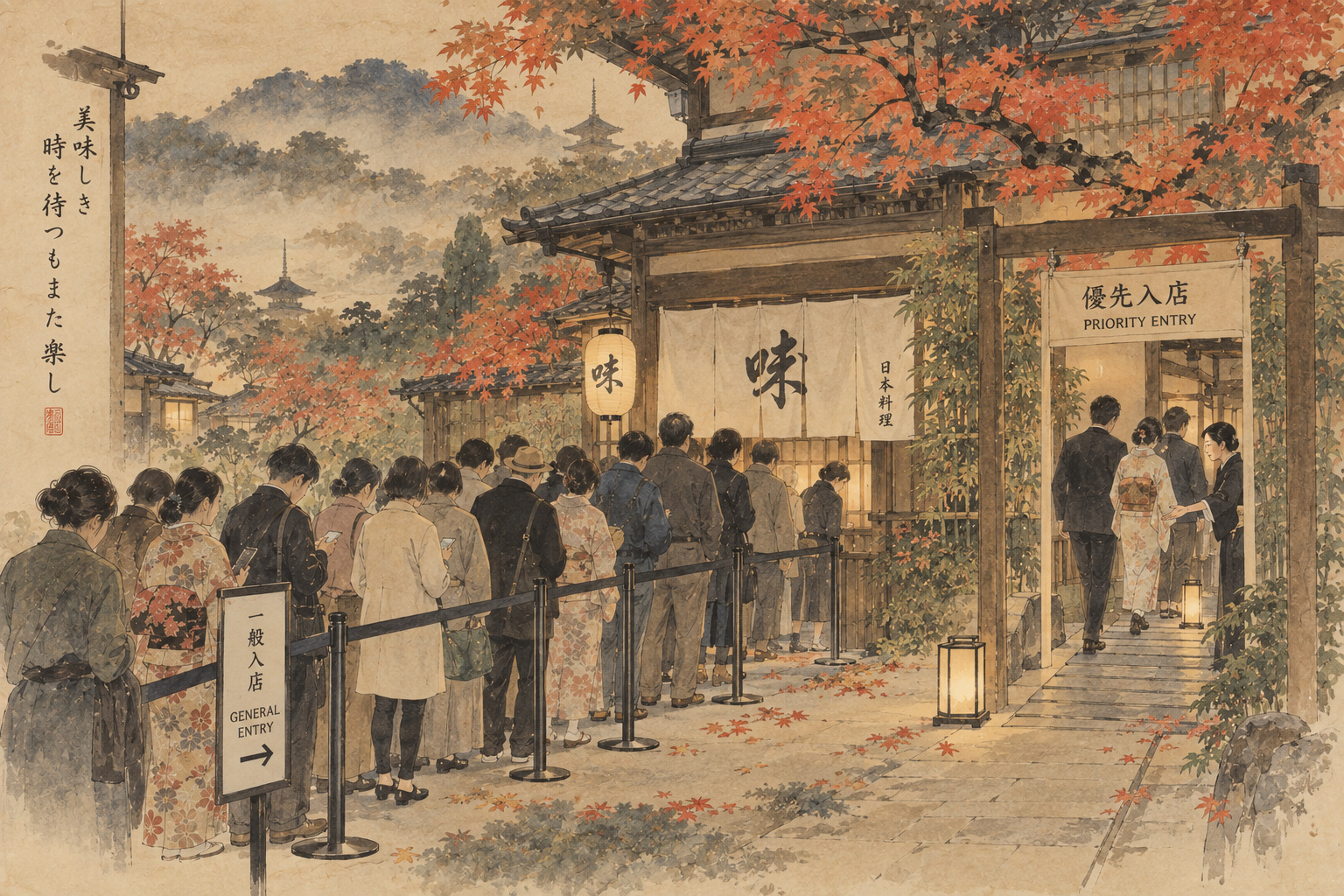
For decades, the line outside a celebrated ramen shop, soba counter or sweets shop has been a familiar part of eating in Japan. A queue signals demand, reputation and scarcity. Diners often accept the wait as part of the experience.
That bargain is beginning to change. Paid priority-entry systems—often described loosely as restaurant “fast passes”—are spreading across urban centers and tourist destinations. Jiji Press reported that SuiSui, one of the most visible services, had reached 104 restaurants in 20 prefectures as of September 18, 2026. Fees generally ran from about ¥500 to ¥2,000, depending on the restaurant and level of congestion. At a Butayama ramen branch in the Yaesu underground mall connected to Tokyo Station, lunch and dinner waits can reach 30 minutes to an hour, and the service is used about six times per weekday on average, according to the report.[1]
It is not quite a reservation
The first important distinction is that “fast pass” does not describe a single operating model. SuiSui says customers arrive at the restaurant first, look at the actual line and the price being offered at that moment, and then decide whether to buy priority entry by scanning a QR code. No seat is held in advance and no arrival time is booked. When a seat becomes available, the pass holder is handled ahead of the regular queue according to the restaurant’s operating rules.[2]
The free queue remains. SuiSui also warns that priority access does not guarantee zero waiting; depending on restaurant operations, pass holders may still wait roughly five to 20 minutes. The product is therefore better understood as a paid reduction in waiting time rather than the sale of a table reservation.[2]
That design matters to restaurant economics. Because the customer is already on site, the restaurant does not have to hold a table for someone who might fail to appear. SuiSui says its model can run alongside existing reservation systems without changing normal table turnover. Its restaurant-facing site says there is no initial or fixed monthly fee and that 50% of the priority-entry charge is returned to the restaurant under its performance-based model.[3]
A second model: paying for a priority time slot
TableCheck FastPass illustrates another branch of the market. Some participating restaurants allow diners to choose a time and pay a fee that moves them to the front of the queue around that time, while explicitly stopping short of promising a reserved seat. Osaka ramen shop Mugi to Mensuke states on its official TableCheck page that its FastPass costs ¥800 per person and is “not a seat reservation”; customers can still wait during congestion. Jinsei Gyoza lists a ¥390 per-person fee.[4][5]
TableCheck formally launched FastPass in February 2024 after pilot operations that began in November 2023. By the end of May 2024, the company said 35,000 guests had used it across 26 participating restaurants.[6] Its current English-language FastPass page markets priority access directly to visitors with the line “Skip the Queue at Japan’s Best Eats,” listing ramen, soba, udon and other sought-after restaurants.[7]
So Japan’s emerging fast-pass market is not one standardized product. The SuiSui model prices the queue after the customer sees it; TableCheck’s model can sell access around a chosen time. What the diner is buying—and what operational risk the restaurant is managing—differs between the two.
From paper tickets and cash to a national network
SuiSui traces its origins to October 2023, when founder Keiichiro Sato experimented at crowded restaurants using paper tickets and cash before building the digital system. The company says the mechanism is covered by Japanese Patent No. 7558588. At its formal launch in spring 2025, SuiSui said it was operating at roughly 50 restaurants; by April 2026 the number was about 80. On September 30, it described its footprint as “about 100” restaurants, with roughly 50,000 users and 26,000 total transactions.[2][8]
Jiji’s more precise figure of 104 restaurants in 20 prefectures as of September 18 is not necessarily inconsistent with SuiSui’s later “about 100” description; the latter is plainly rounded. Both figures should, however, be treated as snapshots in a network where restaurants can be added or removed.
Why now: time performance meets record tourism
One explanation is the Japanese consumer idea of taipa—short for “time performance,” the perceived return on time spent. Yutaka Suzuki, a special research fellow at the Distribution Economics Institute of Japan whose work includes consumer behavior and shopper marketing, has written on retail in the “taipa era.” In Jiji’s reporting, he argued that paid queue-skipping fits younger consumers’ desire to eliminate waiting time and could spread beyond restaurants to other places where lines are long.[1][9]
Tourism makes the economics even sharper. The Japan National Tourism Organization says Japan received a record 42.68 million international visitors in 2025. In July 2026 alone, arrivals reached 3.442 million, the highest ever for that month.[10][11] A traveler with three days in Kyoto or Tokyo may value two hours very differently from a local diner with a free afternoon.
That difference shows up in actual behavior. Jiji reported that Kyoto Kamo Soba Den can draw waits exceeding two hours on weekends and holidays and that one couple paid ¥4,000 each for priority access. The restaurant’s operator said customers appeared to value finishing their meal quickly enough to spend the saved time sightseeing.[1]
The concept is also spreading beyond ramen. Taneya introduced SuiSui at Himure-no-ya in Omihachiman, Shiga Prefecture, on September 20. Its official notice says priority tickets start at ¥500 per person, vary with demand, and must be purchased after arrival rather than in advance.[12] That is significant because it places queue pricing inside a destination food experience closely tied to tourism, rather than only in high-turnover noodle shops.
For restaurants, a queue can be an asset and a cost at the same time
A long line is powerful advertising. It tells every passerby that the restaurant is popular enough to be worth waiting for. But after a point, the same line creates lost sales. Customers walk away. Staff spend time answering “How long?” rather than serving food. Congestion can spill onto sidewalks and neighboring storefronts. The symbol of success becomes an operating burden.
Priority entry offers a way to monetize that contradiction. The restaurant keeps a free line but charges customers who value time more highly. It can add revenue without changing the menu price or expanding the dining room. In economic terms, the restaurant is segmenting demand using both money and time.
Dynamic pricing follows naturally. If a queue is 10 minutes long, few diners will pay ¥1,000 to avoid it. If the line is two hours, the same fee can look cheap. SuiSui says its ticket prices can change according to the day, time and congestion level, although some restaurants use fixed prices.[2]
The fairness question
The model also invites an obvious objection: if everyone once waited in the same line, does charging to move ahead create a two-tier dining experience in which people with money buy time from people without it?
That criticism cannot simply be dismissed. A restaurant could undermine trust if it sells so many priority passes that the free line barely moves, or if it artificially worsens the ordinary experience to increase paid conversions. A queue-skipping system is only as fair as the capacity rules behind it.
But the opposite argument is also real. If the regular queue remains available, the system adds rather than removes a choice. Parents with small children, office workers on short lunch breaks, travelers on fixed itineraries and people who find long periods of standing difficult may value the option disproportionately. In those cases, paying for time can improve access rather than merely create status.
The operational question is therefore not whether paid priority exists, but how much is sold. Sell too many passes and the normal queue deteriorates. Sell too few and the restaurant gains little. The right balance depends on seat count, table turnover, abandonment rates, tourist mix and the shape of each day’s demand.
Time joins price on the restaurant’s menu
Japanese restaurants have traditionally built revenue from menu prices, seat counts, turnover, location and opening hours. Fast-pass systems add a new variable: the explicit price of waiting.
That makes this more than a QR-code novelty. A queue is being redefined from evidence of popularity into something that can be measured, priced and managed. What began as small experiments in 2023 has become a market of roughly 100 restaurants for one provider alone, while other operators pursue different versions of paid priority access.
The decisive evidence will come next. How much does priority entry increase restaurant profit? Does it change repeat visits? What happens to ordinary waiting times as paid adoption rises? Can it reduce street congestion in major tourist districts? Those numbers will determine whether restaurant fast passes become a lasting piece of Japan’s service economy or remain a niche product for unusually crowded venues.
One thing has already changed. The line outside a popular restaurant is no longer just a line. It is becoming a market in which customers reveal, in yen, what an hour of their time is worth.
Sources
- Jiji Press / Nippon.com, “Fast Pass Services Gain Popularity at Restaurants in Japan” (Sept. 30, 2026)
- SuiSui, explanation of its restaurant fast-pass model (Sept. 30, 2026, Japanese)
- SuiSui official restaurant introduction site (Japanese)
- TableCheck: Mugi to Mensuke FastPass page
- TableCheck: Jinsei Gyoza page
- TableCheck, FastPass adoption data (2024, Japanese)
- TableCheck FastPass official restaurant list
- SuiSui, Hakata expansion and April 2026 usage figures
- Distribution Economics Institute of Japan: Yutaka Suzuki profile (Japanese)
- Japan National Tourism Organization: 2025 visitor arrivals
- Japan National Tourism Organization: July 2026 visitor arrivals
- Taneya: SuiSui introduction at Himure-no-ya (Sept. 20, 2026, Japanese)