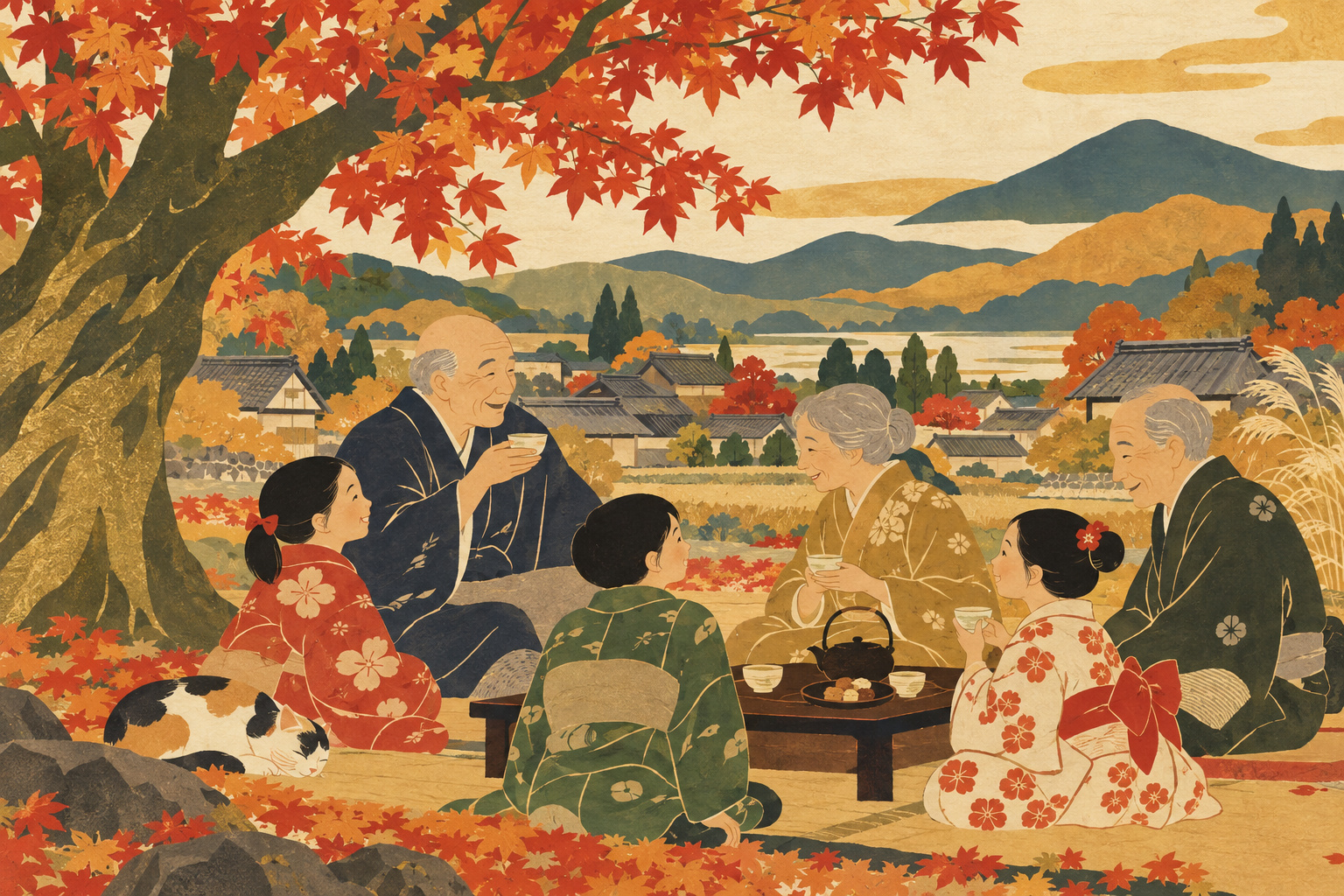
A public holiday can conceal the work that created it. On September 21, 2026, Japan observes Respect for the Aged Day, sixty years after it entered the national holiday calendar. Its beginnings lie in a village gathering in Hyogo Prefecture, nineteen years before the legislation that made the occasion a day off.[1][6]
The distinction matters. This was a local initiative that acquired a wider welfare purpose, passed through national campaigning and eventually became law. Following that route back to the community now within Taka offers a more demanding understanding of respect: making room for older people in the life of a place, including when joining in requires practical help.
A village invitation, with transport attached
Taka’s municipal newsletter dates the first gathering to September 15, 1947, in the former village of 野間谷村, now within its Yachiyo district. The village mayor, 門脇政夫, invited residents aged 55 and over. The account describes an occasion intended both to acknowledge their contributions and to pass knowledge and experience to another generation.[3]
A 2007 account by Taka’s then mayor, published by the National Association of Towns and Villages, adds a memorable detail: three-wheeled motor vehicles were gathered to bring participants to the public hall, where food and local kabuki entertainment awaited them. This is a later civic account of the event, rather than contemporary reporting from the hall.[4]
Transport nevertheless gives the story its practical force. An invitation does not by itself make someone able to attend. Distance, fatigue or an inaccessible entrance can turn a celebration into an event enjoyed chiefly by those already best placed to join it. The historical detail suggests a useful modern question: what would make participation possible for the person who has been invited?
How the idea travelled
The town’s retrospective separates the first gathering from the proposal made at the second, in 1948, to establish September 15 as a local “としよりの日.” That distinction prevents a common compression of the history: the village celebration was not already Japan’s national holiday in 1947.[3]
The Cabinet Office traces the next stages to a prefecture-wide movement in Hyogo in 1950 and a national campaign promoted in 1951 by the Central Council of Social Welfare, the predecessor of today’s National Council of Social Welfare. September 15–21 became the campaign week.[2]
A movement of this kind needs more than an attractive idea. Local organizers supply an example; wider networks make it repeatable; public institutions can eventually give it a lasting place. Reading the history as that sequence also avoids making everyone except the original proposer disappear. A gathering had to become a cause that other communities could make their own.
Welfare recognition came before holiday status
The original legislation supplies a particularly clear dividing line. The Act on Social Welfare for the Elderly, promulgated on July 11, 1963, created “老人の日,” or a day for older people, in Article 5 and specified September 15. Its purpose included increasing public understanding of older people’s welfare. This was a statutory observance; it did not itself add a public holiday to the national calendar.[5]
Elsewhere, the same act assigned responsibilities for older people’s welfare to national and local government. The broader significance is that recognition was being placed alongside public responsibility. Honouring someone was not solely a matter of private family sentiment.
The decisive holiday amendment was promulgated and took effect on June 25, 1966. It added Respect for the Aged Day on September 15 to the national holiday law. It also rewrote Article 5 of the welfare act around activities on the new holiday. Those are related legal changes, not interchangeable dates.[6]
For the 2026 edition, the anniversary arithmetic is therefore precise: sixty years since national holiday status, seventy-nine since the 1947 gathering. Remembering both keeps the long period of local and institutional work visible.
Why September 15 still matters
Respect for the Aged Day moved to September’s third Monday from 2003. Separately, a 2001 amendment to the welfare act established September 15 as “老人の日” and September 15–21 as “老人週間.” The public holiday and the welfare observance consequently have distinct calendar rules.[2]
This year, September 21 is the public holiday and September 23 is the Autumnal Equinox holiday. September 22 is a holiday under the national holiday law’s provision for a day between two national holidays; it is not a substitute holiday. Together with the weekend, that creates a five-day break for people whose schedules allow it.[1]
That last qualification belongs in any account of the occasion. A calendar can create time for a visit without guaranteeing that everyone has it. People providing care, transport or other services may be working while others gather. For a family arranging a reunion, choosing a convenient alternative date can express the occasion’s purpose as clearly as meeting on the official Monday.
A newer town carrying an older memory
Taka itself was formed on November 1, 2005, through the merger of Naka, Kami and Yachiyo. The mayor’s 2007 account places the holiday’s local inheritance within that new municipality. The town name on today’s map and the village name in the founding story belong to different stages of the area’s history.[4]
Commemoration has also taken forms that children can help create. The town’s 2016 newsletter records the production in 2013 of the song “きっとありがとう,” drawing on lyrics submitted by schoolchildren. The song is evidence of an effort to transmit the occasion’s meaning through participation, alongside the more familiar work of preserving dates and monuments.[3]
That raises an editorial question for any community marking the anniversary: how can remembrance remain an exchange? Asking an older neighbour about a photograph or a familiar place can open a conversation, but nobody owes an audience a lesson simply because they have lived longer. A shared activity can be worthwhile without producing a usable story, performance or piece of heritage.
Respect cannot depend on usefulness
The 1963 welfare act held together two ideas that deserve to be read together today. It recognized older people’s knowledge and experience, while also affirming secure and peaceful living. Opportunities for work and other social activity were framed in relation to the person’s wishes and abilities.[5]
There is a substantial difference between making an opportunity available and imposing a role. A person who wants to teach, volunteer or work should not be dismissed because of age. A person who cannot do those things should not have to demonstrate usefulness to deserve attention. Stories of energetic achievement are valuable, but they cannot define the threshold for dignity.
The Cabinet Office’s 2026 campaign includes social participation, respect for human rights, support for carers and neighbourhood connections relevant to disaster preparedness.[2] These concerns bring the observance back to ordinary arrangements: whether someone can ask for help, whether assistance respects their choices, and whether a family carer has anyone to turn to.
The anniversary is an opportunity to assess those arrangements without pretending that a celebration can replace them. A friendly visit cannot deliver an entire care service. Equally, a functioning service does not make companionship unnecessary. The useful question is what each relationship or institution is able to contribute, and what remains missing.
The day after the celebration
For a family, carrying the holiday forward might mean agreeing on the next call before a visit ends. For an event organizer, it might mean asking someone who stayed away what would have made the occasion comfortable—or whether a different form of contact would have been welcome. For a neighbourhood group, it could mean ensuring that someone who needs assistance in an emergency is involved in planning it.
These are present-day possibilities, not claims about what the village’s organizers foresaw. Their value lies in making the word “respect” answerable to another person’s preferences.
The route from a village hall to the national calendar gave Japan a shared date. Taka’s history asks what people do with it. Sixty years after the holiday became law, a fitting measure of its success would be whether the people celebrated on Monday still find someone ready to listen on Tuesday.