- A French painter, a Japanese exhibition
- The painter who refused to stand still
- When Japan looked toward Paris
- The Japanese artists who made the encounter their own
- From industrial wealth to a public collection
- Why the original matters
- Beyond the language of happiness
- Visiting Oita and following the exhibition
A French painter, a Japanese exhibition
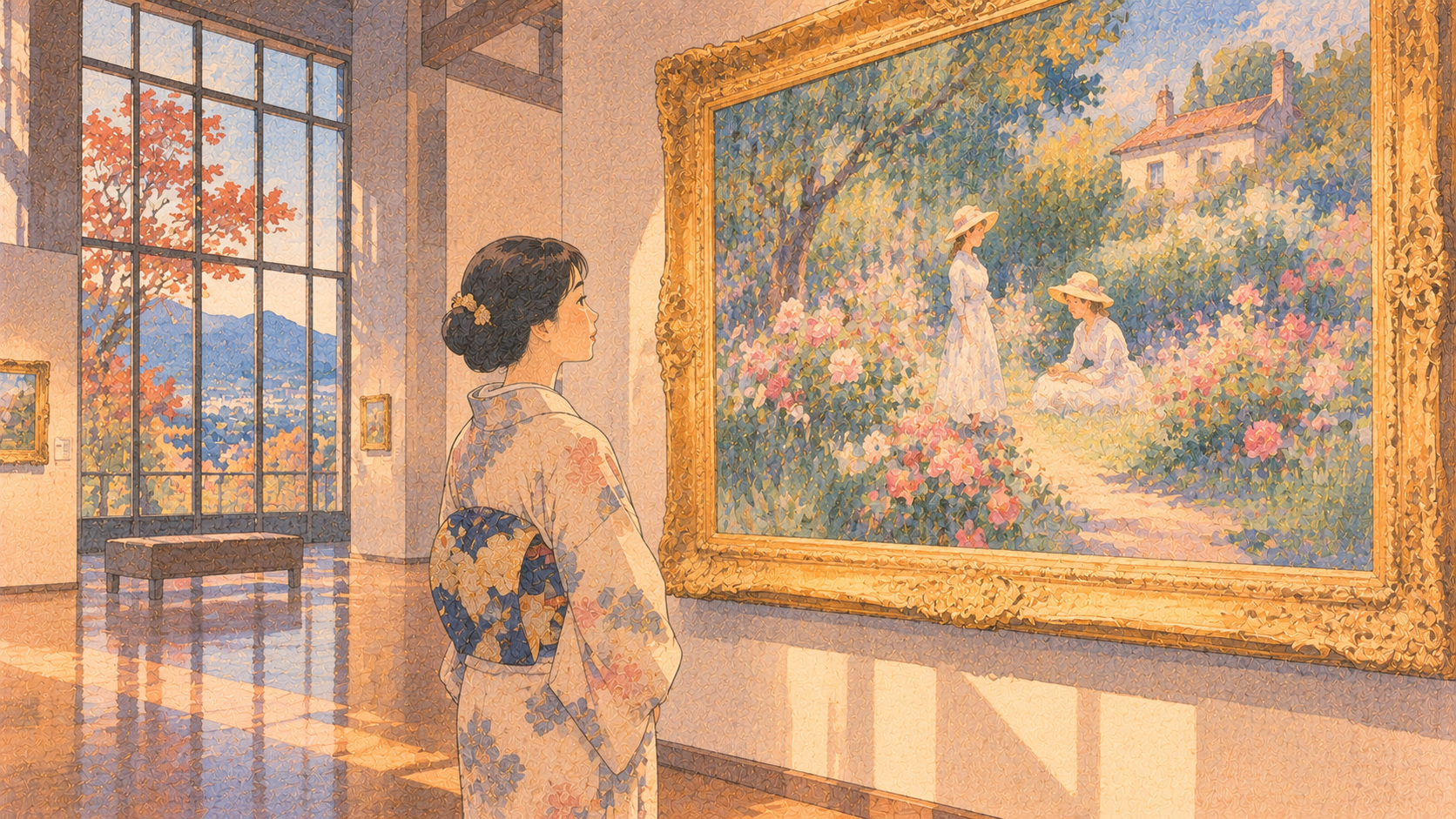
A painting can travel much farther than its creator ever did. On November 23, Oita Prefectural Art Museum opened Renoir and Japan, a touring exhibition that follows the changing place of Pierre-Auguste Renoir in Japanese cultural life. Its focus is not simply the celebrated painter’s career, but the people and institutions that brought his art into the everyday reach of Japanese audiences.
Oita is the third stop after Kumamoto and Shizuoka. The exhibition brings the history of collecting into conversation with Japanese Western-style painting and the wider Impressionist movement. Its organizers invite visitors to consider a question that is more interesting than a survey of famous masterpieces: how does a foreign artist become familiar to a society over several generations?
The exhibition’s affectionate title expresses a curatorial interpretation, not a measured national preference. The evidence for its argument lies in the histories of actual works, their owners, and the museums that make them available.[1][2][3]
The painter who refused to stand still
Born in Limoges in 1841, Renoir learned decorative painting as a young porcelain worker before pursuing fine art. His training in Paris brought him into contact with Claude Monet and other painters who were dissatisfied with the constraints of academic exhibition culture. The independent exhibition of 1874, later identified as the first Impressionist exhibition, helped establish a new space for experimental painting.
Renoir’s distinctive contribution was not confined to landscape or the changing weather. Figures, clothing, leisure and social interaction became occasions for exploring color and light. Visible brushwork could convey the experience of a moment rather than simply record the outline of an object.
Yet the artist also questioned his own methods. His encounters with Italian art in the 1880s encouraged a renewed interest in classical structure and clearer contours. Later paintings returned to softer surfaces and richly modulated color. He continued working despite rheumatoid arthritis and died in southern France in 1919. The variety of his career matters: the Japanese artists who admired him encountered an evolving painter, not a fixed recipe for Impressionism.[2][10]
When Japan looked toward Paris
The Meiji era opened new institutional routes for studying European art. Japanese artists traveled abroad, studied oil painting and returned to participate in the formation of modern art education. The category yōga, or Western-style painting, describes a field of artistic practice in Japan rather than an assertion that its practitioners abandoned Japanese identity.
Kuroda Seiki, who traveled to France in 1884, illustrates this transformation. Initially pursuing legal studies, he turned toward painting and developed connections with Raphaël Collin. His career provides important background to the reception of French art, although he was not a pupil of Renoir.
The exhibition traces some of the earliest Japanese encounters with Renoir to the art dealer Hayashi Tadamasa in the 1890s. The organizers qualify his role in the history of the first imports, and much of his collection was subsequently dispersed. This was also an era when Japanese prints circulated in Europe. Cultural exchange was not a one-way delivery of Western ideas to Japan; it involved active selection, interpretation and movement in both directions.[3][6]
The Japanese artists who made the encounter their own
Ryuzaburo Umehara arrived in Paris in 1908 at the age of twenty. The son of a Kyoto textile merchant, he had already studied Western-style painting under Asai Chu. Renoir’s art made a profound impression on him, and in 1909 he visited the French master in Cagnes and became his pupil.
The Toyota Municipal Museum of Art’s record for Girl Anine (1908) provides a revealing glimpse of Umehara’s early experiments with color. His later work, however, cannot be reduced to a Japanese version of Renoir. He developed an independent, vigorous style whose chromatic intensity drew on his own artistic background. He received Japan’s Order of Culture in 1952.
Shintaro Yamashita, another admirer, helped introduce Impressionist methods to Japan while also pioneering work in painting conservation. The Hiroshima Museum of Art emphasizes both dimensions of his career. Their stories illustrate two kinds of cultural inheritance: the freedom to transform a teacher’s ideas, and the discipline required to preserve the physical objects that carry those ideas forward.[4][5][7]
From industrial wealth to a public collection
One of the most consequential ways in which European art became accessible in Japan was through private collecting. In Kurashiki, businessman Magosaburo Ohara supported painter Torajiro Kojima’s European travels and acquisitions. The Ohara Museum of Art opened in 1930, giving a regional city a major institution devoted to Western art.
The history of Kojiro Matsukata’s collection was more troubled. The shipbuilding executive sought to establish a museum, but financial distress dispersed part of his collection. Works left in Europe faced wartime loss and sequestration. The return by donation of much of the surviving French-held collection provided the foundation for Tokyo’s National Museum of Western Art in 1959.
Consider Renoir’s Woman with a Hat (1891). The national museum records its passage through the Durand-Ruel gallery, its acquisition by Matsukata in 1921, and its eventual entry into the museum following the postwar return. Its history is a tangible example of how commerce, war, diplomacy and cultural institutions affect what audiences can see. It is discussed here as a collection example, not as a confirmed loan to Oita.[8][9][10]
Why the original matters
The exhibition’s Oita publicity centers on Girl in a Lace Hat (1891), a painting from the Pola Museum of Art. Measuring 55.1 by 46 centimeters, the portrait rewards attention to the material quality of fabric, the modulation of whites and the relationship between the figure and its surroundings. These are qualities that can be difficult to appreciate in a small reproduction.
Another example of local familiarity is the Kumamoto Prefectural Museum of Art’s Girl with Flowers at Her Breast, dating from around 1900. The exhibition organizers trace its acquisition to fiscal 1979. A regional collection can make a painting part of the cultural life of a community rather than an object seen only on a rare overseas journey.
The availability of originals does not happen automatically. Acquisitions, conservation, climate-controlled storage, insurance, transport and professional interpretation all require resources. Corporate and private collections can widen access when they participate in museum loans, while publicly owned collections must balance exhibitions with preservation. The touring show makes those networks visible.[3][11]
Beyond the language of happiness
Renoir is often described as a painter of pleasure, but that description should open a discussion rather than end one. His pictures invite viewers to examine the way color models flesh and fabric, how figures occupy space, and how a painter constructs an atmosphere from small variations in tone.
His chosen subjects also belong to a particular historical society. Images of leisure and fashionable dress can be read alongside questions about who had access to such experiences. A painting’s radiant mood is not evidence that the world outside its frame was equally harmonious.
Nor is there a single psychological explanation for Renoir’s appeal in Japan. The exhibition proposes that repeated opportunities to encounter the work helped establish familiarity. That is a persuasive historical avenue of inquiry, but it should not be confused with a contemporary audience survey. The art is available for many different readings, including critical ones.[1][3]
Visiting Oita and following the exhibition
Renoir and Japan runs through January 17, 2027, in Exhibition Room A on the first floor of Oita Prefectural Art Museum, 2-1 Kotobukimachi, Oita City. Hours are 10 a.m. to 7 p.m., extended to 8 p.m. on Fridays and Saturdays; last admission is thirty minutes before closing. General admission is ¥1,600, junior and senior high school admission ¥1,000, and younger children enter free. The museum also lists free admission for eligible disability certificate holders and one accompanying person.
The next announced venue is Tokyo Fuji Art Museum, January 26–March 28, 2027. Okayama Prefectural Museum of Art is provisionally scheduled for April 6–May 30. The organizers caution that not every featured work is shown at every venue, so prospective visitors should consult the museum’s current information.
The lasting subject of the exhibition is a cultural infrastructure built over more than a century. Renoir’s paintings crossed borders through the decisions of dealers, artists, patrons and museums. Their continued public life depends on the care of institutions and on new generations of viewers finding something worth seeing in them.[1][2][3]
Primary sources and references
- OPAM: exhibition details
- Official tour: dates and opening announcement
- Official tour: curatorial themes and selected works
- Toyota Municipal Museum of Art: Umehara
- Aichi Prefectural Museum of Art: Umehara biography
- Tokyo National Research Institute for Cultural Properties: Kuroda chronology
- Hiroshima Museum of Art: Yamashita
- Ohara Museum of Art: history
- National Museum of Western Art: Matsukata Collection
- National Museum of Western Art: Woman with a Hat
- Pola Museum of Art: Girl in a Lace Hat
- Shizuoka City Museum of Art: touring exhibition
- National Art Center, Tokyo: exhibition listing for Shizuoka