- The operator does not have to be at the landslide
- Why this particular mountain valley matters
- From volcanic danger to remote control
- What “unmanned” construction actually means
- A skilled operator, not a publicity prop
- An industry running short of people and time
- What Japan means by i-Construction 2.0
- The employment statistics behind the opportunity
- The hard engineering problems do not disappear
- What the November 13 trial can—and cannot—prove
- Making the workplace reachable without moving the worksite
The operator does not have to be at the landslide
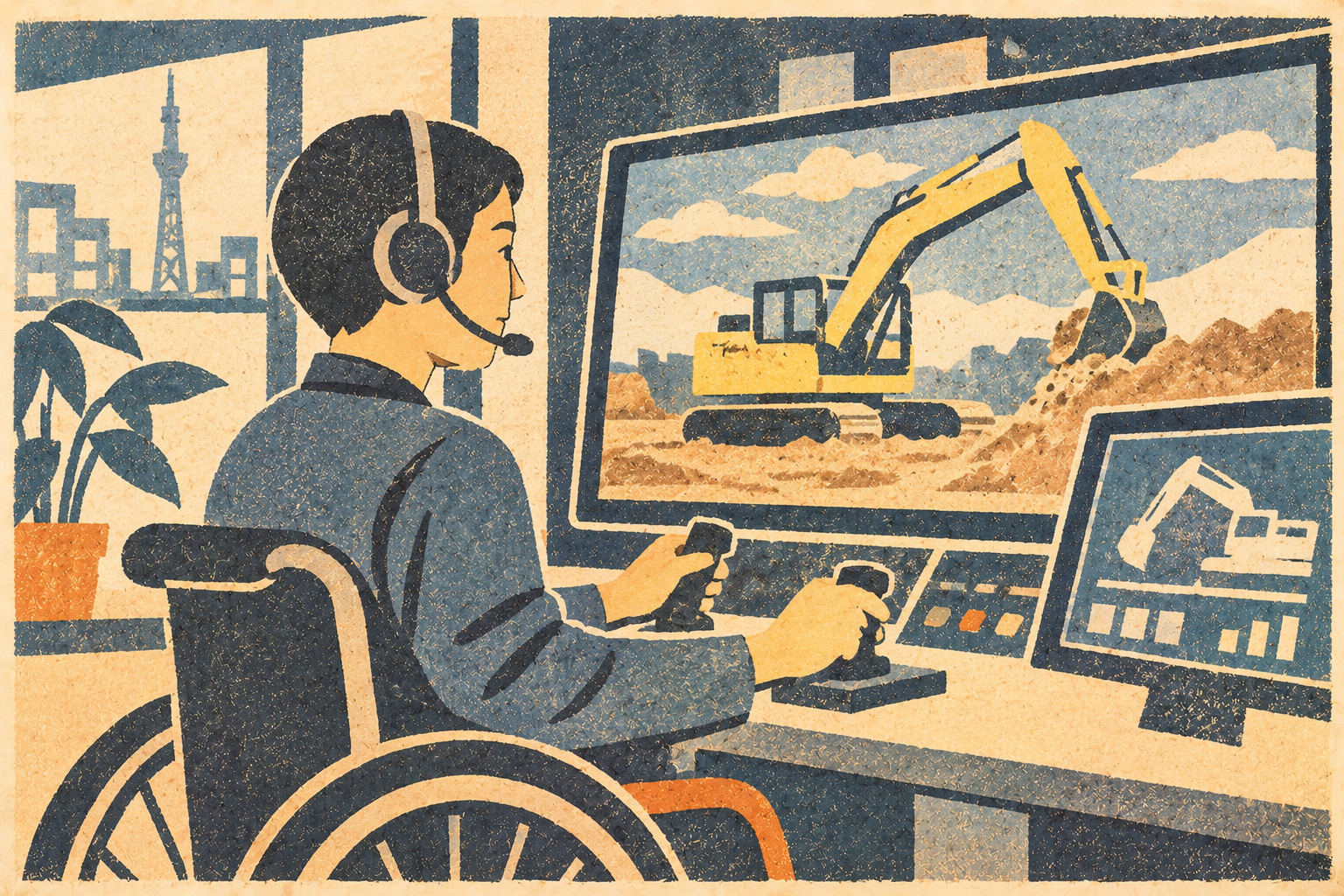
A construction machine can work on an unstable mountainside without carrying a person into the hazard. Japan has spent decades developing that capability for disaster recovery. Now a government trial in a remote valley of Nara Prefecture is asking a different question: could the same separation between operator and machine open skilled construction jobs to people whose disabilities make conventional sites difficult to access?
The Kinki Regional Development Bureau of Japan’s Ministry of Land, Infrastructure, Transport and Tourism (MLIT) announced on November 6 that a person with a physical disability who already holds a qualification to operate vehicle-type construction machinery is scheduled to remotely operate equipment on November 13. The demonstration is planned for 1–3 p.m. in the Kuridaira area of Totsukawa Village. It has not yet happened, and the announcement does not claim that a permanent job has been created.
Why this particular mountain valley matters
The location carries more than engineering significance. Typhoon Talas brought catastrophic rainfall to the Kii Peninsula in September 2011. Deep-seated slope failures dumped extraordinary volumes of earth into mountain rivers, creating unstable natural dams and the possibility of further flooding and landslides. Kuridaira was among the most severe sites.
A technical review published by the Kinki bureau describes a landslide-dammed obstruction roughly 100 meters high and about 24.13 million cubic meters of blocked material at Kuridaira. Temporary drainage works subsequently suffered repeated erosion during typhoons. Long-term stabilization required machines to work where conventional human exposure would be dangerous. Remote construction has been repeatedly used in the area; the proposed trial builds on that established disaster-management practice.
From volcanic danger to remote control
Japan’s unmanned-construction expertise predates the digital era. Early experiments included remotely operated and amphibious earthmoving machines. The decisive proving ground came after the eruption of Mount Unzen-Fugendake in the early 1990s, when dangerous volcanic deposits and the risk of pyroclastic flows made conventional restoration hazardous.
By 1994, remote earthmoving was being implemented around Unzen. The technology later found applications in the aftermath of the Mount Usu eruption, the Kii Peninsula disaster and other restricted-access work. Better wireless links, camera systems, sensors and positioning transformed what could be attempted from a control station. Its original promise was straightforward: keep the worker out of danger. The newer possibility is to keep a worker in the profession even when the worksite itself is inaccessible.
What “unmanned” construction actually means
In a remotely operated system, cameras and other sensing equipment give an operator views of a machine and its surroundings. Controls at a separate station transmit commands to the excavator or other machinery. This should not be confused with fully autonomous construction, where a machine performs tasks without continuous human input. In remote operation, professional judgment and hand-eye coordination remain central.
The ministry suggests that locating the control station somewhere a disabled worker can reach could remove a major employment barrier. Yet the announcement does not specify the exact machine model, distance from the worksite, control-interface adaptations, connectivity requirements or accommodations used in this trial. It would be premature to conclude that it demonstrates working from home—or that every person with a disability could perform the role.
A skilled operator, not a publicity prop
One detail deserves emphasis: the participant described by MLIT holds an existing construction-machinery operating qualification. The demonstration therefore tests access to a skilled occupation, not a shortcut around training or safety credentials. Construction equipment operators plan moves, judge ground conditions, communicate with colleagues and halt work when circumstances change.
That is why inclusion cannot be reduced to whether someone successfully moves a joystick for an afternoon. A fair test would explore how the operator experiences video displays, controls, work pace, fatigue and teamwork. Different disabilities call for different accommodations. The goal should be work that respects the operator’s expertise, with appropriate pay and advancement, rather than an isolated demonstration branded as inclusion.
An industry running short of people and time
Japan has a structural reason to consider new ways of staffing construction sites. MLIT figures put employment in the industry at approximately 4.77 million in 2024, down from around 6.85 million at its 1997 peak. The ministry’s workforce data identify 36.7% of construction workers as 55 or older and just 11.7% as 29 or younger.
Those numbers do not mean workers with disabilities should be treated as a reserve labor pool to plug shortages. They do mean an industry wrestling with recruitment and succession has a reason to redesign jobs that needlessly exclude qualified candidates. Whether remote operation can turn that prospect into durable employment depends as much on hiring practices, job design and training as on the sophistication of the equipment.
What Japan means by i-Construction 2.0
The November experiment sits within the government’s larger i-Construction 2.0 agenda, which aims to automate field operations, connect design and construction data, and modernize supervision and inspection. MLIT has set a policy target of reducing the labor required on sites by at least 30% by fiscal 2040, corresponding to a 1.5-fold productivity increase.
In a progress report issued in April 2026, the ministry said remote-construction implementations or trials had increased to 41 in fiscal 2025 from 21 the previous year. That is a measure of deployment, not evidence of 41 successful disability-employment cases. Automation has both productivity and social implications, and progress in one category does not prove results in the other.
The employment statistics behind the opportunity
Japan’s legal framework has been pushing employers to consider inclusion more systematically. The Ministry of Health, Labour and Welfare’s June 2025 survey found the equivalent of 704,610 people with disabilities employed by covered private companies, an actual employment rate of 2.41%; 46% of companies subject to the requirement met their quota. The private-sector statutory rate, 2.5% at the time, rose to 2.7% in July 2026.
These measures are useful context, but they cannot tell readers whether a construction operator enjoys a meaningful career. Wage levels, job security, worker autonomy, assistance, working hours and promotion prospects are part of the picture. A remote-control workstation is not by itself an employment policy. Sustainable inclusion requires employers and the workers themselves to shape the way work is performed.
The hard engineering problems do not disappear
Remote operation exchanges some risks for others. A narrow camera view can conceal people or obstacles. Network latency makes precision harder. Heavy rain, dust, glare or a lost connection can turn a routine movement into a safety problem. A robust system needs emergency-stop logic, clear operating procedures, reliable communications and a workable division of responsibility between the remote station and personnel on site.
Accessibility adds another design layer. Controls may need adaptation; screens, seating, rest breaks and access to assistance can affect whether an individual can work comfortably over an entire shift. Training and certification must remain rigorous. The government release does not provide measured latency, productivity, fatigue or total-system costs for this planned test. Those are questions for the trial and subsequent reporting, not facts to invent beforehand.
What the November 13 trial can—and cannot—prove
The November 13 demonstration was originally planned for October 26 and subsequently postponed. MLIT has invited media to attend, with a November 11 registration deadline. The November 10 article is therefore a preview grounded in the government’s stated plan, not a field report from an event already completed.
Useful evidence would include what task was completed, how the equipment performed under real site conditions, what adjustments the operator needed, and whether the participant found the work manageable and worthwhile. Longer-term evaluation would ask whether a company can offer recurring assignments, realistic wages, training and support without compromising safety. An impressive demonstration is a first step, not the same thing as an established employment pathway.
Making the workplace reachable without moving the worksite
The irony is instructive. In the wake of the 2011 disaster, Japan developed ways to move workers away from hazardous ground. Fifteen years later, those methods could also bring a demanding occupation within reach of people previously blocked by the physical geography of a construction site.
That possibility is still unproven at scale. But it is why the Totsukawa demonstration deserves attention beyond machinery enthusiasts. The meaningful benchmark will not be a remotely controlled excavator moving successfully across a television monitor. It will be whether qualified people can use the technology to build lasting, fairly compensated careers.
Sources and reporting method
Document-based reporting cross-checked against Japanese government releases on the scheduled trial, remote-construction history, and labor policy. Plans are distinguished from completed results.
- MLIT Kinki Regional Development Bureau, November 6, 2026 announcement
- MLIT, i-Construction 2.0 annual progress, April 28, 2026
- MLIT, i-Construction 2.0 targets and policy
- MHLW, 2025 Employment of Persons with Disabilities survey
- MHLW, statutory employment rate changes for July 2026
- National Museum of Nature and Science, history of unmanned construction
- MLIT, Kii Mountains landslide-dam disaster mitigation reference
- MLIT, construction workforce age and labor trends