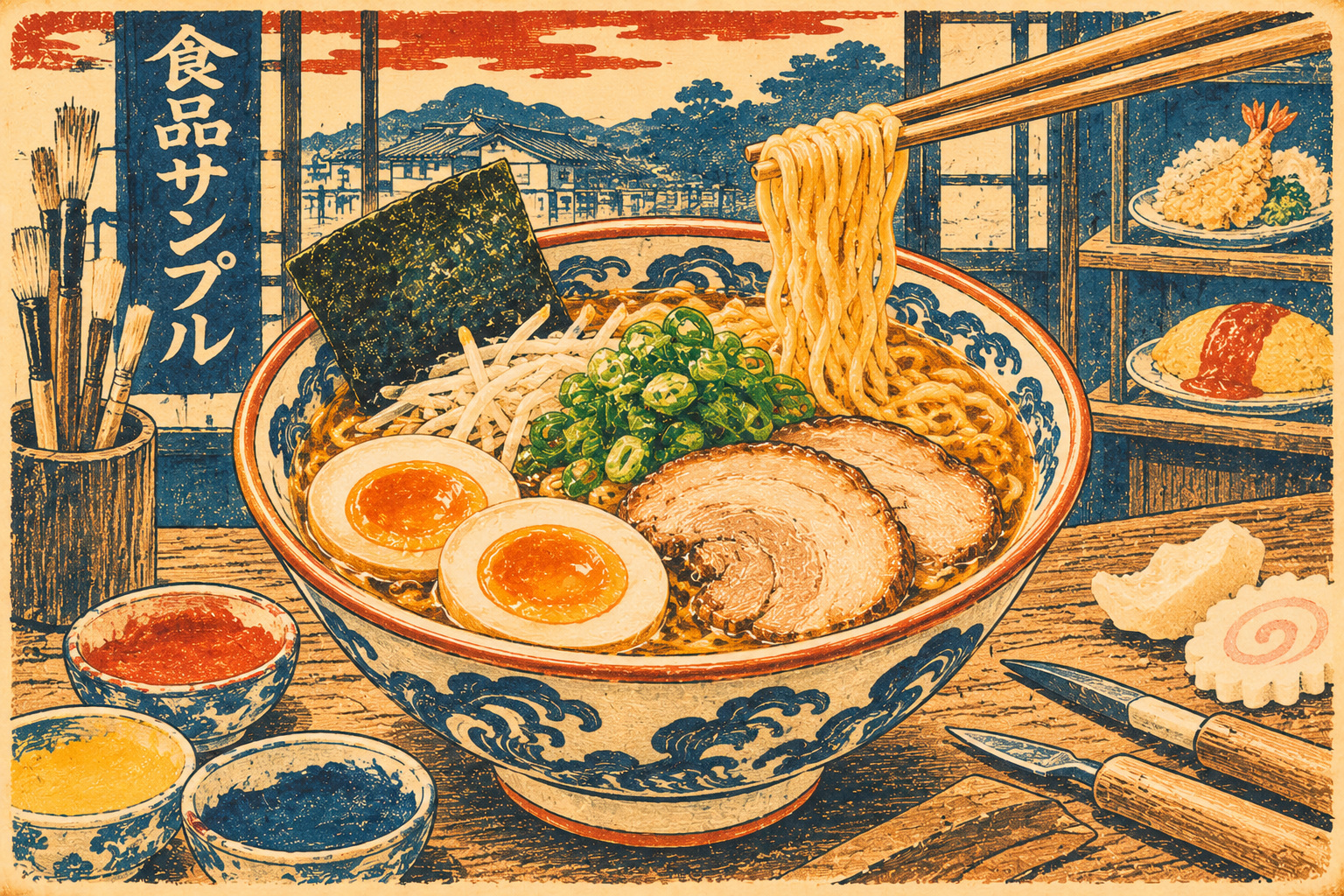
- The noodle that never cools
- A practical guide to the Wakayama exhibition
- Before plastic food, the department-store dining revolution
- Iwasaki Takizo turns a clever idea into an industry
- The material science hiding beneath a fried prawn
- Making food look more delicious than food
- A menu that can be read without Japanese
- From Gujo Hachiman to New York and London
- The craft economy behind the illusion
- What an inedible meal teaches us
The noodle that never cools
A forkful of spaghetti hangs eternally in the air. A fried chicken leg holds the shine of fresh oil. A bowl of ramen appears to have been rearranged by gravity into an impossible sphere. These dishes were never intended for a dinner table. They were designed to persuade the eye—and, increasingly, to challenge it.
The Food Sample Exhibition 2026 in Wakayama opened on November 12 at Kintetsu Department Store Wakayama, running through November 23. Its centerpieces are recent entries from the annual food-replica competition staged by Osaka-based Iwasaki, a company closely associated with the industry’s development. There are playful displays, opportunities to pose with giant pasta, and workshops in which visitors can make replicas of their own. According to the organizers, general admission is free.
The exhibition points to an unexpected evolution. What began as a practical way of showing customers the contents of an unfamiliar menu has become an exercise in craftsmanship, visual communication and sometimes cheerful absurdity. The newest replicas do more than imitate food: they ask what kind of impossible food only an artist could create.
A practical guide to the Wakayama exhibition
The venue is the fifth-floor event hall of Kintetsu Department Store Wakayama, 5-18 Tomoda-cho, Wakayama City. Published hours are 10 a.m. to 6:30 p.m., with the final day, November 23, ending at 4 p.m. These are organizer schedules, not an independently verified attendance or real-time entry report.
On November 14, 21 and 23, visitors can make a fruit parfait replica. Wax-tempura sessions are scheduled for November 15 and 22. The official store page lists a ¥2,750 fee per workshop, approximately 30 to 40 minutes of activity and a limit of ten participants per session. Advance reservations are offered through the Kintetsu app, and same-day places may be available if sessions are not full.
Other activities include posing with an enormous forkful of Neapolitan-style spaghetti and assembling a plate with replica ingredients. The latter is a free display experience, not a take-home workshop. Anyone planning a visit should check the department store’s current announcement for cancellations, session availability and conditions.
Before plastic food, the department-store dining revolution
The familiar story that Japanese food replicas began with one inventor in 1932 is too neat. Historical research traced by Japan House London and Kyoto Women’s University identifies earlier applications, including work on food models for health and nutritional education around 1917. The use of edible-looking models developed at the intersection of scientific display, dining and commercial illustration.
A pivotal episode came in 1923, when Shirokiya’s temporary Nihonbashi department store dining room offered food models and meal tickets. The display helped customers understand dishes they might never have tried, especially Western-style cuisine. In a fast-expanding urban restaurant culture, looking at a three-dimensional sample could be easier than deciphering a long list of names.
The National Diet Library describes how food displays and prepaid tickets contributed to more efficient restaurant operation. Later historical accounts describe major sales gains, but it would be misleading to assign those gains to replicas alone: tickets, queuing systems and dining-room design evolved together. What matters is the new language of choice—seeing an order before placing it.
Iwasaki Takizo turns a clever idea into an industry
In 1932, Iwasaki Takizo established the Iwasaki workshop in Osaka. Its history records the adoption of a food model by Sogo that year and the later development of manufacturing and distribution practices. He did not create the first three-dimensional imitation of food in Japan. His crucial contribution was turning a scattered technique into an organized, repeatable commercial enterprise.
The company tells a vivid origin story: as a child, Takizo watched melted candle wax bloom into curious shapes when it fell into water. Later, helped by his wife Suzu, he developed highly convincing food models. The story is part of the firm’s account of its origins, rather than proof that no earlier pioneers existed.
The enterprise expanded from Osaka, and a factory established in 1955 in Takizo’s home region of Gujo Hachiman, Gifu Prefecture, laid the groundwork for the town’s enduring association with food-replica making. Today visitors can learn techniques in the same region where manufacturing expertise became a local identity.
The material science hiding beneath a fried prawn
Early food replicas were commonly made with waxes that could be poured into molds, cooled and colored. A curl of shrimp tempura coating could be created by dropping melted wax into warm water. The effect remains spectacular, which helps explain why the Wakayama exhibition’s program includes a wax-tempura workshop.
Wax had limitations. Heat and long-term exposure could damage it; commercial displays demanded more durable alternatives. Iwasaki’s historical timeline records that it established a technical research unit in 1958 and began systematic work on molding with synthetic resins. Different workshops and products changed materials at different times, so the development should not be reduced to a single overnight transition.
Modern replicas can combine molding, resin casting, hand painting, finishing and careful assembly. A glossy broth surface, a translucent slice of fish and the airy roughness of fried batter require distinct treatments. The essential technology is not merely a recipe for plastic; it is the ability to convince an observer that a material possesses the properties of food.
Making food look more delicious than food
Commercial realism has a peculiar goal. A replica should usually convey what a diner can expect, yet it may need to preserve a perfect split second that real food will never sustain. The spaghetti stays aloft, the tempura never wilts and the ice cream cannot melt. A fixed object can capture the visual climax of a meal.
That demands disciplined observation. The translucency of noodles, the irregular pores of batter, the way sauce coats a surface and the tiny changes in color at the edge of grilled meat all contribute to believability. Such details are difficult to communicate through flat color alone. They depend on layered materials, surface finishes and the maker’s judgment.
At Wakayama, competition entries are released from even the ordinary obligation to represent an orderable dish. “Three-in-One Spherical Ramen,” a ramen creation in a ball-like form, and an elaborate hairstyle fashioned from yakisoba illustrate how the makers use technical mastery for humor and surprise. Those examples are documented in the organizer’s announcement; this report does not claim to have inspected them in person.
A menu that can be read without Japanese
Food replicas have long provided a kind of visual translation. Visitors who cannot read a menu can recognize a dish, compare rough portion sizes, or get an idea of ingredients before ordering. For unfamiliar cuisine, a physical model can lower the psychological cost of entering a restaurant.
But visual clarity has limits. A replica cannot certify whether a dish contains allergens, how a sauce is made, whether ingredients meet dietary requirements or whether the displayed price has changed. Clear written descriptions and staff guidance remain necessary. The model is a visual aid, not a substitute for accurate food information.
Some restaurants now rely on photographs, self-service kiosks and digital signage. A three-dimensional sample still offers a different encounter. Customers can view it from the side or above and understand its scale in relation to an actual plate. It is physical communication in an increasingly screen-based retail environment.
From Gujo Hachiman to New York and London
The culture once associated mainly with restaurant storefronts has entered museum collections. New York’s Museum of Modern Art holds an example of plastic food attributed to an unidentified Japanese manufacturer in Tokyo’s Kappabashi area and dated around 1975. The object is treated as design history, not a joke about imitation cuisine.
Japan House London staged “Looks Delicious!” in 2024–25, placing food replicas in an international exhibition context and explaining their links to department stores, modern dining and craft. That exhibition was another reminder that an ordinary feature of Japanese streets can be a fascinating design object when seen by people encountering it for the first time.
In Gujo Hachiman, workshops have transformed techniques once practiced behind factory doors into visitor experiences. Wakayama’s exhibition extends the same idea to another city: a manufacturing process becomes accessible entertainment while retaining the opportunity to learn about artisanship.
The craft economy behind the illusion
Creating a convincing replica depends on skills that do not fit neatly into a mass-production spreadsheet. There is form-making, pigment mixing, brushwork, finishing and the ability to interpret a restaurant’s particular bowl or portion. Standardized items may be produced efficiently, but some commissions require extensive handwork.
Iwasaki describes its annual competition as a way to develop the expertise of its technicians. Competition gives makers room to explore ideas that would be impractical for an ordinary restaurant commission. It can also offer a route for experienced artisans to communicate skills to newer colleagues. The organizer’s material does not provide verified workforce totals or an industry-wide shortage figure, so neither should be invented.
Food replicas have moved beyond shop windows into keychains, magnets, desk accessories and exhibition pieces. The Wakayama program sells such items, including a half-eaten pudding tray and onigiri pen stands. These are not merely souvenirs; they turn the same observational trick into objects used in everyday life.
What an inedible meal teaches us
Wakayama’s exhibition is a chance to enjoy extraordinary objects. It is also a condensed history of how Japanese businesses learned to make meals visible before serving them, and how the people making those models developed an independent creative language.
The craft will not tell a customer how ramen tastes. It cannot supply fragrance, temperature or texture in the mouth. What it can preserve is anticipation: the moment before chopsticks touch noodles, when the meal appears most inviting.
An ordinary plastic bowl in a restaurant display is easy to overlook. Look longer at the irregular edge of a slice of pork, the shadow beneath an egg, or the suspended curve of a noodle. Each is the product of a real person deciding exactly how an unreal dish should look.
Sources and reporting method
Reporting method: Kintetsu and Iwasaki event materials cross-checked with the National Diet Library, Kyoto Women’s University, Japan House London and MoMA. No independent onsite visit or organizer interview was conducted; descriptions of current displays are organizer-supplied.
- Kintetsu Wakayama, official exhibition times and workshop schedule (Japanese)
- Kintetsu Department Store, November 5 exhibition announcement (Japanese)
- Iwasaki, exhibition and annual competition details (Japanese)
- Iwasaki, company chronology and founder’s history (Japanese)
- Iwasaki Model Manufacturing, founder Takizo and Gujo Hachiman (Japanese)
- National Diet Library, the rise of Japanese department-store dining
- Japan House London, the history and craftsmanship of food replicas
- Kyoto Women’s University, historical research on food replicas
- Museum of Modern Art, Plastic Food, c. 1975