- The moment a falling drop becomes an electrical experiment
- A century-old puzzle, revisited with modern instruments
- What actually happened in the laboratory
- Two kinds of jet, two different electrical outcomes
- Why the mesh’s tiny dimensions matter
- From charged spray to a useful circuit: the missing engineering
- Why this could still matter for sensors and materials
- A useful discovery precisely because its limits are visible
The moment a falling drop becomes an electrical experiment
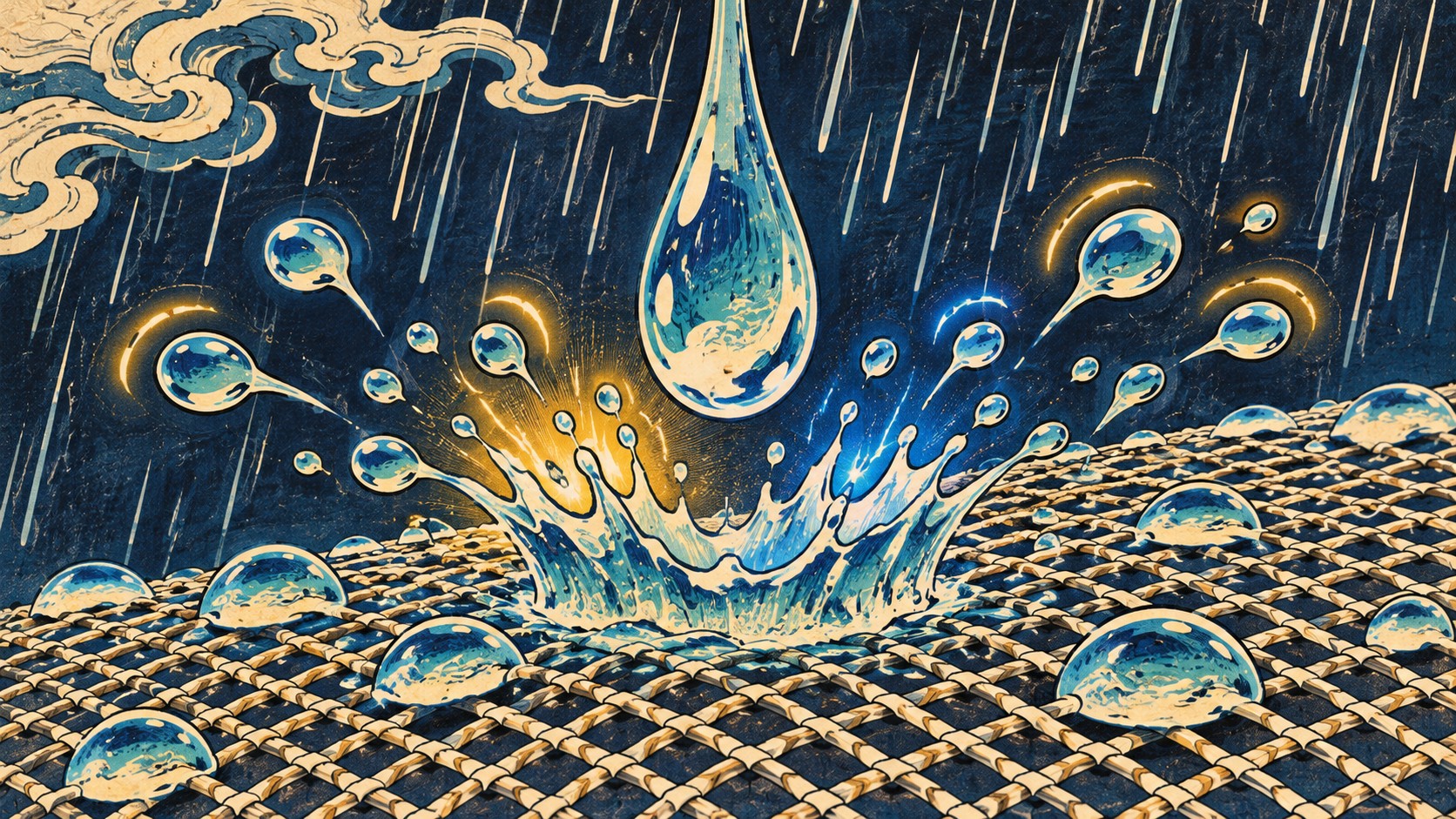
Imagine watching a raindrop hit a sieve made to reject water. Instead of simply passing through or bouncing away, the liquid can force its way into microscopic openings, stretch into jets and fracture into a fine spray. Some of those tiny secondary droplets carry electrical charge. The motion seems ordinary; the underlying electrical separation is anything but.
On November 19, 2026, Tohoku University announced that researchers led by Professor Masaya Toda of its Graduate School of Engineering, working with Hans-Jürgen Butt and Rutvik Lathia of Germany’s Max Planck Institute for Polymer Research, had clarified how this electrification depends on the collision and breakup of water droplets on superhydrophobic mesh. The study, “Drop spray electrification,” by Riko Kazama, Masaya Toda, Butt and Lathia, appeared in the peer-reviewed journal Physics of Fluids on November 17.
The work is an examination of a physical mechanism, not the unveiling of a rain-powered electrical product. Its importance lies in explaining which splash conditions produce charged spray and how a mesh might be designed to control that process.
A century-old puzzle, revisited with modern instruments
The relationship between water spray and electrical charge predates present-day clean-energy debates. In the nineteenth century, researchers investigated the charging associated with waterfalls and splashing water; Tohoku University points specifically to work reported by Philipp Lenard in 1892. The broader phenomenon is sometimes discussed as waterfall or spray electrification.
What remained less clear was the role of deliberately structured, liquid-repellent surfaces. Modern surface treatments can create microscopic textures that produce very high water contact angles, usually 150 degrees or more in the conventional definition of superhydrophobicity. Such surfaces let water keep a rounded shape even as it encounters a solid mesh.
Other recent research has explored droplet sliding and so-called triboelectric nanogenerators. But designing a device around an occasional electrical effect requires more than proving charge exists: researchers must identify repeatable mechanisms, collection methods and the mechanical limits of the surface. The new experiment addresses part of that first step.
What actually happened in the laboratory
The international team tested meshes made from steel, copper and polypropylene. The metal meshes received a porous silica coating formed using a soot template, followed by silane treatment to repel water. Polypropylene samples were modified using plasma and silane treatments. The mesh was not an ordinary kitchen strainer; surface chemistry and minute geometry were essential parts of the test.
Investigators delivered controlled drops of pure water, including 25-microliter drops documented in the study images, toward the mesh. A high-speed camera viewed the impact from the side while a Faraday cup and electrometer beneath the mesh measured the electrical charge of secondary droplets that emerged through the pores. Comparing the images with the electrical measurements allowed the team to link charge to the way the spray formed.
One crucial boundary emerged from the research paper: below the threshold at which water penetrated the mesh, no measurable spray charge was detected. Contact alone was therefore not enough to create the particular measured charging process. Water had to enter, divide and emerge.
Two kinds of jet, two different electrical outcomes
The researchers distinguished between an impact jet, emitted immediately after a fast collision, and a recoil jet, formed when the parent drop contracts and rebounds. These are physically different phases of the splash. Their charge properties were different as well: the recoil-generated spray could carry more charge for each unit of water mass than the initial impact spray.
Impact conditions were described using the Weber number, a dimensionless measure comparing fluid inertia with surface tension. At approximately We 25 the university illustrated a recoil jet; around We 30 both types appeared; around We 150 an impact jet dominated. These are examples from the apparatus, not universal thresholds for every kind of rain or surface.
The result helps explain why “harder impact” does not automatically mean a more useful electrical outcome. A design that maximizes splashing may not maximize the charge-per-mass metric. Timing, penetration and fragmentation all matter.
Why the mesh’s tiny dimensions matter
When the scientists compared different structures, meshes with smaller openings and thinner wires generally produced higher charge-to-mass ratios in the generated spray. In the experiments, conductive mesh materials also supported more stable charging across repeated impacts. The authors interpret the observations in terms of charge separation where liquid contacts and separates from the solid surface.
The charge-to-mass ratio was evaluated in picocoulombs per milligram. That value tells researchers how much electric charge accompanies a given mass of sprayed water; it is not the same as voltage under load or useful electrical energy delivered to a device. A high ratio can be scientifically impressive without proving that sufficient continuous current can be harvested.
Mesh geometry is therefore a meaningful design variable. But a viable collector must also cope with water accumulation, contamination, coating deterioration and fluctuating rain intensity—conditions that controlled laboratory tests do not reproduce in full.
From charged spray to a useful circuit: the missing engineering
The phrase “electricity from rain” is attractive because rain arrives without a fuel bill. Yet the experiment principally measured separated charge, not the efficiency of a complete generator that captures that charge, regulates voltage, stores electricity and supplies an electronic load. Those stages are not interchangeable.
To evaluate a future device, researchers would need to report how much power it produces per unit of surface area and rainfall, the energy required by collection electronics, its performance under varied weather and the degradation of the coating over years. Water must also move through or away from the collection surface reliably, rather than clog it or short the circuit.
Even if those challenges are overcome, the natural kinetic energy arriving in falling rain places a physical limit on what can be recovered. A sensor with tiny energy needs may be a more plausible initial target than household or industrial electricity supply. That is an editorial inference about application scale, not a device performance claim made by the researchers.
Why this could still matter for sensors and materials
Environment-harvesting technologies are most attractive where a small amount of locally collected energy can reduce maintenance visits or dependence on replaceable batteries. Remote environmental monitors, distributed sensing networks and certain low-power devices are conceivable candidates for future investigation. The Tohoku team itself identifies autonomous sensing as a potential direction.
The researchers say they intend to optimize materials and mesh structures, improve durability through repeated droplet impacts and develop ways to collect the separated charge efficiently as electrical power. Each is a substantive open engineering problem. The present paper offers a map of the charging conditions that may help researchers pursue them.
Japan has an established interest in surface engineering, precision manufacturing and low-power electronics; this study bridges surface chemistry, fluid dynamics and electrical measurement. Its international character matters too: Japanese and German laboratories contributed to the same mechanistic question rather than presenting competing commercial devices.
A useful discovery precisely because its limits are visible
In scientific reporting, the distinction between observed charge and delivered electricity is the difference between a demonstrated phenomenon and a working energy system. It is entirely reasonable to be excited about the first while acknowledging that the second remains to be shown.
The peer-reviewed paper establishes evidence for charged secondary spray from controlled droplet impacts on superhydrophobic meshes, including the roles of pore geometry and impact regime. It does not supply a tested rooftop installation, a commercially useful power rating or a claim that rain can replace solar or grid electricity.
Sometimes the most consequential advances do not generate spectacular output on their first day. They give engineers better questions to ask. Here, the question is no longer merely whether broken water drops can carry charge. It is how to make the phenomenon repeatable, collectable and eventually useful.
Original sources and further reading
Based on Tohoku University’s original Japanese announcement, the peer-reviewed journal paper and Max Planck Institute communication. No original researcher interview was conducted. November 17 is the paper publication date; November 19 is the university announcement date. The study did not demonstrate a commercial electrical generator.