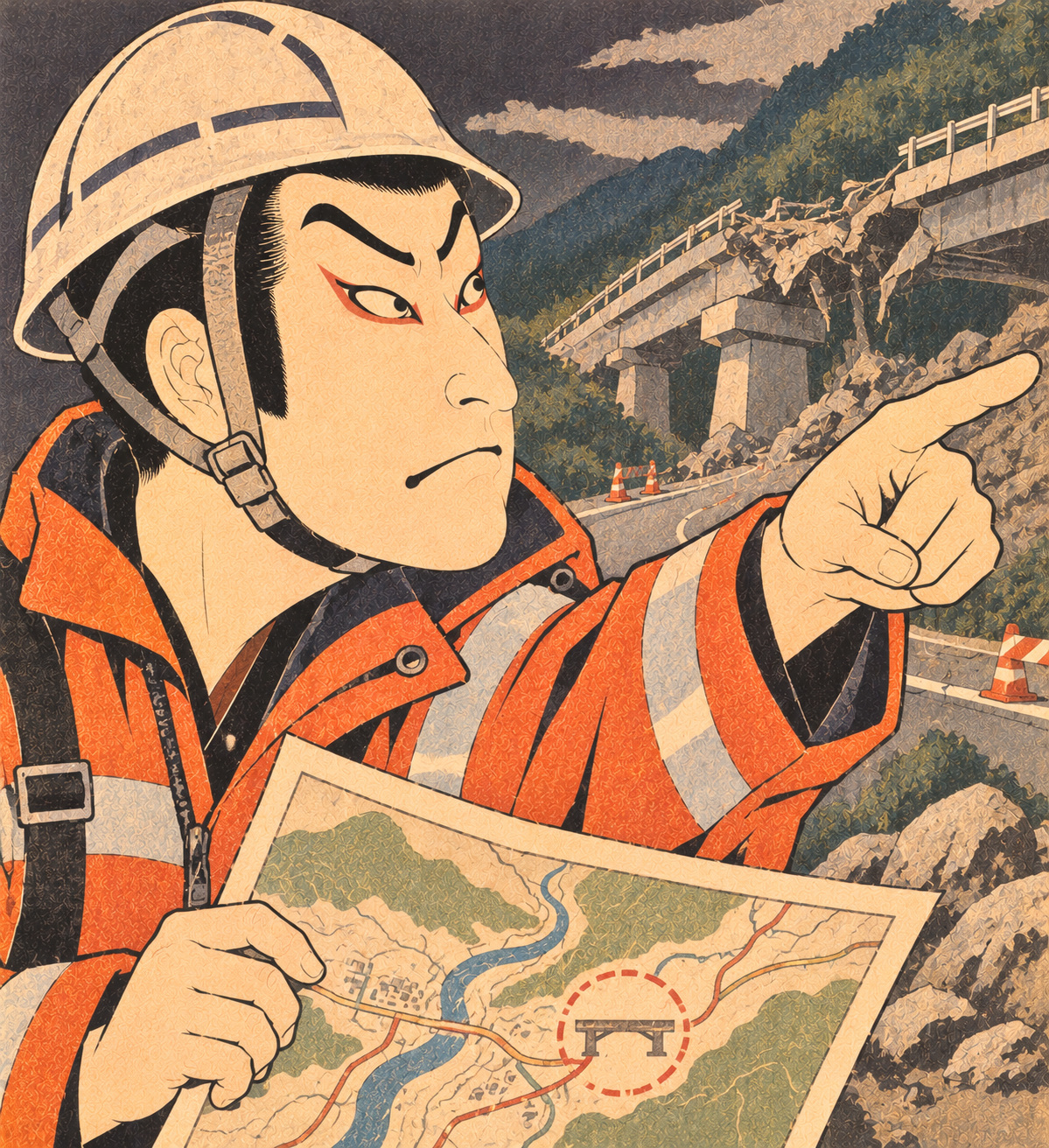
- The first task after a disaster is often to measure what has broken
- What the November agreements actually say
- A technical force built after earlier disasters
- What 2011, 2018 and 2024 taught the system
- Why surveyors and designers matter before rebuilding
- Training together, using the same tools
- The hidden problems of crossing prefectural boundaries
- Support is not the same as taking over local government
- Partners and reservists: similar ambition, different rules
- The next test will be in the field
The first task after a disaster is often to measure what has broken
A bridge may be standing but unsafe. A road can disappear behind a landslide, while the only alternative route is vulnerable to another collapse. In those first hours, repair crews need something before concrete, machinery or money: a dependable picture of the damage. Surveyors, engineers and field investigators help turn a chaotic landscape into decisions about access, danger and recovery.
On November 17, 2026, Japan’s Kinki Regional Development Bureau announced expanded disaster-response agreements intended to put private-sector expertise alongside the country’s Technical Emergency Control Force, known as TEC-FORCE. The agreements had been signed on November 10 with two organizations: the Shiga Surveying and Design Technology Association and the Osaka Surveying and Design Association.
The significance lies less in a new piece of equipment than in the way assistance could be organized. Japan is trying to make it easier to deploy civilian technical capacity beyond its normal operating territory when a municipality faces damage on a scale it cannot readily assess alone. The announcement describes a framework—not evidence that the expanded arrangement has yet succeeded in a real emergency.
What the November agreements actually say
The ministry’s Kinki bureau says existing disaster-cooperation agreements are being broadened so private-sector “TEC-FORCE Partners” can conduct integrated work with national emergency technical teams, including when support must be provided over a wide area. The revised relationships concern disaster-response work and aid to affected local governments.
Two distinctions matter. First, November 10 is the signature date; November 17 is the public announcement date. Second, these are agreements with two professional associations, not a blanket declaration that every private engineering business in Kansai will automatically deploy. The public announcement does not identify a guaranteed number of responders or a binding arrival time.
Nor should this be confused with Japan’s separate TEC-FORCE reserve-personnel arrangement. Registered reservists can be hired as part-time national civil servants during disasters. A partnership based on cooperation agreements is a different mechanism, with potentially different duties and contractual relationships.
A technical force built after earlier disasters
Japan established TEC-FORCE in April 2008 to reinforce the technical capacity of disaster-stricken municipalities. Its mission includes damage assessment, prevention of secondary hazards and support for early restoration of public works. Firefighters and police principally address rescue and public safety; TEC-FORCE’s distinctive function is to bring engineering knowledge and national resources to damaged infrastructure and local authorities.
National teams are drawn from the ministry’s regional organizations and related agencies. Liaison officers, known in Japan as “liaison” personnel, help communicate local requirements to those who can supply equipment, specialists and assessment teams. It is not simply a matter of sending more people: those people must know what information is missing, what ground is dangerous and whom to brief.
The arrangement is tested most sharply when nearby regions are also affected. An earthquake or typhoon can disrupt the very contractors, roads, fuel networks and communications needed for an emergency deployment. This is why agreements about geographical scope and organizational coordination have real operational consequences.
What 2011, 2018 and 2024 taught the system
During the Great East Japan Earthquake response in 2011, an MLIT retrospective recorded 18,053 cumulative TEC-FORCE personnel deployments by August 7 of that year. Their activities included damage investigations, restoring communications, emergency pumping in flooded districts and preliminary work to support reconstruction.
The devastating floods of July 2018 and the Hokkaido Eastern Iburi earthquake again required nationwide technical assistance. MLIT recorded roughly 17,000 person-days of deployment in fiscal 2018. In 2019, personnel surveyed flooding and helped clear roads and restore access; construction companies worked alongside public response teams to remove sediment in some affected areas.
The Noto Peninsula earthquake of January 2024 presented another formidable problem: broken roads and difficult terrain made it hard even to reach places requiring assessment. Drone imagery and geospatial data could help when entering an area was unsafe. These precedents explain why coordination matters, but they do not demonstrate that the specific November 2026 Kinki agreements have already delivered comparable results.
Why surveyors and designers matter before rebuilding
Surveying is sometimes associated with the quiet work that precedes an ordinary construction project. After an earthquake or flood, the same skills become urgent. Engineers may need to plot the extent of a road collapse, record cracks and displacement, identify slope instability, reconcile aerial images with existing maps or prepare diagrams for a temporary access route.
Private design firms can potentially help with three-dimensional measurements, field records, damage mapping and early engineering options. But those are examples of the sector’s capabilities; the public announcement does not spell out every task assigned to the two named associations under every possible deployment. Actual responsibilities depend on requests and the detailed agreement terms.
Speed also has limits. A satellite image is not a bridge inspection. A drone model does not guarantee the stability of a hillside. Someone must interpret the evidence, document uncertainty and make a safety-conscious decision about what can be acted on. Reliable judgment matters more than simply producing data quickly.
Training together, using the same tools
An October 23 announcement from the Kinki bureau describes another strand of preparation: practical equipment exercises with prefectures and ordinance-designated cities. The scheduled training covers laser rangefinders, panoramic cameras, satellite communications, mobile image transmission and software for collecting point-cloud data.
The announcement sets out sessions across Shiga, Osaka, Kyoto, Hyogo and Nara. Those exercises are not the same as the agreements with the two surveying associations, and the available material does not establish that the participants are identical. Still, they reveal the practical question underneath national policy: can different organizations collect, interpret and transmit information in compatible ways?
A map can arrive promptly and still be unusable if its coordinates, update time or confidence level are unclear. An early warning about a damaged embankment is of little value if it fails to reach the official responsible for closing the road. Training is the bridge between equipment and a dependable procedure.
The hidden problems of crossing prefectural boundaries
An agreement originally tailored to a regional office’s own facilities may not automatically answer what happens when engineers must travel hundreds of kilometers to help another government. Who activates the request? Who pays for transport and lodging? Who sets field priorities? Who is responsible for personal protective equipment and withdrawal when conditions deteriorate?
There are less visible questions, too: the ownership and sharing of survey data, confidentiality around critical facilities, liability for errors and whether private companies can release staff while their existing projects are disrupted. Making a partnership work across jurisdictions involves logistics and governance as much as technical expertise.
The November release does not publish complete cost ceilings, staffing commitments or response-time standards. These omissions do not invalidate the initiative, but they do set a limit on what can responsibly be claimed about readiness. Stronger evidence will come from detailed agreement terms, joint exercises and, ultimately, performance during an actual deployment.
Support is not the same as taking over local government
Municipalities and infrastructure managers retain their own roles in disaster response. National personnel and private specialists can provide reinforcement, technical findings and equipment; their arrival does not automatically transfer every local authority or legal responsibility to the ministry.
For residents, institutional distinctions matter chiefly because they influence practical outcomes. When will the next road be assessed? Why is a bridge still closed? Can a temporary route be made safe? Better coordination has public value only when reliable technical information improves decisions and explanations on the ground.
There is a larger demographic question as well: how can Japan sustain specialized engineering support as the workforce and many local governments face long-term pressure? The Kinki announcement does not quantify a particular shortage, so claims about the exact number of missing municipal engineers should not be attached to this agreement without additional evidence.
Partners and reservists: similar ambition, different rules
The ministry’s wider TEC-FORCE Partner framework covers corporations, associations and member firms cooperating under disaster agreements. Regional development bureaus have described extensions that permit activity beyond their ordinary territories and alongside national teams in affected municipalities.
Japan also has a TEC-FORCE reserve-personnel program, in which individuals registered with the government may be appointed as part-time national public servants when activated. The October 2026 government explanation makes that status clear. Both seek to bring outside expertise into emergencies, but their participants and legal arrangements should not be treated as interchangeable.
The new Kinki agreements therefore fit into a broader national effort while remaining specific local instruments. Their success must be judged on their own scope and implementation, not on all achievements claimed for TEC-FORCE across the country.
The next test will be in the field
The agreements with Shiga and Osaka’s surveying and design associations are a concrete step toward a more coordinated response network. They show that the Kinki bureau wants private technical specialists to work with national teams when disaster assistance extends beyond familiar boundaries.
What remains unknown is just as important: the number of available personnel, lead times for deployment, rules for cost recovery, performance measures, and whether local authorities receiving assistance find the information timely and useful. The published announcement establishes the intention and the signatories, not a measurable improvement in recovery times.
The most consequential moment in infrastructure recovery may occur before a repair begins: the moment an engineer can say, with evidence, which route is safe and which slope might still fail. Japan’s new arrangements will ultimately matter if they make such judgments reach affected communities sooner and more reliably.
Primary Sources and Reporting Limits
This independently composed report is based on ministry and regional-bureau documents available through November 18, 2026 JST. No direct interviews or field visits were conducted. Full agreement texts, staffing guarantees, costs and outcomes were not independently obtained. Descriptions of surveyors’ general professional capabilities are not claims that every task is mandated under these specific agreements.
- Kinki Regional Development Bureau: November 17 announcement and signatories
- Kinki bureau: joint TEC-FORCE equipment training, October 23
- MLIT: Origins of TEC-FORCE and its 2011 earthquake response
- MLIT: TEC-FORCE during the 2018 disasters
- MLIT: Disaster deployments and cooperation with construction firms
- MLIT: Initial response to the 2024 Noto earthquake
- Tohoku Regional Development Bureau: TEC-FORCE Partner framework
- MLIT: Reserve-personnel program (distinct from Partners)
- Kinki bureau: disaster response and mutual assistance
- Nara Surveying and Design Association: Earlier agreement framework