- A Country That Must Plan for Fewer People—and for the People Still There
- The November 6 Decision Was to Deliberate, Not to Enact
- What the Latest Birth Statistics Actually Say
- The Age Structure Is as Important as the Headline Population
- A School Closure Can Be Much More Than a School Closure
- Transport Is the Hidden Infrastructure of Demography
- A Labor-Scarce Society Needs More Than More Births
- The Generational Balance Is More Complicated Than a Ratio
- Why This Is Not Japan’s First Attempt to Revive Its Regions
- The 87-Million Projection Is a Scenario, Not a Destiny
- Supporting Family Choice Without Treating Families as Targets
- The December Strategy Will Be Judged After December
A Country That Must Plan for Fewer People—and for the People Still There
In some Japanese communities, the population debate begins not with a birth-rate chart but with the bus that no longer comes, the school that has consolidated with another, or a clinic struggling to find staff. In the country’s major cities, the same demographic transition shows up as hiring shortages and a growing need for care. Those are different manifestations of one long-running transformation. Japan is not only getting smaller; its age structure, settlement patterns and service needs are changing at different speeds.
On November 6, 2026, the government convened the first meeting of a 14-member expert council working toward a comprehensive population strategy by year’s end. Former internal affairs minister Hiroya Masuda chairs the panel. Minoru Kiuchi, the minister responsible for reform of the social-security system for all generations, described discussion of reducing burdens on people who hope to marry or have children. The meeting matters because it joins questions that are often treated separately: fertility, the supply of workers, social protection and the viability of local communities. No final strategy or implementation budget was adopted at this first meeting.
The November 6 Decision Was to Deliberate, Not to Enact
The institutional preparations began before the experts met. On October 27 the government authorized the relevant inter-ministerial and expert deliberations. A meeting of senior vice ministers and other officials followed on October 28, with Cabinet Secretariat materials drawing on the Children and Families Agency, the Ministry of Health, Labour and Welfare, the Digital Agency and other policy units. That cross-ministerial design is significant: Japan’s population trajectory cannot be altered by child allowances alone.
Kiuchi identified four areas for the strategy: reversing the falling birth-rate trend; preserving economic and social vitality in a society where people are scarce; building social security for all generations; and creating sustainable local communities. These are agenda headings, not enacted commitments or evidence that particular policies will work. The policy test begins when proposals acquire funding, accountable administrators, local participation and measurable outcomes.
What the Latest Birth Statistics Actually Say
Japan registered 671,270 births in 2025 in the finalized vital-statistics series released by the health ministry on September 30, 2026. That was a record low, down 14,903 from the previous year. The total fertility rate—the hypothetical number of children a woman would have if current age-specific rates persisted—fell to a record-low 1.14. Deaths totaled 1,589,533, producing a natural decrease of 918,263. Marriages, meanwhile, increased modestly to 489,158. These series measure related but distinct phenomena.
The birth count depends on the number of women in childbearing age groups as well as their rates of childbearing. A change in the fertility rate is not automatically the same as a change in total births. Kiuchi has noted a rise in births to Japanese nationals in the first half of 2026 compared with the comparable period; that narrower, preliminary comparison does not establish a lasting reversal in the annual figures. Readers should always ask which population is counted, whether a figure is provisional or final, and what period the comparison covers.
The Age Structure Is as Important as the Headline Population
The Statistics Bureau estimated Japan’s total population at 122.69 million as of October 1, 2026, a decline of roughly 530,000 from a year earlier. Its more detailed May 1 data put the population under 15 at 13.263 million, people aged 15 to 64 at 73.322 million, and those 65 or older at 36.227 million. The number aged 75 and above had grown by 476,000 over the preceding year to 21.564 million. The composition of the country’s population can place greater demands on services even as total numbers fall.
The May data also separate Japanese nationals, whose population fell by 855,000 over the year, from foreign residents, whose number grew by 325,000. Debates about migration, employment and social provision are often confused because commentators interchange figures for nationals, residents, births or the whole population. These categories are neither equivalent nor politically neutral substitutes for one another. A useful demographic plan must start from transparent definitions.
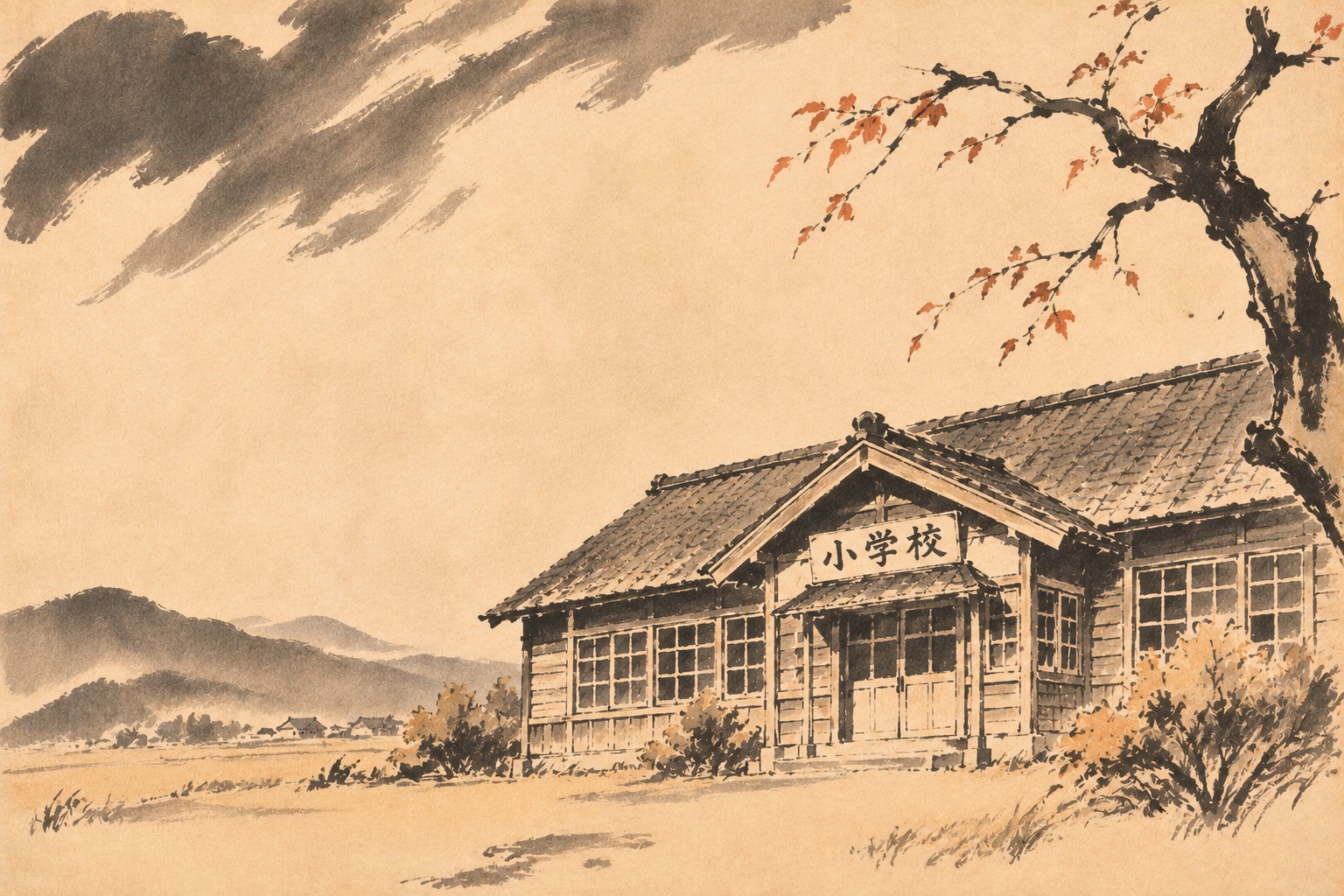
A School Closure Can Be Much More Than a School Closure
The education ministry’s final 2025 school statistics recorded 5,812,375 primary-school pupils, a year-on-year fall of 129,358. A separate ministry analysis found that the number of public elementary and lower-secondary schools had declined by 8,124—about 23 percent—between fiscal 1989 and fiscal 2025. Demographic decline is an important pressure, although consolidation also reflects educational planning, building conditions and administrative decisions.
The apparent efficiencies of consolidation come with tradeoffs. A larger school may offer a broader range of lessons and extracurricular activities. But children may face longer journeys, families may rely more heavily on transportation, and a community may lose an important gathering place or emergency shelter. Neither preserving every building nor closing schools according to enrollment alone constitutes a comprehensive education strategy. The relevant measures include learning outcomes, travel time, safety and the school’s place in local life.
Transport Is the Hidden Infrastructure of Demography
In March 2026, Japan’s Ministry of Land, Infrastructure, Transport and Tourism approved a bill proposal to reform regional public transport arrangements. Its account of the problem is stark: declining passenger numbers, shortages of drivers and service reductions have produced approximately 2,500 areas classified as transportation gaps. Yet an older population, fewer local schools and more distant medical facilities can increase the need to travel even while the number of residents shrinks.
Policy options include coordinating existing buses and taxis, deploying shared rides where authorized and using reservation-based transport rather than frequent fixed-route services in sparsely populated areas. What works in a compact regional center may not serve a mountain hamlet. A narrow measure such as riders per vehicle cannot capture the cost of missed medical appointments or inaccessible food shopping. Transport policy is, in effect, population policy implemented on roads and schedules.
A Labor-Scarce Society Needs More Than More Births
Even a sustained increase in births would not enlarge the working-age population immediately. For employers confronting recruitment difficulties today, the available choices are more immediate: attracting and retaining workers, supporting women and older employees who want to participate, making caregiving and employment compatible, improving productivity, and managing migration through coherent rules and services. Their relative effectiveness will vary by industry and place.
Automation may help a manufacturer, logistics provider or service company handle repetitive tasks. But robots, software and AI also require capital, infrastructure, training and human oversight. A local care home cannot substitute a slogan about productivity for qualified staff. The phrase “labor-scarce society” matters because the challenge is not simply to fill vacant jobs; it is to reorganize how essential work gets done without sacrificing quality or opportunity.
The Generational Balance Is More Complicated Than a Ratio
The shrinking proportion of working-age residents naturally draws attention to how pensions, health care and long-term care are financed. But older Japanese people are not a uniform dependent group: many work, volunteer, provide childcare and care for relatives. Nor are all younger adults equally able to absorb higher contributions. Income, health, household structure and regional access matter alongside age.
The government’s goal of a social-security system for all generations raises practical questions about staff, funding, care quality and fairness. No particular increase in contributions or benefit cut has been established by the November 6 council meeting. Reporting one as the result of that meeting would confuse a policy discussion with a legislative decision. The stronger question is how the eventual proposal distributes costs and access, and whether those choices are explicit.
Why This Is Not Japan’s First Attempt to Revive Its Regions
Japan’s birth patterns changed profoundly with postwar economic development, urbanization, rising education and shifts in household life. The country’s total population entered a sustained declining phase around the 2010s. In 2014, the national government launched the “town, people and jobs” regional revitalization framework, seeking to support local economies and address the concentration of people in the Tokyo area. Those were not merely fertility programs; they also tried to reshape where people could work and live.
The 2022 Digital Garden City Nation strategy brought a stronger emphasis on technology and digital access, with revised policy road maps for fiscal 2023 through 2027. The new comprehensive population strategy therefore enters a crowded policy history. It has to explain what previous incentives accomplished, why some local services continued to disappear, and which institutions can deliver the next round of changes. Renaming a policy is not evidence of a new outcome.
The 87-Million Projection Is a Scenario, Not a Destiny
Japan’s National Institute of Population and Social Security Research projected in 2023 that the country’s population could fall below 100 million in 2056 and reach approximately 87 million by 2070 under its medium fertility and mortality assumptions. The scenario is widely cited, and rightly so: it illustrates the scale of long-term adjustment. But it is a conditional projection, not a measured fact about 2070. Fertility, mortality and international migration assumptions all matter.
Equally important is what the forecast cannot reveal by itself. A future Japan with fewer residents could have improved services in some districts and severe gaps in others. A larger population would not automatically guarantee affordable homes, secure employment or accessible health care. Demographic policy has two clocks: the slow work of changing birth trends and the urgent work of maintaining institutions for people already alive.
Supporting Family Choice Without Treating Families as Targets
People’s decisions about marriage, parenting and work are shaped by an overlapping set of conditions: housing costs, insecure employment, childcare availability, working hours, education expenses and the division of unpaid care. These pressures do not operate identically across households or regions. Some people hope to have children and face major obstacles; others do not want children. A strategy can help remove barriers without implying that any individual owes the state a particular family choice.
Policymakers can evaluate whether childcare is accessible, parental leave can be used in practice, housing is affordable, and families and employers receive reliable information. They should also study whether programs widen regional or income inequalities. A simple promise to reverse the birth rate obscures how long interventions take to show effects, how many factors lie outside a single ministry’s control, and why individual dignity belongs in the policy design.
The December Strategy Will Be Judged After December
When the comprehensive strategy appears, the most revealing material may be in its appendices rather than its headline: who pays, which ministry is accountable, what happens in small municipalities, when implementation begins and how success will be assessed. A population target without transparent assumptions risks becoming an abstraction. Useful measures could include safe travel times to medical care, access to schools, continuity of public transport, childcare availability and employment stability.
Japan cannot wait decades for a fertility rebound before improving the daily lives of those already living in depopulating communities. The November 6 expert meeting creates an opportunity to connect the country’s demographic ambitions with ordinary services and individual choices. Whether it becomes a meaningful turning point will depend less on the language of the eventual strategy than on whether people can still reach school, work, a doctor and the communities they call home.
Sources and reporting method
We cross-checked official Japanese statistics and government documents against contemporaneous reporting on the November 6 meeting. Projections, actual data, preliminary reports and adopted policies are kept distinct.