- A house with a maritime past
- The person building a network around the property
- Where forests meet the Pacific
- Nine million vacant homes, but nine million different circumstances
- A smaller city faces a different housing market
- A decade of experience with participatory renovation
- What the renovation budget must eventually cover
- A relationship with a place, even without a permanent move
- The measure of success is what happens after the workshop
A house with a maritime past
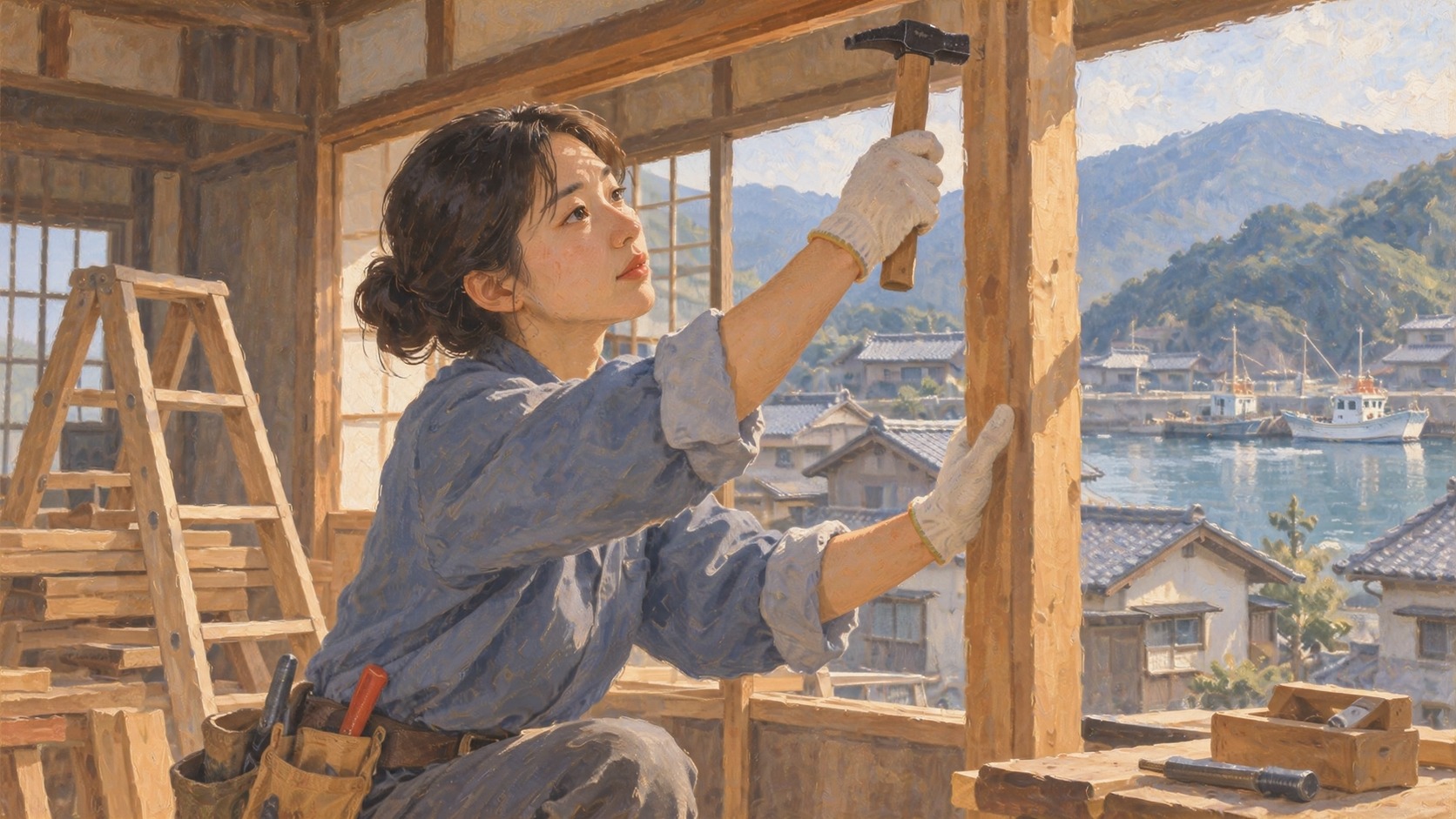
In Owase, a city on the mountainous coast of southern Mie Prefecture, a former fishing boat proprietor’s home is being given a new purpose. A two-day renovation workshop began on November 27, 2026, bringing together people interested in making an unused building habitable and creating a place for social exchange. Taiheiyo Shimbun reported the initiative the following afternoon.
The property is a roughly 70-year-old, two-story timber residence with 207 square meters of floor space, or about 2,228 square feet. Seven people joined the opening day. According to the newspaper, the plans call for a combination of shared accommodation and a guesthouse; the first work included changes to the interior layout and cedar flooring. The project is at the renovation stage, not the opening of a completed hospitality business.
The public workshop invitation also anticipated insulation and decorative work, depending on conditions and materials. Participants could join the work without charge; an optional evening social gathering cost ¥1,000 per day. That structure makes the event more than an inexpensive way to find labor: it is designed to let people meet while learning a practical skill.
The person building a network around the property
The organizer is Kazuha Nagahara, whose name is written 永原一葉 in Japanese. Owase’s municipal profile identifies her as a member of its regional revitalization cooperation team, working on relocation, settlement and the long-term management of the local vacant-house bank. Originally from Kanagawa Prefecture, she began her assignment in May 2024.
In her public introduction, Nagahara describes an interest in older Japanese buildings and the distinctive craftsmanship visible in their windows, fittings and interior details. She has also worked on reusing unwanted kimono fabric and publicizing vacant commercial properties. These activities share a practical concern: how to connect assets that no longer have an obvious use with people who might value them.
A shared renovation network could reduce the barrier faced by a newcomer who knows little about Japanese housing construction. A borrowed tool is helpful, but so is knowing a reliable local carpenter, understanding which problems require a professional, and having someone to consult when an old building reveals an unexpected defect. The social infrastructure may ultimately be as important as the physical improvements.
Where forests meet the Pacific
Owase occupies a narrow and uneven landscape shaped by the Kumano Sea and steep mountains. The municipal overview describes approximately 90 percent of its territory as forest. Settlements cluster around sheltered inlets because level land is scarce. Rainfall is exceptionally abundant by Japanese standards, creating challenges for construction and transportation as well as conditions favorable to forestry.
The present municipality was formed in June 1954 by merging Owase town and four surrounding villages. Its coastal communities developed distinct fishing traditions, while timber production and maritime shipping linked the area with markets elsewhere in Japan. These were working communities whose architecture reflected the requirements of local industry and family life.
One of the region’s best-known products is Owase hinoki, a Japanese cypress grown using carefully managed stands. Plantation forestry dates back to the early seventeenth century. In 2017 Japan recognized the regional forestry system as a nationally important agricultural heritage system. The recognition reflects generations of adaptation to difficult terrain and rainfall, rather than a single modern invention.
The renovation is not documented as using local hinoki. Nonetheless, the idea of extending the useful life of timber buildings has particular resonance in a region where growing and working with wood have long been part of economic life.
Nine million vacant homes, but nine million different circumstances
International attention to Japan’s akiya, or vacant houses, often centers on properties advertised at strikingly low prices. The national statistics tell a more complicated story. The 2023 Housing and Land Survey counted about 9.002 million vacant dwellings, equivalent to 13.8 percent of the country’s housing stock. About 3.856 million were outside the categories of rental vacancies, homes offered for sale and secondary residences.
That distinction matters. An apartment temporarily empty between tenants is not equivalent to a remote farmhouse that has deteriorated for decades. Even within the latter group, some properties may have clear ownership and a sound structure, while others may require extensive work or have little realistic demand. A national vacancy count cannot tell a buyer which building is suitable for reuse.
The economics of an inherited home can also be complicated. Family members may live far apart or disagree about disposal. Removing household possessions and arranging surveys can require time and money. A nominal purchase price does not account for repairs, insurance, registration, utilities or the expense of maintaining the property after acquisition.
A smaller city faces a different housing market
Owase recorded 16,252 residents and 8,153 households in the 2020 census. The municipality publishes more recent resident-register figures each month, a separate statistical series that should not be confused with census counts. For a small coastal city, losing residents can weaken demand for older houses even as the existing stock remains physically in place.
The challenge is not just finding buyers. A house that is affordable to acquire may be inconvenient for a person whose job is elsewhere or whose family needs access to a particular school or medical service. Public transport, road access and reliable communications influence whether a move can be sustained. The availability of skilled tradespeople also affects the feasibility of repairs.
Owase’s relocation portal therefore covers work and ways to live in the area as well as properties. A vacant-house bank can help match available homes with potential occupants, but a successful match involves more than a listing. A prospective resident needs a realistic picture of daily life, and a property owner needs confidence in how the building will be used and maintained.
A decade of experience with participatory renovation
There is a local precedent for learning through the restoration of older houses. In 2016 Owase documented a residential renovation workshop in the coastal district of Kuki. Eighteen people participated in a multiday program under local guidance, working on features including outdoor cooking facilities and the garden. The city presented the experience as a means of meeting established residents and people who had already relocated there.
The 2026 Minatomachi project is a distinct initiative; there is no evidence that it is the continuation of the same organization. The earlier event nevertheless demonstrates that the relationship between practical renovation and migration support has been part of local thinking for at least a decade.
Such projects can teach skills while allowing people to judge whether the responsibilities of maintaining an older Japanese building are compatible with their plans. They also create opportunities for established residents to share knowledge that is difficult to communicate through property listings alone.
What the renovation budget must eventually cover
The work visible at a community workshop is only one component of restoring a building. A timber house in a wet coastal climate may need assessment of its roof, drainage, moisture conditions and structural timber. Changes to partitions or room layouts can have structural implications. Electrical installations, plumbing and earthquake resistance require attention from appropriately qualified people where applicable.
A combined share house and guesthouse also presents operational questions. Depending on its actual use, the operator may need accommodation-related permissions and must address relevant building and fire-safety rules. Regular cleaning, utilities, insurance, staffing and future repairs can make the difference between a sustainable small business and a building that once again falls out of use.
Japan has strengthened the wider legal framework for vacant-property management. Amendments effective in December 2023 expanded the emphasis on reuse and intervention before buildings deteriorate to the most dangerous conditions. In April 2024, mandatory inheritance registration began, making it more important for heirs to regularize ownership records. These general developments do not imply a defect in the title or condition of this particular property.
The project’s overall budget, sources of funding, permit status and opening schedule have not been established from public materials. The reported work is evidence of activity, not evidence that the complete undertaking is financed or ready to accept guests.
A relationship with a place, even without a permanent move
Mie Prefecture’s relocation portal lists a separate vacant-house tour in Owase’s Mikisato district for December 6, 2026. The planned program combines a walk through the neighborhood with property visits. Its purpose is to give prospective newcomers a chance to consider the realities of living there before making a decision.
That approach reflects an important concept in Japanese regional policy: kankei jinko, commonly rendered as relationship population. It encompasses people who maintain meaningful links with a place without necessarily becoming permanent residents. They may return regularly, contribute skills, support businesses or take part in community projects.
For Owase, a guesthouse could offer an intermediate step between visiting as a tourist and making a permanent commitment. For the people who already live there, it could create a place for interaction with visitors. Neither result is automatic: thoughtful management, respect for neighbors and activities that residents actually want are essential.
The measure of success is what happens after the workshop
The new building’s long-term value will depend less on the number of photographs taken during renovation than on whether it remains useful after the work is finished. Relevant measures would include recurring use by local people, sustained accommodation demand, the ability to cover maintenance costs and the emergence of relationships that extend beyond a single visit.
Not every vacant house should be preserved. Some require removal for safety reasons; others have no realistic use in a changing housing market. The difficult task is identifying buildings with viable futures and ensuring that the people responsible for them can afford to maintain them.
Owase’s project is modest in scale, but it illustrates a broader possibility for communities facing population decline: treating existing housing as a resource around which new relationships can form. A renovated home cannot reverse demographic change on its own. It may, however, help make a smaller city easier to enter, understand and participate in. The next chapter will depend on whether that possibility becomes a durable operation.
Sources and further reading
- Taiheiyo Shimbun, local reporting, November 28, 2026
- Kumanogoto, workshop announcement
- Owase City, community revitalization team
- Owase City, Kazuha Nagahara profile
- Owase City, municipal overview
- Owase City, 2016 fishing village house workshop
- MAFF, Owase hinoki forestry heritage
- Mie Prefecture, history of Owase forestry
- Statistics Bureau, 2023 Housing and Land Survey
- Owase City, vacant-house management
- Owase City, relocation and multi-location living portal
- MLIT, amended vacant-house legislation
- Ministry of Justice, mandatory inheritance registration
- Mie Prefecture, Mikisato vacant-house tour announcement
- Owase City, monthly resident-register population