Oshima Tsumugi Takes Up to a Year to Make. Can the Craft Survive Another Generation?
A process measured in months, production below 1% of peak, and skills distributed across specialists: preserving Oshima tsumugi now means preserving an economic ecosystem, not just a beautiful textile.
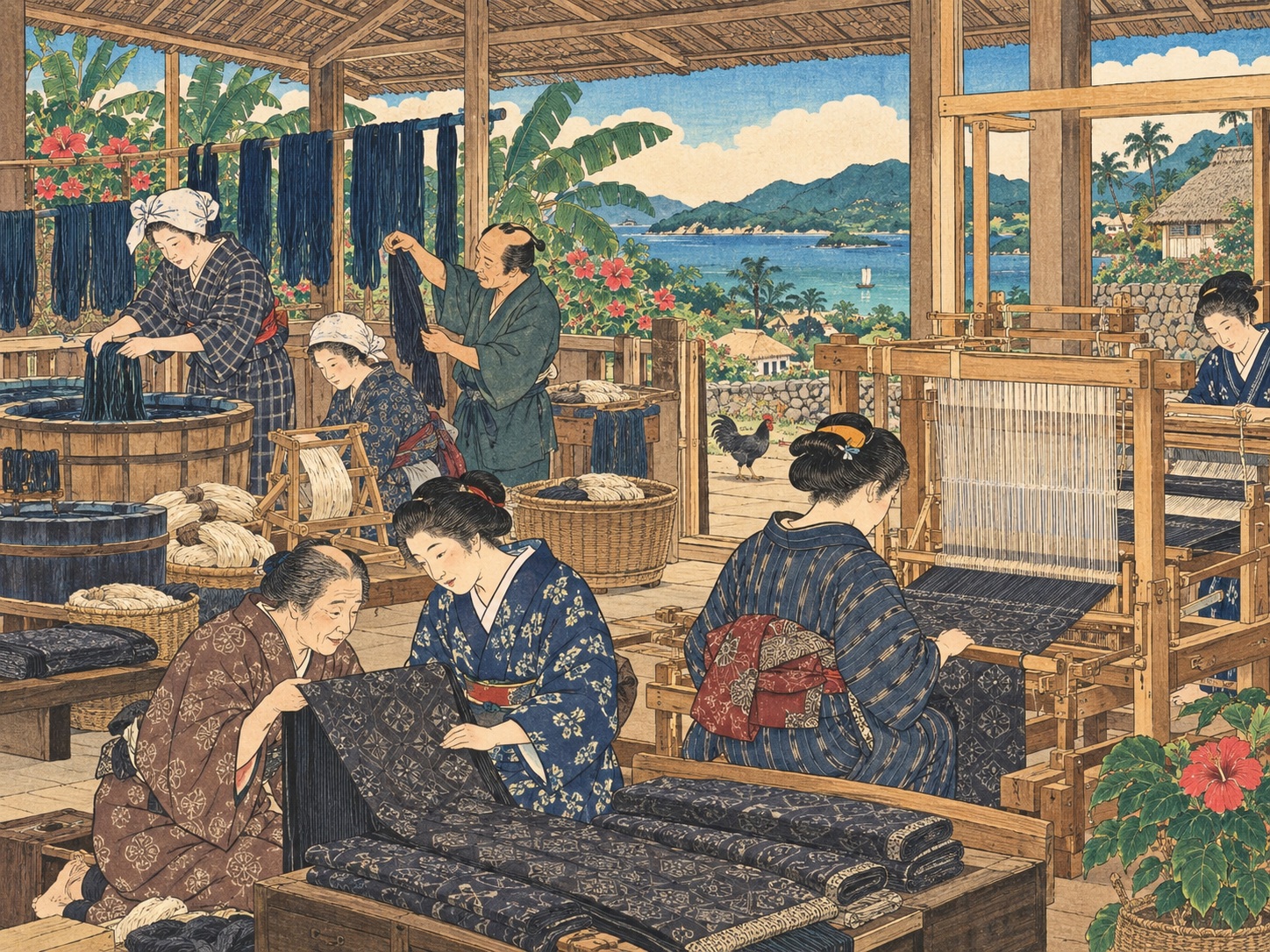
AMAMI. From a distance, the geometry in Oshima tsumugi can look printed. It is not. The pattern is engineered into the threads before they are woven, then reconstructed by hand at the loom.
Amami City describes nine major stages in the production of Honba Amami Oshima Tsumugi: designing the pattern, preparing the silk, sizing it with paste made from seaweed, binding sections for resist dyeing, dyeing with sharinbai wood, mud dyeing, preparing the patterned yarn, weaving, and final inspection. The production cooperative inspects finished bolts across 24 criteria before approved pieces receive certification. citeturn240838search0turn965443search1
During weaving, the work is still not automatic. The city says artisans loosen the warp after roughly every seven centimeters and adjust individual kasuri threads with a needle to keep the pattern aligned. The full process can take six months to a year. citeturn240838search0turn965443search1
That labor explains both the textile’s prestige and its vulnerability. Kagoshima Prefecture said in 2026 that annual production had fallen to less than 1% of its historical peak, with aging workers and a shortage of successors continuing to threaten the industry. citeturn286614search1
The name “tsumugi” hides how refined the material has become
The word tsumugi can suggest rustic spun silk, but modern Honba Oshima Tsumugi is primarily a refined silk textile. It is known as kimono fabric that is light, supple and relatively resistant to wrinkling. citeturn965443search1
Its visual precision begins long before the loom. A design is transferred onto gridded paper so that the position of the pattern can be calculated against thread density. In the distinctive binding process, cotton thread tightly protects sections of silk from dye.
That is why people in the trade sometimes say Oshima tsumugi is “woven twice.” The first weaving-like operation creates the resist pattern. After dyeing, the cotton binding is removed, the silk threads are separated again, and the real cloth is woven. Amami City’s regional-resource materials use the same explanation to describe the craft’s unusually complicated construction. citeturn240838search37
The black is a reaction between a tree and the island’s mud
Mud dyeing is the best-known part of the process.
Sharinbai, known locally as techi, is chipped and boiled. Silk is repeatedly worked through the tannin-rich liquid, taking on a reddish brown tone. The yarn then goes into mud fields. Iron in the mud reacts with tannins from the plant dye, gradually darkening the silk. Repeating the plant and mud stages produces the deep brown-black associated with classic Oshima tsumugi. citeturn240838search0turn240838search37
The technique ties the product to place. The characteristics of the mud, the local vegetation and accumulated practical knowledge are part of the production system. This is not a textile whose origin can be separated cleanly from its method.
Even at the loom, the pattern still has to be rebuilt by hand
Pre-dyed yarn does not simply fall into perfect registration.
Changes in thread tension and humidity can move the kasuri points. Amami City says that after roughly seven centimeters of weaving, the artisan loosens the warp and uses a needle to realign threads one by one. citeturn240838search0
The cost of a bolt therefore reflects not just silk but layers of specialized labor. An October 3 Japan Times feature described an example around ¥400,000 and noted roughly 60 detailed production processes. Price varies greatly according to design, technique, producer and retailer, so ¥400,000 should not be treated as a universal market price. It is better read as an illustration of how much skilled time can be embedded in a single bolt. citeturn286614search0
| Stage | Purpose |
|---|---|
| Design | Map the motif onto a grid according to thread density |
| Thread preparation | Arrange required silk lengths and counts |
| Sizing | Stabilize threads with seaweed-based paste |
| Binding | Create resist zones with tightly woven cotton thread |
| Sharinbai dyeing | Load silk with tannin from the plant |
| Mud dyeing | React tannin with iron in the mud to deepen the color |
| Yarn finishing | Remove binding, sort and color the kasuri yarn |
| Weaving | Hand-align kasuri while weaving on a high loom |
| Inspection | Check 24 criteria before certification |
More than 1,300 years of history does not mean 1,300 years of identical technique
Amami City describes Oshima tsumugi as having more than 1,300 years of history. Local accounts point to ancient sericulture and silk on Amami, while some explanations trace the distant roots of its ikat technique through Southeast Asia to India. citeturn240838search0
That should not be read to mean that today’s exact combination of binding machinery, mud dyeing and fine kasuri existed unchanged 1,300 years ago. The craft evolved. During the Edo period, textile production was refined under the Satsuma domain, and later commercialization and technical innovation produced the form recognized today.
This distinction matters because “tradition” is often misunderstood as stasis. Oshima tsumugi survived precisely because methods changed while certain core ideas—pre-dyed patterning, regional dyeing knowledge and highly skilled weaving—continued.
Production peaked at 284,278 bolts in 1972
The industrial decline is stark.
A 2015 Amami City publication recorded peak production of 284,278 tan in 1972. By 2013, production had fallen to 5,866, roughly 2% of the peak. citeturn240838search38
A later official planning document from Tatsugo Town put total Amami Oshima production in fiscal 2019 at just under 3,600 bolts, about 1.2% of the 1972 level. In 2026, Kagoshima Prefecture went further, stating that annual output had fallen below 1% of the peak and was still declining. citeturn240838search39turn286614search1
The drop reflects the long contraction of Japan’s formal kimono market, changing lifestyles, fewer occasions to wear traditional dress and the difficulty of sustaining a labor-intensive product in a mass-consumption economy.
Specialization makes the craft both exceptional and fragile
Oshima tsumugi is not normally made start to finish by one celebrated master. Design, binding, dyeing, thread preparation and weaving are separate specialist occupations.
That structure produces extraordinary depth of skill, but it also creates a supply-chain problem. If one highly specialized stage loses too many workers, other artisans can remain active and still be unable to complete a finished textile.
A useful example comes from a 2024 Kyushu Bureau of Economy, Trade and Industry award. Traditional craftsman Masafumi Akatsuki was recognized for training roughly 70 workers in the binding process and for developing a labor-saving binding machine that women could operate more easily. The award demonstrates that preservation can include redesigning tools to lower physical barriers rather than insisting every technique remain mechanically unchanged. citeturn240838search2
In 2026, policy turned explicitly toward younger people
Kagoshima Prefecture’s 2026 “next-generation promotion” program states the problem bluntly: production is below 1% of peak levels, the workforce is aging and there are too few successors. Its response is to make younger people central to both demand and recruitment. citeturn286614search1
The prefecture sought proposals involving student models wearing Oshima tsumugi, publicity and research, with the stated goal of raising interest in kimono culture and increasing future craftspeople.
Amami City is pursuing a parallel strategy. Its fiscal 2026 budget includes ¥16.4 million for an Oshima tsumugi revitalization program covering successor training, active use of inventory, market development, Tsumugi Day and purchase subsidies. The city says fiscal 2026 is the final year of its second production-area revitalization plan and that it will evaluate the results before setting policy from fiscal 2027 onward. citeturn286614search2turn286614search24
The city even subsidizes local purchases
Amami City provides support to residents who buy approved Honba Amami Oshima Tsumugi fabric and have it made into kimono, clothing or other garments. For fiscal 2026 it increased parts of the subsidy rate and maximum payment.
Eligible textiles must pass the cooperative’s inspection and carry the “globe” certification mark, among other conditions. citeturn286614search6
This is demand policy as much as cultural preservation. A craft cannot sustain apprentices if it lacks orders. Falling demand makes the occupation less attractive, while a shrinking workforce can increase lead times and reduce the range of techniques available—a cycle that can reinforce itself.
The kimono market alone may be too narrow
Kyushu’s traditional-craft materials describe efforts to develop scarves, accessories and other products, along with promotional projects such as “tsumugi dance.” citeturn240838search36
Diversification is not necessarily dilution. A consumer who will never buy a full kimono bolt may still buy a smaller object that introduces the textile’s texture and technique. Clothing, bags, interiors and accessories can create markets that use less fabric per item while generating more points of contact with the craft.
There is a risk, however. If products borrow only the look while stripping away the underlying technique, the term “Oshima tsumugi” can lose meaning. Inspection, certification and traceable production therefore become more important as the product moves beyond conventional kimono retail.
High price is not the problem. Unexplained price is
For a younger consumer, several hundred thousand yen for kimono fabric is a major purchase. The approximately ¥400,000 example discussed by The Japan Times makes the luxury position clear. citeturn286614search0
But a textile that takes six months to a year across many skilled hands cannot be sustainably priced like industrial fabric.
The real commercial problem is whether buyers understand what the price represents: plant preparation, mud dyeing, specialist binding, manual registration, inspection and the accumulated skill of several craftspeople.
Luxury markets matter not because they justify arbitrary markups, but because they can potentially support low-volume production while returning enough value to keep skilled labor economically viable.
International growth may depend on selling the process, not only the kimono
Outside Japan, a complete kimono is a culturally specific product. The process behind Oshima tsumugi may be easier to translate across markets: natural dyeing, pre-dyed ikat, regional materials, traceability and highly specialized handwork.
Those qualities fit broader luxury trends that value provenance, craft and low-volume production.
But international expansion requires capabilities that are not traditional textile skills: intellectual-property management, clear labeling, export logistics, product design, stable supply, care instructions, pricing and storytelling in other languages.
The production region must therefore become good not only at making the textile but at explaining and selling it without erasing what makes it distinctive.
Preservation requires deciding what can change
Honba Oshima Tsumugi received designation as a national traditional craft on February 17, 1975. The designation recognizes traditional technique, materials and regional production. citeturn965443search1turn965443search36
It does not require the industry to freeze itself in 1975. Producers have already introduced new patterns, improved machinery, contemporary products, digital sales and youth-oriented promotion.
The more important question is which elements define authenticity. Is it the mud-dye chemistry? The pre-dyed kasuri? The binding process? Regional specialization? Inspection standards? Once the core is clear, marketing, product category and some tools can evolve around it.
That is the central paradox of craft preservation: survival requires change.
The next decade risks losing knowledge, not just volume
When production falls, the obvious loss is the number of bolts. The less visible loss is tacit knowledge.
How should dyeing change when the mud behaves differently? How much force is enough in binding? How much misalignment will show in the final pattern? Those judgments are learned through repetition and are difficult to capture fully in manuals.
Training programs need orders because apprentices learn by doing real work. Without sufficient demand, there are fewer opportunities to repeat the process often enough to master it.
That is why Oshima tsumugi policy in 2026 is both cultural policy and industrial policy. Successor training, demand, new channels, inventory, product design and pricing cannot be solved independently.
The challenge is not to preserve the textile unchanged for another 1,300 years. It is to build a system capable of carrying the knowledge into the next 10.
Sources
- Amami City, Honba Amami Oshima Tsumugi
- Kagoshima Prefecture, Oshima Tsumugi next-generation promotion program, 2026
- Amami City, fiscal 2026 policy statement
- Amami City, Honba Amami Oshima Tsumugi purchase subsidy
- Traditional Crafts Aoyama Square, Honba Oshima Tsumugi
- Kyushu Bureau of Economy, Trade and Industry, traditional crafts guide
- Kyushu Bureau of Economy, Trade and Industry, traditional-crafts awards
- The Japan Times, “One bolt, ¥400,000: Why Japan’s Oshima ‘tsumugi’ silk costs a pretty penny”, Oct. 3, 2026