A champion wins without claiming perfection
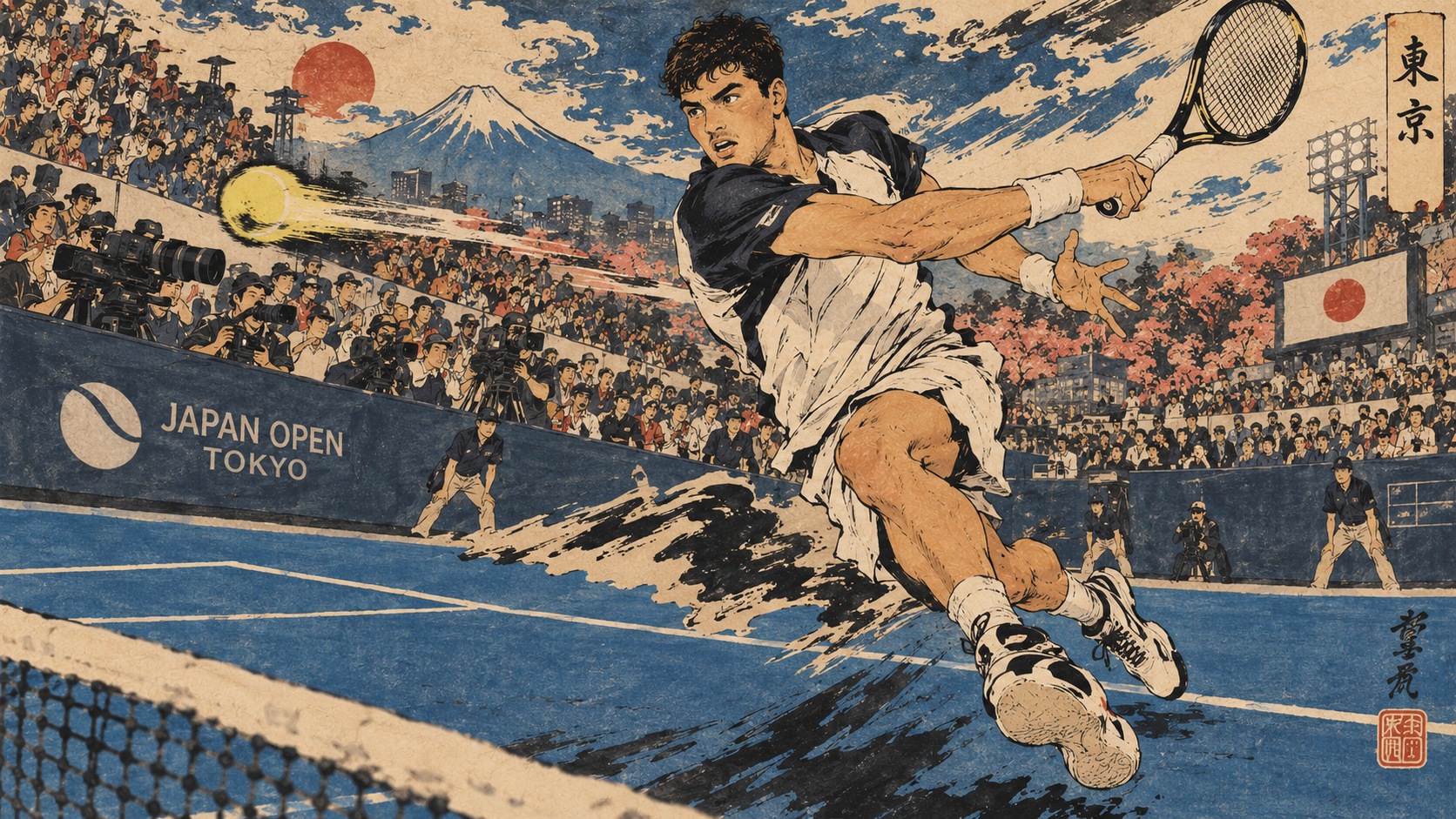
Under the lights at Ariake Coliseum on October 6, Carlos Alcaraz beat Czech finalist Jiri Lehecka 7-6(4), 6-4 to retain the Japan Open singles title. The score captures the result but disguises the journey: Alcaraz had been uneven through the week, and a tournament that might have looked routine on paper became a test of tactical adjustment and composure.
Lehecka broke early in the opening set. Alcaraz recovered, carried the set into a tiebreak and won that breaker seven points to four. In the second he broke in the seventh game, then held the advantage. The tournament's report makes clear that brilliant winners alternated with mistakes. This was not a story of effortless domination; it was a champion getting enough of the important decisions right.
That distinction matters beyond the match. Tokyo is a long-running international tennis venue at a moment when Japanese organizers must offer something more durable than a celebrity-filled week. Alcaraz supplied the sporting drama. The harder question is what a global tournament contributes to tennis in Japan after the last ball is struck.
A difficult route to the final
The official tournament accounts describe a particularly uneven path. Alcaraz went through opening-set tiebreaks in his early matches, and in the semifinal against fellow Spaniard Jaume Munar surrendered a first set that he had led 5-3. He recovered to win 5-7, 6-3, 6-1. His performance showed why resilience is an observable competitive skill, not just a convenient description assigned to the winner.
Alcaraz acknowledged before the final that he was still searching for his best level. Reporting elsewhere has discussed a wrist injury and his return to competition, but this article does not infer medical details or a causal explanation for individual errors from unpublished athlete health data. What is documented is the swing in performance and the capacity to survive it.
Lehecka earned his place by beating Valentin Vacherot 6-4, 6-2 in the semifinal. His early break in the final warned against assuming that a higher-profile opponent would automatically control the contest. Recovering serve, shortening or lengthening exchanges and choosing moments to attack became more decisive than reputation. The narrow opening set, not the pre-match ranking, set the terms of the night.
A tournament with roots in 1972
The Japan Open began in 1972, when Japanese player Toshiro Sakai appears as the inaugural singles champion in the official historical record. The tournament predates both today's ATP 500 label and the commercial architecture of the modern men's tour. Its roll of champions includes Ken Rosewall, Stefan Edberg, Pete Sampras, Roger Federer and Novak Djokovic.
Today's competition takes place at Ariake Coliseum and the Ariake Tennis Forest Park courts in Tokyo's Koto ward. The hard-court tournament forms part of the international autumn swing through Asia. The modern venue supplies a professional event setting, but the tournament's longevity depends just as much on event operations, corporate commitment and repeat public interest.
This historical continuity is important when interpreting an international title. A tournament's value is not created anew when a top-ranked player signs the entry list. It is accumulated over decades of credible competition, regular audiences, broadcast delivery and facilities capable of hosting a global sporting event.
Two generations on one center court
Before the singles final, the tournament honored Kei Nishikori in a tribute ceremony following the conclusion of his final official match. Family members attended, together with figures associated with his development and career, including coaches Michael Chang and Dante Bottini, the Morita Masaaki Tennis Fund and Shuzo Matsuoka. Alcaraz and other leading players appeared in recorded tributes.
Nishikori won Tokyo in 2012 and 2014. His career showed Japanese fans that a homegrown player could sustain a place at tennis's highest international level. To honor him on the same stage where Alcaraz would shortly defend a title made the evening a rare handoff between eras, though not a literal passing of the professional torch.
Japan's next generation will not emerge solely from a single exhibition or tribute. Coaching, junior travel budgets, competitive pathways, access to courts and long-term backing are less photogenic than a trophy presentation. Nishikori's example makes those development questions harder to ignore rather than easier to solve.
The economy of an international tennis week
The Japan Tennis Association organizes the tournament, Kinoshita Group is title sponsor and WOWOW is its official broadcaster. The list of tournament sponsors includes Japanese sporting-goods companies and firms from other industries. Those relationships help support prize money, operations, venue use and broadcasts while connecting brands with domestic and international audiences.
Ticket options range from relatively accessible sessions to high-priced hospitality offerings. The listed ticket prices are not a measure of realized sales: neither the number of seats sold in each category nor the event's net financial return follows from a price chart. The same caution applies to broadcasting rights, whose exact receipts cannot be inferred simply because a broadcaster is named.
For Tokyo, the tournament offers another reason for visitors and local fans to use the Ariake district and spend around the venue. Yet an economic-impact headline requires evidence of incremental expenditure, not a multiplication of the stadium's capacity by an assumed hotel bill. Without disclosed attendance and visitor-spending studies, a credible report must leave that question open.
What ATP 500 does—and does not—tell us
The 2026 tournament is an ATP 500 event, with 32 singles main-draw players and 16 doubles teams according to its official fact sheet. The organizer lists total prize money at US$2,342,275. That sum refers to the event's aggregate prize fund; it is neither a single champion's paycheck nor tournament revenue.
The ATP 500 designation signals the tournament's position in the professional ranking structure, but not a guaranteed profit margin or economic spillover. Tournament finances depend on the cost of venue services, operations, player-related obligations, sponsorship contracts, media agreements and actual ticket mix. A field headed by an international star can help attract attention without eliminating those pressures.
The larger sporting question is whether big-event attention helps sustain smaller stages of the tennis ecosystem. Are Japanese juniors gaining better access to high-quality competition? Are public and private courts more broadly used? Are sponsors willing to invest beyond the headline match? Those are questions for future reporting, not conclusions proved by Alcaraz's victory.
What Tokyo keeps after the trophy leaves
On the night, the storyline was simple: Alcaraz retained his title in straight sets after repeatedly having to reassert control. The richer meaning lies in the layers around the result. Japan's long history of hosting global tennis, a ceremony for one of its most consequential players and the continued investment needed to keep international competition in Tokyo all converged at Ariake.
A successful tournament is a sporting achievement and an organizational one. A lasting tennis culture requires a further step: making the inspiration generated by an elite final useful to people who will never play before a packed center court. The champion leaves with a trophy. Japan must decide what it intends to build from the attention he brought.
Sources and references
Sources checked October 8, 2026. Final attendance, ticket-revenue mix and media contract values were not independently established.