- The problem with an average body
- What electricity can reveal — and what it cannot
- Building a model around athletes
- From physical education to laboratory science
- The Japanese history of measurement at home
- A larger market, but not a simple growth story
- Why repeatability matters more than apparent precision
- Putting the athlete before the data
The problem with an average body
A scale can tell two athletes that they weigh the same. It cannot, from weight alone, tell whether they have the same distribution of muscle, fat and water. For sports scientists, this distinction is fundamental. For engineers designing household instruments, it is a statistical problem as much as an electrical one.
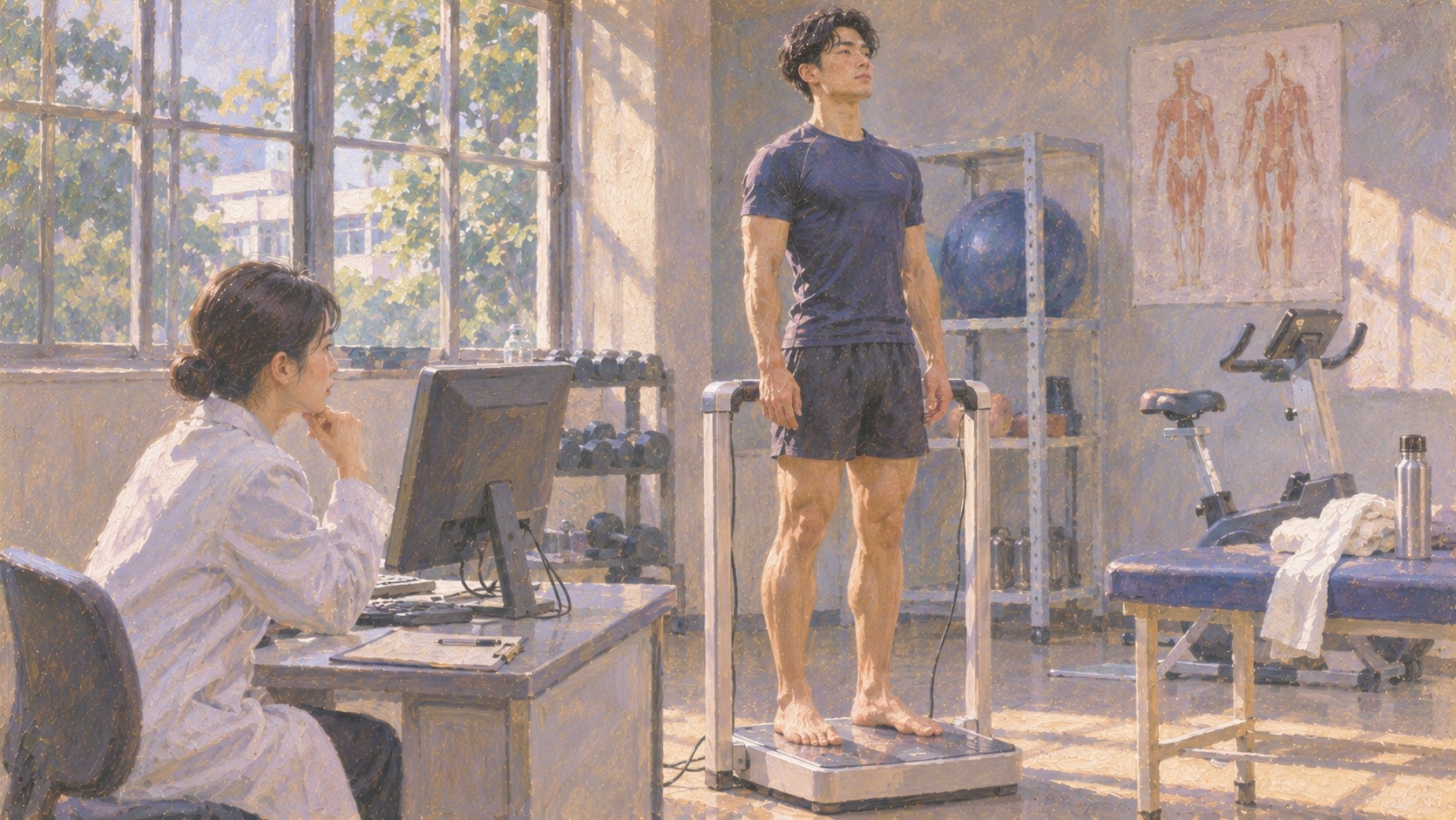
Kyoto-based Omron Healthcare announced on November 20 that it would introduce a new Karada Scan body composition monitor on November 27. Its athlete mode was developed with Nippon Sport Science University (NSSU), with the aim of adapting estimates to people with greater muscular development. The launch is an example of how knowledge from competitive sport can influence everyday measurement technology. It is not evidence that a consumer instrument has become a substitute for a clinical assessment.
What electricity can reveal — and what it cannot
Bioelectrical impedance analysis, or BIA, applies a small alternating current and measures the body's opposition to that current. Water containing dissolved electrolytes conducts electricity relatively well, whereas adipose tissue has different electrical properties. The instrument therefore gathers information related to the distribution of conductive tissue, rather than directly weighing every muscle or fat deposit.
In a simplified model of a conductor, resistance increases with length and decreases with cross-sectional area. This is why a height-squared-to-resistance index can be useful in body composition equations. Real people, however, are not cylinders. Their limbs and trunk differ in shape and composition, and current does not pass equally through every tissue. Prediction equations compensate for some of that complexity using reference measurements and personal characteristics.
A fat-free mass estimate is not identical to skeletal muscle mass: it includes water, organs, bone and other non-fat components. An estimated bone mass is also not a measurement of bone mineral density. Such distinctions matter when a device displays multiple metrics that appear equally precise.
Building a model around athletes
Omron says its collaboration drew on body composition records from more than 100 NSSU sports-club students. The company compared data from its instruments with dual-energy X-ray absorptiometry (DXA) and existing data from people with more typical body builds. DXA uses differences in the attenuation of X-rays at two energy levels to estimate fat, lean soft tissue and bone mineral content. It supplies a useful reference, but has assumptions and sources of uncertainty of its own.
An athlete-specific equation can be valuable because a model calibrated in one population may be biased in another. A rower, a judoka and a distance runner can have very different physiques. Even within one sport, training history, age and sex influence the distribution of tissue. A body mass index derived from height and weight cannot capture these distinctions by itself.
The announcement does not give enough numerical error statistics to establish how accurately the new mode performs across independent populations. To assess it scientifically, researchers would want to know how the training and validation samples were separated, the average bias, the limits of agreement and the ability to detect real changes over time. A high correlation alone does not establish agreement for individual users.
From physical education to laboratory science
Nippon Sport Science University traces its origins to the Physical Education Association established by Tokichiro Hidaka in 1891. The organization arose during Meiji Japan's modernization, when physical education was often associated with national strength. The institution's contemporary mission places emphasis on health, education and developing athletes and coaches. It established its university faculty of physical education in 1949.
The current collaboration includes Professor Takashi Okada and Assistant Professor Hiroku Mitsuya. Okada's doctoral research examined trunk muscles in judoka and their relationship to lower-back injuries. Mitsuya's research interests include resistance training and regional muscle activity. These research questions illustrate why the distribution and function of muscle can be more informative than total body weight alone.
The challenge for an industry partnership is to translate carefully controlled scientific observations into equipment that is convenient and repeatable outside a laboratory. Independent replication remains important even when the researchers have substantial practical experience.
The Japanese history of measurement at home
Omron's first home blood pressure monitor dates to 1973. It was part of a broader transition in which measurements previously associated with clinical settings could be collected during ordinary life. The value of that transition was not simply miniaturization: useful measurements had to be repeatable, understandable and connected to appropriate interpretation.
Body composition presents a different problem from blood pressure. A bathroom instrument estimates tissue composition through a model; it does not directly image the body's internal structure. The new product continues the general movement toward accessible measurement, but its results should not inherit the clinical authority of other instruments merely because they share a manufacturer.
Connected measurement tools can make longitudinal records easier to maintain. Coaches and researchers may find such records useful alongside training logs, recovery assessments and other observations. However, the existence of an app or a detailed display is not itself proof of improved accuracy or sporting outcomes.
A larger market, but not a simple growth story
The Sasakawa Sports Foundation estimates that 16.29 million Japanese adults aged 20 or over performed strength training at least once in 2024, compared with 7.26 million in 2000. The rise is substantial, but the same series peaked at 18.20 million in 2020. Participation at least once annually is a broad survey category and does not identify regular strength athletes.
For manufacturers, this creates an audience whose measurement needs may differ from those of a conventional weight-scale customer. For universities, it creates an opportunity to ask whether methods developed in competitive sport can be useful to wider populations. The commercial success of a product, however, should be judged separately from the quality of its validation.
Why repeatability matters more than apparent precision
Hydration changes the electrical properties of the body. Exercise can affect fluid distribution and skin temperature; meals, recent drinks and other daily activities can also alter readings. A short-term change on a display may therefore reflect water balance rather than a change in tissue. Comparing measurements collected under similar conditions, following the instrument's instructions, can reduce some variability but cannot remove all model error.
There is an important distinction between accuracy and precision. A device may produce a consistent value that is systematically biased. Conversely, an instrument that agrees well with a reference on average may still show considerable individual error. For meaningful monitoring, users need to know whether a change exceeds the ordinary variability of the instrument and the measurement protocol.
The published research on athlete-specific BIA is broader than this product. A 2021 review in Nutrients discusses the development of specialized equations and measurement procedures for athletic populations. It provides context for the approach, not independent certification of Omron's newly launched model.
Putting the athlete before the data
Body composition is only one part of athletic health and performance. Technical skill, recovery, adequate nutrition and psychological wellbeing are also essential. Lower body fat is not universally better, and numerical targets should not be imposed without considering the individual and the sport.
The International Olympic Committee's 2023 consensus on relative energy deficiency in sport (REDs) highlights the risks of pressure around body composition. It recommends limiting assessment of athletes under 18 to medical purposes in ordinary circumstances. Consent, confidentiality and careful interpretation are essential wherever body composition information is collected.
The most useful question raised by this Japanese collaboration is whether measurement models can better represent the diversity of the people who use them. Publicly available independent validation, transparent uncertainty estimates and longitudinal evaluation would help answer that question. A good instrument should support understanding rather than turn an athlete's body into a single number.
Sources and further reading
- Omron Healthcare — November 20 announcement
- Sasakawa Sports Foundation — strength training survey
- Nippon Sport Science University — history
- NSSU — institutional mission
- NSSU — research institute staff
- NSSU — Takashi Okada doctoral thesis
- J-GLOBAL — Hiroku Mitsuya
- Campa et al. — 2021 review of athlete body composition
- Omron — history of home blood pressure monitoring
- IOC — 2023 consensus on relative energy deficiency in sport
- Kaden Watch — launch coverage