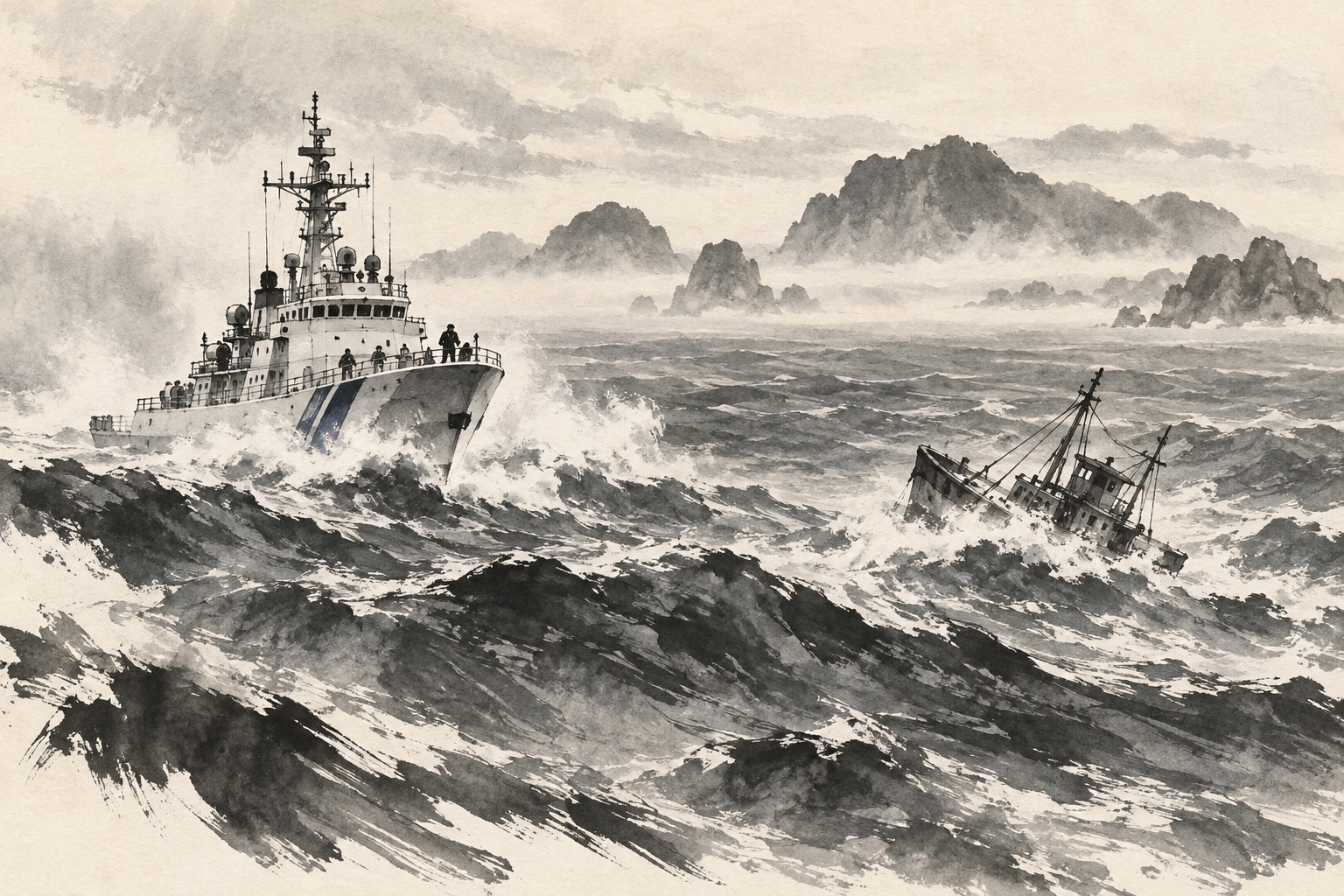
A distress notification from North Korea prompted Japan to send vessels and aircraft to waters off the Oki Islands after a boat under tow sank on September 17. Four people had fallen into the sea, TSK San-in Chuo Television reported, citing Japan’s Eighth Regional Coast Guard Headquarters.[1]
The notification and deployment
TSK’s initial account placed the sinking at about 3 a.m., roughly 104 kilometers west-southwest of Nishinoshima in Shimane Prefecture. Japan received the notification from Pyongyang’s rescue coordination center around 7:45 a.m. Two patrol vessels and two aircraft were dispatched.[1] Times in this report are Japan time.
The broadcaster identified the towing freighter as KUM YA. It was a vessel being towed that sank; the initial account did not describe the freighter itself sinking.[1]
A later report records the handover
TSK reported September 19 that three recovered North Korean men had been handed to the freighter on September 18. One had been in cardiac arrest and a doctor had judged resuscitation unlikely to succeed. One person was still missing at the time of that report.[2]
Reporting cutoff
This account draws on material reviewed through September 22. The follow-up on the recovered men is dated September 19; it is not a statement of search conditions on September 24.
Regional rescue capacity in practice
The Eighth Regional Coast Guard Headquarters is based in Maizuru, Kyoto Prefecture. Its official outline identifies the western Sea of Japan and coastal areas including Shimane as its operating area, with maritime rescue among its responsibilities.[3] The Japan Coast Guard describes early deployment of rescue resources as part of its response to maritime emergencies.[4]
The incident illustrates a practical link between an overseas distress notification and a Japanese response at sea. Its significance lies in that operational sequence. Rescue activity alone cannot establish the purpose of the voyage, explain the sinking or support conclusions about diplomatic relations.
