- A new stage for an old tradition
- When dance brings light back into the world
- Ondake: tracing a tradition through the centuries
- Why Oita has more than one kagura tradition
- The craftsmanship behind a few minutes on stage
- The demographic challenge is also an organizational one
- A festival needs more than dancers
- Keeping heritage alive beyond the festival weekend
A new stage for an old tradition
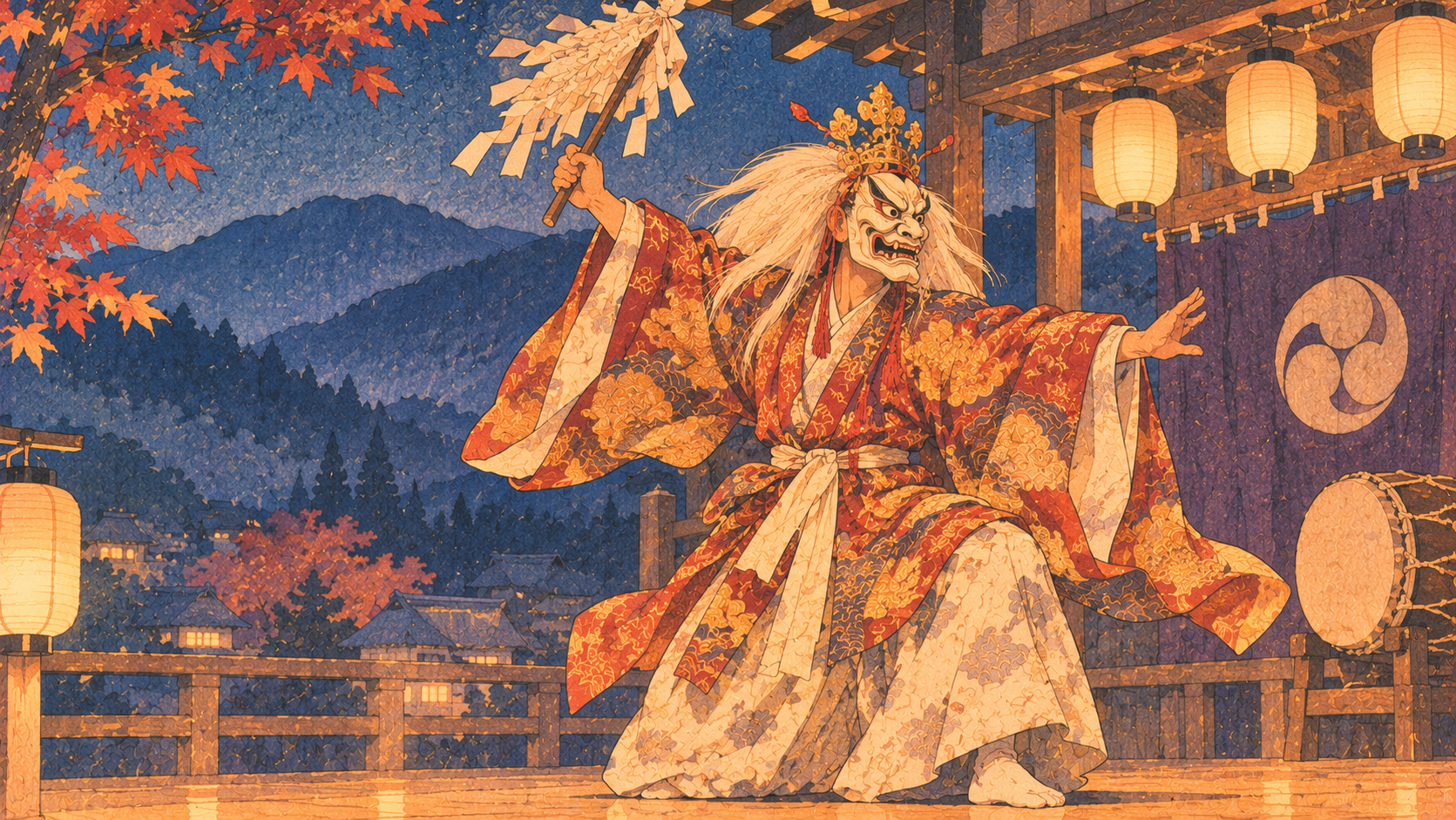
A new festival opened on November 22 at Nanasegawa Natural Park in Oita City, bringing together performers who normally practice in different communities. The inaugural Nanase Kagura Festival was conceived to introduce local traditions to wider audiences and encourage their transmission. Local broadcaster OAB reported that around 100 participants from seven groups delivered 14 performances on Sunday, including a serpent-slaying drama. Six more groups were scheduled for Monday. The arts association now lists the event as concluded.[1][2][11]
The accompanying Oita food market gave visitors another way to encounter the prefecture. Admission was ¥500, with elementary-school children and younger admitted free. The organizers have not released a verified attendance total or financial assessment in the sources reviewed. What makes the event noteworthy is its attempt to create a shared public stage for distinct traditions, rather than its scale alone.[1][3]
When dance brings light back into the world
Kagura is an umbrella term for Japanese ritual performance associated with the kami, the divine beings of Shinto tradition. Its most familiar mythological association is the story of the sun deity Amaterasu withdrawing into a rock cave. The dance of Ame-no-Uzume helps draw the gods together and ultimately restores light to the world. Versions appear in the early Japanese chronicles Kojiki and Nihon Shoki. The story offers a powerful explanation for the ritual significance of dance, not a documented date for the invention of every modern kagura tradition.[6][7]
Court kagura and local folk traditions developed in different settings. At village shrines, offerings of music and movement can express gratitude for a harvest or hopes for collective well-being. Some performances dramatize mythological conflicts, while others emphasize purification or ceremonial gestures. A visitor who recognizes these purposes will see more than spectacular masks and costumes.
Ondake: tracing a tradition through the centuries
One of Oita’s best documented traditions is Ondake kagura, maintained in Kiyokawa, Bungo-Ono City. Local tradition traces its beginning to the establishment of the shrine in 1449. The Kagura Kaikan cultural hall cautions that evidence for the earliest performance form is limited, although a record of kagura dancing survives from 1617.[5][6]
The shrine priest Kato Nagafuru (1739–1814) is credited with shaping the repertoire in the late Edo period. Today the tradition preserves 33 pieces and has held national Important Intangible Folk Cultural Property status since March 7, 2007. Its history illustrates a central paradox of preservation: an art can remain rooted in the past precisely because generations have actively organized and transmitted it, rather than leaving it untouched.[5][6]
Why Oita has more than one kagura tradition
The former province of Buzen encompassed territory now divided between Fukuoka and Oita. Buzen kagura survives in both prefectures, including Nakatsu and Usa. The national cultural-property database describes how shrine priests transmitted it through the Edo period and lay associations assumed that responsibility from the Meiji era onward. Its repertoire features supernatural figures called misaki and elaborate purification rituals involving hot water. It received national designation in 2016.[7]
In Yufu, Shonai kagura has a documented offering dating to 1778. Its two regional schools are known for energetic rhythms and lively flute and drum accompaniment. Regular performances at a dedicated venue offer opportunities to encounter the tradition outside a shrine festival. These are examples of Oita’s regional heritage, not a claim that each named tradition appeared at Nanase.[8]
The craftsmanship behind a few minutes on stage
A mask changes the way a performer moves. Restricted vision, heavy garments and the need to make gestures legible to an audience demand rehearsed coordination. Depending on the repertoire, a dancer may carry a ritual wand, bells or other symbolic implements. Some dances are unmasked. The materials and forms should not be generalized across all schools.
The musicians are equally important: drums and flutes establish the pace and help mark transitions in the narrative. Costumes and masks need storage, maintenance and repair. Behind the visible performance lies a network of makers, instructors, musicians and organizers. Recording a dance can preserve a reference for future learners, but cannot by itself transmit the timing and physical judgment developed through practice.
The demographic challenge is also an organizational one
Oita’s preliminary 2025 census, published in May 2026, counted about 1.077 million residents, 4.18 percent fewer than in 2020. All municipalities recorded declines in that preliminary release. Final census results were subsequently published in September. These figures provide regional context, not a census of kagura practitioners.[9][10]
The festival chair told OAB that children were increasingly taking part in some activities, while expressing concern about how traditions would survive population decline over the next half-century. That combination of optimism and concern matters. A shrinking population does not automatically mean a dying tradition; recruitment, training, transportation and the willingness of experienced performers to teach can all shape its prospects. Schools and community organizations can help, provided that participation remains meaningful rather than obligatory.[2]
A festival needs more than dancers
Before the event, the organizing committee recruited volunteers of high-school age and older to help with reception, performers, venue setup and traffic guidance. These tasks create ways for people to contribute without becoming dancers themselves. They also reveal how much practical work goes into a public celebration of heritage.[4]
Food stalls can connect visitors to producers and local businesses, while a shared festival may encourage travel to communities whose traditions are less widely known. Those are plausible opportunities rather than measured economic results. Long-term evaluation would require reliable visitor counts, costs, repeat participation and evidence that benefits reach the communities sustaining the art. A festival should not become so demanding that it exhausts the volunteers on whom it depends.
Keeping heritage alive beyond the festival weekend
For international visitors, a public performance can be an inviting introduction to kagura. It is worth remembering that a staged festival and a shrine offering have different purposes. The former allows audiences to compare styles; the latter belongs to a particular community’s religious and social life. Visitors should follow local guidance on photography, access and conduct.
Oita’s Kagura Kaikan and the official tourism information for Shonai provide starting points for learning about future performances. The inaugural Nanase event is over, and a subsequent edition has not been confirmed in the sources reviewed. Its lasting achievement will depend on whether the attention it attracted becomes continuing support for the people who teach, maintain and perform these traditions. The real measure of living heritage is not simply whether a dance survives in a recording, but whether someone is there to learn it next year.[6][8]
Sources and further reading
- Oita arts association: festival listing
- OAB: opening-day report
- OBS: opening day and food market
- Oita volunteer centre: recruitment
- Bungo-Ono: nationally designated folk heritage
- Kagura Kaikan: history of Ondake kagura
- Agency for Cultural Affairs: Buzen kagura
- Official Oita tourism guide: Shonai kagura
- Oita: preliminary 2025 census
- Oita: census release status
- Oita arts association: completed event listing