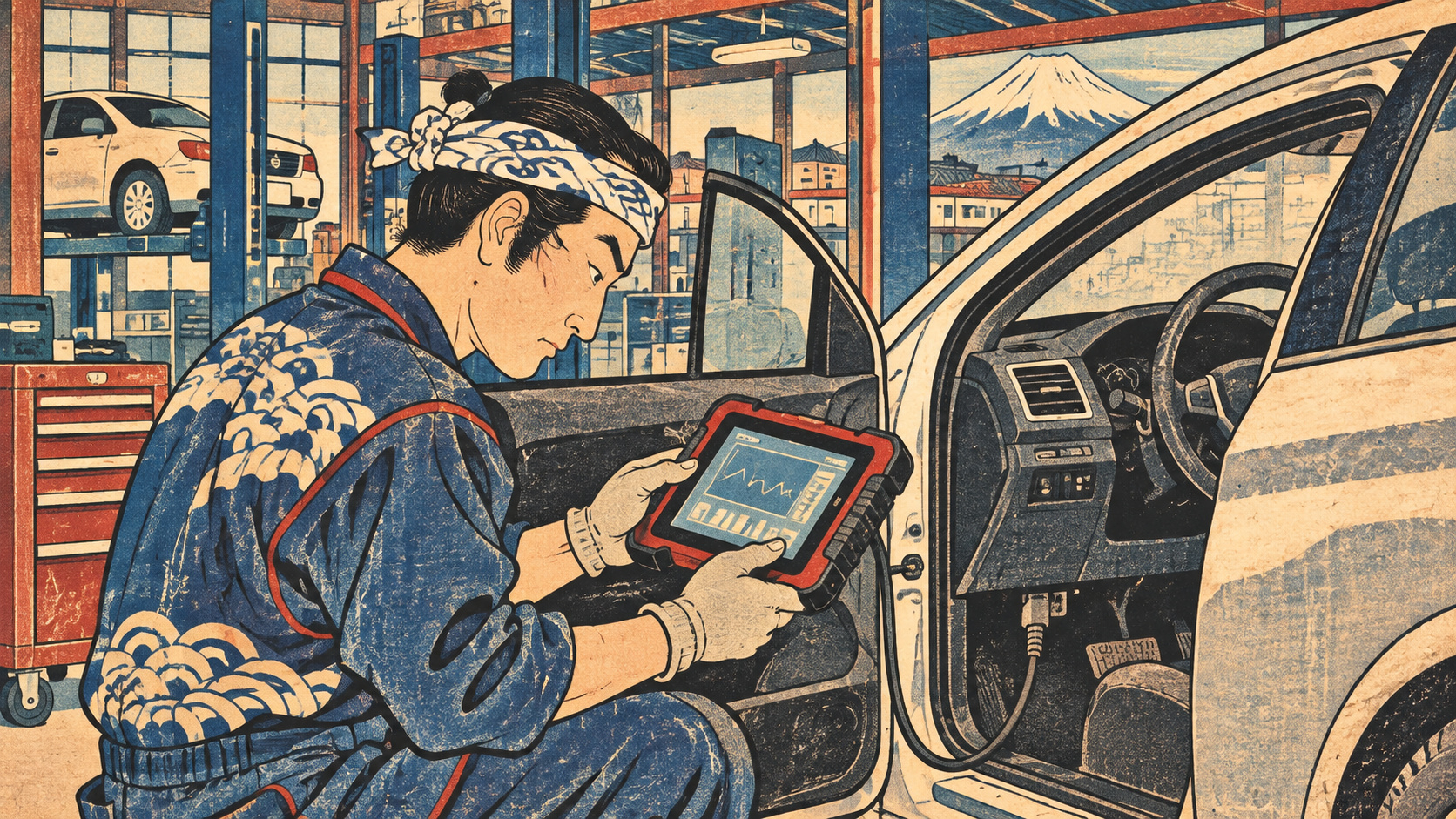
- The fault an inspector cannot see
- How a digital fault becomes an inspection result
- Which vehicles are actually required to take the test?
- The long road from emissions computers to digital roadworthiness
- The challenge for independent workshops
- Why the checklist is getting longer
- What November 30 needs to answer
The fault an inspector cannot see
A car can look perfectly ordinary on an inspection lane while its onboard electronics retain a record of something wrong. The systems responsible for anti-lock braking, vehicle stability, automatic emergency braking and emissions control are partly managed by computers. As vehicles have become more capable, they have also become more difficult to judge through a purely mechanical examination.
On November 20, 2026, Japan’s Ministry of Land, Infrastructure, Transport and Tourism (MLIT) announced that the eighth meeting of its OBD Inspection Monitoring Conference would take place on November 30, from 3 to 5 p.m. The stated purpose is to review how the system is operating and consider changes where necessary. The meeting has not yet happened; no November 30 outcome can be reported in an article dated November 24. The ministry’s original Japanese notice establishes that timeline.
The policy matters beyond Japan because it is a practical response to a global engineering problem. Safety is increasingly controlled by chips, sensors and software, while roadworthiness inspections must still provide meaningful protection to the public. Japan’s experience offers an early account of how a government can add electronic evidence to the traditional inspection system without pretending that one diagnostic readout tells the whole story.
How a digital fault becomes an inspection result
On-board diagnostics, or OBD, enables a vehicle’s electronic control units to register diagnostic trouble codes (DTCs). During a Japanese statutory OBD inspection, a qualified operator connects an approved scan tool to the vehicle, accesses the official inspection system over the internet and checks relevant codes against a database. The system focuses on specified DTCs—in Japanese, tokutei DTC (特定DTC)—associated with failure to meet particular vehicle safety or emissions requirements. The National Agency for Automobile and Land Transport Technology’s portal explains the workflow.
This is not a contest to find every code a manufacturer’s computer might store. An ordinary service diagnostic message and a code specified for a statutory failure are not automatically the same thing. Nor does the absence of a specified code mean a vehicle is mechanically sound in every respect. Tires, suspension, lighting and physical damage still require appropriate conventional checks.
The distinction is particularly relevant to the public debate about self-driving cars. Japan’s OBD regime covers specified driver-assistance and automated-driving equipment where regulated, but it is not an end-to-end simulation of all situations an automated or assisted vehicle could face. A test of stored fault information cannot prove that a collision-avoidance system will operate correctly in every weather condition or road environment.
Which vehicles are actually required to take the test?
The most common misunderstanding is that every car manufactured after a certain date must immediately pass OBD inspection. The eligibility rules are more specific. In general, qualifying domestically produced new models introduced from October 1, 2021 and qualifying new imported models from October 1, 2022 are within scope. For eligible vehicles, statutory OBD inspections began in October 2024 for domestic vehicles and October 2025 for imported vehicles. These dates are confirmed by the inspection portal.
Some categories, including motorcycles and large special-purpose vehicles, are excluded. Parallel imports and certain specially handled imports have additional exclusions. An eligible vehicle’s inspection certificate includes an OBD inspection notation, but even that notation is not sufficient to determine whether a test is due on a particular day: grace periods relate to the model approval date and first registration date.
In short, two cars on the same street may face different electronic inspection obligations even if both have advanced safety equipment. The correct determination comes from the specific vehicle’s approval and registration details, the legally relevant inspection date and the official system—not a generalized age threshold or a mechanic’s guess.
The long road from emissions computers to digital roadworthiness
On-board diagnostics first became widely familiar as a tool for detecting malfunctions in engine and emissions systems. Over time, computers took control of braking, stability and driver-assistance functions, expanding what a fault-code-based examination might reveal. Japan responded by developing separate rules for maintaining, checking and inspecting increasingly electronic vehicles.
MLIT’s deliberations on OBD-based roadworthiness testing began in late 2017, with an interim report issued in 2018. In April 2020, work on certain electronic control equipment entered Japan’s regulated vehicle servicing framework. A different requirement, OBD maintenance checks during periodic vehicle servicing, began in October 2021. Registration and trial use of the statutory OBD inspection system followed in 2023, before formal launch for eligible domestic vehicles in October 2024. Import coverage followed one year later.
Those milestones are related but not interchangeable. Electronic control equipment servicing concerns who may carry out particular regulated repair work. OBD maintenance checks are part of periodic servicing. OBD inspection is the designated electronic component of a statutory roadworthiness examination. MLIT’s official comparison explicitly separates the three. An owner should not assume that a routine diagnostic scan automatically satisfies the legal OBD inspection requirement.
The challenge for independent workshops
For a dealer or small independent garage, compliance involves more than plugging a scanner into a vehicle. The workshop must understand the official inspection workflow, obtain appropriate equipment where required, register users and premises when applicable, run the specified DTC inquiry application and maintain the connectivity necessary to complete the transaction. Japan’s inspection system links user administration, an electronic inquiry application and a results service.
Those requirements raise reasonable questions for independent repairers working across many vehicle brands: the price and compatibility of tools, staff training, software updates, time spent resolving communication failures and the ability to identify which cars actually need testing. These are areas of operational exposure, not proof of a uniform nationwide cost increase. The November 20 meeting announcement does not quantify the cost incurred by small shops, establish a new consumer fee or show that independent repair businesses have been forced out of the market.
There is also a practical distinction between designated inspection garages and other authorized service shops. Their roles in conducting the statutory inspection and completing advance checks are not identical. Reliable reporting should describe these differences rather than implying every auto mechanic has the same authority or must purchase exactly the same equipment.
Why the checklist is getting longer
Japan has already considered expanding which vehicle systems are checked. MLIT materials from June 2025 describe adding lane-departure warning, side-collision warning and acceleration-suppression systems intended to reduce pedal-misapplication accidents. The underlying point is simple: a vehicle fleet equipped with new electronics requires a regulatory list that keeps pace.
The published schedule envisages inspections of the first two added systems for qualifying new domestic models introduced from September 2026, with applicable testing from September 2029. The acceleration-suppression requirement relates to qualifying new domestic models from September 2028 with testing beginning in September 2031. The equivalent imported-vehicle dates are generally one year later. These are phased future requirements, not a claim that every car receives those checks today. MLIT’s equipment-expansion document sets out the planned dates.
There is a larger design challenge here. An electronic feature cannot become a meaningful national inspection item simply because it exists in an advertisement. There must be an applicable safety standard, a reliable diagnostic representation and a test process that inspectors can execute consistently across manufacturers. The government also must consider how diagnostic systems age as software is revised and components are repaired.
What November 30 needs to answer
The monitoring group has previously considered system usability, operational data, reported problems and how to communicate obligations to inspection businesses. The latest announcement promises discussion of current operations, but does not state the decisions that will be made. Government materials and the meeting summary are expected to be posted later on MLIT’s monitoring-conference page.
An effective follow-up should seek concrete answers. Are eligible vehicles correctly identified? How often do connectivity or equipment problems interrupt tests? Are inspectors and motorists able to understand the difference between a routine service code and a statutory fault? What share of problems results in corrective maintenance rather than administrative delays? The answers would help evaluate whether the new requirement is improving roadworthiness or merely adding procedural complexity. These are reporting questions, not findings from the forthcoming meeting.
Vehicle safety has always depended on the quality of both machines and maintenance. With software now woven into the braking and environmental systems of everyday cars, Japan is trying to make diagnostic evidence part of that equation. The next test is whether its inspection regime can keep the equipment trustworthy, the rules comprehensible and the public benefits measurable.
Primary sources and further reading
This report draws on Japanese government and regional primary sources. Terminal ratings are not presented as proof of zero emissions, and pending certificate ceremonies are identified as scheduled events.
- MLIT announcement of the eighth meeting, November 20
- MLIT OBD inspection monitoring meetings and archives
- NALTEC: OBD inspection and eligibility
- NALTEC: introduction for imported vehicles, October 2025
- MLIT: OBD maintenance checks and routine inspections
- MLIT Kanto: distinctions between servicing, OBD checks and statutory tests
- MLIT: planned expansion of inspected equipment
- NALTEC: eligible models, operational reporting and approved scanners
- MLIT: 2018 interim report on electronic inspections