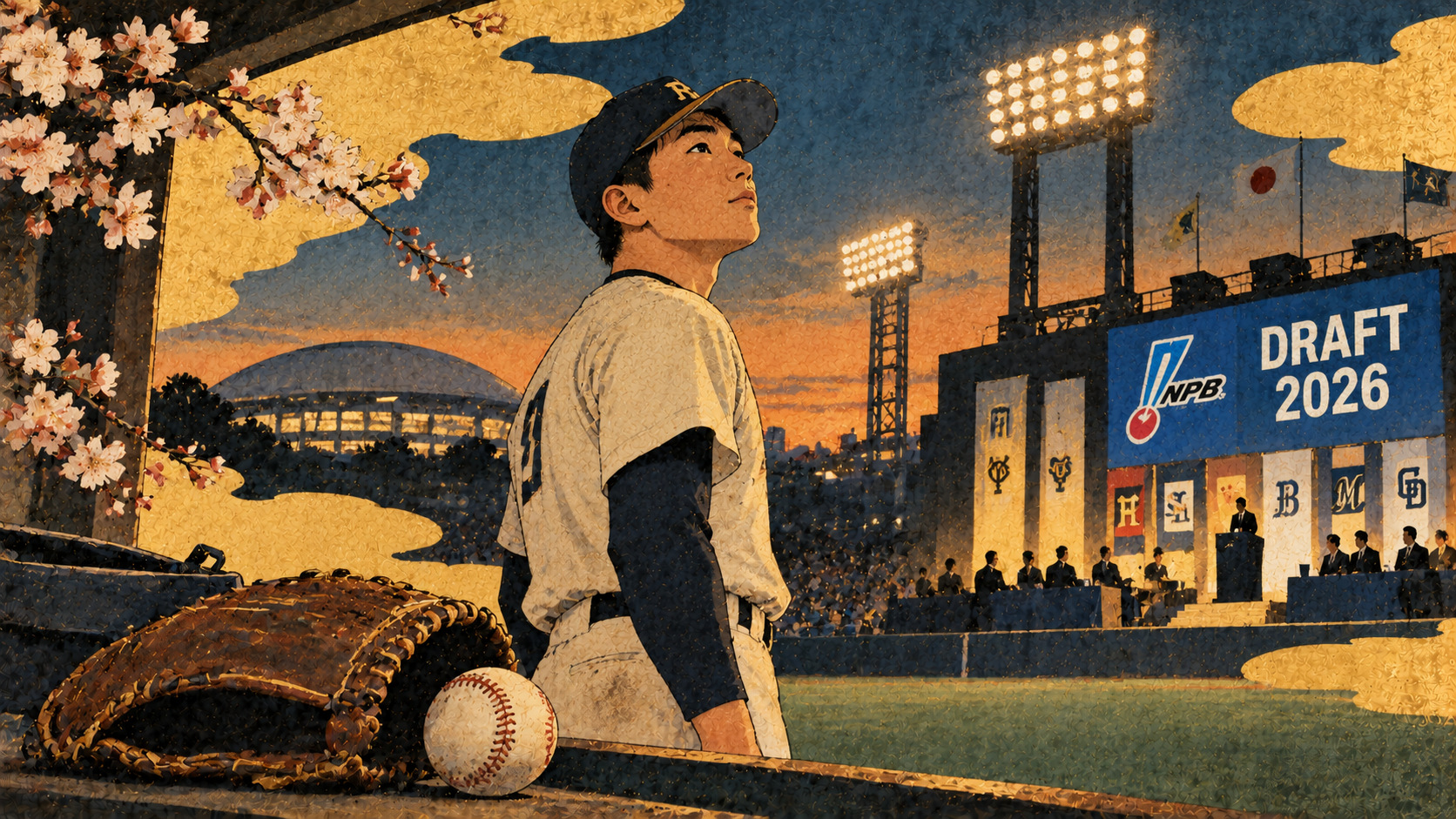
A draft pick is a negotiating right, not a signed future. The player still has a choice.
A draft with no advance promises
For an unusual moment in Japanese baseball, all 12 Nippon Professional Baseball clubs kept their first-round intentions private until draft day. On October 22, the envelopes opened, the negotiations began—and a particularly consequential choice emerged. NPB reported that teams obtained negotiating rights to 76 players through the regular draft and 51 more through the developmental draft: 127 potential professional careers, not 127 signed contracts. The surprise was not simply who went first. It was the growing tension between Japan’s domestic development system and the ambitions of young athletes looking across the Pacific.
The Giants select a pitcher looking toward America
The Yomiuri Giants selected Shoki Oda, a pitcher at Yokohama High School, in the first round. Oda had indicated ambitions to enter US professional baseball without first playing in NPB, according to contemporaneous Japanese reporting. That makes the pick exceptional, but it does not establish what Oda will decide. A draft selection gives a club negotiating rights; it neither compels a player to join nor guarantees a future contract. The audible surprise described in Japanese coverage reflects the unusual calculation confronting the Giants: a prized player may see his future on another continent.
Eight straightforward picks, three rounds of contests
Pre-draft secrecy did not deliver a chaotic bidding war. Daily Sports reported that eight teams secured their initial choices without competition, while three two-club contests arose across initial and subsequent first-round ballots. Chunichi initially sought catcher Kai Watanabe before Rakuten secured his rights, eventually taking pitcher Ren Miyahara. Lotte pursued Taisei Suzuki and Miyahara before settling on pitcher Yuto Yonezawa. The distinction matters: the Japanese term hazure ichi-i—an alternative first-round selection after a failed ballot—does not mean a player is drafted in a lower round. All remain official first-round selections.
The confirmed first-round selections
The table records each club’s finalized first-round negotiating rights, as reported at the conclusion of the October 22 draft. Names are shown in their verified Japanese written forms to avoid guessing romanizations for lesser-known prospects; readers can follow the linked Japanese source material for identification.
| Club | First selection (Japanese) | Background / position |
|---|---|---|
| 阪神タイガース | 榊原七斗 | 明治大学・外野手 |
| 読売ジャイアンツ | 織田翔希 | 横浜高校・投手 |
| 横浜DeNAベイスターズ | 星野世那 | 大阪商業大学・投手 |
| 広島東洋カープ | 山里宝 | 亜細亜大学・内野手 |
| 東京ヤクルトスワローズ | 藤澤涼介 | 東京ガス・外野手 |
| 中日ドラゴンズ | 宮原廉 | 近畿大学・投手 |
| 福岡ソフトバンクホークス | 鈴木泰成 | 青山学院大学・投手 |
| 埼玉西武ライオンズ | 川尻啓人 | 亜細亜大学・投手 |
| 北海道日本ハムファイターズ | 菰田陽生 | 山梨学院高校・投手 |
| オリックス・バファローズ | 角田楓斗 | 富士大学・投手 |
| 千葉ロッテマリーンズ | 米沢友翔 | 関西大学・投手 |
| 東北楽天ゴールデンイーグルス | 渡部海 | 青山学院大学・捕手 |
Why all 12 clubs stayed quiet
Publicly declaring a target can affect rivals’ strategies; keeping the decision private can deny competitors useful information. For years NPB clubs have balanced those advantages. In 2026, however, not one of the 12 publicly identified its first-round target in advance, according to Nikkan Sports. Whether secrecy improved any team’s final outcome cannot be read off the evening’s selection list. The meaningful measure will be which players develop, which sign and which earn sustained places at the highest level.
The long history of Japan’s draft
Japan introduced its professional draft in 1965 to structure access to new talent. The system evolved as the country’s talent pipeline grew more complex, including separate developmental selections introduced in 2005. Today the first round uses simultaneous bids and lotteries for duplicated selections. The later rounds alternate their selection order, with lower-placed teams getting priority in even-numbered rounds under the prescribed interleague sequence. This is different from the straightforward sequential draft familiar to many American sports fans, and helps explain why the lottery moments receive such intense Japanese television coverage.
More than a pathway for high-school stars
Unlike the mental image of an American high-school draft, Japan’s selection process draws heavily on universities, corporate baseball programs and independent leagues as well as secondary schools. The 51 developmental picks are especially significant: those contracts are a distinct category from regular roster registration and do not promise an immediate path to top-flight games. A name called out at the draft is a beginning. The actual professional journey depends on a player’s choice, contract terms, coaching, health and the scarce opportunity to compete.
An international career question, not a loyalty test
Japanese stars’ success in Major League Baseball has made America a tangible goal for many youngsters, but there is no single right route. Japan’s professional clubs offer coaching, established leagues, a domestic fan base and the chance to develop before a possible later move overseas. Young players also weigh education, family and their own time horizons. The Oda case is best understood as a career decision under consideration, not as a completed move or a referendum on which country’s baseball is superior. The player's next public statement and contract discussions remain important unanswered questions.
What the draft can—and cannot—tell us
On draft night, rankings compress people into first-round prizes, development projects and supposed disappointments. Over time, those labels frequently lose their explanatory power. The next evaluation should ask not only who won a drawing but who built a sustainable environment for growth: player health, development resources, meaningful game opportunities and eventual retention. The real story of the 2026 draft will be written over seasons, not minutes. For Japanese baseball, the defining competitive question may be whether NPB can offer the next generation something compelling while the world offers them more options than ever.
Sources and reporting notes
Updated with October 22 completed results. Japanese written names are retained where independent primary-source romanization is not confirmed. Selections are negotiating rights, not contracts.