The grand prize went to a network, not a farm
What would it take to make inclusive agricultural employment something a whole region can offer, rather than an inspiring project on one farm? Japan's latest Noufuku Awards offer an answer worth investigating. On November 2, the Ministry of Agriculture, Forestry and Fisheries (MAFF) announced 21 winners from 196 applicants. The top prize went to the Osumi Peninsula Noufuku Consortium in Kagoshima Prefecture. The ministry emphasized an unusual distinction: a regional council had won the Grand Prix for the first time. Its work is to connect agriculture, welfare organizations and local government, organize training and help match potential work with people and support services. Unlike an individual producer's triumph, this award recognizes the less photogenic infrastructure that can allow many placements to happen. But recognition is not proof that every placement succeeds. That question is at the heart of the story.
What “noufuku” actually means
Noufuku is shorthand for nougyou-fukushi renkei—cooperation between agriculture and welfare. In its common form, farms provide work opportunities for people with disabilities while receiving help with suitable tasks, and welfare providers offer preparation, support and ongoing assistance. MAFF emphasizes both agricultural business development and participation, confidence and a sense of purpose for workers. The model is not simply a farmer receiving low-cost labor; contracts, safeguards, job design and the worker's preferences determine whether the relationship is fair. In Japan, a welfare facility providing work and a farm directly employing someone may operate under quite different legal and remuneration arrangements. Treating all participants as salaried farm employees would therefore mislead readers. So would treating the award as a measurement of wages, safety or independence. Those questions require separate evidence and, where possible, the testimony of workers themselves.
Why the Osumi Peninsula became an organizing hub
Osumi lies in southern Kagoshima, a peninsula whose communities sustain farms, livestock operations and forestry alongside smaller towns. MAFF's regional-council casebook traces the consortium's origins to discussions in 2020 and its founding in 2021. A local welfare organization, Shirahato-kai, whose work had won a 2020 Noufuku award, joined with regional government and businesses to build a framework that outlasted any single project. The initial structure brought together six agricultural corporations, eight disability-welfare organizations, two other bodies, six local governments and two advisers. By 2024 the casebook counted 65 participating entities and three Noufuku JAS-certified members. These are historical, source-specific counts—not 2026 employment totals. The council organizes exchanges, study visits, training in standards and matching of work requirements to local capabilities. Its achievement is a repeatable coordination process, not a claim that agriculture can solve every social barrier.
Behind a successful match is a complicated transaction
Imagine a farm with seasonal sorting or packing work. Its needs vary with harvest timing, quality standards and transportation. A welfare service may know participants' interests and support needs, but not the farm's production cycles. A coordinator can clarify the task, arrange a trial, establish responsibility for training, check transport and agree compensation and supervision. That simplified example illustrates the problem; it is not an invented scene from a particular winning farm. The Osumi network has explicitly used matching activities, farm visits and training. MAFF's casebook also describes work on contractor fee-setting, food-loss reduction and quality standards. The difficulty is that good matching is not simply filling an unoccupied shift. If a person lacks safe transport, accessible tools or reliable support, a placement may be unsustainable even if it benefits the farm's labor schedule. The system must serve both parties, and the person doing the work must have a meaningful say.
Three runners-up reveal three different ambitions
The 2026 award's three runner-up categories are deliberately broader than a traditional farm-product competition. The “Cultivating People” award went to social-welfare corporation Mebuki-kai in Oyama, Tochigi Prefecture. The “Cultivating Communities” award recognized Midori no Mori Fukushikai and Iwaki Winery in Iwaki, Fukushima Prefecture. The “Cultivating the Future” award went to Yume Sodate in Setagaya, Tokyo. The official announcement confirms their names and category placements, but does not by itself supply audited wages, employment transitions or environmental outcomes. Each requires its own investigation. An urban project in Tokyo, a winery in Fukushima and a welfare organization in Tochigi also demonstrate that inclusion cannot be reduced to a single rural landscape. Agricultural work may include cultivation, processing, sales, education, customer contact and the coordination needed to bring products to market.
Twenty-one winners show a widening definition of participation
Beyond the Grand Prix and three runner-up prizes, the ministry named seven Excellence Awards, five Fresh Awards and five Challenge Awards. The recipient list stretches from Miyagi and Hokkaido to Okinawa and Oita; it includes a university agricultural research field center, a hospital in Toyama, a special-needs school in Yamaguchi and agricultural enterprises. Among the Challenge Award recipients are Wajima's Okunoto Genki Project and a support center for younger people with dementia in Nara. The Fresh Award is intended for comparatively new efforts, generally within five years of launch; Challenge Awards seek emerging combinations such as forestry, fisheries and participation by older people or those facing other barriers. None of those labels alone demonstrates outcomes. Their importance is that the government now sees the interface of agriculture and inclusion as a system extending beyond disability employment on conventional farms.
How Japan got here: from a welfare project to national policy
The history extends well before this year's awards. Japan's long-running changes in agricultural labor, demographic aging and employment policy created an opening for work that crosses institutional boundaries. In June 2019, a national Noufuku promotion vision put the concept on the central policy agenda. A consortium established in March 2020 began holding annual awards, creating a mechanism for collecting and comparing models from across Japan. The revised government vision adopted on June 5, 2024 explicitly moved from isolated examples to regional systems, along with broader participation and consumer involvement. The political aim is not merely to reward compassionate intentions; it is to support working arrangements that can be maintained by farms, public bodies and participants. Whether that aim is being achieved should be measured across years and regions, not inferred from a celebratory ceremony.
The 2030 ambition—and the measurement problem
The 2024 vision set two goals for the end of fiscal 2030: at least 12,000 organizations or entities participating in Noufuku-related initiatives, and 200 or more municipalities participating in regional councils. Those are counts of participating bodies and municipalities, not people newly employed. MAFF's fiscal 2024 KPI material identified 8,277 participating entities and 144 municipalities. As categories and counting methods evolve, meaningful trend analysis requires reading the definitions and not equating an organization's enrollment with an individual's successful job outcome. A growing count can show that the movement has reached additional institutions, but it cannot tell us whether a worker earns enough, advances to regular employment, feels safe or chooses to stay. The Osumi win provides an opportunity to ask for those harder measures. Without them, scale alone risks becoming a substitute for success.
Why money and quality standards matter
Farmers face genuine commercial limits: perishable crops, narrow selling windows, high input costs and pressure to meet consistent quality. Welfare providers need reliable staffing and support budgets. In some cases their interests align naturally; in others they do not. The Osumi casebook highlights training around Good Agricultural Practices (GAP), the Noufuku Japanese Agricultural Standards (Noufuku JAS) system and product branding. These standards and commercial arrangements can help make work traceable and reliable, but certification should not be mistaken for a comprehensive independent audit of wages, disability rights or all environmental outcomes. Economic sustainability has to be tested at each link: the producer's margin, the cost of coordination, transport and support, payment to the service provider and the eventual benefit to the worker. A project that survives only on occasional volunteer effort may be valuable, yet hard to reproduce at national scale.
A restaurant in Kyoto brings the supply chain into view
A separate November 2 announcement offers another clue. Among 18 entrants to the Noufuku Supporters program, consortium members voted Kyoto's Restaurant MOTOI the most deserving of further expansion, resulting in a planned certificate of appreciation. This is not the Noufuku Grand Prix and should not be counted as a twenty-second award-winning farming group. It signals recognition of businesses that help producers connect with customers. A farm or welfare enterprise cannot thrive solely by organizing work: someone must purchase its output at viable prices. Restaurants, retailers, distributors and public procurement systems may all influence whether activity can continue. The precise effect of Restaurant MOTOI's support on purchasing volume or participant income was not documented in the award release, so those claims remain questions for follow-up reporting.
The limits of a compelling photograph
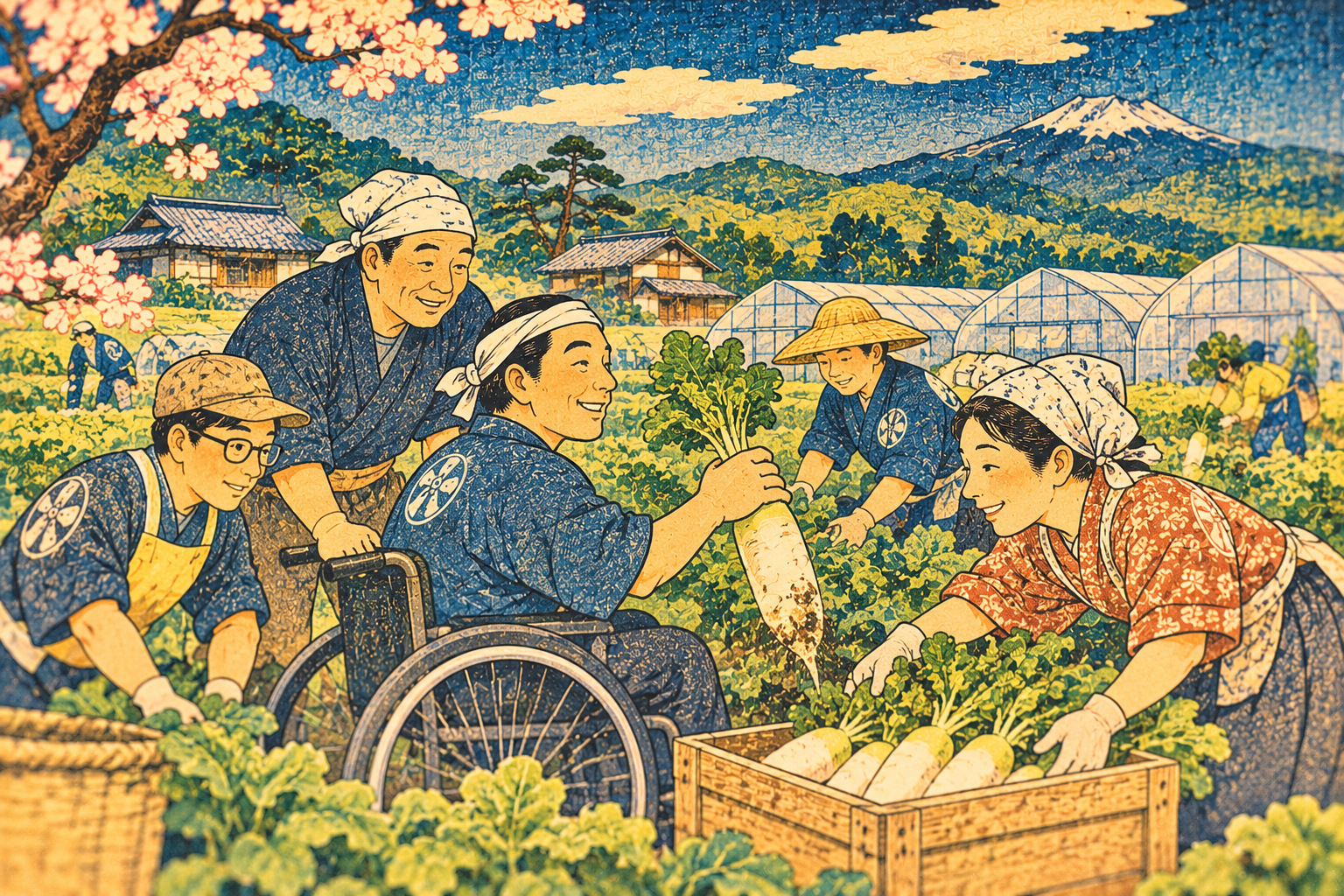
An image of people harvesting vegetables together communicates cooperation quickly. It cannot show whether participants had freely chosen the work, received accessible instructions, been paid fairly or gained opportunities beyond one event. Nor does a single successful case represent every community. Disability is not a uniform category; individualized design and accessible communication are central to good work. Some participants may prefer agricultural tasks, others not. The public interest lies in being precise about organizational structures and asking measurable questions: how many people participated, for how long, on what terms, and what changed for them? Are injury prevention and transportation addressed? How did farmers' productivity and product quality change? The official award announcement does not answer these questions with comparable evidence. An honest report should distinguish the prize's judgment of promising practice from independent verification of the full social impact.
What happens after the award
The ministry says the selection committee reached its decision on October 15, announced the results on November 2 and scheduled the presentation ceremony for November 30 in Tokyo. The ceremony is in the future as of this edition; it has not already taken place. The substantive question is what happens in Osumi after the photographs and speeches. Can the network keep coordinating farmers, public agencies and welfare services when personnel change? Will more employers provide safe, useful tasks? Can the participants themselves define success? The award may help the region be heard elsewhere in Japan. It is not evidence that a national employment problem has been solved. Its more powerful message is that durable inclusion may depend less on a heroic individual farm than on the systems connecting people, work, transport, standards and markets.
Sources and reporting method
Primary Japanese institutional sources for the award and policy history. Official prize selection is not an independent evaluation of all worker outcomes.
- MAFF, November 2, 2026 award decision
- Noufuku Web, complete 2026 recipients
- Noufuku Web, award criteria
- MAFF, regional councils casebook
- MAFF, 2024 revised policy vision
- MAFF, 2024 vision text
- MAFF, KPI documents and historical vision
- MAFF, 2024 agricultural white paper
- MAFF, supporting consortium and award history