- A network preserved in ink
- The literary life that preceded politics
- How a private retreat became a political meeting place
- Exile, rescue and an unfinished transformation
- Reading poetry as an assertion of agency
- Whose work makes political history possible?
- Preserving the places and the paper
- A short exhibition with a long historical reach
A network preserved in ink
A political movement leaves behind proclamations, government records and accounts of battles. It also leaves something less conspicuous: letters sent between people who trusted one another. A five-day exhibition at Fukuoka Art Museum offers an opportunity to examine that quieter record of Japan’s nineteenth-century transformation.
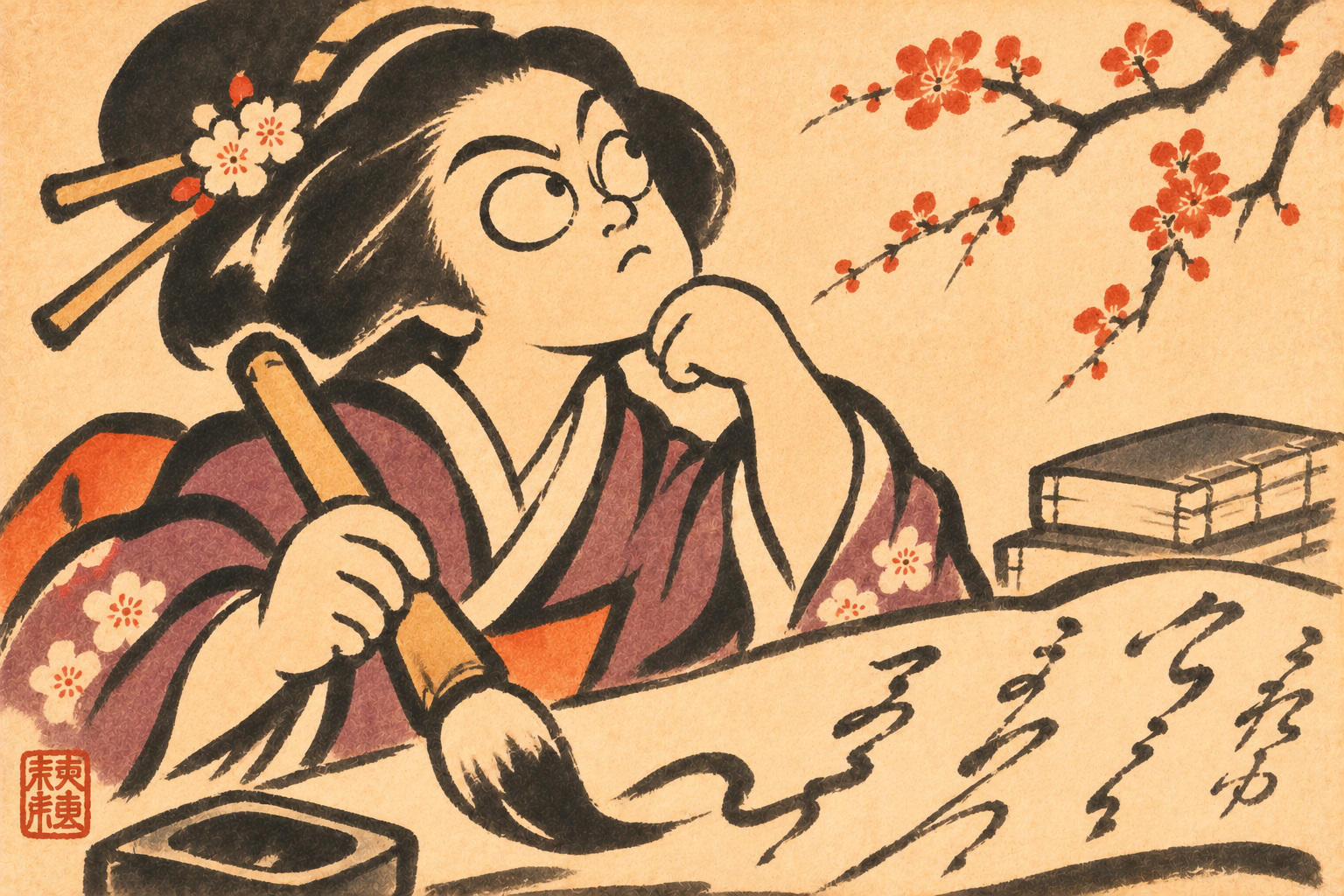
Opening November 25 in Gallery F, the exhibition focuses on the handwritten works of people who interacted with the late-Edo poet Nomura Bōtōni (野村望東尼, 1806–1867), also known as Motoni. The museum calendar specifies 32 hanging scrolls and 11 handscroll or folding-album works. Local broadcaster Television Nishinippon reports approximately 100 items, including letters and poem slips. These totals use apparently different units; a complete checklist has not been released in the sources consulted.
The show, which runs through November 29, invites a different way of approaching the overthrow of the Tokugawa shogunate: through the relationships that made political activity possible, and through the writing of a woman who was a literary figure long before she became associated with the loyalist movement.
The literary life that preceded politics
Born into a Fukuoka domain samurai family in 1806, the woman originally named Moto married Nomura in 1829. In 1832 she began studying waka with Ōkuma Kotomichi, a prominent local poet. The couple later retired to Hirao Sansō, a retreat that became a meeting place for literary acquaintances. The Fukuoka City Museum records poetry gatherings there, as well as her efforts to obtain a preface for her collection from her teacher.
Waka offered an established literary language with which writers could express experience and emotion. Its familiar short form, the tanka, follows a pattern of five, seven, five, seven and seven Japanese sound units. Writing within that form required discipline, but also allowed a poet to convey meanings that could exceed the literal words on the page.
Her collection Kōryōshū preserves poems from her years at the retreat. The city museum has documented a volume whose binding and title slip she made herself. This material evidence matters: she was not simply a subject of later biographies, but a writer who took part in producing and organizing her own literary record. Following her husband’s death in 1859 she became a Buddhist nun, adopting the religious name Shōgetsu Bōtō Zenni.
How a private retreat became a political meeting place
Bōtōni’s life unfolded during the collapse of the political arrangements that had sustained Tokugawa rule. The arrival of Commodore Matthew Perry in 1853 intensified disputes over foreign relations, the authority of the shogunate and the role of the imperial court. Imperial loyalism encompassed different positions; it was not a uniform program for a modern nation-state.
In 1861 she traveled to Osaka to visit her poetry teacher and continued to Kyoto. The Yamaguchi Prefectural Library describes her subsequent involvement in exchanges of information between Kyoto and Fukuoka. Her retreat provided assistance to activists, among them Hirano Kuniomi. In 1864 she sheltered Takasugi Shinsaku of the Chōshū domain.
The significance of this activity lies partly in the setting. A home could offer a place for discussion, correspondence and hospitality beyond the formal institutions of a domain. Literary connections could provide channels of acquaintance and mutual confidence, although it would be mistaken to assume every participant in a poetry circle shared the same political views. The surviving documents offer historians the means to test those relationships rather than simply imagine them.
Exile, rescue and an unfinished transformation
Fukuoka’s suppression of imperial loyalists in 1865 led to Bōtōni’s arrest and exile on Himeshima, an island now within Itoshima City. The crackdown is known as the Icchū no Goku (乙丑の獄). In 1866, people acting at Takasugi’s direction rescued her and brought her to Chōshū. She attended Takasugi in his final illness in 1867 and died later that year at Mitajiri, now part of Hōfu, before the Meiji era began.
Her writings provide a perspective on this turbulent period that differs from retrospective accounts of victorious statesmen. The Fukuoka City Museum’s earlier exhibition documented correspondence from Himeshima and material concerning her time in Nagato. The Shizuoka Prefectural Museum of Art lists her travel diary, island diary and Yume Kazoe among her works. These are separate archival references, not a claim that each is on display in the current exhibition.
Exile illustrates the stakes of involvement in political networks. The eventual success of the restoration movement should not obscure the uncertainty its participants faced, or the personal costs of repression. Bōtōni never saw the political order that emerged after 1868.
Reading poetry as an assertion of agency
One poem slip featured in Television Nishinippon’s coverage conveys Bōtōni’s conviction that a woman who remains faithful to her chosen path is not inferior to a man. It is a striking statement of personal resolve from a period in which women’s access to political institutions was sharply restricted.
It would be tempting to translate that sentiment directly into the vocabulary of contemporary feminism. The historical context is more complicated. Her political loyalties belonged to the imperial restoration movement, not to a documented platform of universal suffrage or equal legal rights. Her assertion nevertheless challenges a reading of nineteenth-century women as passive observers of political change.
The poem’s physical form also matters. A tanzaku is a narrow strip of paper used for verse and calligraphy. A hanging scroll presents writing as an object of display; a handscroll is encountered progressively, and a folding album can arrange multiple texts in sequence. Each format creates a different relationship between author, recipient and later reader. Transcriptions make the words accessible, but they cannot entirely replace the material object.
Whose work makes political history possible?
Standard accounts of the Meiji Restoration often organize events around domain leaders, military commanders and imperial institutions. Bōtōni’s biography suggests another set of historical questions. Who arranged meetings, maintained relationships across distances, preserved correspondence and gave encouragement to people engaged in dangerous political activity? Who produced the texts through which later generations could understand that world?
Her social background is essential to answering these questions. Access to literary instruction and networks was uneven in Tokugawa Japan, and her experience as a member of a samurai household cannot stand for all women. Yet her case reveals how intellectual work and political participation could overlap even without formal office.
Nor should her work be valued only because she knew famous men. Her poems, diaries and other surviving creations are worthy of study in their own right. Treating them as literature as well as historical evidence makes possible a more complete account of both her life and the society in which she lived.
Preserving the places and the paper
Visitors to Fukuoka can encounter another part of this history at Hirao Sansō, now a municipal historic site. The current retreat is not an untouched building from the 1860s: the original deteriorated and was reconstructed in 1909, with later rebuilding and repairs. The distinction between a historic location and surviving original fabric is fundamental to responsible heritage interpretation.
In Hōfu, Yamaguchi Prefecture, the site associated with her death and her grave are protected as a prefectural historic property. Together these locations trace the geographic reach of a life that linked northern Kyushu with the political world of Chōshū.
Manuscripts present a different preservation challenge. Paper and ink can be damaged by excessive light, moisture and repeated handling. Conservation, high-resolution photography and careful transcription can make these works more widely accessible while limiting wear. Catalogues should also document provenance, dates, uncertain readings and the relationships between individual pieces. Digital access is most useful when it retains that context, rather than reducing an object to a decorative image.
A short exhibition with a long historical reach
The exhibition closes on November 29. The museum’s official gallery calendar provides the venue and dates, while its local institutional counterparts offer further avenues for research. A full item-level exhibition catalogue would help establish precisely which correspondents and works are represented, and enable researchers to distinguish originals from any later copies.
For readers outside Japan, the exhibition is a reminder that the restoration was not simply a story of modernization arriving from above. It was also a period of intellectual exchange, conflicting loyalties and decisions made in households far from the principal seats of power. The correspondence of a Fukuoka poet opens a window into that world.
The surviving handwriting does not resolve every historical question. Its value is that it gives us better questions to ask — about authorship, trust, political agency and the people whose work made change possible without leaving their names on the institutions that followed.
Sources and further reading
- Fukuoka Art Museum — November gallery schedule
- Television Nishinippon — November 25 exhibition report
- Fukuoka City Museum — Nomura Bōtōni and late-Edo Fukuoka
- Fukuoka City cultural properties — Hirao Sansō
- Yamaguchi Prefectural Library — biographical research guide
- Yamaguchi Prefecture — site of her death and grave
- Shizuoka Prefectural Museum of Art — artist and collection record
- Fukuoka City Museum archival exhibition — Ōkuma Kotomichi and his circle
- Fukuoka official tourism — Hirao Sansō and its history
- Fukuoka Art Museum — November 27 calendar