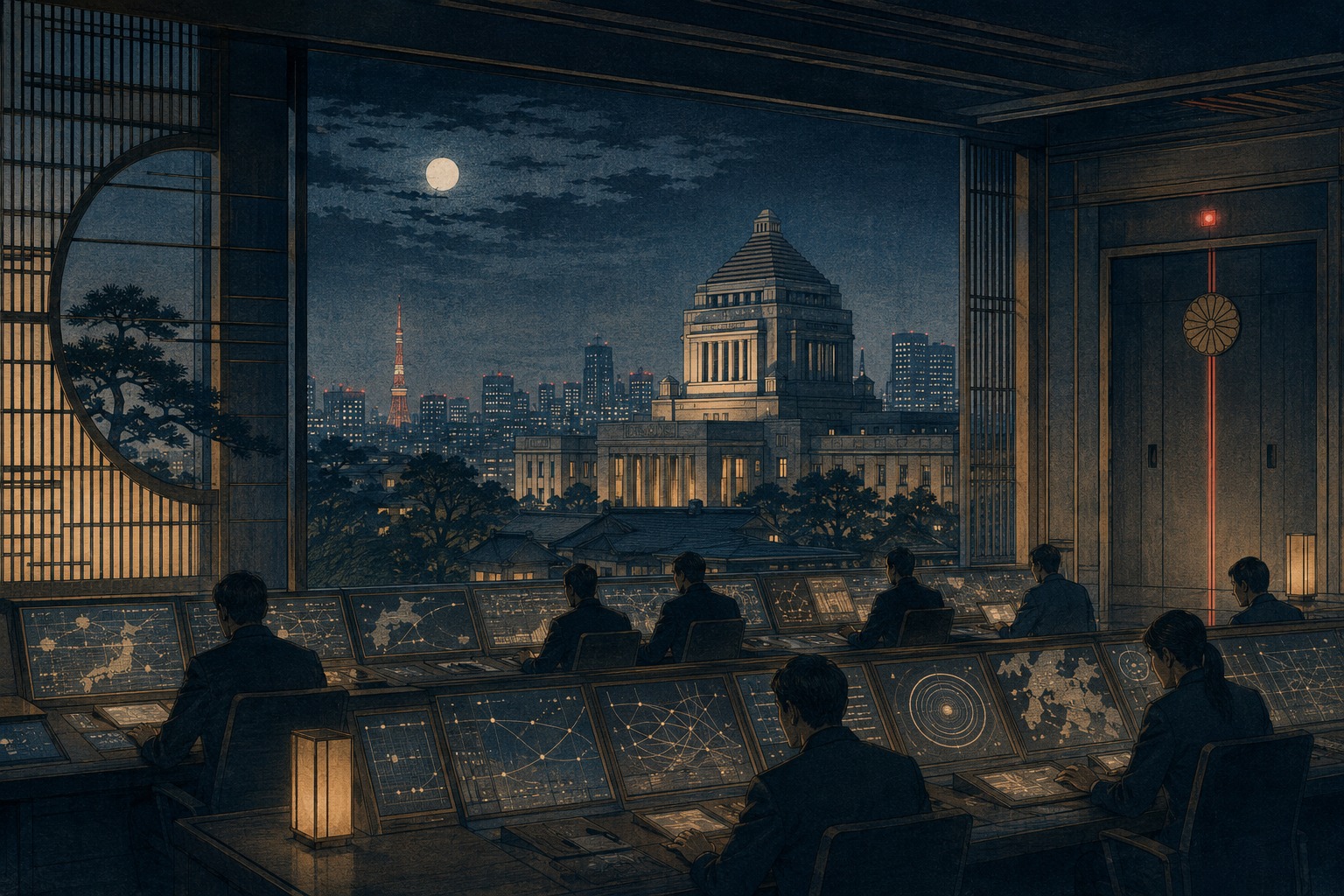
“About 700 personnel” does not mean Japan hired 700 new spies. The new bureau is an upgrade of the Cabinet Intelligence and Research Office. In Diet testimony, the government put the predecessor’s authorized strength at 537 and its actual working complement—including personnel carried on other agencies’ rolls—at about 730 as of April 1. The fiscal 2026 launch added roughly 30 positions and no new investigative or intelligence-gathering power.
A new nameplate—and a different center of gravity
Intelligence reform rarely arrives with a public spectacle. Its product is usually invisible: a warning delivered early enough, a contradiction noticed before a meeting, a minister told that the comforting interpretation is probably wrong. Japan’s new National Intelligence Bureau begins with that unglamorous ambition. It is meant to make the government see sooner and think across institutional borders.
The Cabinet approved the July 31 launch and named Kazuya Hara as the first director one week earlier. Hara, 58, joined the National Police Agency in 1990, built much of his career in public security, led the NPA Security Bureau and became director of Cabinet intelligence in June 2023. His new rank is placed alongside the secretary-general of the National Security Secretariat—a symbolic and bureaucratic statement that intelligence assessment should stand level with security policy.
Above the bureau sits the National Intelligence Council. Prime Minister Sanae Takaichi chairs it. The other statutory members include the chief cabinet secretary and ministers responsible for public safety, justice, foreign affairs, finance, economy, transport and defense. Its job is not to choose a military operation or negotiate a treaty. It is to decide what the government most needs to know, direct cooperation among ministries and examine especially important assessments.
The legal power is in the verbs
The National Intelligence Council Act is revealingly procedural. The council sets the basic direction and priorities for “important intelligence activities.” It coordinates cooperation among agencies. It considers the development and operation of intelligence-gathering satellites. It frames the government’s response to foreign intelligence activity. And it produces shared assessments of the international and domestic situation, including all-source analysis of especially important cases.
The consequential provision comes in Article 7. Agency heads must provide useful intelligence and materials to the council in a timely way. When the prime minister requests information, explanations or other cooperation, they must comply. That does not give the bureau a new power to wiretap, arrest, search or recruit an overseas agent. It gives the center a stronger statutory claim on information held elsewhere.
For decades, Japan’s intelligence community resembled an archipelago. The Foreign Ministry watched diplomacy and political conditions abroad. The Defense Ministry’s Defense Intelligence Headquarters concentrated on military threats. The National Police Agency handled security and law-enforcement intelligence. The Public Security Intelligence Agency investigated threats under its legal mandate. The Cabinet office tried to combine the streams. Each island had expertise, sources, cultures and incentives of its own.
The problem was not that Japan knew nothing. It was that knowledge could remain vertical—reported upward inside a ministry—when the threat itself moved horizontally across finance, technology, policing, diplomacy and defense. A cyber intrusion could also be industrial espionage. A social-media narrative could support diplomatic coercion. A questionable acquisition could implicate advanced technology, supply chains and military capability at once. The bureau exists for the seam between those files.
Seven hundred people—but not 700 new operatives
The staffing figure is the easiest part of the launch to misunderstand. During Diet debate, a government official said the Cabinet Intelligence and Research Office’s fiscal 2026 authorized strength would be 537. Yet about 730 people were actually doing its work on April 1 when employees assigned on other agencies’ personnel accounts were included. The launch increment was approximately 30.
Those additions include a director-general-level deputy, two counselor-level posts and two senior analyst or office-head posts. They are designed mainly to run the new council, plan across government and coordinate the community. The government explicitly told the Diet that the bill did not create new collection or investigative authority and therefore did not require a new hundred-person investigative team.
This does not make the reform cosmetic. In bureaucracies, rank determines access; legal status determines whether a request can be ignored; a prime-minister-chaired process determines whether an intelligence priority survives competition with the urgent business of the day. But it does locate the reform correctly. Japan is initially strengthening the top and the connective tissue, not suddenly multiplying people in the field.
Further capacity is likely to come more slowly. The government said it would examine fiscal 2027 requests for stronger collection and investigative functions and would seek specialists in systems and artificial intelligence. Recruiting, clearing, training and retaining people with languages, cyber expertise and regional knowledge cannot be accomplished by changing an organization chart.
What the bureau can do—and what it cannot
| The bureau can | The bureau cannot do merely because it launched |
|---|---|
| Serve as secretariat for a prime-minister-chaired National Intelligence Council. | Act as a stand-alone Japanese CIA or MI6 with a newly created worldwide agent network. |
| Set community-wide priorities and coordinate the work of relevant ministries and agencies. | Arrest suspects, execute searches or exercise police powers in its own name. |
| Integrate material from multiple agencies into all-source assessments for national leaders. | Acquire new wiretap, surveillance or compulsory-investigation powers under the launch law. |
| Require timely provision of information and cooperation through the council’s statutory process. | Replace the Defense Intelligence Headquarters, police, Foreign Ministry or Public Security Intelligence Agency. |
| Shape counterintelligence priorities and the response to foreign intelligence activity. | Make a separate anti-espionage law, foreign-agent registration system or foreign intelligence service automatically exist. |
Why Japan built an intelligence system in pieces
The modern bureau inherits a history older than its launch-day name. The Cabinet Intelligence and Research Office traced its roots to a Cabinet research office established in 1952, as the U.S. occupation ended and Japan rebuilt national institutions under its postwar Constitution. The Public Security Intelligence Agency also dates to 1952. Their creation took place in a political culture deeply wary of centralized secret power.
That caution was not abstract. Wartime intelligence and political-police institutions had been associated with repression and the suppression of civil liberties. After defeat, the safer institutional answer was dispersion: foreign affairs in one place, police security in another, military intelligence elsewhere, and a modest Cabinet coordinator above them. Dependence on the United States for high-end strategic intelligence and alliance planning reduced the political pressure to create a large autonomous service.
The system acquired new organs when events exposed a gap. The Defense Intelligence Headquarters was created in 1997 to centralize military intelligence inside the Defense Agency. North Korea’s 1998 missile launch over Japan shocked Tokyo and accelerated the information-gathering satellite program; the Cabinet Satellite Intelligence Center was established in 2001. The satellites became a sovereign source of imagery for national security and major disasters.
Reforms in 2008 tried to strengthen the intelligence community and improve coordination. In December 2013, Japan established the National Security Council and adopted its first National Security Strategy, giving the prime minister a stronger machinery for security policy. The National Security Secretariat followed in January 2014. The specially designated secrets law, enacted in 2013 and implemented in 2014, sought to standardize protection and clearance for the most sensitive information. Economic-security legislation in 2022 and a 2024 law creating a clearance framework for important economic-security information expanded the protected domain beyond traditional defense secrets.
Each step solved part of a different problem: collection, policy coordination, classification, economic security. The 2026 reform attempts to join the pieces at the assessment level.
Japan’s intelligence architecture, 1952–2026
| Year | Institutional change | Why it mattered |
|---|---|---|
| 1952 | Postwar Cabinet intelligence office and Public Security Intelligence Agency take shape. | Japan rebuilds national intelligence functions while keeping authority dispersed. |
| 1997 | Defense Intelligence Headquarters established. | Military collection and analysis gain a central organization inside the defense establishment. |
| 1998–2001 | North Korean missile shock leads to the Cabinet Satellite Intelligence Center. | Japan develops a sovereign space-based imagery capability for security and disaster response. |
| 2008 | Government intelligence-community reforms. | Coordination, requirements and analysis receive greater emphasis. |
| 2013–2014 | National Security Council, National Security Secretariat and secrets-protection regime. | The prime minister gains a stronger security-policy process and a common framework for sensitive information. |
| 2022–2024 | Economic-security law and economic-security clearance legislation. | Critical infrastructure, supply chains, advanced technology and protected information move toward the security core. |
| 2026 | National Intelligence Council and National Intelligence Bureau. | Ministerial priority-setting and all-source assessment receive a clearer legal center. |
Why now: threats that refuse to stay in one ministry
China’s military expansion, pressure around the Senkaku Islands, economic leverage and sophisticated influence activity present different faces of the same strategic competition. North Korea combines nuclear weapons, missiles, cyber theft and the unresolved abductions issue. Russia’s war against Ukraine has brought sanctions evasion, technology-acquisition concerns, information operations and military coordination with North Korea into the same picture.
None of these challenges is exclusively “foreign,” “military,” “economic” or “domestic.” Nor are emergencies. A major earthquake can interrupt semiconductor supply, expose communications vulnerabilities and require satellite imagery while diplomats manage offers of foreign assistance. Intelligence for the modern Cabinet is not a classified encyclopedia; it is a system for deciding what matters before the connections become obvious.
The new law explicitly covers security, terrorism prevention, emergency response and other important national administration. Its definition of response to “foreign intelligence activity” reaches efforts conducted for a foreign interest to acquire nonpublic information whose leak could harm important state operations, including related improper activity. That is broad enough to support a more coherent counterintelligence picture. It is also broad enough to demand disciplined safeguards.
The first national intelligence strategy: turning anxiety into priorities
The first National Intelligence Council begins with a strategic task Japan has never previously formalized at this level: preparing a national intelligence strategy. A security strategy says what the country wants to protect and how policy will do so. An intelligence strategy should translate that into answerable questions—what leaders must know, by when, with what confidence, and which agency should collect the missing evidence.
A serious strategy will need to make choices. How much analytic capacity should be devoted to a Taiwan contingency compared with gray-zone pressure around remote islands? Where does economic security end and ordinary commercial competition begin? Which foreign influence activities warrant government attention, and which are protected persuasion in an open society? How should warning on cyberattacks, disinformation, critical infrastructure, emerging technology, terrorism, pandemics and natural disasters be fused without turning every public problem into a national-security file?
The document will also have to address the unglamorous foundations: interoperable information systems, common analytic standards, language training, red teams, secure use of artificial intelligence, career paths that reward expertise and rules for sharing with allies. A strategy that merely lists China, North Korea, Russia, cyber and economic security will describe Japan’s anxieties. A strategy that assigns priorities, deadlines and responsibility could change performance.
Hara’s appointment and the police lineage
Kazuya Hara brings continuity as well as elevation. He was already the Cabinet’s intelligence director, and his career in the National Police Agency’s public-security stream gives him long experience with counterterrorism, foreign intelligence activity and sensitive interagency work. Chief Cabinet Secretary Minoru Kihara cited that depth in explaining the appointment.
Continuity lowers the risk of a chaotic launch. It also illustrates a longstanding feature of Japanese intelligence leadership: senior coordination posts have often been influenced by police-security careers. That can be valuable for operational discipline and counterintelligence. The bureau will nevertheless be judged on whether it becomes genuinely all-source—equally capable of challenging a military assessment, interrogating economic data, understanding technology and incorporating diplomatic reporting—rather than allowing one institutional culture to dominate the synthesis.
The hardest product: an unwelcome assessment
The new intelligence council and the existing National Security Council will have heavily overlapping ministerial membership. Both are chaired by the prime minister. In the Diet, lawmakers asked an unavoidable question: if the same political leaders request intelligence and then choose policy, what prevents analysis from drifting toward the answer policy already prefers?
The government’s reply is institutional separation. The National Intelligence Bureau will prepare objective and neutral assessments from agency reporting; the National Security Secretariat will support policy deliberation. Collection and analysis are also kept organizationally distinct, and specialized analysts conduct all-source work. Separate rooms and reporting lines can help. They cannot alone protect judgment.
Intelligence earns its value when it says “we do not know,” attaches uncertainty to a dramatic claim, preserves a dissenting view and warns a leader that the favored course rests on a weak assumption. If analysts learn that agreement advances careers while contradiction closes doors, the most elegant new machinery will manufacture consensus rather than insight.
The democratic deficit cannot remain classified
Japan’s historical caution about secret institutions did not disappear when the security environment worsened. JIIA professor Yoshiki Kobayashi notes that the Diet has no standing committee dedicated specifically to intelligence oversight. Japan has mechanisms for supervising designated secrets, and the Diet can question ministers, examine budgets and investigate administration. But the new bureau’s growth reopens the question of whether lawmakers with appropriate clearances need a permanent, specialist capacity to inspect intelligence activity in depth.
Diet debate also focused on records and later accountability. The government said council materials would be official documents, managed under document-retention rules even when marked secret, leaving open the possibility of future release. It said the details of written information requests were still being designed but promised compliance with public-records law. Those administrative details matter. A democracy cannot debate every live source or method, but it can preserve the record required to learn from failure.
The launch law itself does not grant new surveillance or coercive powers. The more difficult civil-liberties debate may arrive next. The governing coalition has discussed a separate foreign intelligence service, stronger anti-espionage law, foreign-agent registration and lobbying disclosure. Those measures would touch speech, association, privacy, journalism, research and international exchange more directly. They should not be smuggled into public understanding under the label of this bureau’s administrative reorganization.
Effective intelligence and democratic restraint are not opposing luxuries. Trust determines whether talented citizens will serve, whether companies and researchers will share warnings, whether allies will disclose sensitive material and whether the public will accept necessary secrecy. Oversight is not a brake added after the engine. It is part of the engine’s legitimacy.
Five tests that will decide whether the bureau matters
- Does information actually move? The bureau should be able to obtain timely reporting across ministries without reducing every disagreement to a turf war.
- Does analysis preserve dissent? Major assessments need confidence levels, alternative explanations and a protected route for minority views.
- Does the strategy choose? A useful national intelligence strategy must allocate attention and responsibility, not simply catalogue every threat.
- Does talent stay? Languages, data science, cyber expertise, economics and regional knowledge require professional careers, not only short rotations.
- Can the system explain itself? Public annual reporting, specialist Diet scrutiny, lawful document preservation and independent review can protect necessary secrecy from becoming habitual opacity.
A bureau measured by crises that do not happen
The National Intelligence Bureau opens without the theatrical powers its name may suggest. It inherits most of its people, most of its legal authorities and much of its institutional culture. Its initial expansion is modest. Its future strategy is still to be written. Judged as the instant creation of a global spy service, it would be easy to dismiss.
Judged as an attempt to change the geometry of the Japanese state, it is more significant. The prime minister now chairs a statutory forum that can set intelligence priorities and demand timely cooperation. The director stands level with the national-security policy chief. Analysts have a clearer mandate to combine sources that previously traveled through separate bureaucratic channels.
Success may look like nothing at all: a technology transfer stopped quietly, a cyber campaign attributed before it spreads, a missile assessment that gives leaders minutes more, a crisis memo that prevents an avoidable mistake. Failure may be equally quiet until the day it is catastrophic.
Japan has spent seven decades building intelligence capacity in cautious layers. On July 31 it did not tear down that postwar architecture. It placed a new room at its center. What happens inside that room—what questions are asked, which warnings survive and who is permitted to disagree—will determine whether the bureau becomes Japan’s intelligence brain or only its newest nameplate.
Sources and methodology
Japan.co.jp reviewed the enacted bill text, Diet committee records, Cabinet decisions, official institutional histories and independent specialist analysis available by the morning of July 31, 2026, Japan time. The article distinguishes the bureau launched under the 2026 law from separately proposed anti-espionage, foreign-agent and foreign-intelligence-service legislation. The displayed exchange rate was supplied as 1 U.S. dollar to 160.57 Japanese yen at July 31, 12:54 a.m. UTC, equivalent to 9:54 a.m. JST.
- House of Representatives: National Intelligence Council Act bill text
- House of Representatives: legislative history and May 27 enactment
- House of Representatives Cabinet Committee, April 15: staffing, powers, policy separation and records
- Prime Minister’s Office: July 24 Cabinet decision appointing Kazuya Hara
- Prime Minister’s Office: February 20 policy speech on intelligence command reform
- Jiji Press via Nippon.com: Hara’s appointment and career
- Jiji Press via Nippon.com: July 31 launch plan and bureau remit
- Japan Institute of International Affairs: structure, history and oversight of the 2026 reform
- Cabinet Secretariat: Cabinet Intelligence and Research Office recruitment guide and institutional history
- Cabinet Secretariat: Cabinet Satellite Intelligence Center history
- Ministry of Defense: Defense Intelligence Headquarters role and history
