- The hidden work behind a mountain view
- What the researchers measured—and what they did not
- Why Japan’s national parks work differently
- Ninety years of protected landscapes
- The economics of keeping a remote hut open
- Public support already exists—but it has limits
- Governance beyond the hut door
- The unanswered question: can Japan measure the full cost of access?
The hidden work behind a mountain view
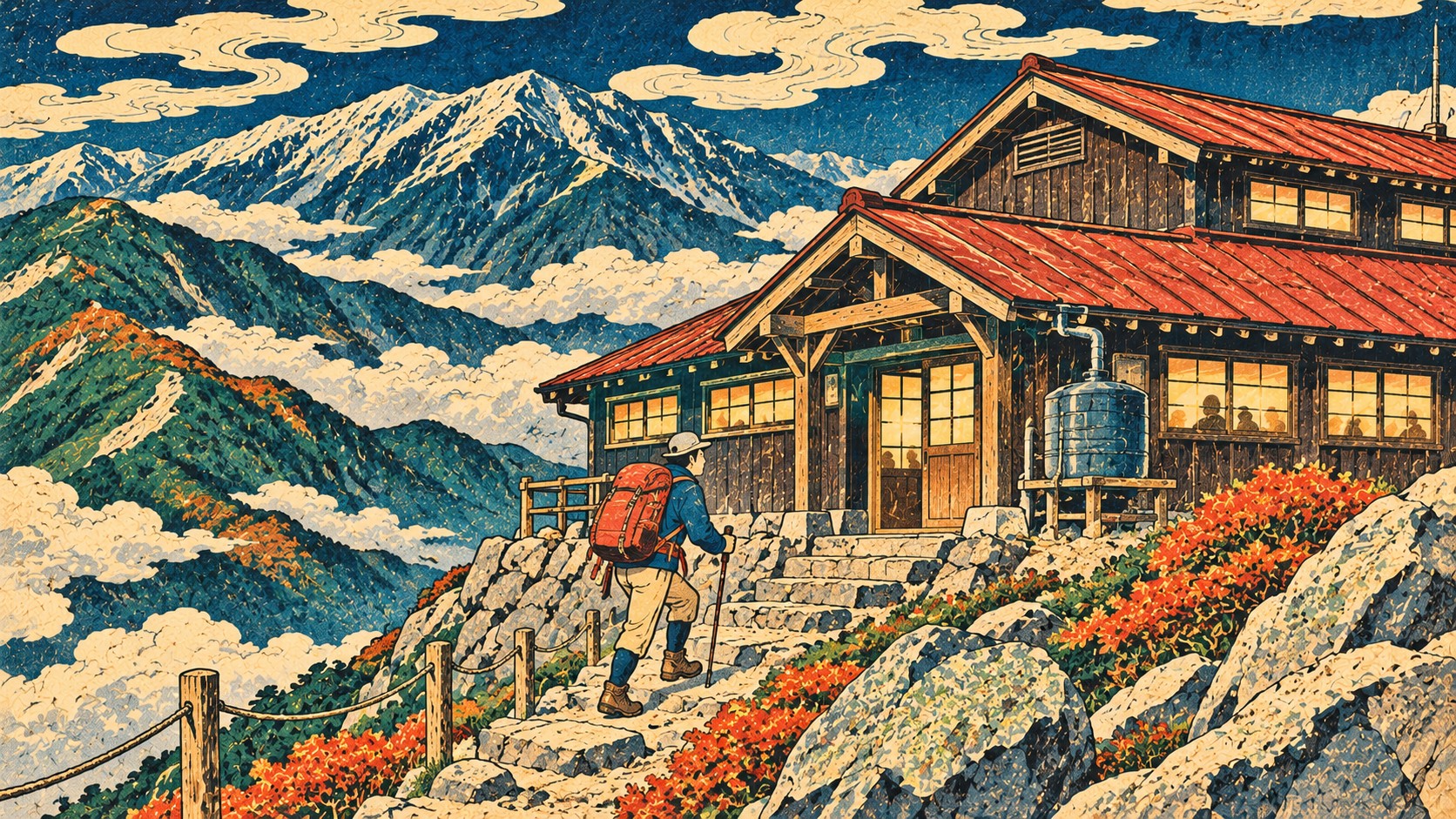
An alpine hut offers a roof when the weather turns, a hot meal after a steep ascent and a place to rest before the summit. But much of its importance is visible only when something goes wrong: a damaged trail is repaired, a missing hiker needs help or a remote toilet system must be maintained without a sewer connection. The hut is not merely selling a night’s accommodation. It is part of the infrastructure that makes mountain access possible.
That distinction is at the heart of research announced by Hokkaido University on November 19, 2026. Professor Tetsuya Aikoh of the university’s Faculty of Agriculture, lecturer Nao Yoshizawa of its media and communication research faculty and Jean Miczka of the University of Lausanne examined how huts and emergency shelters perform public functions within Japanese national parks. Their paper appeared online October 25 in the Journal of Alpine Research / Revue de géographie alpine.
The findings are particularly relevant as Japan seeks to accommodate visitors while protecting steep, fragile landscapes. If private operators provide functions that resemble public services, a basic question follows: should the viability of those services depend principally on how many beds a hut sells?
What the researchers measured—and what they did not
The researchers compared 232 mountain huts and emergency shelters using Ministry of the Environment survey data from five national parks in central Honshu: Chubusangaku, Minami Alps, Chichibu-Tama-Kai, Oze and Bandai-Asahi. The study did not survey huts situated in Hokkaido, despite the lead university’s location.
Facilities were compared by ownership and operating arrangement, including whether personnel were present. According to the university, more than 80% of the staffed, privately operated huts performed trail maintenance and more than 90% took part in mountain rescue-related activities. Environmental protection was another important function. These patterns show how much fieldwork is undertaken by operators who also run commercial accommodations.
Those percentages require precision. They describe the share of facilities in the relevant sample category reporting each activity. They do not mean private huts conducted 90% of all Japanese mountain rescues or maintained 80% of all national-park trail kilometers. The public summary also does not establish the hours, costs or outcomes of each task; activity rates and workload are different measures.
Why Japan’s national parks work differently
Japan uses a regional national-park system in which a protected area may include privately owned land, settlements and commercial activity. It is not a single unified estate in which one public agency owns and operates every trail, shelter and visitor facility. This arrangement requires coordination among national and local authorities, landowners, businesses and users.
In rugged mountain areas, official staff and budgets are limited. A hut already has people on the ground, a supply chain and extensive local knowledge. Operators often help with trail repairs, sanitation, waste management, visitor information and emergency response because those services matter to their guests and to the surrounding mountain environment.
The model creates a productive overlap between private incentives and public benefits. A safe, attractive trail brings customers to the hut; repairing the trail also helps day hikers who never buy a meal or a bed. In economic terms, some benefits extend beyond the paying customer. That is precisely why reliance on accommodation revenue alone can become a problem.
Ninety years of protected landscapes
Japan’s national-park system grew out of an early twentieth-century push to protect remarkable scenery while enabling recreation. The National Parks Law was enacted in 1931, and Setonaikai, Unzen and Kirishima became the first designated national parks in March 1934. Chubusangaku and several other parks were designated later that year. The Natural Parks Act of 1957 established the modern categories of national, quasi-national and prefectural natural parks.
As mountain travel expanded, huts became familiar landmarks in Japan’s alpine regions. Their location made them different from ordinary hotels: roads, public water supplies, power networks and sewerage may be absent. Bringing up materials or removing waste can require extraordinary logistics. Maintaining facilities in snow, high winds and short working seasons adds to the burden.
This study has not discovered an entirely unknown public role. Japan’s Environment Ministry has long acknowledged that mountain huts maintain toilets, trails and visitor safety, and has supported some environmental facilities. The new contribution is comparative evidence showing how these functions vary across management types and why long-standing arrangements may need institutional reinforcement.
The economics of keeping a remote hut open
A hut must pay staff, maintain buildings and move supplies through difficult terrain. Helicopter transport, where used, is expensive; heavy rain can damage approach trails; and changing visitor patterns can make income less predictable. Researchers point to rising transport costs, extreme weather and shifts in recreational demand as pressures on a model that historically depended on private operators reinvesting earnings in shared infrastructure.
A person who stays overnight contributes through the accommodation bill. A day hiker may use the same trail, benefit from rescue cooperation and rely on sanitation or information without supporting the hut in the same way. This is not evidence that day hikers are free riders in every case—some contribute through other fees or local spending—but it exposes a mismatch between the people who benefit and the revenue that sustains the service.
The university announcement does not provide a national deficit for the hut sector, the costs of every rescue mission or a definitive subsidy amount. An assertion that all operators are unprofitable would overstate the evidence. The stronger argument is structural: essential work should not be put at risk solely because a hut’s commercial income fluctuates.
Public support already exists—but it has limits
The Environment Ministry already runs a mountain-environment conservation support program for facilities such as wastewater and human-waste treatment systems at privately operated mountain huts. A separate subsidy mechanism dating from fiscal 2011 has covered portions of qualifying infrastructure expenses, subject to conditions involving remoteness and public purpose.
In June 2026 the ministry also launched a mountain visitor-environment improvement grant call, backed by international tourist-tax revenue, supporting work such as nature-sensitive repairs of eroded trails and restoration of nearby vegetation. The ministry’s annual environmental reporting describes related support. It would therefore be inaccurate to claim the Japanese government provides no help to mountain huts.
The researchers are arguing for something broader: appropriate compensation or public finance for public functions, clearer recognition of the huts’ multiple roles within the legal framework and participation by hut operators in collaborative decision-making. These are research recommendations, not reforms the government has already enacted.
Governance beyond the hut door
Many authorities have overlapping interests in a mountain landscape: the Environment Ministry manages the national-park framework, local governments may maintain infrastructure, police and rescue services respond to emergencies, and operators know the changing terrain and visitor behaviors. A sustainable system would have to make responsibility clear without erasing the practical expertise of those already working on the mountain.
Possible arrangements include user contributions, contracts for clearly defined maintenance tasks, compensation for emergency support and joint planning bodies. None is automatically right for every park. A remote emergency shelter, a large staffed lodge and a small family-run hut may have different costs, users and legal obligations.
This debate is already taking shape among practitioners. A March 2026 Natural Parks Study Group session brought researchers, hut operators and ministry representatives together to discuss the public interest, legal position and future sustainability of huts. For the study’s authors, collaborative governance means that the people carrying out work on the trail have a meaningful voice in how that work is organized and funded.
The unanswered question: can Japan measure the full cost of access?
The findings are based on existing Ministry of the Environment survey data; they are not the result of a new census of every hut in Japan in November 2026. The sample is regionally focused, and the percentages do not quantify the magnitude of each service. A policy response would benefit from clearer information on maintenance hours, trail conditions, rescue support, transport costs, changing occupancy and environmental outcomes.
Any increase in public spending should also bring accountability: what activities are being funded, how are results measured, and can small operators meet reporting requirements? Conversely, demanding complex paperwork from isolated businesses could undermine the very services a subsidy aims to preserve.
The panorama from a Japanese mountain ridge appears timeless. The systems that let people reach it are not. Trails wear away, storms interrupt access and skilled workers become harder to retain. This research reframes a familiar mountain building as a public-serving institution—and asks whether the people who benefit from the mountains are prepared to share the responsibility for keeping them accessible.
Primary sources and reporting notes
Based on Hokkaido University’s November 19, 2026 announcement, the paper published October 25, and Environment Ministry resources on national parks and mountain-environment programs. No original interviews with researchers or hut operators were conducted. Participation rates are not national shares of rescue missions or trail mileage.