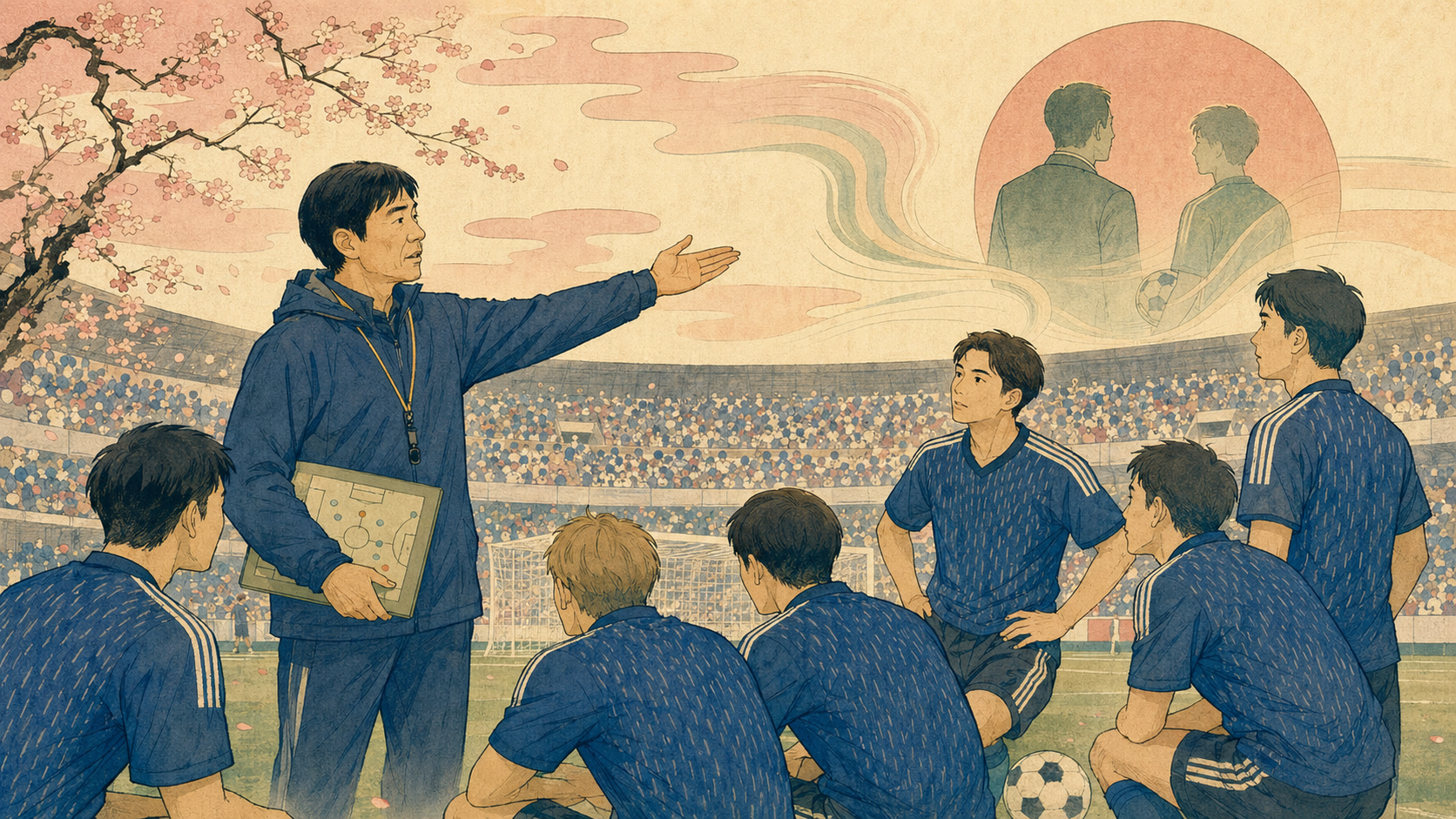
The most revealing thing about Japan’s next coaching change is that nobody has to guess when it will happen. On July 23, the Japan Football Association wrote the ending of Hajime Moriyasu’s tenure and the beginning of Go Oiwa’s into the same board resolution. Moriyasu will remain through the AFC Asian Cup in Saudi Arabia, ending February 5, 2027. Oiwa will take the senior team from the March friendlies through the 2030 World Cup—and, for a crucial stretch, coach Japan’s under-21 side on its road to the Los Angeles 2028 Olympics at the same time.
National-team successions are usually born in turbulence. A tournament ends, the result is judged, names leak, negotiations begin and a new coach arrives after the emotional weather has changed. Japan has chosen the opposite. The successor is known before the outgoing coach selects his final squad. The handover is not merely expected; it is a policy. JFA president Tsuneyasu Miyamoto named the governing idea “inheritance and evolution.”
That phrase contains both the promise and the risk. Moriyasu has led Japan since July 2018, longer than any previous Samurai Blue coach, and his official record at the time of the announcement stood at 108 matches: 74 victories, 16 draws and 18 defeats. Oiwa brings two consecutive AFC under-23 titles, a Paris Olympic quarter-final and an Asian Champions League trophy with Kashima Antlers. Yet a known successor creates a second center of attention. Every selection can be read as a message to 2027; every tactical experiment can be mistaken for a rehearsal; every defeat can reopen the question of why the future is waiting.
The resolution is unusually precise
The board paper removes ambiguity. Moriyasu is appointed through the 2027 Asian Cup. Oiwa is appointed from the March 2027 friendlies through the FIFA World Cup 2030. The public announcement adds that he will retain the Olympic-age team, creating a bridge between today’s senior internationals and players who will be entering their mid-twenties when the 2030 tournament arrives.
JFA did not describe Moriyasu’s extension as an open-ended third cycle. It defined a six-month mission: win the Asian Cup and deliver the team cleanly to an already chosen successor. Nor is Oiwa an interim placeholder. He has a World Cup destination, a youth-development mandate and time to shape both before qualification pressure peaks.
Miyamoto said the decision was made by working backward from the Asian Cup. Japan must demonstrate that it can finish the job in Asia before it can claim to challenge the world. Technical director Masakuni Yamamoto argued that the federation should not tear everything down: Japan had risen from the 50s in the FIFA ranking when Moriyasu began to 17th, built trust across age categories and proved it could compete with elite opponents. The institution wants new air without institutional amnesia.
Why Moriyasu remains after the 2026 World Cup
The decision makes more sense when viewed against a World Cup that was neither a breakthrough nor a collapse. At the expanded 2026 tournament, Japan drew 2–2 with the Netherlands, beat Tunisia 4–0 and drew Sweden 1–1 to advance from its group in second place. In the round of 32, Japan led Brazil through Kaishu Sano’s 29th-minute goal, conceded an equalizer to Casemiro and lost 2–1 to Gabriel Martinelli’s strike in the fifth minute of stoppage time.
It was a cruel exit, especially after Japan had beaten Brazil for the first time in a 2025 friendly. But it was not evidence of a program in ruins. Moriyasu told the post-announcement press conference that he was disappointed not to go further, yet did not feel he had unfinished World Cup business. That distinction matters. He is staying to complete a continental task, not to claim another four-year right to the job.
JFA’s calculation is practical. A new coach appointed in the summer of 2026 would have only a handful of windows before a major championship beginning January 7. Moriyasu knows the senior pool, the European club calendar, the qualification environment and the pressure of Asian tournament football. Keeping him reduces transition cost. Naming Oiwa now reduces the cost that would otherwise follow the Asian Cup.
A career shaped by the distance between “almost” and “finished”
Moriyasu’s place in Japanese football began long before he became its most durable national coach. As a disciplined midfielder, he played for Japan’s first Asian Cup-winning team in 1992 and was on the pitch in Doha in October 1993 when Iraq’s late equalizer denied Japan a first World Cup appearance. The “Agony of Doha” became the foundational heartbreak of the professional era: a lesson that a match, a qualifying campaign and a national dream remain provisional until the final whistle.
His club coaching career turned those experiences into repeatable structure. At Sanfrecce Hiroshima, a club that routinely lost leading players to richer rivals, he won the J1 League in 2012, 2013 and 2015. The teams were tactically flexible, collectively drilled and able to shift between possession and transition. Success did not depend on buying the most famous squad; it depended on clarity, adaptation and belief in a system.
JFA first placed him on the pathway that Oiwa now follows. Moriyasu took the Olympic-age team in 2017, joined the senior staff before the 2018 World Cup and became senior head coach after the tournament. He later held the senior and Olympic roles together, guiding Japan to fourth place at the postponed Tokyo Games. The federation’s new dual-role design is therefore not theoretical. It is a variation on a structure Moriyasu himself embodied.
The Moriyasu record: historic victories, an unbroken ceiling
At Qatar 2022, Japan beat former world champions Germany and Spain by identical 2–1 scores, won its group and pushed Croatia to a penalty shootout in the round of 16. Moriyasu became the first Japan coach retained after leading the team at a World Cup. The continuity was historic, and it signaled that JFA no longer saw each four-year cycle as a sealed container.
Yet the ceiling remained. Japan has reached the World Cup knockout stage five times but has never reached the quarter-finals. Under Moriyasu, the team exited in the round of 16 in 2022 and in the new round of 32 in 2026. The labels differ because the tournament expanded; the frustration does not. Japan could trouble giants and recover inside games, but could not yet win the elimination match that opened the “new scenery” Moriyasu so often invoked.
The debate around his football reflected that tension. Supporters admired emotional steadiness, squad unity and daring mid-match adjustments. Critics saw periods of passive possession, dependence on individual acceleration and reactive choices that arrived after control was lost. Both readings can be true. Moriyasu made Japan exceptionally difficult to break and capable of shocking great teams; he did not make the final barrier disappear.
The Asian Cup is not a farewell tour
For Japan, the Asian Cup is the sharpest test of the contradiction between global reputation and continental delivery. The country remains the competition’s record four-time champion—1992, 2000, 2004 and 2011—but will arrive in Saudi Arabia 16 years removed from its last title. Moriyasu’s 2019 side won six straight matches before Qatar defeated it 3–1 in the final. At the tournament called Qatar 2023 but played in early 2024, Japan entered as favorite and lost 2–1 to Iran in the quarter-finals after conceding a stoppage-time penalty.
Those defeats explain why the 2027 campaign cannot be treated as a ceremonial ending. JFA has explicitly prioritized the title. Winning also matters to FIFA ranking and future tournament seeding. A squad chosen mainly to prepare Oiwa’s 2030 team would weaken Moriyasu’s mandate; a squad frozen around aging loyalty would burden the successor. The outgoing coach must choose the best team for January while leaving the next coach a stronger player base in March.
Japan’s Group F schedule offers no soft narrative. Indonesia comes first on January 11, followed by Thailand and defending two-time champion Qatar. Indonesia has recently become a familiar, fast-improving opponent. Thailand’s technical quality can punish complacency. Qatar carries the memory of the 2019 final and the confidence of consecutive championships. A record four-time winner will be measured less by reputation than by how it manages three different problems before the knockout rounds even begin.
Go Oiwa has been built for this moment
Oiwa’s résumé is different in shape but compatible in logic. A center-back from Shizuoka, he played 386 J1 matches for Nagoya Grampus, Júbilo Iwata and Kashima Antlers and won three senior caps for Japan. At Kashima he spent more than six years as an assistant before becoming head coach in 2017. His league record was 50 wins, 20 draws and 20 losses in 90 matches. In 2018 he led Kashima to its first AFC Champions League title, surviving the travel, styles and psychological swings that define Asian competition.
JFA then moved him into development. He coached Japan’s under-18s in 2021 and took charge of the group that advanced from U-21 to U-23. His team won the 2024 AFC U-23 Asian Cup and qualified Japan for an eighth consecutive Olympics. In Paris, Japan reached the quarter-finals without using any over-age players—an intentional investment in the eligible generation. JFA renewed him for the LA 2028 project, and he added the 2026 AFC U-23 title with the next age group.
That sequence matters more than the convenient label “youth coach.” Oiwa has won Asia at club level and twice at under-23 level. He has managed selection across rapidly changing age groups, where a star can disappear into a senior club, an injury can transform a qualifying roster and development must coexist with elimination football. JFA is betting that these are not lesser pressures than senior management, only different ones.
| Coach and phase | Primary competitive task | Institutional purpose |
|---|---|---|
| Moriyasu, September 2026–February 2027 | Build a tournament-ready senior side and win the Asian Cup | Preserve stability after the World Cup and complete the current era with a major title |
| Oiwa, from March 2027 | Launch the senior program toward 2030 qualification | Introduce new authority without discarding accumulated data, staff knowledge and player trust |
| Oiwa, through LA 2028 | Lead the Olympic-age side while also managing Samurai Blue | Make the youth-to-senior pathway direct and accelerate the 2030 generation |
| Oiwa, 2028–2030 | Integrate Olympic graduates with established internationals | Turn development continuity into a team capable of winning a World Cup knockout match |
Two teams can create one pathway—or split one coach
The dual mandate is the boldest part of the plan. In its ideal form, Oiwa will know the Olympic generation in unusual depth. He will understand which players can learn multiple roles, who responds to pressure, who can travel across continents and recover, and who leads without a captain’s armband. When a senior position opens, promotion will not begin with video alone. It will begin with accumulated knowledge.
The calendar can also become punishing. Senior windows, Olympic preparation, player negotiations with clubs, scouting, staff meetings and international travel all compete for the same attention. The senior team cannot become an annex of the Olympic side, and the under-23s cannot become a reserve team whose best players are repeatedly removed. Clear delegation will be essential: aligned principles, separate daily leadership, shared data and an explicit rule for which team has priority when schedules and player needs collide.
Moriyasu and Oiwa already work in neighboring coaching rooms at JFA’s national training center and have exchanged players between their teams. That proximity can help. But a good handover requires more than friendship. It requires documentation of player evaluations, medical history, tactical vocabulary, set-piece processes, opposition analysis, club relationships and the small operational lessons that disappear when a staff leaves. “Inheritance” must be a system, not a mood.
What may change on the pitch
It would be careless to reduce either coach to a fixed formation. Moriyasu has used back threes, back fours, aggressive wingbacks, compact mid-blocks and high pressing depending on the opponent and available players. Oiwa’s youth teams have likewise shifted structures while emphasizing compact distances, defensive responsibility and rapid forward play. Both coaches came through Japanese club environments where collective coordination matters more than a branded shape.
The likely evolution is therefore less about replacing one diagram with another than about changing where authority sits. Oiwa will inherit a senior group accustomed to tactical switching and extensive European-club experience. He can demand earlier control of matches rather than waiting for halftime rescue, deepen coordinated pressing, and make promotion from youth teams part of normal competition for places. But he must preserve the resilience and emotional equality that made Moriyasu’s squads dangerous after setbacks.
The most important tactical question is the one Japan has carried across several cycles: can the team impose itself when favored as reliably as it disrupts an elite opponent? Asian tournaments often deny Japan the transition spaces that appear against Germany, Spain or Brazil. Oiwa’s success will depend on solving low blocks, controlling second balls, defending counters and winning physically difficult matches without turning possession into comfort.
A succession with a shadow
Pre-announcing the next coach has costs. If Moriyasu leaves a popular player out, the debate may shift immediately to whether Oiwa would select him. If a young player appears, observers may call it succession planning even when the choice is purely competitive. Oiwa will be asked about senior decisions he does not yet own. Players may feel two evaluations running at once.
The remedy is a hard boundary. Moriyasu said that communication with Oiwa would continue, but Asian Cup decisions would be his and he would take full responsibility. That is the correct constitutional arrangement. Consultation can prepare the future; divided authority would damage the present. Oiwa’s restraint before March 2027 will be as revealing as his first selections afterward.
There is also a fairness issue. A plan announced in 2026 cannot guarantee performance in 2029. JFA has provided direction, not immunity. Oiwa’s contract horizon should give him room to integrate a generation, but the federation still needs transparent checkpoints: World Cup qualification, competitive performance, staff effectiveness and tactical progress. Continuity becomes stagnation when succession is treated as destiny rather than a tested strategy.
Japan’s coaching history reaches a new stage
Modern Japanese football was built through alternating kinds of authority. Dutchman Hans Ooft led the first Asian Cup triumph in 1992 and the near-miss in Doha. Takeshi Okada took Japan to its first World Cup in 1998 and later to the round of 16 in 2010. Philippe Troussier won Asia in 2000 and reached the 2002 knockout stage. Zico won the 2004 Asian Cup; Alberto Zaccheroni won in 2011. Akira Nishino’s short emergency tenure ended with the painful 3–2 defeat by Belgium in the 2018 round of 16.
Moriyasu changed the pattern. He became the first Japan coach retained after a World Cup he had managed, then led a second tournament and stayed for a defined continental coda. Oiwa’s appointment extends the shift from episodic hiring to internal succession. Both are Japanese coaches formed by the J.League, Asian competition and JFA’s age-group system. The federation is asserting that its own coaching pipeline is now mature enough to carry a national project across cycles.
That is a sign of confidence, not proof of superiority. Foreign coaches helped internationalize Japan’s ideas and expectations. Domestic coaches can offer cultural fluency, continuity and detailed knowledge of the player pathway. The best system should remain open to both. What distinguishes the new plan is not nationality alone; it is the decision to make the transition itself part of performance strategy.
The road to 2030 spans generations and continents
The 2030 World Cup will be staged primarily in Morocco, Portugal and Spain, with centenary matches in Argentina, Paraguay and Uruguay. Reaching the latter stages will demand more than one golden age. Some current senior leaders will be deep into their thirties. Several players Oiwa has coached at youth level will be entering their physical prime. Others not yet prominent in 2026 will emerge from academies and universities during his tenure.
This is why the overlap with LA 2028 is strategically attractive. An Olympic tournament can harden a group two years before the World Cup, while the senior team provides an immediate higher ceiling for exceptional players. But 2030 cannot become the Olympic side plus veterans. The best national team must remain open to late developers, dual-national players, domestic standouts and those who grow outside Oiwa’s direct pathway.
JFA’s long-term ambition is to win the World Cup by 2050. Such declarations can sound remote, but institutions reach distant goals through nearer decisions: how coaches are trained, how information survives a transition, how players move between age levels and whether a tournament loss produces learning rather than panic. The Moriyasu–Oiwa plan is one of those decisions. Its value will be measured not only in 2030, but in whether planned succession becomes a repeatable capability.
First, there is a cup to win
The future can wait until the final whistle in Saudi Arabia. Moriyasu’s last chapter is not an epilogue because the Asian Cup is the title that has eluded his national-team tenure. He won it as a player in 1992. As a coach he came within one match in 2019, then left the 2023 edition in the quarter-finals. To finish with Japan’s fifth championship would turn an administrative handover into a sporting inheritance.
Oiwa’s task is harder to photograph. Before he leads a senior match, he must prepare without intruding, study without second-guessing and preserve his Olympic project while absorbing the scale of the role ahead. After March, every promise of continuity will be tested by the first squad, the first difficult away match and the first time a great player no longer fits.
Japan has chosen to place a bridge between two eras before reaching the river. That can look overdesigned in a sport ruled by form, injury and accident. It can also be the mark of a federation mature enough to know that continuity should not mean permanence and change should not require destruction. Moriyasu has one last trophy to chase. Oiwa has four years to turn the handover into progress. For once, the uncertainty lies not in who comes next, but in what Japan can build because it already knows.
Sources and references
The coaching succession is an official JFA decision. Match records and appointments are stated as of July 25, 2026; future schedules may change.
- JFA: official announcement of Moriyasu’s extension and Oiwa’s succession, July 23, 2026
- JFA: 2026 ninth board meeting resolution, including the March 2027 handover (PDF)
- JFA: Moriyasu, Miyamoto and Yamamoto press conference, July 24, 2026
- JFA: board meeting report and coaching timetable
- JFA: Brazil 2–1 Japan, 2026 World Cup round of 32
- JFA: Japan team history from Qatar 2022 through the 2026 cycle
- JFA: Japan’s AFC Asian Cup history
- JFA: 2027 Asian Cup Group F draw
- AFC: dates and host cities for the 2027 Asian Cup
- JFA: Oiwa appointed to lead the LA 2028 Olympic project
- JFA: Oiwa and Kashima win the 2018 AFC Champions League
- AFC: coaching profile of Go Oiwa
- FIFA: the 1993 “Agony of Doha”
- FIFA: World Cup 2030 host information
- Reuters: Moriyasu targets the Asian Cup title before the handover