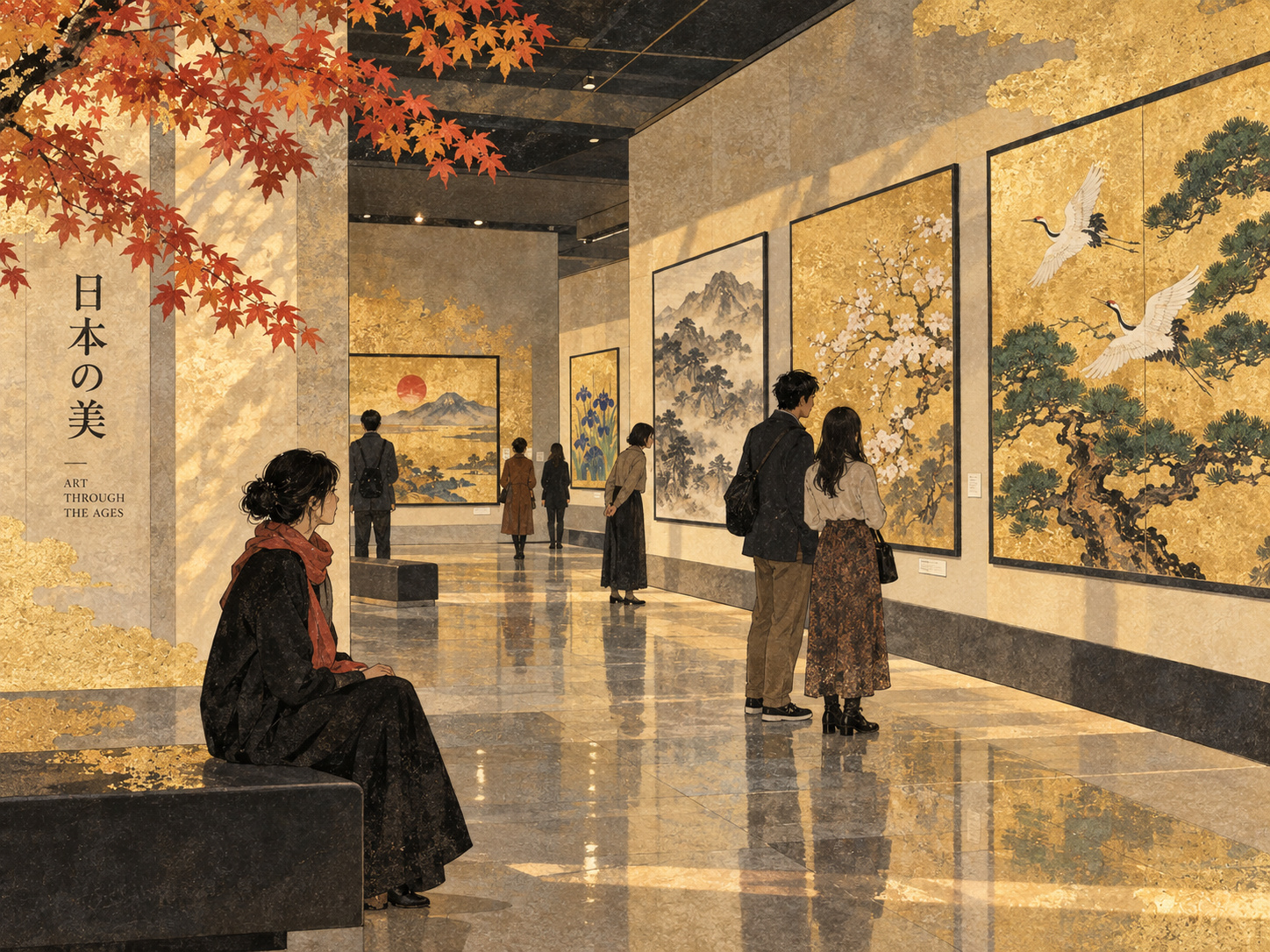
An autumn program at an art museum usually begins with one exhibition title. Tokyo's National Museum of Modern Art is trying something broader in 2026.
From September 29 through November 15, MOMAT is holding its first “MOMAT Autumn Days,” a museum-wide seasonal program rather than a single exhibition. Its center is the rotating MOMAT Collection, but the program pulls together a premium display of collection masterpieces, family days, guided ways of looking, a Paris-focused collection project and even food trucks in the museum forecourt.
This is an edited museum experience, not one exhibition
MOMAT Autumn Days does not occupy one gallery under one curatorial thesis.
It gathers the MOMAT Collection that opened September 29, the collection-focus project Amis de Paris: Japanese Artists in Paris, the October Family Day program, conversational gallery activities and outdoor food service into one seasonal frame.
That framing is the real experiment.
A conventional museum visit begins with the idea that a person has come to “see the exhibition.” Autumn Days asks the visitor to treat looking, talking, resting, eating and moving through several kinds of programming as one museum stay.
Kiyokata's triptych is also a portrait of Tokyo becoming modern
The most famous work in the autumn display, Tsukiji Akashicho, dates from 1927. Its companion paintings Shintomicho and Hamacho-gashi were made in 1930.
In Tsukiji Akashicho, a woman pulls her sleeve close in an autumn breeze. A pale Western-style fence, ship masts in the mist, her fashionable coiffure and a large gold ring all carry traces of Meiji-era Akashicho, once a foreign settlement.
The painting is often categorized as bijinga—a picture of a beautiful woman—but Kiyokata's larger subject is urban memory. Edo survives inside a city being reshaped by Western architecture, newspapers, theater and new forms of public life.
For 44 years, the paintings were effectively lost from public view
The three paintings have their own institutional history.
Tsukiji Akashicho established Kiyokata's reputation after its appearance in the 1927 Imperial Art Exhibition. Together with the two 1930 companions, it became a celebrated triptych.
After Kiyokata's death, however, the works disappeared from public exhibition for 44 years. MOMAT has described them as “phantom masterpieces.”
The museum acquired all three in 2019. They were shown prominently in the 2022 exhibition marking 50 years since Kiyokata's death, and in 2023 all three were designated Important Cultural Properties.
The 2026 reunion is therefore not simply a popular-work encore. It illustrates the public-museum cycle: acquire a privately held work, research it, conserve it, place it in historical context and make it repeatedly available to the public.
No need to call them “national-treasure level”
Popular writing about Japanese art sometimes calls an admired modern work “national-treasure level.” In this case, vague praise is unnecessary.
The three Kiyokata works are legally designated Important Cultural Properties. MOMAT records June 27, 2023 as the designation date for Tsukiji Akashicho.
That status is significant because modern art entered Japan's cultural-property framework later than temple sculpture, ancient painting or medieval scrolls.
A modern-art museum therefore has a long-horizon conservation role: works that once seemed “recent” are becoming protected national cultural assets.
Hishida Shunso and Higashiyama Kaii show why “Nihonga” is not one style
The premium autumn collection also highlights major works by Hishida Shunso and Higashiyama Kaii.
Hishida Shunso, born in 1874, helped transform modern Japanese painting through the Japan Art Institute. MOMAT's best-known holdings include his 1902 Wang Zhaojun.
Higashiyama Kaii, born in 1908, became one of the defining landscape painters of postwar Nihonga, turning roads, forests and water into quiet spaces that are representational and almost abstract at once.
Kiyokata's urban women, Shunso's Meiji-period experiments and Higashiyama's postwar landscapes can all be filed under “Japanese-style painting.” The collection galleries make the inadequacy of that single label visible.
The museum was created to collect Japan's modernity
MOMAT opened in 1952 in Kyobashi as Japan's first national art museum.
Its first building was a converted prewar Nikkatsu headquarters. Space was limited, and the absence of a proper permanent collection gallery became a major institutional problem.
In 1969 the museum moved to a newly built home in Kitanomaru Park designed by architect Taniguchi Yoshiro and donated through Bridgestone chairman Ishibashi Shojiro.
Major renovation and expansion around 1999-2001 strengthened galleries, library and visitor functions. In 2012 the collection galleries were again reorganized into the MOMAT Collection format familiar today.
MOMAT's “permanent collection” is deliberately not permanent
Many large museums are imagined as places where famous works occupy the same wall indefinitely. MOMAT's collection display is more actively rotated.
Several times a year, the museum re-edits the story of Japanese modern and contemporary art across roughly a dozen rooms. Conservation requirements are one reason: works on paper and silk cannot remain under gallery light indefinitely.
But rotation also has an intellectual consequence. The collection does not become a fixed textbook. Changing themes and juxtapositions change the history visitors see.
Autumn Days makes that act of editing unusually visible to a broad public.
A magazine collaboration extends the collection beyond the museum
This edition of the MOMAT Collection also includes a collaboration with the November issue of Fujingaho.
Works introduced in the magazine's guide to modern Japanese art and MOMAT are displayed during the exhibition period.
The visitor can encounter the work first in print and then in the gallery—or reverse the sequence. It moves interpretation beyond the traditional museum wall label and into a lifestyle publication with a different readership.
Amis de Paris complicates the idea of “Japanese modern art”
The concurrent collection project Amis de Paris: Japanese Artists in Paris adds another useful dimension.
Japanese modern art is often narrated as a one-way process in which “Western art” entered Japan and was adapted locally. The reality was more mobile.
Japanese artists lived in Paris, rented studios, ate, exhibited, made friendships and absorbed very different parts of European artistic life. Paris was not simply an abstract West. It was a working city in which Japanese artists built careers and communities.
Those experiences returned to Japan through oil painting, prints, design and debates about what modern Japanese art could be.
Family Day begins October 8
Another pillar of Autumn Days is “Family Day Kodomo-MAT,” running October 8-16.
The program is designed around children, families and visitors who may be entering an art museum for the first time.
A related display, roughly translated as “Seeing Stories,” invites visitors to ask what appears to be happening inside a work, what a figure may be doing or how different viewers construct different narratives from the same image.
Museum education at its best is not about memorizing artist names. It is about learning to describe what one sees and discovering that another person can stand beside the same picture and see something different.
Why does a national museum need a food truck?
Food trucks in the front yard can look unrelated to art history.
They make more sense if the program's subject is how people use a museum.
A visitor who can sit, eat, talk and return to the galleries experiences the institution differently from someone moving through a checklist of masterpieces and leaving. Dwell time becomes social rather than simply transactional.
For a national museum, that can be part of public access: making the building feel like a place where non-specialists are allowed to spend time without already knowing what they are supposed to appreciate.
Summer Festival to Autumn Days
MOMAT had already experimented with a seasonal frame during the 2026 Summer Festival.
That program combined evening highlight tours, short curator talks, a collection rally, late opening and food and drinks in the forecourt.
Autumn Days extends the idea but changes the emphasis. Summer offered the practical attraction of a cool indoor place during Tokyo heat. Autumn can lean on the Japanese cultural idea of geijutsu no aki—“autumn for the arts”—and put collection masterpieces at the center.
What makes up MOMAT Autumn Days
| Program | What it does | When |
|---|---|---|
| Premium autumn collection | Kiyokata triptych plus highlights including Shunso and Higashiyama | Within collection display |
| MOMAT Collection | Re-edits Japanese modern and contemporary art by period and theme | Sept. 29-Jan. 11 |
| Amis de Paris | Japanese artists and their Paris networks | Sept. 29-Jan. 11 |
| Family Day | Child- and family-centered looking and participation | Oct. 8-16 |
| “Seeing Stories” | Conversational interpretation of works | Selected autumn dates |
| Forecourt | Food-truck and rest space | During program |
A Takehisa Yumeji exhibition joins the program later in October
From October 23, the special exhibition Takehisa Yumeji: An Artist Who Created an Era overlaps with the final weeks of Autumn Days.
Yumeji worked across painting, book design, magazines, sheet music, advertising and commercial objects.
Showing him at a modern-art museum raises a productive boundary question: where does “fine art” end and publishing or commercial design begin?
That overlap fits a museum-wide program built around making modern art feel less like a sealed hierarchy of canonical paintings.
A ¥500 collection ticket is part of the story
Admission to the MOMAT Collection is ¥500 for adults and ¥250 for university students. High-school students, visitors under 18, people 65 or older and eligible visitors with disability documentation enter free under the museum's rules.
In a Tokyo exhibition economy where major temporary shows often exceed ¥2,000, inexpensive access to a large national collection matters.
When family programming, volunteer guides and seasonal activities sit on top of that admission structure, “who gets to enter and feel welcome” becomes part of the museum's cultural value.
A national museum also writes the canon
The phrase “National Museum of Modern Art” carries authority.
What it buys, conserves and hangs affects which artists later generations understand as central to Japanese modern art.
MOMAT has increasingly used collection displays to revisit that canon—through women artists, new acquisitions, conservation research and connections between historical and contemporary work.
A collection gallery that changes is therefore not merely trying to stay fresh. It acknowledges that art history itself is continuously edited.
1927: Kaburaki Kiyokata paints Tsukiji Akashicho.
1930: Shintomicho and Hamacho-gashi complete the triptych.
1952: The National Museum of Modern Art opens in Kyobashi, Japan's first national art museum.
1969: The museum moves to Taniguchi Yoshiro's new building in Takebashi.
2001: Major expansion and renovation strengthens galleries and visitor facilities.
2012: Collection galleries are reorganized into the modern MOMAT Collection format.
2019: MOMAT acquires the three Kiyokata paintings.
2023: The triptych receives Important Cultural Property designation.
Sept. 29, 2026: The first MOMAT Autumn Days opens.
More than an autumn masterpiece show
The reunited Kiyokata triptych alone is enough reason for many visitors to go to Takebashi.
But the more interesting part of Autumn Days is that MOMAT does not let the program depend only on famous pictures.
Look at a painting. Talk about it with a child. Let a guide suggest a different reading. Sit outside. Walk from Japanese artists in Paris to Kiyokata's remembered Tokyo. Return to a room you thought you had finished.
That is a different model from “study the masterpieces in the correct order.”
MOMAT was founded in 1952 to collect, preserve and show Japan's modern art. More than seven decades later, its first Autumn Days asks a second institutional question.
Not only what should a national museum show—but what kind of day should people be able to have around the art?
Sources & Reporting Notes
- The National Museum of Modern Art, Tokyo: MOMAT AUTUMN DAYS — Official museum homepage confirming MOMAT AUTUMN DAYS, Sept. 29-Nov. 15, 2026.
- MOMAT Collection, Sept. 29, 2026-Jan. 11, 2027 — Official collection exhibition that anchors the seasonal program.
- MOMAT: Tsukiji Akashicho — Official object record for Kaburaki Kiyokata's 1927 Important Cultural Property.
- MOMAT press release on Kaburaki Kiyokata triptych — Primary background on Tsukiji Akashicho, Shintomicho and Hamacho-gashi, their 2019 acquisition and Important Cultural Property designation.
- MOMAT institutional history — Official history: founded in 1952 as Japan's first national art museum, moved to Takebashi in 1969 and later expanded.
- MOMAT: 50 years at Takebashi — Official historical account of the museum's move from Kyobashi to the Taniguchi Yoshiro-designed building in Kitanomaru Park.
- MOMAT Summer Festival 2026 — Official background on MOMAT's seasonal-event strategy, including collection tours, evening hours and food programming.
- Internet Museum: MOMAT Autumn Days — Event summary describing the first Autumn Days, the Kiyokata triptych reunion, Hishida Shunso and Higashiyama Kaii highlights, Fujingaho collaboration and family programming.
This article is based principally on MOMAT public information available through September 30, 2026. MOMAT Autumn Days is described as a museum-wide seasonal program combining the collection exhibition, collection-focus displays, education/family programming and forecourt events rather than as a single special exhibition. The statement that the three Kiyokata Important Cultural Properties are reunited for the first time in seven years comes from the event announcement. Individual works may rotate for conservation reasons, so visitors should check MOMAT's current display information for exact dates.
Image rights: © 2026 Japan.co.jp. AI-assisted editorial illustration. Permission is required for reuse. Contact.