- The magnet that begins as a solution
- A Japanese tradition of challenging what a magnet can be
- A chemical design problem with two competing demands
- Why the molecules form a herringbone
- A small magnetic moment at an extremely cold temperature
- From the coating blade to an electrical device
- What spintronics could gain, and what is missing
- The next breakthrough may be in the manufacturing process
The magnet that begins as a solution
A magnetic crystal can be a beautiful laboratory specimen and still be a frustrating engineering material. To turn it into a component, researchers need a way to place it on a surface without destroying the very arrangement of molecules that makes it interesting. A Japanese collaboration has now demonstrated a route around that difficulty for a particular molecular compound.
The paper appeared online on November 13 in Angewandte Chemie International Edition, followed by a joint institutional announcement on November 17. Its subject is Au(4OEt), a gold-containing molecular complex. The researchers made a crystalline coating from a solution, detected a low-temperature magnetic signature in the film and built a transistor using the material.
So Yokomori, now an assistant professor at Ibaraki University, is a corresponding author alongside Shun Dekura and Hatsumi Mori. The work draws on chemistry, solid-state physics and device engineering across Japanese institutions. Its significance is not a stronger magnet, but a new route to an experimentally useful form of magnetic matter.
A Japanese tradition of challenging what a magnet can be
The familiar world of magnets was long dominated by metals and inorganic solids. Molecular chemistry offered another possibility: build the units that carry magnetic moments, then control how those units interact. An unpaired electron can contribute a magnetic moment even when it belongs to an electrically neutral molecule.
In 1991 researchers at the University of Tokyo's Institute for Solid State Physics reported ferromagnetism in the organic radical crystal p-NPNN, with a transition at about 0.65 kelvin. This landmark helped establish that collective magnetism need not depend on a metallic element. Later work on coordination compounds and molecular nanomagnets expanded the range of questions that synthetic chemistry could address.
The field is diverse. A single-molecule magnet relies on magnetic behavior associated with an individual molecular unit; a molecular crystal such as the new material instead provides a network in which interactions between molecules are central. Confusing the two obscures why the arrangement of the solid matters so much.
A chemical design problem with two competing demands
A coating process starts with a practical question: will the compound dissolve? But the desired product is not a liquid. It is a solid whose molecular architecture must form again as the solvent leaves. Good solubility alone is therefore not a guarantee of useful magnetism.
The Japanese team drew on earlier gold and nickel complexes, replacing the relevant substituents with four ethoxy groups in the new gold dithiolene compound. The design enabled dissolution while favoring a useful packing arrangement in the crystal.
This is a lesson for materials engineering more broadly. A chemical modification can influence manufacturing and electronic behavior at once. Designing a functional molecule without considering its processing route may leave a promising discovery stranded in the laboratory. Designing only for processability can have the opposite problem: the convenient material may no longer perform the desired function.
Why the molecules form a herringbone
The crystal structure resembles a herringbone pattern when viewed in the relevant plane. Rather than treating the molecules as isolated magnetic particles, the researchers examined how neighboring units interact across a two-dimensional network. This is a description of connectivity inside a crystal, not a claim that the coating is a single atomic layer.
Electrical measurements showed behavior consistent with a Mott insulator. In such a system electron-electron repulsion can impede movement even when a simpler electronic model would suggest available pathways. Localized electronic spins can then interact with their neighbors.
The broader importance of this arrangement is that a molecular chemist can change the building blocks, while a physicist can examine how those changes affect the collective state. The coating gives both disciplines a common platform for investigating the consequences.
A small magnetic moment at an extremely cold temperature
Imagine two sets of magnetic moments pointing in opposite directions. If the opposing moments cancel perfectly, the material may have little or no net magnetization. If their alignment tilts slightly, a small residual moment can remain. This is the idea behind canted antiferromagnetism.
The team used several probes, including magnetic susceptibility, solid-state nuclear magnetic resonance and magnetic torque. Their results place long-range ordering near 8 kelvin under weak-field conditions. The researchers associate the canting with the crystal arrangement and spin-orbit interactions, which can be substantial in compounds containing heavy atoms such as gold.
Eight kelvin is approximately minus 265 degrees Celsius. This matters more to prospective users than any headline about a paintable magnet. The result opens a route to scientific experiments, not a replacement for the magnets in household equipment or industrial motors.
From the coating blade to an electrical device
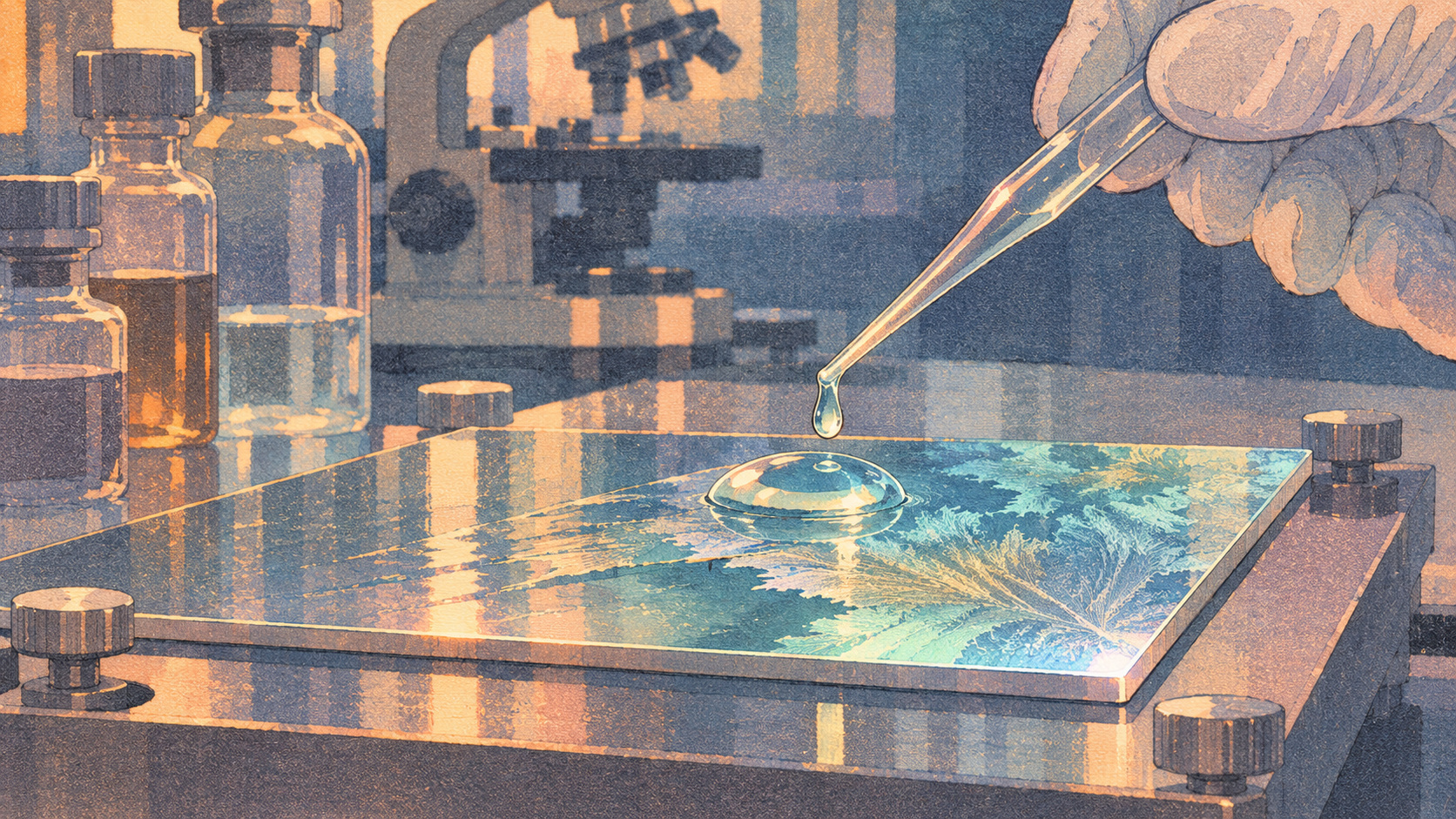
The material was dissolved in ortho-dichlorobenzene and blade-coated onto silicon. Diffraction data supported the formation of an ordered crystalline film. Magnetization measurements revealed a small hysteresis loop at 2 kelvin, but not the equivalent response at 10 kelvin. These observations connect the coated material to the magnetic state found in the bulk crystals.
The team also fabricated a field-effect transistor. Its ambipolar behavior means that the gate can select conduction involving electrons or holes, the latter being a useful description of missing electrons acting as positive charge carriers.
That combination makes the platform interesting: researchers can study electrical transport in a material whose magnetic order is also accessible experimentally. It does not yet establish that a gate can write magnetic information, nor that the transistor performs a spin-based logic operation.
What spintronics could gain, and what is missing
Modern information technology already uses magnetic properties to read and store information. The 2007 Nobel Prize in Physics recognized giant magnetoresistance, a discovery that transformed magnetic readout. Spintronics extends electronic engineering beyond charge alone to exploit spin-dependent behavior.
Molecular antiferromagnets could eventually offer researchers more freedom to engineer interactions and interfaces through chemistry. A future memory element would still need distinct, controllable states, a reliable readout and acceptable retention and switching performance. None of those system-level requirements follows automatically from observing magnetic hysteresis in a cold film.
Flexible electronics is another possible research direction because coating can be compatible with different substrate strategies. However, the reported film was made on silicon; mechanical bending, repeated flexing, adhesion on polymer substrates and large-area production remain untested in this work.
The next breakthrough may be in the manufacturing process
The long-term industrial question is whether molecular design can produce materials that retain useful order at higher temperatures while remaining easy to coat. For manufacturing, uniformity, crystal orientation, contact resistance, solvent recovery, raw-material cost and stability all matter. Gold-containing chemistry and organic solvents also make it premature to promise cheap or environmentally superior production.
Future experiments could test how injected charge changes the magnetic state, map the spin arrangement in greater detail, or compare chemical variants with different ordering temperatures. Those are concrete research questions rather than a forecast of a particular commercial product.
The achievement is a reminder that invention often consists of making an existing class of phenomena accessible in a new physical form. Japan's research team has taken a molecular magnetic crystal from the realm of bulk specimens toward patterned electronic structures. The next challenge is to discover how far that new freedom can be pushed.
Primary sources and references
- Original paper, November 13
- Rikkyo University: detailed joint release
- Ibaraki University: announcement
- RIKEN: joint announcement
- Tohoku University: research announcement
- Ibaraki University: So Yokomori profile
- 1991 organic ferromagnet paper
- Molecular magnetism review (2022)
- Organic and molecular magnets review (2004)
- Nobel Prize: giant magnetoresistance