A defender delivers again
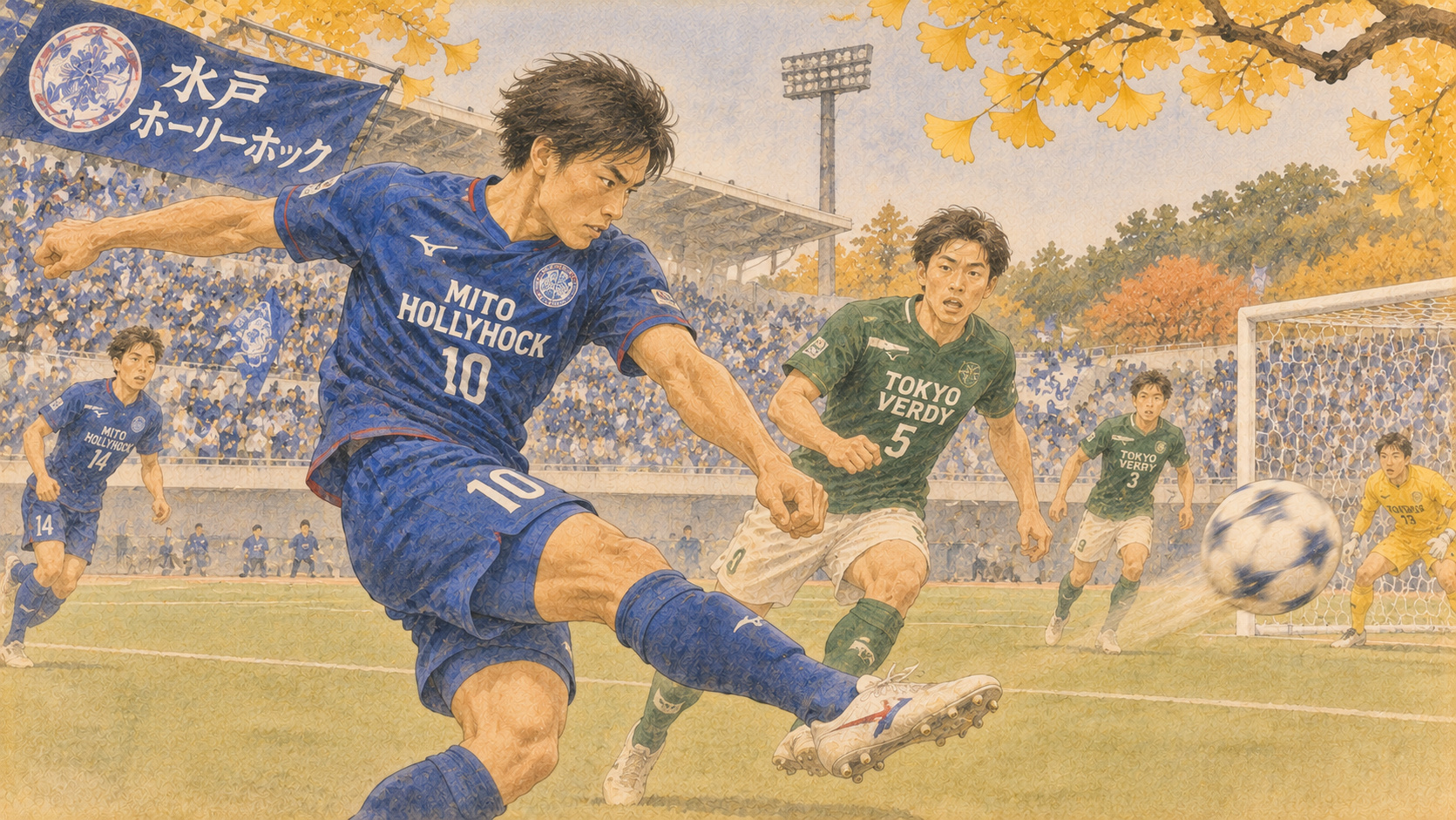
For a club trying to establish itself in Japan’s top division, a cold Wednesday evening in Naka offered something more valuable than a spectacular scoreline: a second consecutive league victory. Mito HollyHock defeated Tokyo Verdy 1–0 on November 25, with defender Yasuki Kimoto heading home a free kick in the 68th minute.
The result needs context. Verdy lost Yuta Arai to a red card after a video review in the 17th minute. Despite the numerical advantage, Mito had to wait until the second half to score. The opposing club’s match record confirms the goal, the dismissal and an attendance of 5,083.
Five days earlier Kimoto had struck an 89th-minute winner away at Vissel Kobe, sealing a 2–1 victory that broke an eight-game losing run. Kobe also had a player dismissed. The two wins are a welcome reversal, not evidence that Mito has solved every problem it faces at J1 level.
The value of experience in a developing squad
Kimoto arrived on a permanent transfer from FC Tokyo in June. The Shizuoka-born defender, 33, had already played for several Japanese professional clubs, including Cerezo Osaka and Nagoya Grampus. His recruitment illustrates an important challenge for promoted teams: young talent needs experienced colleagues capable of handling difficult matches.
Against Kobe, Mito took the lead through Genki Nishihara before conceding an equalizer to Yuya Osako. Kimoto’s late volley brought manager Naoki Mori his first league victory since taking charge in the current campaign. His subsequent header against Verdy showed how decisive contributions can come from outside the forward line.
Set pieces can provide opportunities when opponents restrict open play, particularly when a team is protecting a narrow lead or struggling to convert possession into goals. Mito’s next challenge is to sustain that effectiveness against opponents playing with a full complement of players.
From an amateur league to the national stage
Mito’s rise is a useful introduction to the structure of Japanese professional football. Its roots lie in a local club formed in 1994, a year after the J.League began. A merger with Prima Ham’s Tsuchiura team followed in 1997. Mito entered J2 in 2000, then spent a quarter-century pursuing promotion.
On November 29, 2025, the club secured its first J2 championship and promotion to J1. For supporters, the achievement represented an accumulation of seasons rather than a sudden arrival. Tokyo Verdy offers a contrasting history: it won the first two J.League championships in 1993 and 1994, yet later spent many years in the second division before returning to J1 in 2024.
Promotion and relegation make such encounters possible. A regional club does not need a permanent franchise in a major metropolis to reach the top division. Staying there, however, demands sporting depth, infrastructure and financial resilience that a single promotion cannot supply.
A club identity rooted in Ibaraki
The name HollyHock is a reference to the aoi emblem associated with the Mito branch of the Tokugawa family. It links modern football to the historical identity of a former castle town. The club’s territory extends beyond Mito itself: its official hometown network includes 18 municipalities in Ibaraki Prefecture.
Mito City describes a program established in 2022 in which professional players serve as municipal ambassadors, participating in local events and promotional activities. After the 2025 championship, the club invited businesses and shopping districts to make use of the promotion celebrations. These are concrete mechanisms through which football becomes part of civic life rather than merely a televised competition.
It would be premature to assign an economic value to November’s wins without evidence. Local spending, sponsorship renewal, visitor flows and repeated attendance would offer better measures of whether a successful club is generating durable benefits.
Building a pipeline rather than buying a shortcut
The official club history records investment in a residence for younger players in 2022, a development partnership with Germany’s Hannover 96 in 2023 and the completion of an academy training pitch in 2025. Mito also established a football team for people with intellectual disabilities in 2023. These activities show the range of responsibilities a regional club can assume.
A well-run academy can help a club identify talent early, reduce dependence on expensive recruitment and provide a pathway to professional football. Yet those advantages are neither immediate nor guaranteed. Training facilities, coaching quality, education and player welfare require funding even when the senior team is losing.
For Mito, the combination of developing young players and bringing in seasoned professionals such as Kimoto may be more sustainable than trying to match the purchasing power of larger organizations. That is an analytical possibility, not a claim about the club’s unexamined financial accounts.
A new calendar and a different home
The 2026–27 campaign marks Japan’s first regular season under its new summer-to-spring calendar. The J.League decided in December 2023 to shift the season, with a winter break and a finish around the end of May. This makes the November matches part of an ongoing campaign rather than the final stretch of the old calendar-year schedule.
Mito moved its home matches in August to Mito Shinkin Stadium, the athletics venue at Kasamatsu Sports Park in Naka. The November 25 matchday guide offered a discounted ticket for the second half and warned supporters about limited train services after the game. Both details illustrate the practical work of making weekday football accessible.
The next scheduled test is a home game against V-Varen Nagasaki on November 29. Whatever that result, Mito’s wider story is about whether years of local institution-building can support a lasting place in the country’s highest football division. Two narrow victories have offered encouragement; the longer test is still ahead.
Primary sources and references
- Tokyo Verdy: official match record
- J.League: November 25 results
- J.League: Kobe match review
- Mito: Kimoto signing announcement
- Mito: club profile and history
- Mito: 2025 J2 championship and promotion
- J.League: Tokyo Verdy historical results
- Mito City: hometown ambassadors
- J.League: season transition decision
- J.League: Mito fixtures
- Mito: promotion celebration retail initiative
- Mito: November 25 matchday information