- A museum exhibition that begins at the dinner table
- Mingei was an argument about value, not a decorative style
- Two potters whose training complicates the story of tradition
- Reading the objects: what materials tell us
- The difficult economics of beautiful everyday things
- How new work can help sustain old skills
- A Japanese movement with international roots and unanswered questions
- Visiting the exhibition in Komaba
A museum exhibition that begins at the dinner table
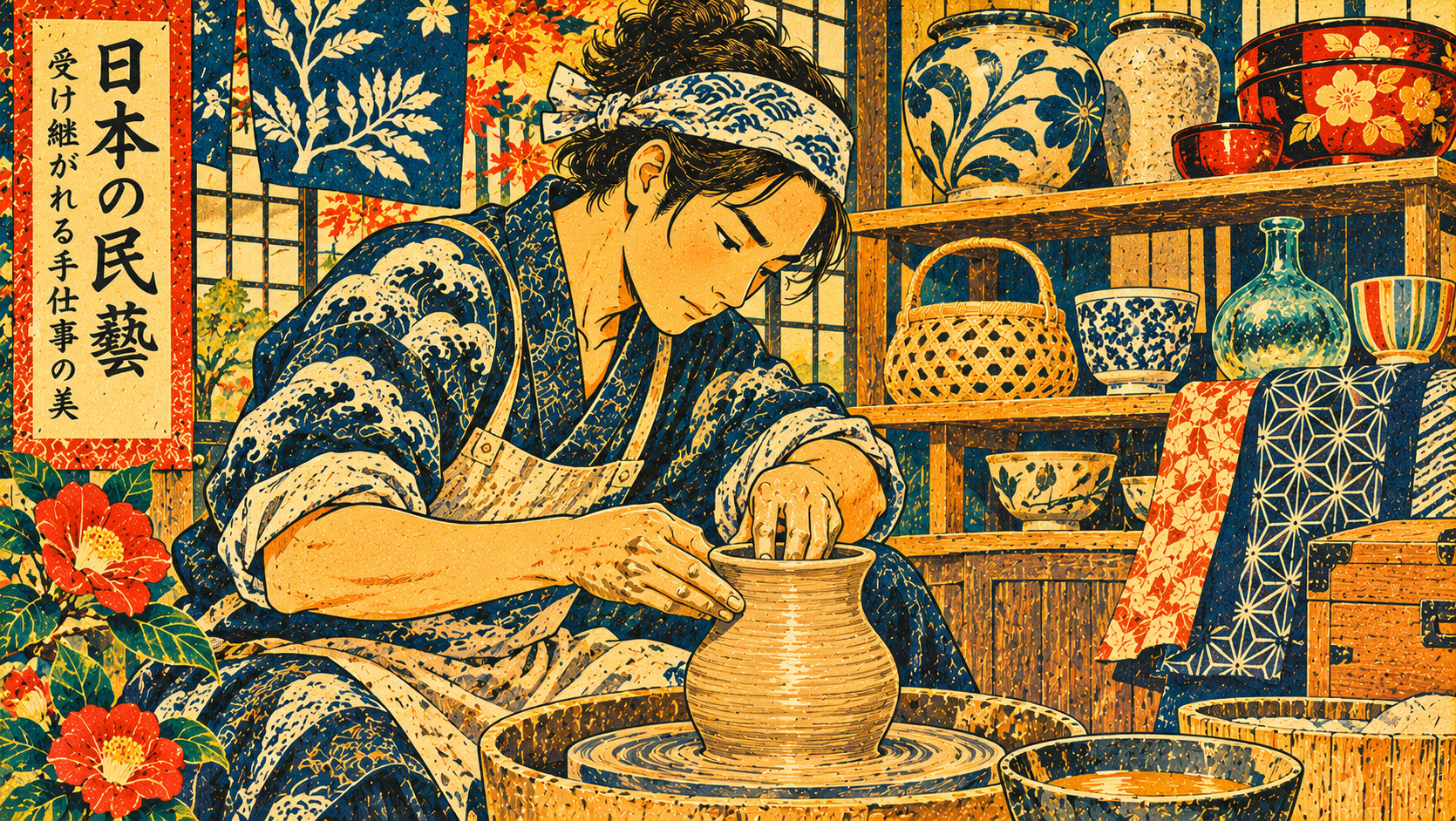
An object need not be rare to be worth looking at closely. A wooden serving plate, a dyed tablecloth or a rope curtain can reveal decisions about weight, texture and the rhythm of daily life. At the Japan Folk Crafts Museum in Tokyo, those ordinary categories of object are the subject of an annual juried exhibition that opened on November 22 and runs through December 17.
The museum's published selection includes work in pottery, weaving, dyeing, wood, lacquer, glass, metal and plant fibers. The principal museum award went to a large lacquered horse-chestnut plate by 仁城逸景 of Okayama; the Japan Folk Crafts Association award went to a moss-colored blown-glass bowl by 三浦侑子, also of Okayama. Four encouragement awards recognize an indigo tablecloth by 金成美枝, a twill-woven checkered obi fabric by 望月サラン, a rope curtain by 小林守雄 and amber-glazed ceramics by 栗田荘平. The names are retained in Japanese where an authoritative romanization was not established.
The exhibition combines display with sales, and a concurrent presentation offers works selected in a secondary category. Its focus on new production is particularly appropriate in 2026, ninety years after the museum opened. It asks whether a philosophy born during an earlier period of industrial transformation still has something to offer households and makers today.
Mingei was an argument about value, not a decorative style
The Japanese word mingei was coined late in 1925 by philosopher Soetsu Yanagi (柳宗悦, also read Muneyoshi), and potters Shoji Hamada and Kanjiro Kawai. Their 1926 museum prospectus, joined by Kenkichi Tomimoto, envisioned a place for everyday craft objects that had attracted little attention from conventional art institutions.
Yanagi, born in 1889, studied philosophy at Tokyo Imperial University and participated in the Shirakaba literary circle. Korean ceramics were central to his developing appreciation of ordinary objects. In 1924 he established a museum of Korean folk art in Seoul, during Japanese colonial rule, and criticized aspects of Japanese policy toward Korea. His intellectual journey also included research into vernacular religious sculpture and exposure to British slipware.
His 1928 book Kogei no Michi and the periodical Kogei, launched in 1931, helped spread his ideas. Supported by industrialist Magosaburo Ohara and other patrons, the Japan Folk Crafts Museum opened in Komaba in 1936. Yanagi's movement challenged the assumption that objects made for routine use were necessarily inferior to works created for collectors.
Two potters whose training complicates the story of tradition
Hamada and Kawai were not isolated village craftsmen untouched by modernity. Both studied ceramics at Tokyo Higher Technical School and subsequently worked at a Kyoto ceramics testing institution, where glaze research formed part of their professional development. Their careers show how technical knowledge and handcraft can reinforce each other.
Hamada traveled to England with Bernard Leach in 1920 and worked in St Ives. After returning to Japan he established his base in Mashiko, Tochigi, developing pottery grounded in local materials. In 1955 he was recognized as a holder of an Important Intangible Cultural Property, and in 1961 he succeeded Yanagi as museum director. His work helped bring a regional pottery center into international conversations about ceramics.
Kawai established his kiln and home in Kyoto in 1920. He initially gained recognition for sophisticated work based on historical Asian ceramics, then explored robust forms and vivid glaze effects in dialogue with the folk craft movement. His use of molds illustrates that repeatability need not eliminate creative variation. Both men became celebrated individual artists, a productive tension within a movement that emphasized the work of unnamed makers.
Reading the objects: what materials tell us
The 2026 selection invites visitors to compare materials rather than judge every entry by the same visual criteria. A lacquered wooden plate must work as a surface for serving food. Its profile, balance and finish matter as much as its appearance. In blown glass, small changes in wall thickness and curvature alter the way light travels through a vessel.
Textiles present another kind of engineering. Fold-resist dyeing uses the arrangement of fabric to influence where color penetrates; twill weaving creates a diagonal structure through the sequence of interlacing yarns. A rope curtain, by contrast, is a flexible architectural element that can divide a space without forming a solid wall.
Amber-toned ceramic glaze demonstrates the relationship between a surface treatment and the shape beneath it. These are general explanations of craft techniques, not documented recipes or workshop observations for the individual prizewinning pieces. The museum's published titles identify the works, but do not establish every material, firing condition or production method.
The difficult economics of beautiful everyday things
Mingei poses a modern economic question: can an object remain accessible to ordinary households while paying its maker fairly? A studio must cover materials, equipment, energy, unsuccessful pieces, packaging and the hours required to produce and sell its work. Training a new generation requires a livelihood, not simply public admiration.
Mass production has made durable and well-designed household goods accessible to millions of people. It would be misleading to treat the factory as inherently inferior or handmade goods as automatically environmentally beneficial. A useful comparison considers how long an object lasts, whether it can be repaired and what resources are required over its lifetime.
For a household, the practical issue might be whether a bowl fits comfortably in the hand, whether it stacks securely and whether its finish suits everyday cleaning. A costly object that remains unused is not necessarily a better expression of functional beauty than a modest one that becomes part of the daily routine.
How new work can help sustain old skills
Japan has a separate industrial policy framework for traditional crafts, established by the 1974 Act on the Promotion of Traditional Craft Industries. Designation by the economy minister depends on conditions including everyday usefulness, substantial manual production, inherited techniques and materials, and a regional production base. This statutory category should not be confused with mingei, which is a cultural and aesthetic idea.
A juried exhibition offers a different kind of support. It places contemporary work in front of an audience that may become customers, retailers or future collaborators. It also creates a setting in which makers can see how techniques developed in different regions address similar practical needs. The museum's secondary selection is explicitly offered for sale during the exhibition.
None of that guarantees commercial success. The published exhibition information does not quantify maker incomes, order volumes or the number of apprentices supported. Its contribution is best understood as a potential connection between production and demand, not proof of an industry-wide recovery.
A Japanese movement with international roots and unanswered questions
It is tempting to package mingei as a uniquely Japanese visual aesthetic. Its history is more interesting. Yanagi learned from Korean pottery, Hamada worked with Leach in Britain, and the museum built a collection encompassing craft traditions outside Japan. International exchange shaped the movement from its beginnings.
That history also demands attention to the conditions under which objects were collected and interpreted. Korean culture was subject to colonial rule when Yanagi first developed his ideas; accounts of Okinawan and Ainu crafts likewise need to recognize the perspectives of the communities that made them. Admiration for an object does not remove the responsibility to understand its provenance or the agency of its producers.
For readers overseas, the most transferable aspect of mingei may therefore be a way of examining ordinary possessions rather than a set of Japanese motifs to reproduce. Who made an object? What knowledge went into it? What does its use require? Those questions remain relevant in an economy where consumers often know little about the origins of their possessions.
Visiting the exhibition in Komaba
The Japan Folk Crafts Museum is at 4-3-33 Komaba, Meguro, Tokyo, approximately seven minutes on foot from the west exit of Komaba-todaimae Station on the Keio Inokashira Line. The exhibition runs until December 17, 2026. The main building opens from 10 a.m. to 5 p.m., with final admission at 4:30 p.m. Remaining closure dates during the exhibition are November 30 and December 7 and 14.
Admission is ¥1,500 for adults and ¥800 for university and high school students; younger schoolchildren are admitted free. The opening two days required timed reservations, but from November 25 the museum directs visitors to purchase tickets at the entrance. The former Yanagi residence, the West Building, is scheduled to open on December 9, 12 and 16. Visitors should consult the museum's official information before traveling.
The exhibition's most enduring question will follow visitors home. The next time they reach for a cup, unfold a cloth or choose a serving dish, they may notice details that previously escaped attention. Ninety years after the museum opened, this is a modest but meaningful way for its founding ideas to remain part of contemporary life.