- A farewell to a building, not to a railway
- A station older than the town that surrounds it
- When a rural railway carried industrial wealth
- A smaller population, a continuing need to travel
- Why preserving a wooden station is not a simple choice
- The station as one link in a longer journey
- What can survive when the building cannot?
- What the next station must deliver
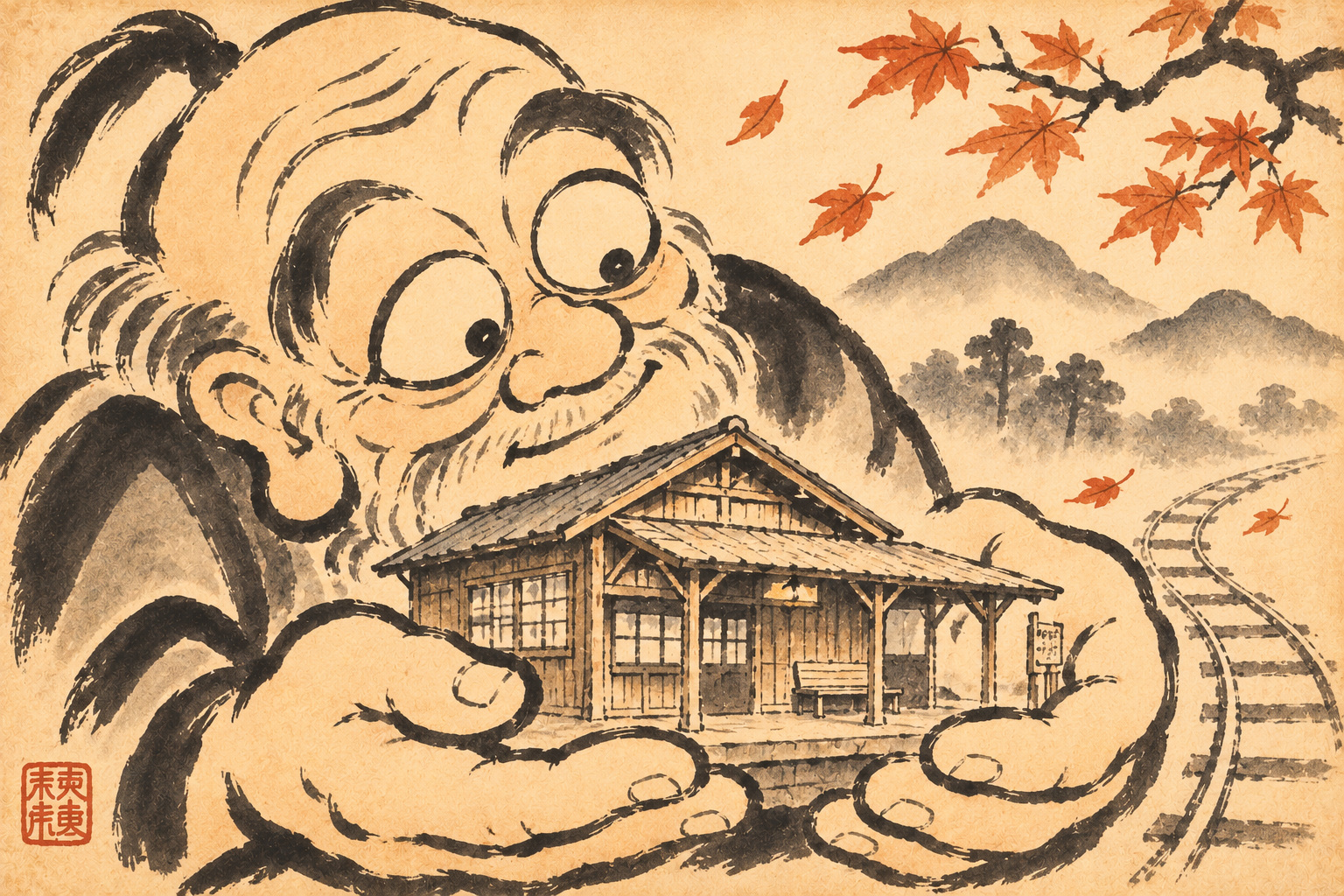
A farewell to a building, not to a railway
In Mihama, a coastal town in southern Mie Prefecture, a railway waiting room has become part of a local history exhibition. Residents are gathering photographs and memories before the wooden building at JR Atawa Station is removed. The exhibition runs from November 22 through November 29, and a notice published by the Mie Prefectural Cultural Center puts the beginning of removal work in early December. The Taiheiyo Shimbun reported on the exhibition on November 25.
The citizens’ group organizing the project, 阿田和の駅を考える会 (Atawa Station community group, descriptive English rendering), has spread its displays across the station, Pine shopping center and Mihama Central Public Hall. The arrangement takes the history of the railway beyond the railway property itself. Local reporting describes photographs, illustrations and a more detailed chronological display.
The distinction matters: demolition of the station building is not the same as discontinuation of the station or its trains. The event is a farewell to a familiar structure, and an opportunity to ask what a functioning railway station should mean to the next generation.
A station older than the town that surrounds it
Atawa’s wooden building was completed in 1939, according to local reporting. A 2022 architectural account records a building identification plate dated December of that year. The station opened in 1940, before Mihama existed in its present municipal form.
Rail construction around the mountainous Kii Peninsula proceeded in stages. JR Central dates the completion of the Kisei Main Line to July 15, 1959, when its remaining gap between Mikisato and Atashika opened. The railway ultimately provided a continuous route around a coast where the mountains often approach the sea.
The building thus spans several different eras of Japanese mobility: the wartime railway, the expansion of postwar passenger and industrial transport, the rise of private motoring and today’s challenge of providing services in sparsely populated areas. Its value is not simply its age, but the continuity it represents through those changes.
When a rural railway carried industrial wealth
Atawa once served economic functions that are easy to overlook in an era of passenger timetables and unstaffed stations. The Yoshino Kumano Shimbun describes former retail and baggage facilities and the station’s role in transporting ore from the Kishu mine. The exhibition draws on photographic material supplied by the Kiwa Mine Museum in Kumano.
Rail freight gave industries away from major cities a way to reach wider markets. The railway station was a point of exchange where goods could be transferred, workers could travel and families could send belongings. Its importance cannot be reconstructed simply by counting present-day passengers.
Industrial photographs can help explain why particular station facilities existed and how the surrounding economy worked. Establishing precise freight volumes or the entire transport route would require archival records; the available reporting does not provide those figures. The exhibition nonetheless makes a useful connection between industrial history and the architecture of everyday life.
A smaller population, a continuing need to travel
Mihama was formed on September 1, 1958, by merging Atawa town with the villages of Koshiyama and Ichigi-Oroshi (神志山村 and 市木尾呂志村). The municipality occupies 88.13 square kilometers between the Kii Mountains and the Pacific coast and is known for citrus cultivation. Its official profile reports a 2025 census population of 7,297. A census compilation gives the 2020 figure as 8,079, implying a decline of roughly one tenth in five years.
A smaller population can reduce the number of regular passengers, particularly as school cohorts shrink. But the need for public transport does not necessarily decline at the same rate. Older residents who stop driving, teenagers without licenses and people who cannot use private cars still need access to schools, shops and healthcare.
Mihama’s resident register recorded 7,497 people on October 1, 2026. This is a different statistical measure from the census, not evidence of a sudden population recovery. For transport planners, household access to cars, age, trip purposes and the distribution of essential services matter alongside total population.
Why preserving a wooden station is not a simple choice
An October 2024 editorial in the Taiheiyo Shimbun identified deterioration and termite damage as reasons behind the planned removal. The town assembly’s March 2025 agenda also records questions from more than one member about the rebuilding of Atawa Station. The debate therefore predates the current exhibition.
Historic timber structures can require substantial expenditure on roofs, foundations and damaged structural members. Accessibility, fire protection and earthquake resilience may add to the challenge. A railway operator must consider both the condition of its buildings and the demands of keeping its transport network operational.
Yet the cheapest replacement on a construction spreadsheet is not necessarily the least costly option for the community over time. A comfortable waiting area and a welcoming station can have value that does not appear in ticket revenue. A fair comparison would consider maintenance, safety, accessibility and local uses as well as initial expenditure. A verified final project budget and detailed replacement design were not available in the sources reviewed.
The station as one link in a longer journey
The real test of rural mobility begins before a passenger reaches the platform and continues after leaving it. Mie Kotsu lists stops at Atawa Station and Kinan Hospital on its regional bus service between the Kumano and Shingu areas. Atawa also lies near National Route 42 and local commercial facilities. These connections matter particularly to travelers who cannot simply drive to their destination.
A railway and a bus network can complement one another, but timetables, walking routes and information must work together. A missed connection or a difficult crossing can undermine the usefulness of a journey even when each individual service continues to operate. Weather protection, seating and clear guidance are practical considerations for the replacement station facilities.
The nearby Shichiri Mihama coast also forms part of the historic Kumano pilgrimage landscape. Tourism could create additional demand for local transportation, but it is not a substitute for a dependable daily service. The challenge is to make a station useful both to residents going about ordinary life and visitors discovering the region.
What can survive when the building cannot?
The community group had explored alternative uses for station buildings through exchanges with residents connected to Tamaru Station in Tamaki and Kabuto Station in Kameyama, according to the Yoshino Kumano Shimbun. Their experience suggests that residents can learn from each other even when the eventual outcome differs between sites. The exhibition program also included a planned children’s railway-uniform activity and model trains.
The official exhibition notice asks residents to contribute recollections and historical photographs. Such material can form a lasting archive when accompanied by dates, locations and information about the people or events depicted. Recording oral histories, architectural dimensions and surviving fittings could complement the photographs where resources and permission allow.
These are preservation possibilities, not claims that each has already been undertaken at Atawa. Digital archives also require long-term stewardship, permission to reproduce images and respect for the privacy of the people represented. A collection becomes more useful when the context of each item survives alongside the image itself.
What the next station must deliver
Atawa offers a lesson for other communities confronting a similar decision: preserving an old building, sustaining a transport service and protecting local history are related but distinct objectives. Each has its own costs and requires different forms of cooperation among owners, government and residents.
The replacement should ultimately be judged by how well people can travel, not only by how efficiently the building can be maintained. Measures such as the quality of waiting facilities, walking accessibility, transfer times and residents’ ability to reach essential services would help reveal whether modernization delivers practical improvements.
The exhibition ending November 29 gives the community a chance to pass on a part of its history before the physical structure disappears. The more difficult task comes afterward: ensuring that the railway remains meaningful in the lives of the people who inherit that history.
Primary sources and references
- Mie Prefectural Cultural Center: exhibition notice
- Taiheiyo Shimbun, November 25 report
- Yoshino Kumano Shimbun, November 21 report
- Mihama Town Assembly, March 2025 session
- Taiheiyo Shimbun, October 18, 2024 editorial
- JR Central: Kisei Main Line 50th anniversary
- Mie Prefectural Kumano Kodo Center: Mihama historical photographs
- Mihama Town: municipal profile
- Mihama Town: resident register
- Mie Kotsu: bus route information
- Railway Channel: 2022 architectural account
- NIPPON ATLAS: census series compilation
- Mihama regional promotion site: Atawa district