Can Art Revive Downtown Maebashi? A New Biennale Tests a Decade of Urban Reinvention
Arts Maebashi, Shiroiya Hotel, Maebashi Galleria, shopping arcades and vacant buildings become one walkable cultural landscape in a festival that doubles as a test of a decade of downtown reinvention.
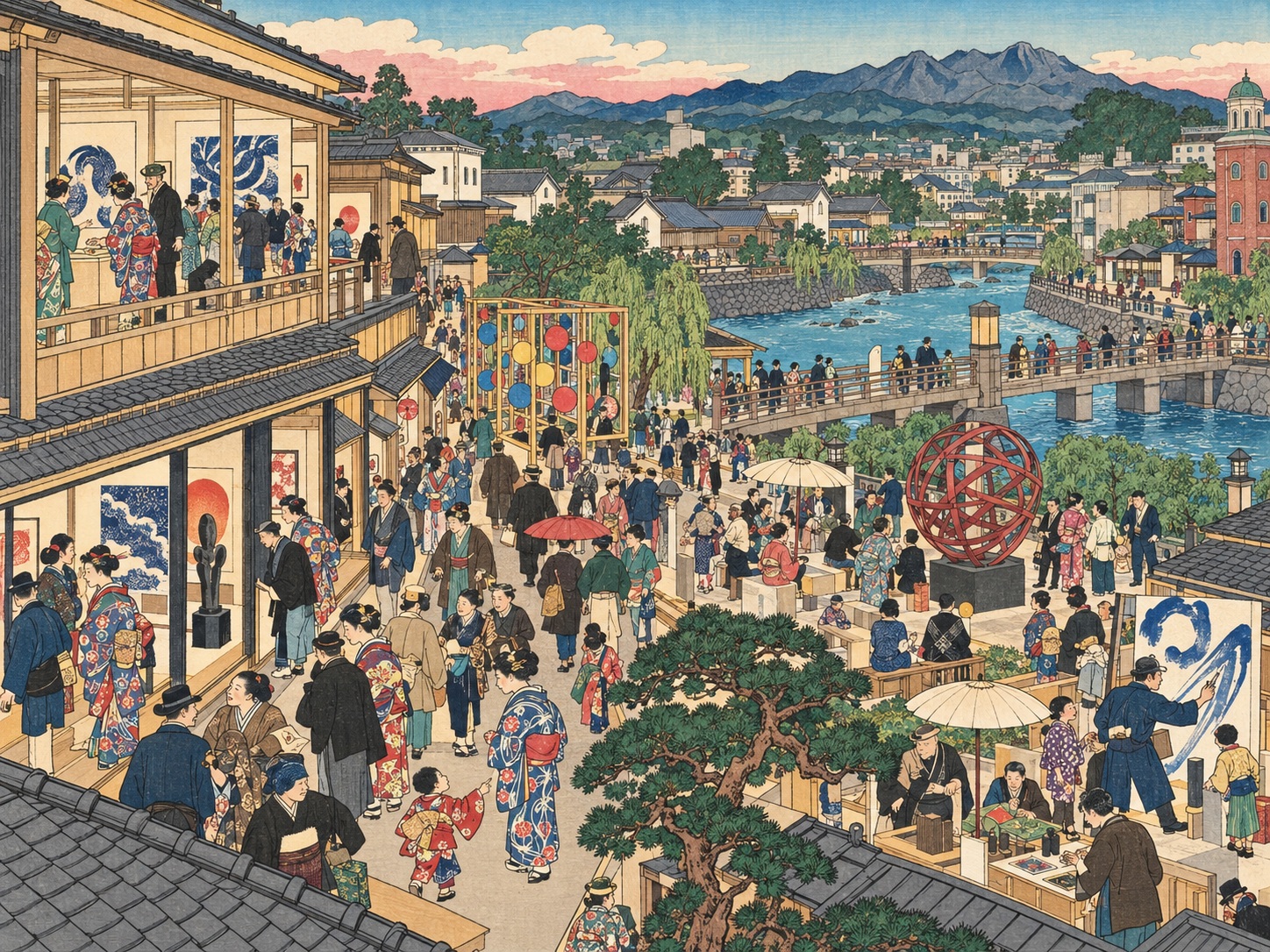
MAEBASHI. The venue is not only the museum. Visitors leave Arts Maebashi, cross an arcade, turn into an alley, enter a hotel, pass new housing and galleries, reach the river and continue. The act of moving through the city is part of the exhibition.
The first Maebashi Biennale opened on September 19 and runs through December 20, an 80-day festival spread across central Maebashi in Gunma Prefecture. Its official theme is “Mebuku. — Where good things grow.” The program links Arts Maebashi with streets, vacant buildings, commercial arcades, public spaces and privately developed architecture, incorporating contemporary art, architecture, music, poetry, film and research.
The event is best understood not as a stand-alone arts festival but as a public test of a decade of urban policy. Maebashi’s center has struggled with decline since the late 1990s. Since 2016, however, the city has tried to build a different model of regeneration—one driven not only by government projects but by foundations, business owners, architects, artists, museums and civic groups.
The biennale attempts to connect those scattered investments into a single walkable experience.
Maebashi has long questioned the easy promise of “art-led regeneration”
What makes the city’s experiment more interesting is that its own cultural institution has never treated art as a guaranteed economic cure.
Arts Maebashi opened in October 2013. Only months later, it organized a three-day symposium on the relationship between communities and art that explicitly asked whether art was really a “magic bullet” for regional revitalization and whether cultural projects necessarily brought tourists or economic recovery.
That skepticism matters. Regional art festivals are often judged by visitor counts and economic-impact estimates. A city museum embedded in a declining downtown has a different problem: how can culture change the way residents and visitors actually use the city?
Arts Maebashi began artist-in-residence activity before the museum formally opened and from 2014 converted vacant downtown buildings into studios and accommodation. The 2026 biennale therefore does not represent a sudden decision to “take art into the streets.” It extends more than a decade of work outside the museum walls.
A museum inserted into a declining commercial center
Arts Maebashi itself was an early urban-reuse project. After town meetings and a 2012 policy process on the role of a new cultural institution, the museum opened in October 2013 in a converted commercial building in the city center rather than on a new suburban site.
That location allowed the museum to function as both exhibition space and downtown anchor. It won Japan’s Regional Creation Award, presented by the internal affairs minister, in 2018.
The institution’s history has also included failure. In 2020, Arts Maebashi disclosed that several works scheduled for acquisition and several borrowed works were missing. The city established an investigation committee, carried out a complete collection check, improved facilities and convened a committee to reconsider the museum’s management.
That episode belongs in the history of Maebashi’s cultural strategy. A city cannot build its identity around art without also maintaining public trust in the institution responsible for it.
“Mebuku” became more than a slogan
In 2016, Maebashi adopted the urban vision “Mebuku.” The city says the process began with a proposal from the Hitoshi Tanaka Foundation as a public-private project to identify Maebashi’s future direction.
The German branding consultancy KMS TEAM—known for work with international companies including Porsche and Adidas—analyzed the city and proposed the phrase “Where good things grow.” Shigesato Itoi, a copywriter born in Maebashi, reinterpreted the idea in Japanese as “Mebuku,” meaning “to sprout.”
The phrase subsequently moved into formal policy. Maebashi’s Seventh Comprehensive Plan uses “Mebuku — a city where good things grow” as a shared community vision and defines the city’s future as a place that creates new value.
In 2019 the city adopted an Urban Design plan built through public-private cooperation. Later policy added the concept of a “Digital Green City,” linking the earlier urban vision to digital services and well-being.
The biennale turns what could otherwise remain policy language into something physical: visitors are asked to walk through the places where that vision has been applied.
Shiroiya Hotel: from a 300-year inn to a symbol of reinvention
One of the most visible symbols is Shiroiya Hotel.
The original Shiroiya was an inn with a history stretching back about 300 years. It closed in 2008 as downtown Maebashi declined and faced demolition. A regeneration project began in 2014, with architect Sou Fujimoto leading the overall design.
After roughly six and a half years of renovation and new construction, Shiroiya Hotel reopened on December 12, 2020. The project combines architecture, landscape, contemporary art and food, with works and contributions by international and Japanese artists and designers.
The hotel describes itself as a kind of “living room for the city,” intended not merely for overnight guests but as a place where local residents can gather.
Its importance to Maebashi lies in more than architecture. The redevelopment became an early physical expression of the ideas that later fed into the “Mebuku” city vision.
Maebashi Galleria brings art into everyday life
Another emblem is Maebashi Galleria, designed by architect Akihisa Hirata. The mixed-use development combines housing, galleries, shops and public-facing space.
The model is significant because cultural infrastructure in regional cities often becomes a destination people visit only for a special event. Maebashi Galleria reverses that logic by putting art beside daily residential and commercial life.
The biennale’s official materials highlight the building as a place where “art and daily life merge.” It embodies the festival’s walkability concept: art is not isolated in a museum but encountered while moving through the city.
| Year | Key step in Maebashi’s cultural and urban regeneration |
|---|---|
| 2008 | Historic Shiroiya inn closes |
| 2013 | Arts Maebashi opens in the city center |
| 2014 | Shiroiya redevelopment begins; Arts Maebashi expands artist-in-residence use of vacant buildings |
| 2016 | Maebashi adopts the “Mebuku” city vision |
| 2019 | Maebashi Urban Design adopted |
| 2020 | Shiroiya Hotel opens |
| 2023 | Arts Maebashi marks its 10th anniversary |
| 2026 | First Maebashi Biennale |
About 70 artists and 80 days: turning points into a district
At the July announcement, organizers described plans involving about 70 participants from contemporary art, architecture, music and related fields. Ayaka Wada, a Gunma native known first through pop music and later for her art activity, was named an official ambassador and participant.
The scale is not primarily about building one giant exhibition. Its logic is geographic. Maebashi already has museums, hotels, galleries, renovated buildings and public-space projects scattered across the center. Viewed separately, each can look like an isolated design object.
The biennale connects them by foot.
In urban-planning language, that can increase circulation, lengthen dwell time and spread spending among shops and restaurants. In cultural terms, it makes the city itself part of the work rather than a neutral background for art.
The goal is not to restore the old downtown
Official Maebashi materials acknowledge that the city center has been declining since the late 1990s. Like many regional Japanese cities, Maebashi was affected by suburban retail, changing demographics, car dependence and the withdrawal of traditional commercial functions.
The current regeneration strategy does not attempt to reproduce the shopping district of several decades ago.
Maebashi’s 2026 revised City Planning Master Plan instead emphasizes private-sector-led urban development based on the Urban Design framework, road-space restructuring for a more walkable center and the use of historic character alongside new projects.
That implies a different downtown: less dependent on retail alone and more mixed among housing, culture, tourism, work, food, public space and small-scale entrepreneurship.
The strengths—and risks—of private-sector-led regeneration
Maebashi’s model is difficult to explain as a conventional government redevelopment scheme. The Hitoshi Tanaka Foundation, local businesses, private developers, architects, museum staff, shop owners, universities and civic groups have all played roles.
That distributed model can be nimble. Rather than wait for one enormous public project, a city can accumulate smaller buildings, businesses, exhibitions and public-space improvements.
It also creates questions. When cultural regeneration depends heavily on private capital and prominent patrons, who sets the agenda? If architectural prestige raises land values, do existing businesses benefit? Can younger residents and ordinary households use the new places, or does the revived center become a district primarily for visitors and higher-income consumers?
There is not enough evidence to characterize Maebashi as undergoing large-scale gentrification. But those are precisely the questions that should accompany any long-term evaluation of culture-led urban regeneration.
The museum’s earlier failure remains relevant
Arts Maebashi’s 2020 missing-artworks case is not a side note to an otherwise celebratory story. It illustrates why cultural institutions require administrative competence as well as creative ambition.
The city responded with an investigation, a complete inventory review, facility improvements and a management-review process. Whether those measures have fully restored trust is a question residents and users ultimately answer.
For a city positioning culture as civic infrastructure, institutional credibility is part of urban credibility.
Is the biennale tourism policy or cultural policy?
It is both, but the distinction matters.
Visitors from outside the city can generate hotel, restaurant, transport and retail spending. Paired with destination architecture such as Shiroiya Hotel, the event can help make Maebashi a place where travelers stay rather than pass through.
Yet the official concept also emphasizes local walking and rediscovery. Residents encounter alleys, buildings and commercial streets they may not normally use. That is less about tourist promotion than about changing the mental map of one’s own city.
A serious evaluation of the event therefore needs more than a single visitor total. It should track movement through the center, use of vacant properties, cooperation among institutions, repeat local participation and what remains after temporary installations disappear.
Ten years after “Mebuku,” measurement becomes the next challenge
A decade has passed since the 2016 vision. Maebashi now has enough physical evidence to ask whether the idea changed the city.
There is new architecture. There is a downtown museum. There is a destination hotel. There are mixed-use cultural developments. And now there is an international biennale.
But a city is not revitalized because it photographs well.
The more consequential measures are whether foot traffic becomes regular, vacant storefronts find uses, younger people can start businesses, older residents can navigate the center, visitors stay overnight, private investment continues and residents feel that the city center belongs to them.
If the biennale contributes to Maebashi’s recovery, something about how the city is used should remain after December 20.
The first Maebashi Biennale is therefore both an 80-day arts event and an 80-day audit of an urban vision that has been growing for 10 years.
Sources
- Maebashi Biennale 2026 official site
- Arts Maebashi, First Maebashi Biennale 2026
- Maebashi City, “Mebuku” city vision
- Arts Maebashi, institutional history
- Arts Maebashi, archive of community art projects
- Arts Maebashi, symposium on art and regional communities
- Maebashi City, 2026 revised City Planning Master Plan
- Maebashi City, Seventh Comprehensive Plan
- Shiroiya Hotel official site