- The business behind the AI boom
- A small Kyoto company enters the computer age
- The economics of a turnaround
- The recovery already visible in the accounts
- Ceramics inside the machines that make chips
- Power delivery, connectivity and mobility
- Restructuring the diversified company
- Beyond the current generation of AI hardware
- How the five-year program would be financed
- What to watch through 2031
The business behind the AI boom
A data center is a collection of physical systems, not merely a collection of processors. Its equipment must distribute power, move information and operate reliably through years of repeated use. Those requirements create opportunities for manufacturers whose names rarely appear on the front of a computer.
Kyocera, the Kyoto industrial group, is trying to capture more of that opportunity. At its November 26 strategy meeting, President and CEO Shiro Sakushima presented a plan through March 2031 that envisages ¥900 billion of capital expenditure and ¥650 billion of research and development spending. The combined amount, ¥1.55 trillion, is a planned five-year total rather than a single new factory announcement.
The crucial question is whether the company can turn a larger industrial footprint into substantially better returns. The plan is a test of management's ability to select technologies, customers and businesses, not just a bet on the continued expansion of artificial intelligence.
A small Kyoto company enters the computer age
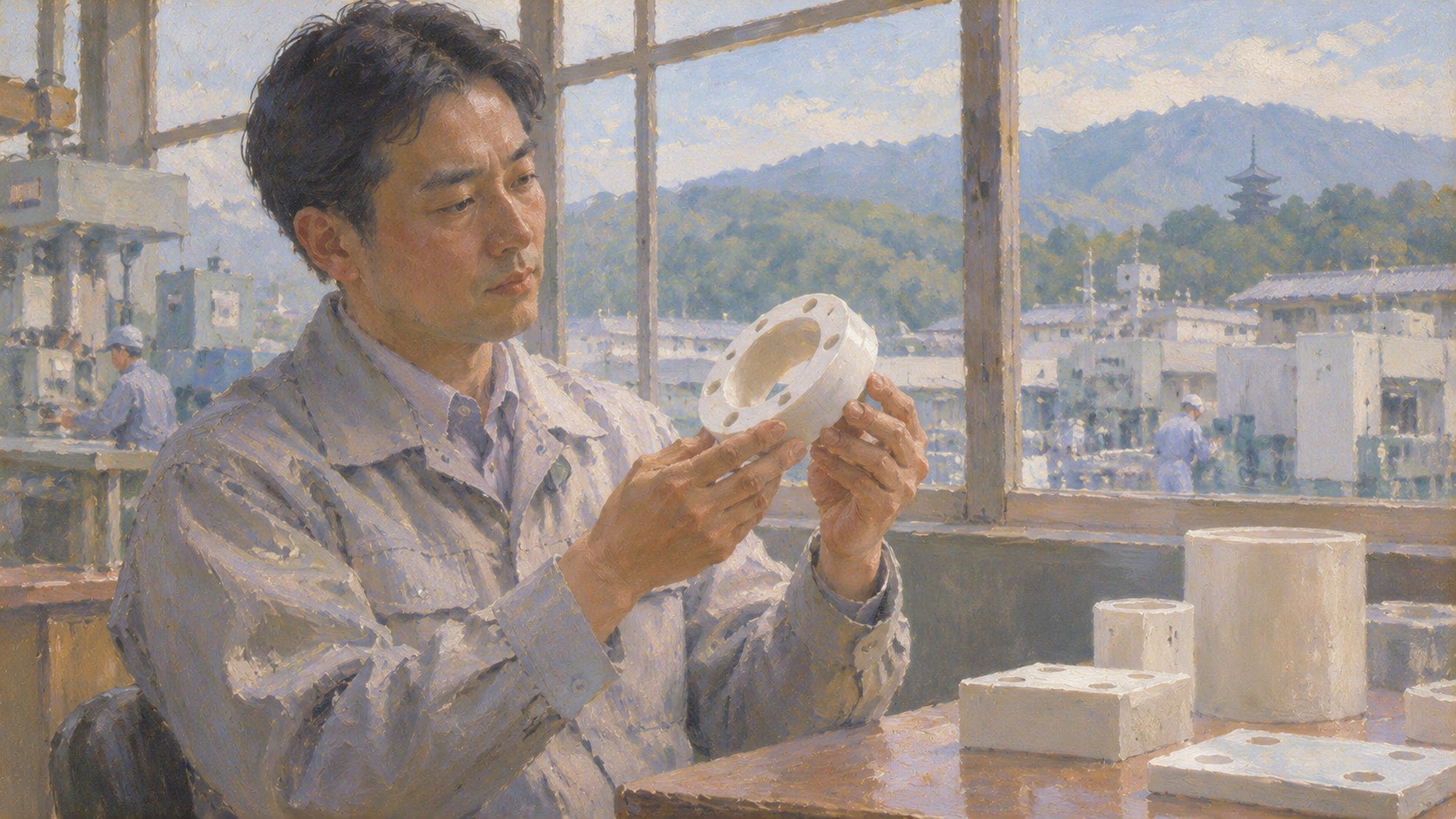
The origins of Kyocera lie in a much earlier electronics revolution. Kazuo Inamori, an engineering graduate from Kagoshima, established Kyoto Ceramic in April 1959 with ¥3 million of capital. The enterprise began with 28 employees and a specialty insulating component for cathode-ray tube televisions.
Industrial ceramics differ from household pottery in the control required over raw materials, internal structure and finished dimensions. A carefully manufactured insulator can withstand conditions that would compromise an ordinary material. In the 1960s, those capabilities helped the young company enter the computer supply chain: IBM adopted its alumina substrates in 1966.
As integrated circuits spread, ceramic packaging became a natural extension of that expertise. Kyocera subsequently diversified into capacitors, cutting tools, solar technology and equipment businesses. Its acquisition-led expansion included the US electronics manufacturer AVX, consolidated in 1990, and the copier business that became Kyocera Document Solutions in 2000.
Inamori's separate initiative to establish a telecommunications challenger in 1984 eventually contributed to the formation of KDDI. His career helps explain why the group's industrial heritage is intertwined with the history of Japanese electronics and communications. But the modern company faces a different challenge from its founder: deciding where an already diversified business should concentrate its resources.
The economics of a turnaround
Kyocera's fiscal 2031 revenue target is ¥2.6 trillion, compared with a forecast of ¥2.12 trillion for the year ending March 2027. That represents an increase of roughly 23 percent. Management is seeking a much larger proportional gain in operating earnings: ¥320 billion against the current ¥160 billion forecast.
This difference matters because expansion can destroy value if the additional factories and working capital generate insufficient returns. An operating margin of 12.3 percent would represent a significant change from the 5.7 percent recorded in fiscal 2026. The proposed increase in return on equity to 8.2 percent also makes the balance sheet part of the strategy.
Return on equity measures earnings relative to shareholders' capital. It may improve through higher profit or a reduction in equity; the two mechanisms should not be confused. Investors will need to examine recurring earnings, cash generation and the productivity of the new assets alongside the headline ratio.
| Indicator | FY2026 actual | FY2027 forecast | FY2031 target |
|---|---|---|---|
| Revenue | 2,070.2 | 2,120 | 2,600 |
| Operating profit | 118.1 | 160 | 320 |
| Operating margin | 5.7% | 7.5% | 12.3% |
| Profit attributable to owners | 141.0 | 160 | 250 |
| ROE | 4.3% | 4.9% | 8.2% |
The recovery already visible in the accounts
The November 2 interim filing offers a useful starting point. In the six months through September 2026, Kyocera earned ¥65.609 billion in operating profit on revenue of ¥1.078337 trillion. Revenue increased 8.8 percent from the corresponding period, while operating earnings rose 56.4 percent. Profit attributable to owners of the parent reached ¥73.43 billion.
There are important qualifications. The company's estimated currency translation effect on revenue was about ¥63 billion, reflecting a weaker yen. Separately, it recognized roughly ¥29.5 billion in impairments associated with gallium nitride devices and about ¥7.6 billion in provisions for energy-related products. Those charges illustrate why technically promising fields do not automatically become profitable businesses.
Management raised the full-year sales outlook by ¥40 billion on November 2 but left its operating-profit forecast unchanged. At September 30, the ratio of equity attributable to owners of the parent to total assets was 71.1 percent. A substantial equity base gives management flexibility, but capital efficiency depends on what the company does with it.
Ceramics inside the machines that make chips
To understand the investment case, look inside a semiconductor processing tool. A wafer must be moved and held precisely while it is exposed to demanding chemical and physical conditions. Some components must maintain their shape when temperatures change; others must withstand plasma without releasing contaminants.
Engineered ceramics can address these requirements. High stiffness and low weight may be important in positioning systems, while corrosion resistance is particularly valuable in plasma processing. Yttria, or yttrium oxide, is one example of a ceramic used for demanding plasma environments. The right material depends on the particular process and component geometry.
A supplier's advantage is not necessarily in discovering an entirely new substance. It can come from producing complex shapes repeatedly, controlling impurities, achieving tight tolerances and meeting a customer's qualification requirements. Replacing a component with an unqualified alternative may impose costs far beyond its purchase price if it disrupts production.
That makes advanced materials a strategic part of the chip supply chain. It also means that increased demand for AI chips does not translate mechanically into equal growth for every materials supplier. Equipment investment, component service life and competitive alternatives determine the actual orders.
Power delivery, connectivity and mobility
AI accelerators need reliable power delivery, and their networks must carry enormous amounts of information. Capacitors can help stabilize electrical supplies, while carefully designed packages and communications components support the transfer of high-frequency signals. Heat, signal integrity and reliability are challenges that extend well beyond the processor itself.
Kyocera's strategy includes components for AI network infrastructure and semiconductor production equipment, as well as next-generation mobility. Vehicles increasingly incorporate electronic controls and sophisticated power systems, but automotive suppliers face different operating environments and qualification requirements from data-center suppliers.
The economic appeal of serving multiple industries is that similar manufacturing knowledge can be applied in different markets. The danger is assuming that a single technology or plant can satisfy every customer without adaptation. Engineering resources and production capacity must be allocated according to the likely returns of each application.
Restructuring the diversified company
The management plan also addresses operations that do not belong to the immediate AI infrastructure boom. In industrial tools and document equipment, Kyocera wants to combine physical products with services that solve broader customer problems. A tool manufacturer, for example, might help customers improve machining processes rather than compete solely on the price of a replacement part.
Such a transformation requires different capabilities, including software development, customer support and the ability to measure outcomes. Recurring revenue is attractive only if the cost of delivering those services leaves an adequate margin.
A more detailed review of business performance is another element of the plan. Return on invested capital, or ROIC, gives management a way to compare profit with the capital deployed in an operation. It is useful when considering whether to expand, improve or exit a business. Yet a mechanical application of financial thresholds could undervalue early research and ignore the human and supplier costs of restructuring. Those consequences warrant attention as individual decisions emerge.
Beyond the current generation of AI hardware
The research budget extends beyond the technologies that generate today's demand. Kyocera identifies space, marine applications, nuclear fusion and future semiconductor processes as areas where ceramic engineering may be useful. Approximately ¥160 billion of the ¥650 billion research envelope is intended for next-generation businesses.
The technical connection is understandable: extreme heat, corrosive environments, radiation and demanding mechanical conditions can make conventional materials unsuitable. However, the existence of a useful material property is not evidence of a commercial market of a particular size. Aerospace qualification, fusion engineering and industrial-scale semiconductor production each operate on different development schedules.
Research should therefore be evaluated through milestones such as material performance, reproducibility, customer qualification and production economics. A laboratory result can be valuable without producing immediate sales. Conversely, a successful prototype does not guarantee a competitive manufacturing process.
How the five-year program would be financed
Kyocera's capital allocation framework anticipates ¥2.1 trillion of operating cash flow before research expenses and ¥700 billion from selling shareholdings. The planned uses include the capital and research budgets, ¥400 billion in dividends, and a combined ¥850 billion category for acquisitions and share repurchases.
The distinction between those sources and uses is essential. Proceeds from selling financial assets are not recurring operating income. Research expenditure is already excluded from the cash-flow measure used in the presentation, so the ¥2.1 trillion figure should not be read as ordinary reported operating cash flow. The combined acquisition and repurchase envelope does not establish how much will ultimately be spent on either activity.
The plan provides scope for borrowing if acquisitions warrant it. That may increase flexibility, but the price paid for acquisitions, subsequent integration and financing costs will affect the eventual return. A capital allocation diagram is a statement of intent, not a schedule of completed transactions.
What to watch through 2031
The first test of the strategy will be the relationship between order growth and the timing of new capacity. If equipment comes online before customers need it, depreciation and other fixed costs could reduce earnings. If expansion is too slow, the company may lose opportunities to competitors.
Other indicators include operating margins, cash generation after research expenses, restructuring costs, customer qualification and the ability to retain skilled workers. Exchange rates, trade restrictions, energy prices and shifts in AI investment could change the economics materially. The company's targets should be assessed against subsequent disclosures rather than treated as a prediction of inevitable growth.
Kyocera's history offers a reminder that the most consequential technologies are not always the most visible. The small ceramic component that made a television work eventually led to a global industrial business. The question for 2031 is whether the same discipline in materials engineering can now be matched by discipline in capital allocation.
Primary sources and references
- Kyocera: November 26 management plan (Japanese)
- Kyocera: English presentation filed through TDnet
- Kyocera: interim consolidated financial results
- Kyocera: November 2 forecast revision
- Kazuo Inamori: official biography
- Kyocera: fine ceramics business history
- Kyocera: historical investor presentation
- Kyocera: directors and executive biographies
- Kyocera: ceramics for semiconductor equipment
- Kyocera: yttria material properties
- Sankei reporting via ITmedia, November 27
- Kyocera: 2026 investor disclosures