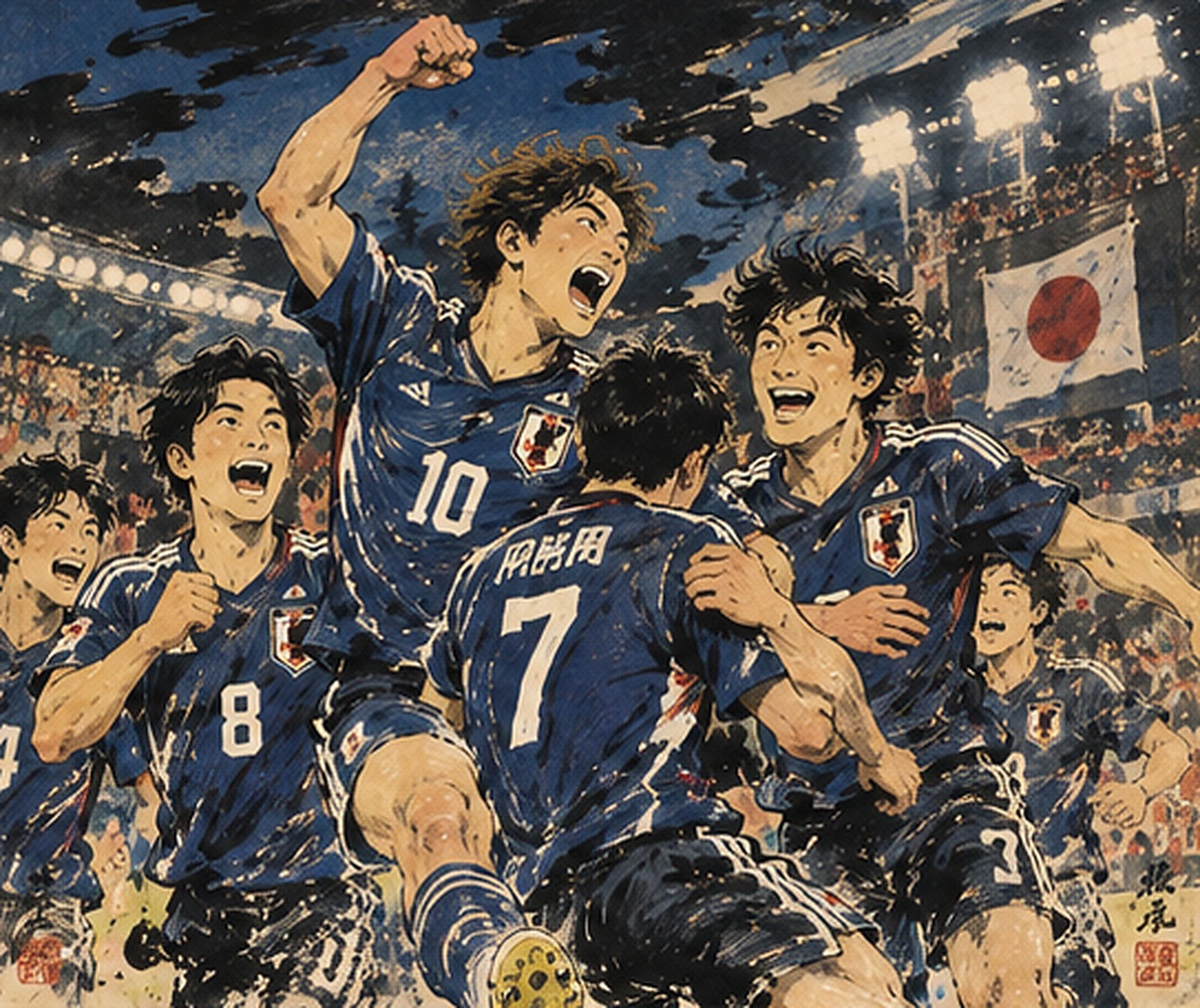
A winner that had to be constructed
Japan lifted the 2026 Kirin Cup on October 5 by beating New Zealand 2-1 at Tokyo's National Stadium, but the margin and the sequence matter more than a victory label. Ayase Ueda scored after 28 minutes, Ben Old equalized four minutes later, and Ritsu Doan delivered the winner in the 71st. This was a game in which Japan possessed the ball, lost its lead almost immediately and then needed to rethink how it would breach a disciplined opponent.
The decisive second goal emerged from a change in Japan's attacking personnel. Substitute Keito Nakamura drove along the left and supplied the cutback for Doan. The moment linked two questions facing Hajime Moriyasu's team: can a talented squad create better chances against a compact defensive block, and can its substitutes change a contest rather than merely replace tired legs?
The Kirin Cup is an invitational international tournament, not a qualification campaign or a global championship. One win does not prove superiority over every possible opponent. Yet the match offered an unusually useful picture of Japan's current strengths: varied attacking routes, a deep bench and a willingness to alter shape during play.
A different defensive shape, a familiar attacking problem
Japan had begun its previous matches with a back three. Against New Zealand it chose a 4-2-3-1. Shuto Nakano, Ayumu Seko, Hiroki Ito and Junnosuke Suzuki formed the back four, with Kaishu Sano and Daichi Kamada in deeper midfield. Daizen Maeda, Takefusa Kubo and Ritsu Doan supported Ueda from behind.
The structure gave Japan options for circulation across the back and width in attack, but New Zealand defended in a back five and protected the central channels. Japan could spend time in possession without forcing the visitors into an immediate collapse. Its breakthrough came from the right, where Nakano's delivery created the opportunity Ueda finished with his left foot.
The equalizer illustrated the cost of a poorly executed transition: a misplaced pass allowed New Zealand to counter. It would be simplistic to describe the formation itself as either vindicated or flawed by that sequence. The more relevant question is whether Japan can keep enough defensive protection behind attacking possession while preserving the ability to switch structures under pressure.
Why the 64th minute mattered
After the interval Japan still searched for a second goal. In the 64th minute Moriyasu introduced Ao Tanaka, Keito Nakamura and Junya Ito. Their arrival added a different kind of directness. Seven minutes later Nakamura carried the ball deep on the left before releasing the pass that Doan converted.
The winner can be described as a goal for Doan, but tactically it was also evidence of a substitute reshaping the attack. It followed an opening goal from the opposite side of the pitch and showed that the team could generate end product from different corridors. Japan still needs to demonstrate the same fluency against opponents pressing more aggressively and defending with greater individual quality.
Further changes in the 78th minute brought Kodai Sano, Hayato Araki and Kento Shiogai, together with a return to a back three. Kuryu Matsuki and Satoshi Tanaka followed later. Those substitutions are not proof that every experiment succeeded, but they reveal a team testing how its pieces can work in different configurations, rather than treating the starting eleven as fixed.
Why a tournament founded in 1978 still matters
The predecessor of the Kirin Cup was the Japan Cup, established in 1978 as Japanese football sought higher-quality encounters with international opponents. In 1985 the tournament adopted the Kirin Cup name, and in 1992 it gained the status of an international A-match competition. Japan first won it in 1995, according to the Japan Football Association's official historical account.
For much of that early history, hosting overseas teams was itself a route to knowledge. Japanese players could test the pace and technical standard of international football on home soil before the national game had accumulated today's extensive global experience. This is part of the background to the later professional era and to Japan's emergence as a regular participant in major international tournaments.
The 2026 tournament returned after four years, bringing Japan, Ecuador, New Zealand and Panama together. Japan advanced past Ecuador in a shootout after a scoreless draw; New Zealand defeated Panama on penalties after a 1-1 draw. The final therefore culminated a compact, four-team sequence rather than an extended league table or a qualifying campaign.
The result and the evidence are not the same thing
Japan's football establishment reported four successive home victories by the conclusion of the New Zealand game. The run strengthens a narrative of confidence, but confidence is not a performance metric. Against a low block, the side still had to solve how to create high-quality opportunities; immediately after scoring it showed a vulnerability during transition.
For international preparation, this may be more valuable than a comfortable exhibition win. Coaches can examine the passing error that led to Old's equalizer, the positioning that limited central penetration and the successful left-sided sequence after the substitutions. Without possession, expected-goals or tracking datasets independently validated for this match, this article makes no numerical claims about chance quality.
The recent calendar also demands caution in projecting outcomes. A friendly tournament can reveal patterns in player combinations, but does not recreate every intensity, travel demand or game-state pressure of a future competitive event. The purpose of analysis is to identify repeatable skills and weaknesses, not assign a championship forecast from ninety minutes.
A domestic stage with international purpose
The JFA's October 5 event page reported the match as sold out. Strong demand supports the proposition that the men's national team remains a major domestic sporting attraction, but sold-out ticket inventory does not reveal the event's net operating surplus, broadcasting fees or the incremental spending generated across Tokyo.
The larger return may lie in the football system around the national squad. The careers of players at European clubs rest on earlier development through schools, academies, domestic competition and coaches in Japan. International visibility gives the federation and sponsors another opportunity to connect national-team interest with youth access, professional-club audiences and long-term participation.
The Kirin Cup was founded to narrow Japan's distance from international football. In 2026 the relationship is different: Japan can win at home and still regard the fixture as a laboratory for more difficult challenges. Ueda's opener and Doan's winner are the memorable moments. The enduring question is whether the team's tactical flexibility will survive sterner tests.
Sources and references
Source review: October 8, 2026. Tournament financial returns, broadcast-rights values, unpublished tactical datasets and private player-health information were not independently verified.