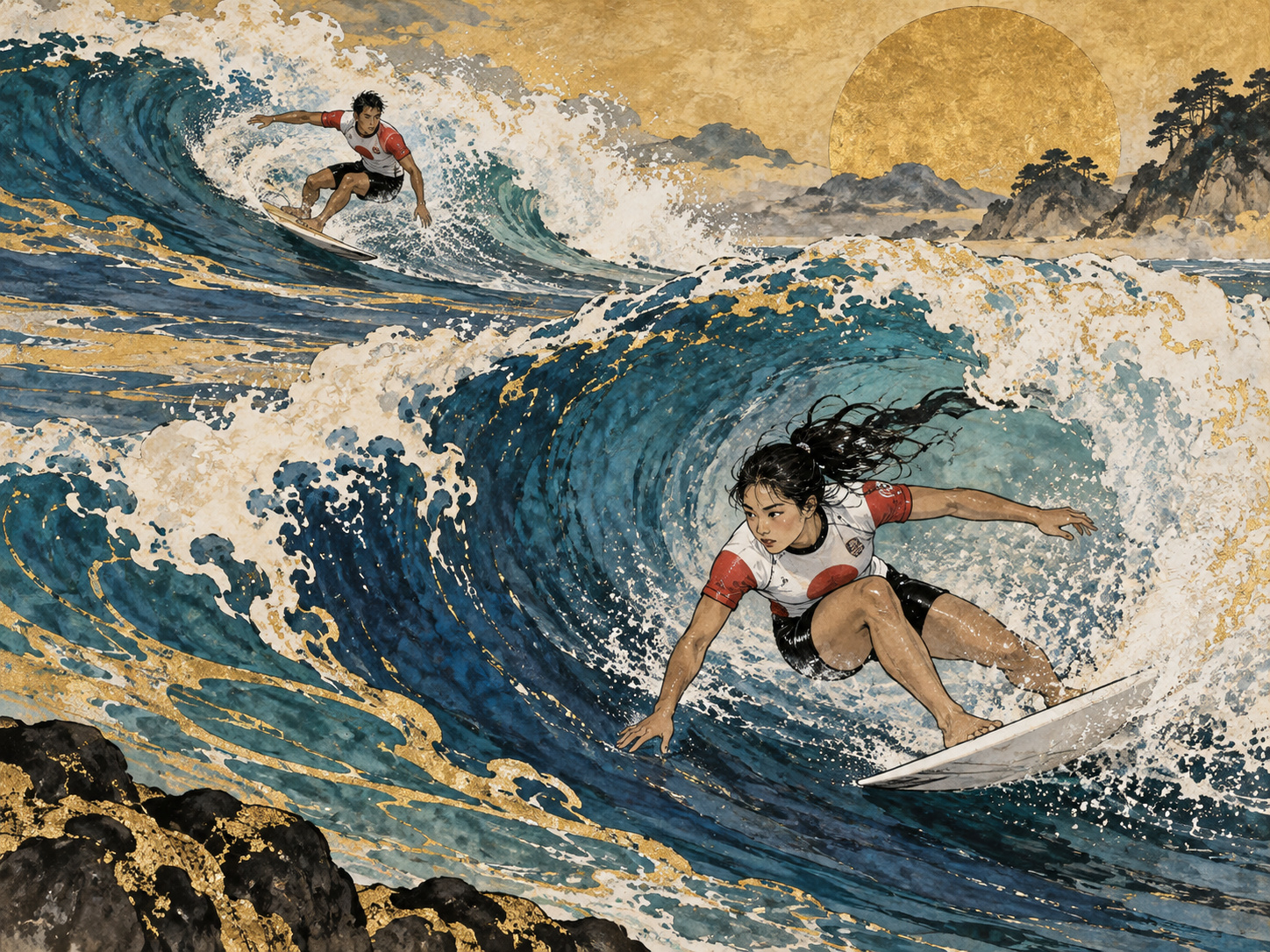
On the same stretch of Japanese coast, a 28-year-old Olympic medalist and an 18-year-old first-time Asian Games champion connected two generations of Japanese surfing.
At Pacific Long Beach in Tahara, Aichi Prefecture, Kanoa Igarashi won the men's shortboard title and Mirai Ikeda won the women's on September 29. Surfing was making its Asian Games debut. Japan therefore claimed both of the sport's first gold medals—and both athletes earned named continental qualification places that can lead to the Los Angeles 2028 Olympics.
For Igarashi, the route points toward a third Olympics after silver at Tokyo 2020 and a ninth-place finish at Paris 2024. For Ikeda, it points toward a first Games.
The ocean forced the competition to use its final reserve day
Surfing is unlike track, baseball or swimming in one fundamental way: the field of play changes every minute.
The competition began September 25, but wave conditions and bad weather forced schedule changes. It eventually reached the reserve day of September 29. Rain fell and swell from Typhoon 26 increased wave size as quarterfinals, semifinals and finals were run through the day.
Igarashi did not dominate from the opening horn. In the first round he shared a heat with Japanese teammate Connor O'Leary, another Championship Tour surfer, and finished second with 11.77 points behind O'Leary's 13.90.
As the event progressed, Igarashi's performance sharpened.
Igarashi produced the rarest number in judged surfing: 10.00
In the semifinal, Igarashi found a section that gave him the ramp he needed, launched a highly technical aerial maneuver and completed it cleanly. The judges awarded a perfect 10.
In competitive surfing, a 10 is not a fixed reward for a named trick. Judges evaluate degree of difficulty, innovation, speed, power, flow, commitment and completion in the context of the wave. A perfect ride means the panel saw essentially no meaningful room to improve that performance on that wave.
The final matched Igarashi with Indonesia's I Made Pajar Ariyana. Igarashi again completed aerial surfing under pressure and won the first men's Asian Games surfing gold. Japanese reporting put his final total at 12.87.
He wanted the Olympic route settled early
Igarashi had made the strategic importance of the Asian Games clear months earlier. In March, he told JOC-linked media that he wanted to win the event and secure an Olympic route early so he could focus on preparing for Los Angeles.
That logic matters because normal Olympic surfing qualification can run deep into the cycle through the Championship Tour and ISA World Surfing Games.
A continental place gives an athlete an early pathway. But it does not remove the hierarchy. If Igarashi qualifies later through the higher-priority 2028 Championship Tour, his status is reorganized under those rules rather than simply stacking two individual places.
For Mirai Ikeda, Tahara is where the professional story began
Mirai Ikeda began surfing at age five. In 2019, when she was an elementary-school sixth grader aged 11 years and eight months, she earned professional qualification at Pacific Long Beach in Tahara—at the time the youngest to do so in Japan.
Seven years later, she returned to the same coast for an Asian Games final.
She showed scoring range from the opening round, winning her first heat with 10.93. Earlier in the event she also produced a heat containing two nine-point rides, evidence of the high ceiling that had made her one of Japan's most watched young surfers.
Her semifinal against Indonesia's Jasmine Studer was less comfortable. Ikeda began with 4.50, waited through a low-wave period, then found a 6.33 with about five minutes remaining to reverse the result and reach the final.
The final put Ikeda against China's Yang Siqi
Ikeda's opponent was Yang Siqi of China, already an Olympian and one of Asia's strongest teenage surfers.
Ikeda attacked early with mid-five-point rides and extended the lead with a backhand re-entry through the closing section of a wave. Then the ocean went quiet. With few opportunities arriving late in the heat, Yang could not find the score required to reverse the result.
Ikeda became the first women's Asian Games surfing champion.
The title is easy to describe as a breakthrough by an 18-year-old, but it rests on a long competitive apprenticeship. Seven years separated her exceptionally early professional qualification from the day she put an Olympic continental place beside her name.
The two gold medals mean very different things
Igarashi is an established global athlete with an Olympic silver medal. Ikeda has never competed at the Olympics.
For one, Tahara opened the pathway toward a third Games and another attempt at Olympic gold. For the other, it created the first plausible direct route into an Olympic field.
That contrast is part of what made Japan's double historically resonant: the country's most internationally established male surfer and one of its emerging female stars won the same new title on the same day.
Why the LA28 places remain conditional
| Priority | Qualification route | Key rule |
|---|---|---|
| 1 | 2028 WSL Championship Tour | Top eight eligible surfers per gender; maximum one per NOC |
| 2 | 2028 ISA World Surfing Games | Top seven eligible surfers per gender; maximum one per NOC |
| 3 | Continental places | Includes one men's and one women's Asian Games place |
| 4 | 2026 & 2027 ISA WSG team places | Top team by gender can earn an NOC quota |
| 5–6 | Host and universality places | Allocated under separate eligibility rules |
The normal maximum is two surfers per gender per NOC, although team qualification at the 2026 and 2027 ISA World Surfing Games can exceptionally create a third place. The Asian Games slots are earned by name, but the final usable quota depends on the later hierarchy.
Surfing itself is still a young Olympic sport
Surfing entered the Olympic program at Tokyo 2020. Japan immediately became part of the sport's Olympic story: Igarashi won men's silver and Amuro Tsuzuki won women's bronze at Tsurigasaki Beach in Chiba.
Paris 2024 moved the competition halfway around the world from the host city to Teahupo'o in Tahiti, underlining how unusual surfing is as an Olympic discipline. The quality of the natural wave can matter more than geographic proximity to an Olympic stadium.
Aichi-Nagoya 2026 added another layer: surfing entered the Asian Games for the first time, with Pacific Long Beach in Tahara chosen as the venue and the winner linked directly to LA28 qualification.
In only six years, surfing has moved from Olympic newcomer to a sport with continental qualification pathways embedded in Asia's largest multi-sport event.
Surfing scores quality, not the number of moves
Shortboard competition is usually decided by the sum of an athlete's two highest-scoring waves in a heat.
Judges evaluate difficulty, innovation, commitment, speed, power, flow and combinations. There is no rigid table saying a specific aerial is always worth a specific number of points.
Context matters. Where on the wave the maneuver is attempted, how much risk is taken, whether the surfer lands cleanly and how the entire ride flows all influence the score.
That is why Igarashi's semifinal 10.00 was more than an acrobatic highlight. It was a perfect competitive answer to the wave he had selected.
Nature controls the schedule
Surfing competition uses a waiting period because organizers cannot manufacture suitable waves.
Wind, swell direction, tide and local sand formations can make the same break excellent one hour and poor the next. At Aichi-Nagoya, organizers postponed rounds after assessing conditions, and the event ultimately needed its reserve day.
That unpredictability is inconvenient for television and spectators, but it is inseparable from the sport. Athletes compete against one another while also competing for access to a limited, constantly changing resource: the next good wave.
Japan had genuine home-water knowledge
Igarashi said before the Games that he knew Tahara's waves well. Ikeda's connection was even more personal: it was where she earned professional status as a child.
Japanese surfers also had the benefit of domestic events and training around the region.
But local knowledge is not a guarantee. Pacific Long Beach changes with swell, tide, wind and sand movement. On a storm-influenced day like September 29, the advantage belongs to the surfer who can convert familiarity into rapid reading of a new version of the same break.
Igarashi's career mirrors the globalization of Japanese surfing
Kanoa Igarashi was born October 1, 1997 and grew up in California, advancing from junior competition into the world's top professional tour.
In 2019 he became the first Japanese surfer to win a WSL Championship Tour event. He won Olympic silver at Tokyo 2020 and the men's individual title at the 2022 ISA World Surfing Games.
His career broadened the model of what a Japanese surfer could be: raised inside the world's most competitive surf culture while competing internationally for Japan.
Ikeda is crossing from junior promise into Olympic contention
Ikeda developed in Shizuoka, began surfing as a small child and accumulated domestic and international competition experience after turning professional unusually young.
Early professional status is not the same thing as world-class senior success. The difficult years come afterward: international junior events, professional qualifying contests, travel, changing waves and the transition into adult competition.
The Asian Games gold marks a shift in status. She is no longer only a talented junior building toward a future Olympic cycle. She now holds a named Olympic qualification route of her own.
2019: Igarashi becomes the first Japanese WSL CT event winner; Ikeda earns professional qualification at 11 years, eight months.
2021: Surfing makes its Olympic debut at Tokyo 2020; Igarashi wins silver.
2022: Igarashi wins the men's individual ISA World Surfing Games title.
2024: Igarashi finishes ninth at the Paris Olympics.
June 2026: Japan announces its Aichi-Nagoya Asian Games surfing squad.
Sept. 29, 2026: Igarashi and Ikeda win gold and earn conditional LA28 continental places.
2027–2028: Higher-priority Olympic qualification continues through WSL and ISA competition.
2028: Olympic surfing returns to Southern California.
LA28 is unusually close to home for Igarashi
Igarashi grew up in California. Los Angeles 2028 would therefore be an Olympic Games in the country whose surf culture shaped him, while he again represents Japan.
He had also just shown current form in Southern California: at the September 19 Trestles Pro, he reached the final and finished second.
Tokyo ended with silver. Paris ended in the round of 16 and ninth place. Igarashi has repeatedly said Olympic gold remains the missing target.
For Ikeda, keeping the route may be as hard as winning it
Ikeda's gold is one of the biggest results of her career, but it does not allow her to sit out the next two years.
Japan's women's field includes internationally experienced surfers such as Shino Matsuda, Amuro Tsuzuki and Minami Nonaka. Higher-priority qualification through the 2028 CT and World Surfing Games can affect how the national quota is filled, while team places from the 2026 and 2027 ISA World Surfing Games can change the total number available.
Ikeda's strongest way to protect her Olympic future is therefore to continue improving internationally rather than rely on the continental place as an insurance policy.
Japan's sweep also showed where Asian surfing stands
Japan entered two Championship Tour-caliber men in Igarashi and Connor O'Leary, while Ikeda and Minami Nonaka formed a strong women's pair. Nonaka also won bronze, giving Japan two golds and a bronze across four athletes.
But Indonesia and China are producing increasingly competitive surfers. Women's finalist Yang Siqi already has Olympic experience. Men's finalist I Made Pajar Ariyana belongs to a younger Indonesian generation climbing the international professional ladder.
The Asian Games now gives those countries a direct continental route toward Olympic surfing. Over time, the event may become much harder for Japan to dominate.
What to watch on the road to LA28
- Whether Igarashi qualifies through the higher-priority 2028 WSL Championship Tour.
- How quickly Ikeda climbs in global senior competition.
- Whether Japan earns 2026 or 2027 ISA WSG team quota places.
- Which athletes ultimately fit inside the normal two-per-gender NOC limit.
- How the Asian Games places are retained or reallocated under the final hierarchy.
- How experience in Southern California translates to the LA28 Olympic venue.
One coast carried Japan's surfing past and future on the same day
Igarashi knows an Olympic podium. Ikeda was still in junior high school when surfing made its Olympic debut in Tokyo.
In 2019, the year Igarashi became Japan's first Championship Tour event winner, Ikeda was an 11-year-old earning professional status at Tahara.
Seven years later they became Asian Games champions together on that coast.
Their places at LA28 are not yet completely locked by the qualification rules. But the gold medals already mean more than one day's results.
For Igarashi, Tahara opens an early route from Tokyo silver toward another attempt at Olympic gold. For Ikeda, the beach where she first became a professional has now produced the first Olympic pathway of her senior career.
Sources & Reporting Notes
- International Surfing Association: 20th Asian Games Aichi-Nagoya 2026 — Primary source for athletes, venue and the LA28 qualification hierarchy, including the Asian Games continental slots.
- Japan Olympic Committee: Kanoa Igarashi — Official Japanese team profile and name data.
- JOC, June 11, 2026: Asian Games surfing team announcement — Team announcement noting the Olympic qualification opportunity and Mirai Ikeda's age and pre-Games comments.
- JOC, Mar. 20, 2026: Kanoa Igarashi targets Asian Games title — Igarashi's stated goal of securing the LA28 place early and his familiarity with Tahara's waves.
- JOC Sept. 25 surfing results — Official Team Japan first-round results.
- SURFMEDIA, Sept. 29, 2026 — Detailed competition report on Igarashi's perfect 10 semifinal ride, Ikeda's final, and why the LA28 places remain conditional.
- Reuters, Sept. 29, 2026 — International confirmation that Igarashi and 18-year-old Ikeda won gold and secured LA28 places.
- N High School, Sept. 29, 2026 — Background on Ikeda beginning surfing at age five and earning professional qualification at 11 years, eight months.
- Shizuoka Subaru, Apr. 30, 2026 — Primary sponsor release confirming the Japanese reading Ikeda Mirai and 2026 profile.
- JOC athlete profile: Kanoa Igarashi — Official Olympic record: Tokyo 2020 silver medal and ninth at Paris 2024.
- JOC, May 25, 2019 — Contemporary record of Igarashi becoming the first Japanese surfer to win a WSL Championship Tour event.
- JOC surfing overview — Background on Olympic surfing, judging and shortboard competition.
This article is based on material public through September 30, 2026. The LA28 places earned by Kanoa Igarashi and Mirai Ikeda are conditional, named continental qualification places under the ISA hierarchy; they are not yet irreversible final Olympic team selections. Later results through the 2028 WSL Championship Tour, 2028 ISA World Surfing Games, NOC athlete limits and team quota places from the 2026 and 2027 ISA World Surfing Games can affect final allocation. Reports differed on some detailed women's-final scoring, so this article avoids presenting a disputed final total as an official result.
Image rights: © 2026 Japan.co.jp. AI-assisted editorial illustration. Permission is required for reuse. Contact.