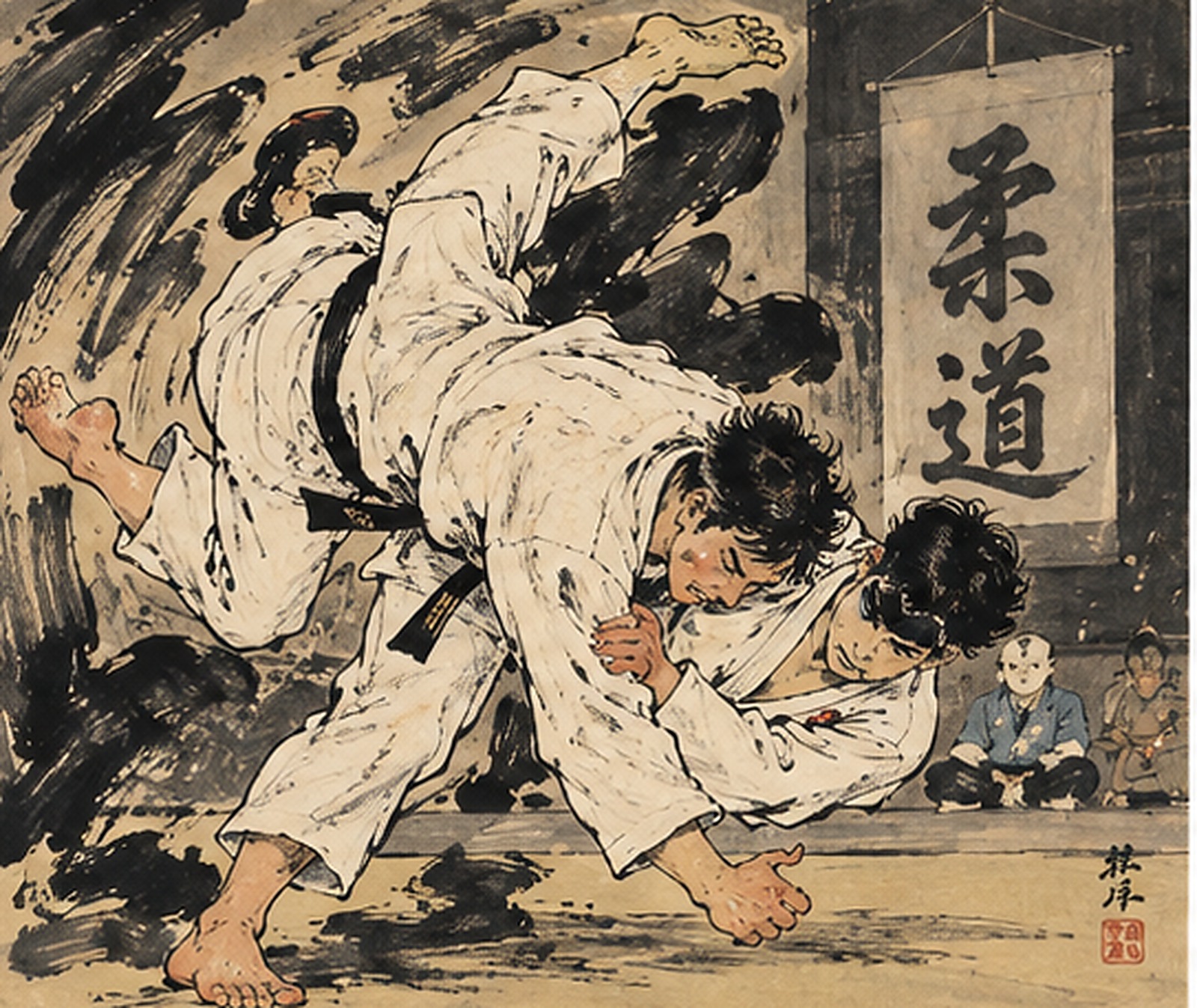
What happens after the bow?
Two judoka face one another on a mat. Before a throw, hold or contest for a grip, they bow. It is a small movement in a sport capable of extraordinary force, and a clue to why judo’s Japanese founders considered it something more than a fighting system.
That cultural ambition meets a less tidy present. Olympic competition requires scores, time limits, penalties and tactical choices; schools require safe instruction; international federations need rules understood in many languages. None of those needs automatically delivers the mutual respect articulated in judo’s founding ideals.
For Japan’s October Sports Day weekend, the interesting question is not whether judo is authentically Japanese. Its historical birthplace is clear. The question is how a practice conceived as education can remain recognizable when shaped by medals, commercial attention, injury risks and international competition.
A Meiji experiment, not a timeless relic
The All Japan Judo Federation identifies 1882 as the year Jigoro Kano founded judo. Drawing from older jujutsu systems, Kano reorganized physical techniques within a project of character formation and useful participation in society. This was an intervention in the educational world of Meiji Japan, not the mere preservation of an unchanged feudal combat art.
Judo, commonly translated as the gentle way, is not simply gentle exercise. Its throws and holds are forceful, and effective use of balance, timing and leverage demands rigorous practice. The educational claim rests on how those skills are learned and used, not on the absence of physical struggle.
The Kodokan tradition distinguished practice, technical study and discussion. As judo entered schools, police training and eventually international sport, the balance among those elements evolved. The survival of the tradition has depended on adaptation as much as conservation.
Two principles that test the institutions
The Japanese federation’s educational materials explain seiryoku zenyo as using mental and physical energy to best effect for a good purpose. Jita kyoei means mutual welfare and benefit: people prosper by helping and cooperating with one another. These concepts are best treated as practical standards, not uplifting slogans.
During randori, or free practice, the partner is simultaneously a competitor and someone whose cooperation makes learning possible. If one participant disregards the other’s safety or dignity, both lose the conditions required for improvement. That is the institutional challenge hidden inside the philosophical ideal.
A winning program may speak of mutual benefit while protecting powerful coaches, pushing unhealthy training loads or overlooking bullying. To measure whether the principle survives, reporters must examine procedures for reporting abuse, instructor training and the treatment of novice athletes—not merely ceremony or medal counts.
Etiquette is more than a photograph
Reiho, the formal etiquette of judo, includes standing and seated bows and the conduct surrounding practice. The All Japan Judo Federation calls it one of the discipline’s most important elements. Respect is made visible before and after competitive struggle.
But proper bows do not demonstrate that everyone is treated fairly. They can coexist with coercive instruction or disrespect in private. Nor should etiquette become a pretext for policing international athletes’ minor stylistic differences while ignoring the broader principles behind the practice.
The bow has a stronger meaning when an athlete can challenge unsafe instruction, lose a match without humiliation and train alongside someone with different cultural experience. In that context the ritual marks mutual recognition instead of unquestioning obedience.
From Tokyo 1964 to a worldwide sport
Men’s judo made its Olympic debut at Tokyo 1964, while women’s judo became an official medal sport at Barcelona 1992. Those milestones helped transform a Japanese educational and physical discipline into a shared arena of international technical experimentation.
International competitors developed variations in gripping, combinations, groundwork and tactical preparation. The evolution widened the sport’s possibilities but also made scoring criteria and officiating an increasingly contested public subject. A spectacular ippon must coexist with consistent decisions in close contests.
There is no straightforward division between pure traditional judo and an imported modern system. Kano’s original reform was itself modernizing. The useful test of changes today is whether they make competition understandable and fair while protecting athletes and preserving opportunities to demonstrate skill.
Why the scoring rules keep changing
For the 2025 international competition cycle, the International Judo Federation reintroduced the yuko score. Its published explanation allowed scores for five to nine seconds of immobilization in groundwork, adjusted certain grip permissions and retained penalties for prohibited direct leg contact. These are documented provisions of the published 2025 framework, not a claim that every 2026 tournament used identical rules.
Additional scoring gradations may reward meaningful attacks that fall short of higher scores. They may also generate unfamiliar borderline calls, leaving athletes, coaches and audiences dependent on transparent and consistent judging. The tensions are structural: a sport wants action and clarity, while real contests produce ambiguous movement.
As governance becomes multinational, Japan cannot simply dictate what counts as authentic. Its influence depends on articulating principles that competitors everywhere can test against safety, fairness and the quality of the contest.
A promise of education requires safety
Ukemi, the techniques of safely receiving a fall, is a foundation of beginner instruction. The federation’s safety manuals and school teaching guides emphasize progression, appropriate conditions and careful instruction. Its outreach materials also describe programs that introduce young children to falling safely and to respectful conduct.
Japan’s judo authorities have acknowledged that philosophy alone did not prevent harmful behavior. The All Japan Judo Federation launched its Judo MIND initiative in 2014, defining manners, independence, nobility and dignity as core expectations, following work to combat violence and harassment within the sport.
Publishing a safety manual does not by itself demonstrate a safe gym. The questions are whether instructors receive effective training, young participants have independent ways to seek help, injuries are reviewed and organizations respond to complaints without favoring successful competitors. These are obligations, not optional decorations on a martial-arts tradition.
The future is decided outside the medal podium
A federation-described preschool outreach effort in Yamaguchi Prefecture introduced children to etiquette and safe falling, offering a view of judo that was not dependent on competitive success. Its relevance extends to regional participation, physical confidence and the possibility of lifelong learning.
As Japan ages and its youth population contracts, judo faces choices about who is invited onto the mat. A community club that is safe for beginners, welcoming to women, accessible to people with different abilities and accountable to parents may do more for the tradition’s endurance than another high-profile victory alone.
The essential achievement of Kano’s experiment was to connect the effectiveness of a technique with the purpose for which it was used. More than a century later, judo’s legitimacy depends on bringing that question to the whole sport—from the world final to the smallest neighborhood dojo.