- A criminal conviction followed by removal from office
- Why a criminal sentence is not the same as impeachment
- The constitutional bargain established in 1947
- How Japan investigates and removes a judge
- Why summary courts matter to ordinary citizens
- Online gambling and the reach of Japanese law
- Accountability without sacrificing judicial independence
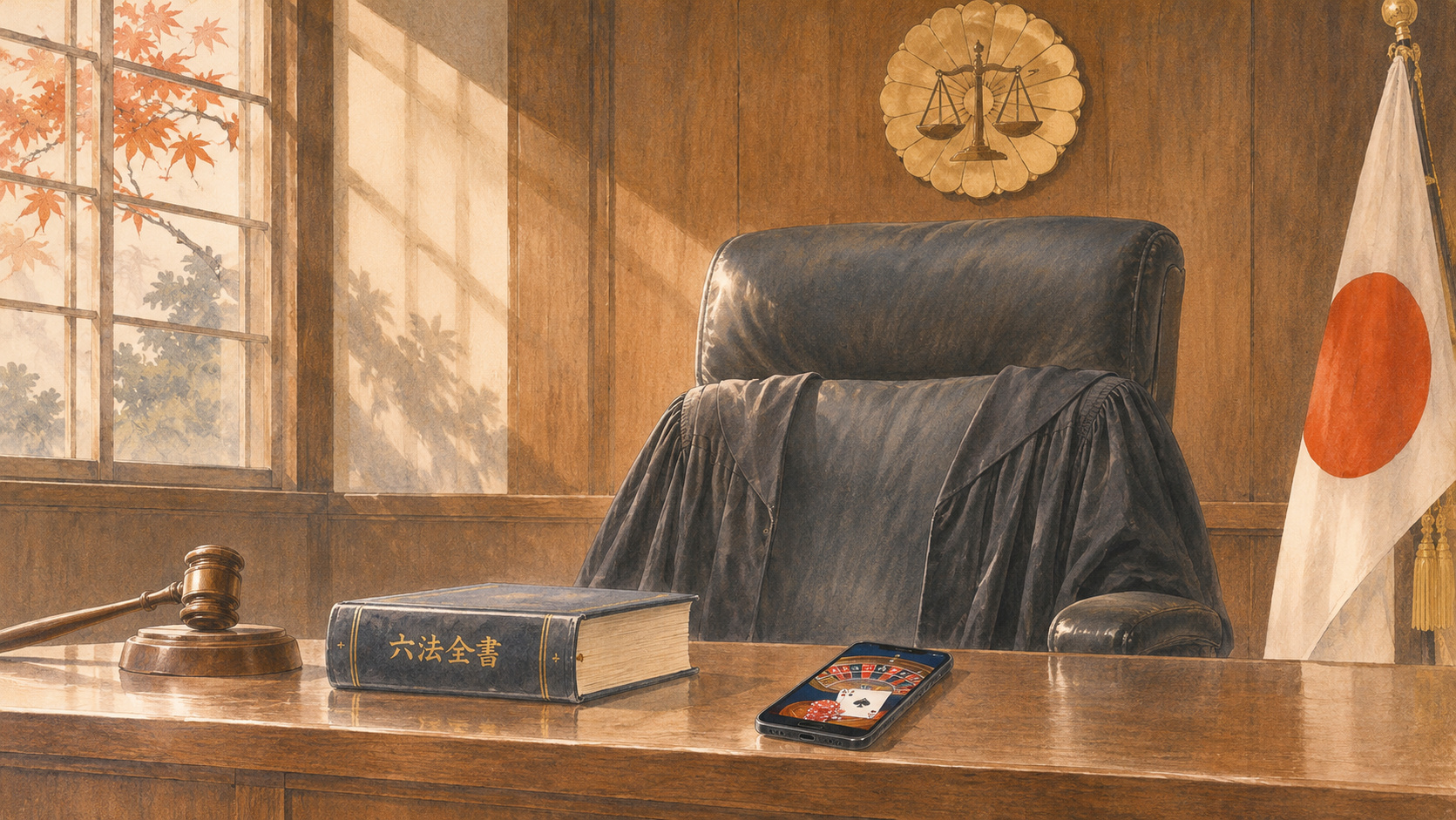
A criminal conviction followed by removal from office
Japan’s Judge Impeachment Court removed Niigata Summary Court judge Akifumi Morimoto, 52, on November 25, following a final criminal conviction for habitual gambling and other offenses. Jiji Press reported that the decision was the ninth removal of a judge through impeachment in postwar Japan, and the first since April 2024.
The case involved more than wagers placed through a smartphone. Reporting by TV Asahi and Jiji described the misappropriation of approximately ¥2.78 million in common expenses belonging to a government employees’ housing association in Akita. The criminal sentence was three years of imprisonment, suspended for four years. The impeachment proceedings also addressed gambling during working hours.
The ruling therefore raises a question that goes beyond the criminal conduct itself: how can a judicial system hold its own members accountable without making their decisions vulnerable to political pressure? Japan answers that question through a separate constitutional procedure.
Why a criminal sentence is not the same as impeachment
The criminal court determines whether the defendant committed offenses and imposes the punishment authorized by law. A suspended sentence does not erase a conviction. The impeachment court, by contrast, determines whether the judge should retain judicial office. It neither retries the criminal prosecution nor functions as an appellate court reviewing the sentence.
Kyodo News reported that the Judge Indictment Committee submitted its indictment dated September 10. At the first impeachment hearing on October 28, Morimoto did not contest the charges; the hearing concluded that day. Removal took effect when the verdict was pronounced on November 25.
This distinction matters for international readers accustomed to other forms of impeachment. In this Japanese proceeding, the immediate question is judicial status rather than the removal of a president or minister. The two processes can impose different consequences for the same underlying conduct without serving the same legal function.
The constitutional bargain established in 1947
Japan’s postwar Constitution was promulgated in 1946 and entered into force on May 3, 1947. Article 76 establishes judicial independence, while Article 78 protects judges against removal outside the constitutionally prescribed processes and prevents administrative agencies from disciplining them.
These protections exist for the benefit of litigants as much as judges. If a government could dismiss a judge simply because it disliked a ruling, the protection offered by an independent court would be weakened. But independence cannot mean immunity from accountability for serious misconduct.
Article 64 establishes an impeachment court composed of members of both houses of the Diet. The Judicial Impeachment Act of 1947 specifies two broad grounds for removal: serious breaches or neglect of official duties, and misconduct sufficiently grave to undermine judicial dignity, whether committed on or off duty. It is the statutory grounds, not dissatisfaction with the outcome of an ordinary case, that define the removal process.
How Japan investigates and removes a judge
Members of the public, as well as the Supreme Court, can request action by the Judge Indictment Committee. The committee investigates and deliberates in private; it may decide to indict, suspend indictment or decline to indict. If it brings an indictment, a different body, the Judge Impeachment Court, conducts a public hearing.
The court consists of seven members of the House of Representatives and seven members of the House of Councillors. These legislators are not the citizen lay judges who sit in certain ordinary criminal trials. Removal requires the agreement of at least two-thirds of the members who participated in the hearing. The law requires reasons and supporting evidence for a removal judgment.
There is no ordinary appeal against an impeachment verdict. Removal also entails loss of legal professional qualifications. Under Article 38, restoration of qualifications may be sought under specified conditions, including after five years when sufficient grounds exist. Such restoration is not automatic reinstatement to judicial office.
Why summary courts matter to ordinary citizens
Japan’s judiciary lists 438 summary courts across the country. These institutions hear civil claims generally valued at ¥1.4 million or less, as well as certain less serious criminal cases. They also offer procedures intended to resolve everyday disputes more accessibly, including small-claims litigation and civil conciliation.
For a household seeking repayment of a debt or a small business pursuing an unpaid bill, the judge may be the most direct encounter with the justice system. Trust in the individual administering the process is consequently important even when the sums at stake are modest by commercial standards.
The dismissal of a judge does not, in itself, invalidate every decision previously made by that judge. Questions about particular judgments must be addressed through the applicable legal procedures and facts of those cases. The institutional issue is how to maintain confidence in fair adjudication while correcting misconduct through lawful means.
Online gambling and the reach of Japanese law
The National Police Agency warns that wagering from within Japan on an overseas online casino is illegal even when the operator is licensed in another jurisdiction. A foreign license does not displace the law governing conduct inside Japan.
The agency’s survey, discussed at a National Public Safety Commission press conference on March 14, 2025, estimated that roughly 3.37 million people in Japan had wagered through online casinos. Estimated annual stakes amounted to ¥1.2423 trillion. That is an estimate of sums wagered, not net consumer losses or casino profit; it is also survey-derived rather than a census of users.
Japan broadened its response in 2025. An amendment to the Basic Act on Measures against Gambling Addiction, effective September 25, prohibits specified forms of promotion and referral to illegal online gambling. The policy addresses the digital environment in which access to gambling can be promoted, in addition to the conduct of people who place wagers.
Accountability without sacrificing judicial independence
The wider lessons are institutional. Where officials handle money belonging to others, measures such as separate authorization and periodic reconciliation may reduce opportunities for misappropriation. Confidential support for people experiencing financial problems may also help identify difficulties before they become more serious. These are possible preventative measures, not reforms ordered in the November judgment.
Such safeguards must be designed with care. Oversight of personal conduct and financial responsibilities should not become a mechanism for supervising the substance of judicial decisions or subjecting judges to unrestricted scrutiny of private life. Clear standards and proportionate procedures matter to both accountability and independence.
Gambling-related harm deserves a public-health response as well as enforcement of the law. But the available sources do not establish a psychiatric diagnosis for Morimoto, and it would be inappropriate to infer one. Japan’s ninth postwar removal provides a concrete illustration of the constitutional balance: the public needs judges who are protected from political retaliation, and it needs a credible, transparent procedure for addressing serious breaches of the responsibilities that accompany judicial office.
Primary sources and references
- Jiji Press via Nippon.com, November 25
- TV Asahi, November 25
- Kyodo via Kumamoto Nichinichi, November 25
- Kyodo via Kumamoto Nichinichi, September 11
- Constitution of Japan (e-Gov)
- Judicial Impeachment Act (e-Gov)
- Judge Indictment Committee: procedure
- Courts of Japan: lower courts
- National Police Agency: online casinos
- National Public Safety Commission, March 14, 2025
- Asahi Shimbun, November 25