- The productivity paradox inside Japan’s factories
- Three shifts, one industrial challenge
- Why the product may never be “finished”
- A history that begins well before generative AI
- The automobile offers a preview
- AI can write code; who guarantees it works?
- Three possible business strategies
- The workforce problem is bigger than coding speed
- What a business proof of concept should prove
- The next Japanese manufacturing advantage
The productivity paradox inside Japan’s factories
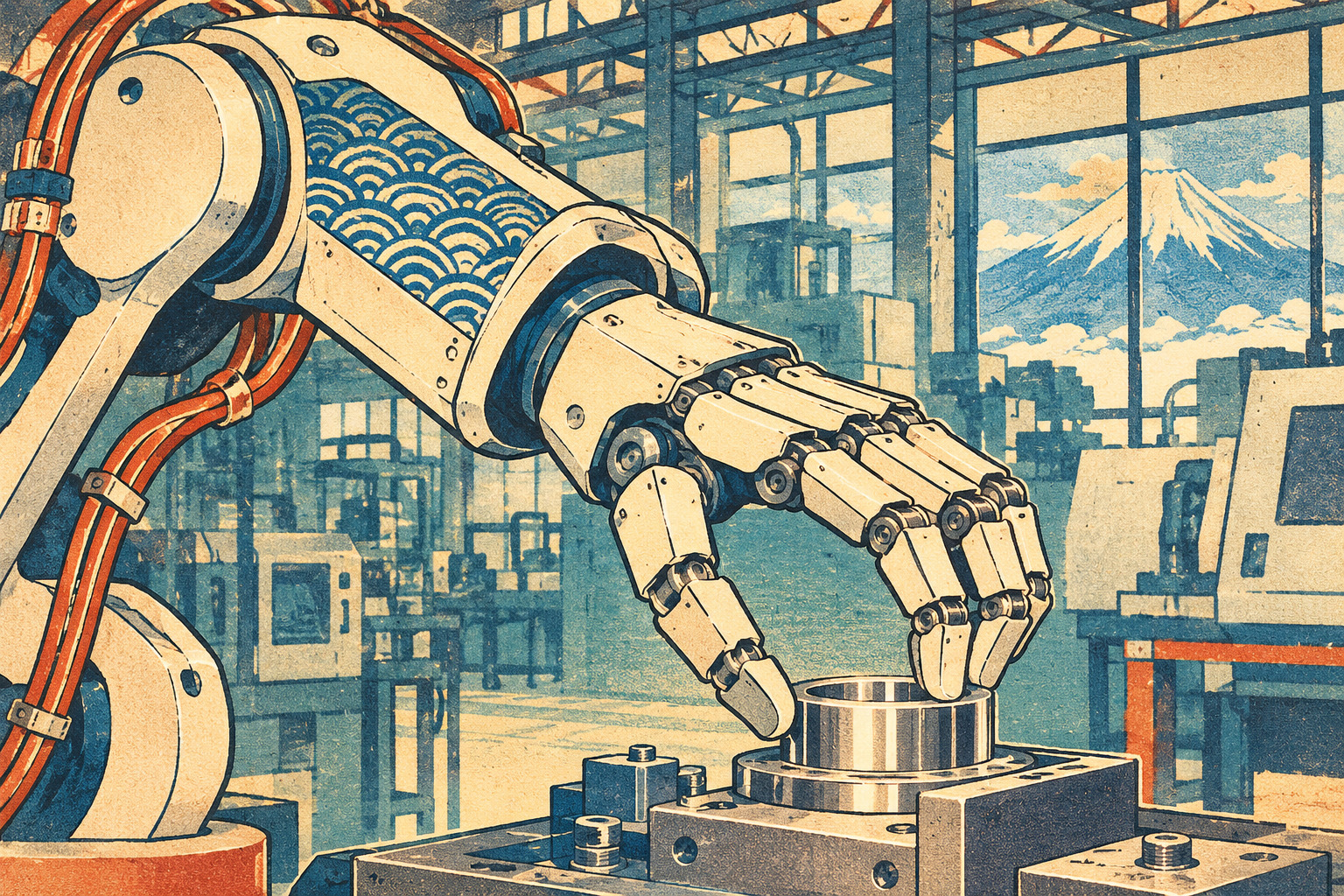
A robot arm can repeat a motion thousands of times with extraordinary precision. What most observers do not see is the software controlling the motor, interpreting the sensors, checking the limits and deciding what must happen when something goes wrong. Embedded software is one of the quiet foundations of Japan’s manufacturing economy. Now the companies that write it face an uncomfortable question: what happens to their business when artificial intelligence makes their work faster?
On November 16, 2026, the Japan Embedded Systems Technology Association, known as JASA, released a strategy report asking what embedded-software suppliers will be paid for next. Its argument is not that robots have suddenly acquired human judgment, or that Japanese factories have completed an AI revolution. It is that product design, software engineering and industrial business models are beginning to change together.
One tension is especially sharp. Suppliers traditionally paid according to engineer-months may bill less if AI enables them to finish the same task in fewer hours. Productivity improves, yet revenue can fall. The outcome is not inevitable—contracts differ—but it exposes an incentive problem that technology alone cannot solve.
Three shifts, one industrial challenge
JASA identifies three developments: software-defined everything, or SDx; AI-driven development; and physical AI. The first means that a machine’s capabilities can evolve after it leaves the factory. Instead of treating shipment as the end of product development, manufacturers must manage updates, faults, security and performance across years of use.
The second is a change in how code and engineering documentation are produced. AI-assisted systems can generate drafts, suggest tests and help engineers navigate complex codebases. That does not make the resulting code safe or correct. The third involves AI that interacts with physical surroundings through sensing and action, including robotics and industrial equipment. Unlike a text-generation system, a malfunctioning physical system may damage goods or injure people.
Together, the changes create a new proposition: industrial software is becoming a continuing service tied to the lifetime behavior of a product. JASA frames the challenge through 2030, while urging businesses to begin experiments in 2027.
Why the product may never be “finished”
A traditionally engineered device could spend years performing a fixed task. A software-defined device may receive security fixes, new functions or entirely different operating logic after sale. That can improve usefulness and extend service life, but every update can create a new failure mode.
JASA describes the accompanying responsibility as “continuous dependability.” A dependable product must remain sufficiently safe, secure and reliable across its operational lifetime—not merely pass an acceptance test on delivery day. This requires version control, regression testing, vulnerability management, incident response and, in some industries, long-term support for components no longer in production.
The business implication is easy to overlook: somebody has to pay for all that continuing work. If procurement treats software as a one-time engineering expense, manufacturers and suppliers may struggle to fund the assurance that software-defined products require.
A history that begins well before generative AI
Japan has decades of experience in computing that is invisible to consumers. The TRON Project began in 1984 under computer scientist Ken Sakamura, emphasizing open architectures and real-time operating systems for embedded devices. According to the TRON Forum, its work has influenced a broad range of products, from industrial controls and home electronics to automotive systems.
Real-time computing is about meeting deadlines predictably, an essential property when a controller must respond to a sensor within a narrow time window. Today’s AI models, by contrast, may produce probabilistic outputs that need monitoring and constraints. Integrating the two is not as simple as replacing conventional control logic with a neural network.
JASA was established in 1986. Its latest report is therefore more than a response to the current enthusiasm for AI. It is an industry body rooted in the age of embedded microcontrollers asking whether the software skills that made Japanese products reliable can be transformed into lasting commercial value.
The automobile offers a preview
Japan’s Ministry of Economy, Trade and Industry and Ministry of Land, Infrastructure, Transport and Tourism adopted a Mobility DX Strategy in May 2024 and updated it in June 2025. It places software-defined vehicles, mobility services and data use at the center of industrial competition. The government set an objective for Japanese-affiliated companies to account for 30% of global software-defined vehicle sales in both 2030 and 2035. That is a policy target, not a forecast.
A vehicle that can change through software brings different commercial relationships. Chipmakers, systems integrators, software vendors, cybersecurity specialists and automobile manufacturers may need to cooperate for the life of a platform. A supplier once paid to deliver a controller may be expected to support diagnostics, updates and defenses against new threats many years later.
This is also why the concept stretches beyond cars. Agricultural equipment, energy systems, factory robots and medical devices raise related questions, although their regulatory and safety requirements are not interchangeable.
AI can write code; who guarantees it works?
Imagine an engineering job once budgeted for ten engineer-months. Better tools reduce the required work to six. Under strict time-based billing, the supplier may earn less even though the customer gets the same functioning system sooner. Under an outcome-based arrangement, the supplier might capture some of the value created. JASA argues that businesses should reconsider what customers are actually buying.
Yet moving to outcomes is difficult. Requirements must be clear. Testing has to be auditable. When defects emerge after deployment, contracts must specify who investigates, who fixes them and who pays. Embedded systems often operate under tight constraints on timing, memory, power consumption and physical safety. A generic code assistant cannot simply assume responsibility for those constraints.
The new competitive asset may therefore be a combination of reusable engineering knowledge, skilled human oversight, automated validation and legally robust support arrangements—not the raw volume of code produced.
Three possible business strategies
JASA outlines three directions. The first is an efficient, scale-oriented model: use AI and shared engineering methods to outperform what clients could economically build internally. The second is specialized problem-solving: own a hard technical problem from definition through sustained improvement. The third is new-market creation, including ventures built around physical AI.
These are strategic alternatives rather than a universal recipe. A large supplier may find advantage in common platforms and highly automated testing. A specialist could command a premium for safety engineering or a demanding industrial interface. A smaller group may choose to invest in an emerging application where a recurring service can be built around the machine.
In each case, pricing must reflect value and responsibility. The report’s central proposal is not simply to lay off engineers or install an AI tool. It is to redesign the relationship between expertise, risk, customer benefit and revenue.
The workforce problem is bigger than coding speed
Japan’s Information-technology Promotion Agency reported in its DX Trends 2025 research that more than 80% of surveyed Japanese companies considered their digital-transformation talent insufficient. The survey covers DX personnel more broadly; it should not be misread as an embedded-engineer shortage statistic.
That distinction matters. Physical AI needs software developers, but also control engineers, designers, test technicians, domain experts and workers familiar with production environments. Engineering capacity is not just a headcount. A promising demonstration must become a system that can be maintained, audited and operated when conditions differ from the training data.
AI-generated code may help teams cope with scarce resources. It can also introduce vulnerabilities or unexpected behavior at industrial scale if validation does not keep pace. Responsible deployment demands measurements: defect rates, test coverage, maintenance effort, time saved and the actual cost of failures.
What a business proof of concept should prove
For 2027, JASA recommends business-oriented proofs of concept rather than isolated technology demonstrations. A functioning model is useful; a viable contract is harder. Does a customer pay for improved uptime rather than engineering hours? Can the supplier price long-term safety updates? Are reusable tools actually lowering cost without weakening quality? Who owns the data and intellectual property?
JASA plans to discuss its 2030 outlook at EdgeTech+ 2026 in Yokohama on November 18. At the time of writing, that conference session remains scheduled; its discussion and outcomes are not treated here as events that have already occurred.
A realistic pilot could compare two contracts for similar engineering work, tracking development time, failure rate, customer outcomes and maintenance costs. Another could test whether safety verification can be delivered as a recurring service. The point is to obtain evidence before restructuring an entire company around a forecast.
The next Japanese manufacturing advantage
The iconic image of Japanese industry is physical precision: a carefully machined part, a reliable motor, a robot repeating its task within tight tolerances. The next advantage may depend on combining that physical craftsmanship with software, learning systems and the ability to demonstrate that a product remains trustworthy after thousands of operating hours and repeated updates.
It would be a mistake to portray JASA’s report as independent proof that Japanese companies already dominate physical AI, or that new revenue models are guaranteed to work. The report is an industry strategy document. Evidence about productivity, profitability and the safety of real deployments still has to be collected company by company.
But its question is timely. If software increasingly defines what a machine can do, who owns the capability to keep improving it—and who earns the revenue from doing so? That is the business battle behind the impressive robot arm.
Primary sources and reporting limitations
Sources and reporting limits: JASA’s official announcement is the principal source, supported by government and TRON Forum records. The full 2026 PDF could not be independently retrieved in this research session; specific claims about the report are therefore limited to what its official release supports. No original company interviews were conducted.