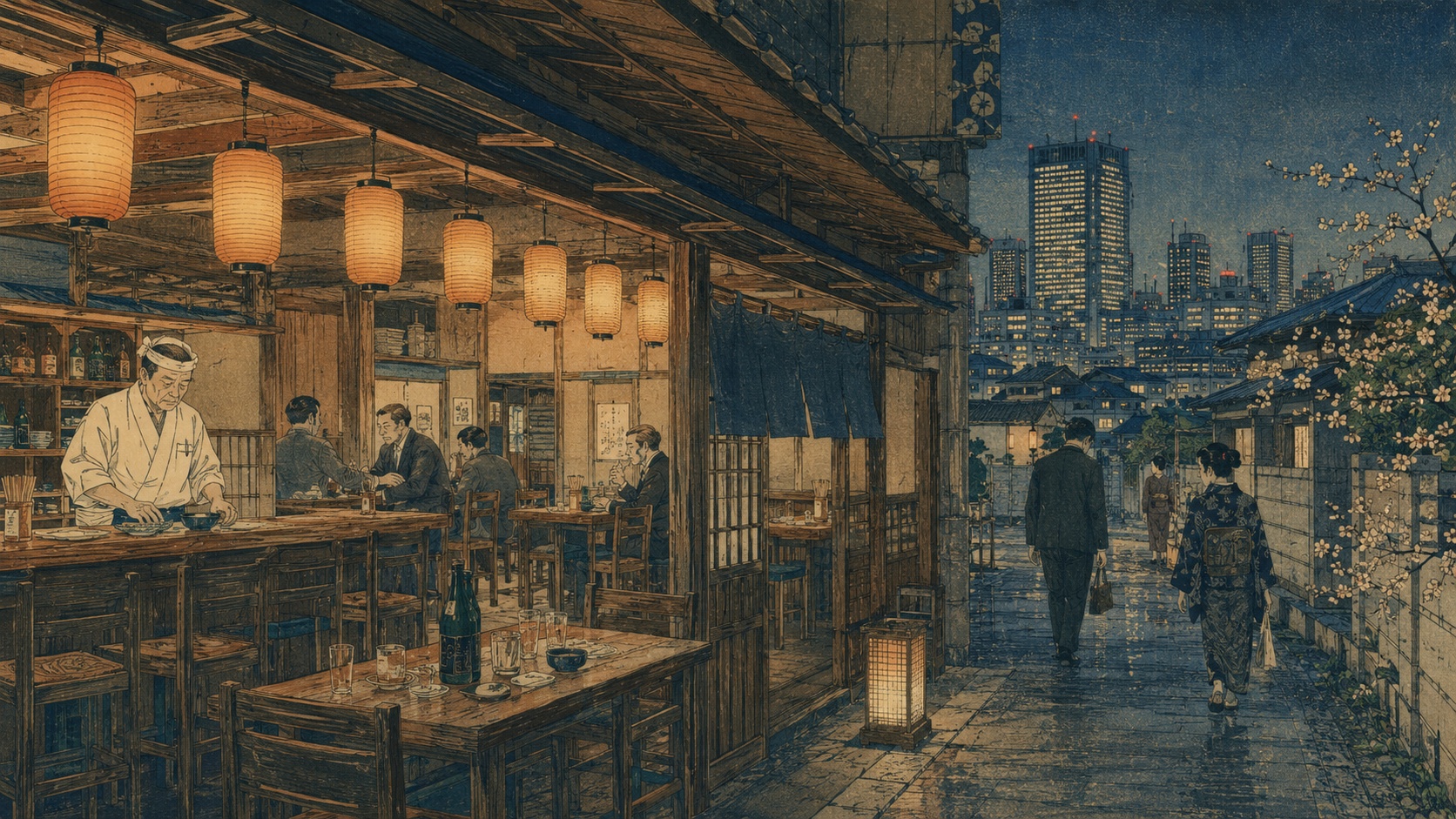
Tokyo Shoko Research counted 118 “izakaya” bankruptcies in the first half of 2026, the highest first-half total in its series beginning in 1989. Teikoku Databank counted 125 failures in the broader “bars and beer halls” category among legal insolvencies with liabilities of at least ¥10 million. The classifications, universes and time series differ, so the figures are not supposed to match. Both, however, set first-half records. Neither count captures every voluntary closure, succession failure or quiet withdrawal by a sole proprietor.
The empty banquet room
At seven in the evening, the counter downstairs is alive. Two friends divide skewers. A solitary office worker nurses a small glass. A visiting couple uses a translation app to identify the fish on a handwritten menu. Upstairs, however, the banquet room is dark: cushions for forty, pitchers once filled for an all-you-can-drink course, and the doorway where an organizer used to welcome an entire department.
That vacant room explains more about the 2026 izakaya crisis than a simple claim that Japan has stopped drinking. The desire to share food, alcohol and conversation has not vanished. What is breaking apart is the old economic bundle that tied cheap drinks, large company parties, second rounds, late hours and plentiful part-time labor into one dependable business model.
For customers, the bargain was extraordinarily convenient. The bill was predictable. The menu pleased almost everyone. Head counts could change at the last minute. A manager’s speech, a newcomer’s welcome, client maintenance and complaints about work could all be processed inside the same inexpensive box. Behind that convenience, however, were thin margins, long hours, complex preparation, a late-night workforce and countless services that were never fully priced. When customer behavior changed and every major cost rose, the balance began to fail.
118 is a profit-and-loss number, not a nostalgia statistic
Tokyo Shoko Research says 105 of the 118 izakaya failures in the first half of 2026—88.9%—were attributed primarily to weak sales. Add accumulated losses and business deterioration accounts for 94.9%. Bankruptcy, a liquidation form in which the operating company generally disappears, represented 106 cases, or 89.8%. And 115 failures, 97.4%, involved businesses with fewer than ten employees.
Teikoku Databank’s broader restaurant survey reached the same structural conclusion. Restaurant bankruptcies totaled a first-half record 473, with bars and beer halls the largest category at 125. Of all restaurant failures, 369, or 78.0%, carried liabilities below ¥50 million. Smallness can be an izakaya’s greatest asset—the owner’s eye, the relationship with regulars, local sourcing, a menu written that afternoon. In purchasing power, recruitment, financing and technology investment, the same smallness becomes exposure.
Large groups can pool procurement, central kitchens, logistics, membership apps, advertising and several restaurant formats. An independent tavern can have its entire week changed by the price of one fish, one drum of cooking oil or the departure of one cook. Raise prices and regulars come less often; hold prices and the owner’s income disappears. The sector is trapped between household thrift and the arithmetic of survival.
The ¥5,000 wall
For decades, the fixed-price banquet course was one of the izakaya’s most effective inventions. A package of food and unlimited drinks made the organizer’s job easy and gave participants a visible budget. For the restaurant, a reservation converted a large block of seats into known revenue before the evening began.
But when alcohol, fish, meat, rice, oil, seasonings, electricity, wages and rent all rise, yesterday’s price can be preserved only by cutting portions, quality or profit. TSR reports that sub-¥5,000 all-you-can-drink packages have become harder to find, making it more difficult to invite colleagues or friends casually. Customers reduce the number of gatherings, order one fewer dish or go home sooner.
The significance of ¥5,000 is not merely that it is expensive. The old course sold freedom from decision. Once the bill crosses a psychological threshold, each participant asks whether the evening is necessary, whether the company will pay, whether the money comes from the household budget, and whether the experience is worth the lost time the next morning.
The second round has weakened too. A first party followed by another bar and perhaps a final bowl of noodles once distributed spending across an entire nightlife district. The new pattern is often one venue, one or two drinks, several dishes and home. Standing bars and tightly focused specialists can serve that brief occasion. A large banquet izakaya retains the rent, kitchen and labor cost of a longer night even when the night itself has contracted.
Company drinking moves from entitlement to consent
Year-end parties and welcome gatherings were never only restaurant transactions. They were Japan’s second conference room: places to display hierarchy, introduce recruits, mark transfers, trade unofficial information, cultivate clients and say what could not easily be said at a desk. The izakaya supplied that room cheaply, while the company often treated after-hours sociability as a voluntary extension of employment.
Work-style reform, less overtime, remote work, dual-income households, caregiving, childcare, attention to harassment and a stronger claim on personal time have changed the meaning of the evening. The freedom not to attend has become real. A supervisor’s invitation can be kindness or pressure depending on the relationship. For an employee who does not drink, must drive, has religious or health reasons, or simply wants to go home, a supposedly voluntary party can feel like unpaid work.
Tokyo Shoko Research found that 57.2% of companies actually held a year-end 2025 or New Year 2026 party. That was down from 59.6% the previous season—the first post-pandemic decline—and far below the pre-COVID rate of 78.4%. Among companies that had once held parties but chose not to, 21.7% cited cost reduction. The survey also identified a widening gap between employers seeking cohesion and workers who prefer to socialize with people they choose rather than extend the office into the night.
The story is not that corporate hospitality has disappeared. TSR found total corporate entertainment spending of ¥345.377 billion in 2025, above its pre-pandemic level. Yet entertainment expense as a share of sales and operating profit remained below 2019. Companies are still meeting in person; they are becoming more selective about with whom, for what purpose and at what cost. Ritual mass banquets lose, while smaller meals with an explicit objective can gain.
Has Japan stopped drinking?
The National Tax Agency’s latest alcohol overview shows adult per-capita alcoholic beverage sales falling from 80.3 liters in fiscal 2014 to 74.8 liters in fiscal 2024. Total volume declined from roughly 8.33 million kiloliters to 7.73 million over the same period. Population structure, health awareness and changing habits create a clear long-run headwind.
But “young people do not drink” is too crude to explain the market. Beer sales per adult rose from 21.5 liters in fiscal 2023 to 22.5 liters in fiscal 2024. Consumers move among beer, sparkling products, spirits, liqueurs, lower-alcohol drinks and nonalcoholic options. The change is as much about selecting occasions, limiting quantity, seeking flavor and origin, and alternating alcoholic and alcohol-free drinks as it is about abstinence.
In 2024, the Ministry of Health, Labour and Welfare issued national guidelines on health-conscious drinking. Their purpose is to help individuals understand risk and make decisions appropriate to their circumstances, rather than treat a single social norm as suitable for everyone. The cultural message is shifting from “an adult should be able to drink” to “an adult decides whether and how much to drink.”
An izakaya that depends on volume alone faces a shrinking runway. A tavern that sells food, conversation, regional identity, atmosphere and serious nonalcoholic choices still has a market. The distinction is fundamental: fewer liters do not necessarily mean fewer reasons to go out.
In 1596, the customer stayed at the liquor shop
The izakaya is much older than the chain restaurant or the corporate banquet. Gurunavi’s account of Toshimaya traces the business to 1596, when a liquor shop at Kanda-Kamakura-gashi in Edo also began serving drinks on site. Instead of buying sake and leaving, customers remained at the shop. The expression for staying to drink—izake—is presented as the root of izakaya. Simple accompaniments such as miso dengaku followed.
That origin matters. The earliest izakaya was not a machine for maximizing alcohol volume. It was a small point where distribution and sociability met: stock from the liquor shop, uncomplicated food, passersby, neighborhood information and close contact with the proprietor. Capital needs were modest and the length of a visit could be flexible.
During the Edo period, cold-season brewing and the rise of professional toji brewing teams improved production technique and supply. As Edo’s population and street-food culture expanded, drinking places became rooms where artisans, merchants, travelers and others could share urban time. They did not erase social rank, but a cup could loosen the boundary of ordinary life.
The red lantern becomes infrastructure for the salaryman
Postwar urbanization and rapid growth gave the izakaya a new institutional role. Millions commuted from expanding suburbs into company-centered lives. A drink before returning home softened fatigue, adjusted relationships among colleagues and turned senior employees into informal instructors. The red lantern became a buffer between corporation and household.
Under long-term employment, seniority and strong company identity, investing in workplace relationships could shape a career. The company party was not always compulsory in writing, but absence could carry a cost. Economic growth, the bubble years and client entertainment thickened demand for everything from owner-operated counters to large banquet halls.
Chain izakaya industrialized the habit. Familiar signs outside major stations, long photographic menus, uniform prices, large private rooms and all-you-can-drink plans made it possible to organize a department party almost anywhere in Japan with limited risk. “Something for everyone” was the product. When employment relationships became more fluid and attendance became truly optional, the infrastructure built for certainty became heavy.
COVID-19 destroyed demand—and delayed insolvency
In 2020, shortened hours, restrictions on alcohol service and warnings against group dining struck directly at the reason the izakaya existed. Operators tried lunch, takeaway, boxed meals and temporary closure. The pandemic did not merely remove revenue; it questioned whether the shared after-work room was safe or necessary.
Yet insolvency totals did not fully express the pain at the time. TSR notes that cooperation payments and financing support suppressed bankruptcies. Those measures were essential, but they could not restore the old demand structure. When support receded, debt repayment, food costs, utilities and wages arrived together. The record failures of 2024 and 2026 are partly the pandemic’s delayed invoice.
Customers also learned durable alternatives: one venue rather than three, home drinking, smaller groups, reservations and earlier nights. Restaurants learned to operate with fewer staff, shorter hours and narrower menus. Traffic returned, but the 2019 ritual did not return intact.
No one is available to carry the late night
The izakaya is unusually exposed to labor scarcity. Preparation begins before opening; cooking, service and dishwashing peak together; cleaning comes after the last customer. A Friday requires extra people, often until or beyond the final train. If demand is uncertain, the restaurant must either pay workers through quiet periods or lose sales during the rush.
In Teikoku Databank’s January 2026 survey, 58.6% of restaurants reported insufficient nonregular labor, the second-highest share among industries even after three years of improvement. Labor-shortage bankruptcies across all sectors reached a record 441 in fiscal 2025; restaurants recorded 21, also a category high. Recruitment difficulty, departures and an inability to match competing wages all become operating-capacity problems.
Foreign employees, spot-work platforms, mobile ordering, self-checkout, service equipment and reservation systems are now indispensable. Technology, however, cannot read a regular customer’s face or explain why tonight’s fish is different. Good automation removes transcription, walking, payment and inventory chores so human attention can return to cooking and hospitality. Bad automation simply leaves fewer exhausted people responsible for everything that remains.
The surviving izakaya separates into two futures
The first future is short, inexpensive, focused and fast: standing bars, small counters, a narrow menu built around yakitori, stew or another signature, transparent prices and quick service. The guest can be satisfied in an hour. The operator does not depend on a banquet floor or a second-round crowd. In one sense, it is a return to the compact liquor-shop drink of 1596.
The second is the destination tavern: regional sake, seasonal fish, fermentation, a proprietor’s point of view, distinctive vessels, counter conversation and perhaps a reservation-led course. Price is justified not by abundance but by an experience that cannot easily be substituted. For international visitors, it can become an entrance into regional Japanese culture.
The most vulnerable position is the undifferentiated middle. A hundred-item menu, many seats, average food, prices that cannot rise, fewer parties and insufficient late-night staff create complexity without a reason to visit. “We have everything” once reduced risk for the organizer. Today it multiplies procurement, training, waste and kitchen movement. Reinvention begins with editing—with deciding what the restaurant will stop doing.
Do not exile the nondrinker from the tavern
The future izakaya cannot treat a person who does not drink as an accompanying noncustomer. A single bottled alcohol-free beer is not enough. Tea, fermented drinks, fruit, spice, carbonation and regional water can form a food-pairing program in their own right. Drinkers and nondrinkers should be able to share the same table at the same pace.
This need not reduce revenue. High-quality zero-proof beverages, pairing flights, dessert and earlier dinner use can create a new check. People abstain for health, pregnancy, driving, religion, training, medication, the next morning’s work or simple preference. Modern hospitality allows the choice without demanding an explanation.
Entrance design, lighting, clear prices, smoke policy, allergy information and ordering instructions also matter to solo guests, women, younger customers, older customers and visitors. Regular-customer culture can be warm, but it can look closed from outside. Opening the circle slightly can bring revenue from beyond the neighborhood without erasing the room’s character.
Inbound tourism: savior or mirror?
Teikoku Databank points to strong inbound demand and the central place of Japanese food in visitor motivation as a growth opportunity. An izakaya offers sashimi, grilled dishes, fried food, hot pots, sake and shochu in one room. For a traveler, it can function as an encyclopedia of everyday Japanese dining.
But demand does not enter automatically. Reservations, cover charges and otoshi, multilingual menus, allergies, vegetarian choices, payment, ordering quantities and smoking rules can all be unfamiliar. Explaining them does not dilute tradition; it builds a door into it.
Nor is charging tourists more a complete rescue plan. A restaurant that prices out its regular neighborhood becomes dependent on seasonality and travel flows. The strongest operators serve local life and visitor curiosity from the same kitchen. Tourism is less a savior than a mirror: can the value of the room be understood by someone entering for the first time?
The old izakaya and the next one
| Design | Old model | Next model |
|---|---|---|
| Primary group | Company organizer and large party | Small groups, solo guests, locals and visitors mixed together |
| Value proposition | Low price, quantity and broad choice | Specialization, origin, story, safety and time value |
| Alcohol | Sell volume through unlimited drinking | Quality by the glass, lower alcohol and serious zero-proof pairing |
| Time | Second rounds, late night and long stays | Earlier periods, shorter visits and demand concentrated by reservation |
| Menu | A hundred items and “something for everyone” | Fewer signature dishes that simplify sourcing and training |
| Labor | Large part-time pool and tacit knowledge | Multinational teams, standards, technology and clearly human hospitality |
| Price | Avoid increases and hide the burden inside the business | Explain the value of wages, ingredients, origin and experience |
| Regulars | Comfort of the inner circle | Keep the warmth while making a first visit legible |
From 1596 to 2026: nights that changed the tavern
| Period | Turning point | Meaning for the izakaya |
|---|---|---|
| 1596 | Toshimaya is said to begin a liquor-shop drinking business at Kanda-Kamakura-gashi. | Customers remain at the shop for sake and simple food—the compact origin. |
| Mid-Edo period | Cold-season brewing and professional toji teams develop as urban food culture expands. | More consistent supply supports a denser social world around sake. |
| Postwar growth | Urbanization, commuting and company-centered employment spread. | The red lantern becomes a third place between office and household. |
| 1980s–90s | Bubble-era entertainment and chain expansion. | The large-party, long-menu, uniform-price model reaches maturity. |
| 2003 | TSR’s January–April failures first move into the twenties after the IT-bubble collapse. | Economic sensitivity becomes increasingly visible in insolvency data. |
| 2007 | Stronger drink-driving rules and social enforcement reshape the conditions of drinking out. | Demand changes particularly in car-dependent locations. |
| 2012 | Post-earthquake restraint and weaker use. | TSR’s January–April izakaya failures reach 50. |
| 2020–22 | COVID restrictions, support payments and emergency finance. | Demand collapses while public support temporarily suppresses insolvency. |
| 2024 | First-half failures rise to 98 after the pandemic. | Repayment, cost inflation and changed party habits surface together. |
| 2026 | First-half izakaya failures reach 118, the first triple-digit total. | The adjustment moves from cultural change to business exit. |
Seven signals to watch next
- Bankruptcy versus closure:Track voluntary exits, succession failures and reduced hours, not only legal insolvency.
- Party size:Look beyond whether gatherings occur to head count, second-round rates and length of stay.
- Life above ¥5,000:Does a higher price empty the room, or can food, pay and sourcing be explained well enough to retain trust?
- Retention:Watch departures, days off, late-night duties and promotion of foreign employees—not only the advertised hourly wage.
- Zero-proof revenue:Can nondrinkers generate a serious check and a repeat visit?
- Visitors and locals together:Can tourism revenue grow without displacing the neighborhood’s evening?
- The empty banquet room:Can it become smaller rooms, reservation dining, daytime use, classes or community events?
Not the final order, but the next glass
The number 118 is severe. Behind each case are suppliers, employees, regulars, families and one less light in a shopping street. Calling the failures merely inevitable would underestimate what a neighborhood loses.
But the number does not announce the death of the izakaya. For more than four centuries, the Japanese tavern has changed with society: liquor-shop drinking, red lanterns, station-front chains, private banquet rooms and craft-focused counters. What has endured is the desire to sit beside strangers, speak a little more honestly with friends, and occupy time that belongs neither to home nor to work.
What is ending is the model that treats drinking as proof of belonging, hides the cost of low prices in the bodies of owners and staff, and waits for forty-person parties to return by habit. The next izakaya can put the freedom to drink and the freedom not to drink, a brief evening and a long conversation, regional flavor and a first-time visitor at the same table.
Whether the red lantern survives will not be decided only by how many liters Japan consumes. It will be decided by whether the person of 2026 can see a reason—chosen freely—to sit beneath its light.
Sources and methodology
Japan.co.jp reviewed corporate surveys, government alcohol statistics, health-policy documents and industry-history materials available through 6:00 a.m. Japan time on August 1, 2026. Bankruptcy series use different industry definitions and universes. Alcohol volume is sales per adult across the full adult population, not an average limited to drinkers. Historical and operating conclusions are Japan.co.jp analysis based on the cited evidence and are not legal, medical or company-specific management advice.
- Tokyo Shoko Research: Record 118 Izakaya Bankruptcies in First-Half 2026
- Teikoku Databank: Restaurant Bankruptcies in First-Half 2026
- Tokyo Shoko Research: Izakaya Failures, Banquet Prices and the ¥5,000 Wall
- Tokyo Shoko Research: 2025–26 Year-End and New Year Party Survey
- Tokyo Shoko Research: Corporate Entertainment Spending in 2025
- National Tax Agency: Alcohol Overview, July 2026
- Ministry of Health, Labour and Welfare: Guidelines for Health-Conscious Drinking
- Gurunavi Communications: Toshimaya and the Roots of the Izakaya
- Gekkeikan: Cold-Season Brewing and Toji in the Edo Period
- Teikoku Databank: Corporate Labor Shortage Survey, January 2026
- Teikoku Databank: Labor-Shortage Bankruptcies, Fiscal 2025
