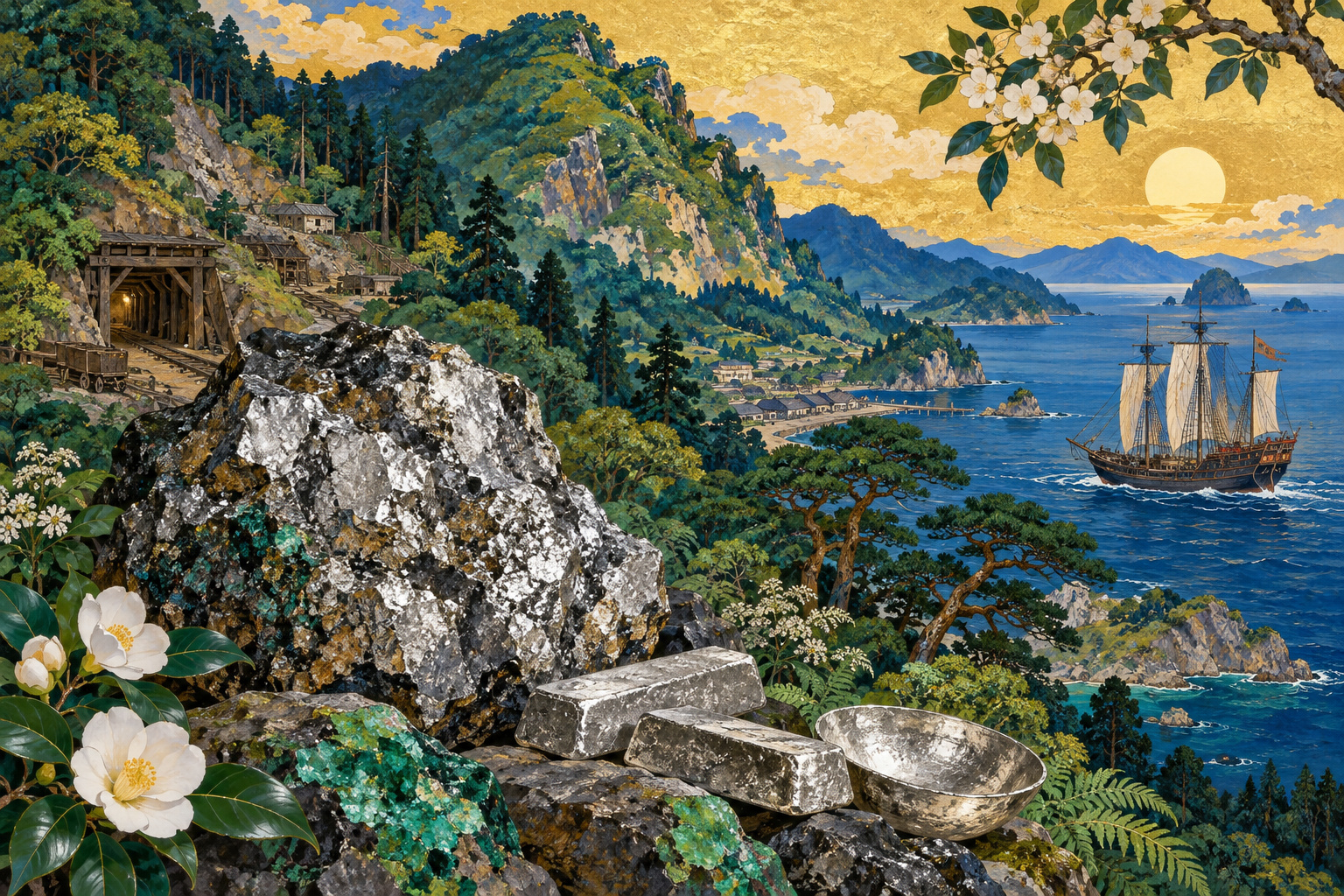
An exhibition in Tokyo places Iwami Ginzan within a much longer history of silver: as an artistic material, a measure of value and a means of exchange. The Ancient Orient Museum’s exhibition, titled 古代オリエントから石見銀山へ―銀が動かす世界―, opened on September 19 and runs through December 6.[1][2]
It is part of the commemorative program for 2027, when Iwami Ginzan marks 500 years since its discovery and 20 years since World Heritage inscription, according to Shimane Prefecture. The exhibition is in Ikebukuro, Tokyo, rather than at the mining site in Shimane.[2]
From objects to systems of exchange
The museum’s five-part structure moves from humanity’s encounter with metals to silver objects, money, maritime trade and Iwami Ginzan. Jewelry, vessels, coins and materials associated with the mine provide different ways into that story.[1]
The curatorial sequence encourages a question beyond an object’s appearance: what gave the metal its value, and who made its circulation possible? Looking at silver as both a crafted material and a means of payment brings cultural and economic history into the same frame.
A mine connected to the wider world
UNESCO’s listing encompasses a landscape of mining and refining remains, settlements, transport routes and ports. Its assessment credits Iwami Ginzan’s silver production in the sixteenth and early seventeenth centuries with contributing to commercial and cultural exchanges between Japan, East Asia and European trading partners.[3]
That landscape makes the connection tangible. Production required more than access to ore; it also depended on skills, communities and routes to shipping points. The heritage site preserves relationships between those activities, as well as individual remains.
Keeping the mining community in view
The Iwami Ginzan World Heritage Center in Oda, Shimane, likewise organizes its permanent interpretation around global history, mining technology, research and the cultural landscape. It is a separate institution from the Tokyo exhibition venue.[4]
For visitors, that broader perspective can prevent a history of silver from becoming only a story of treasure. The metal’s international importance is also a history of local work and the systems that carried its products beyond the mine.
Visiting the Tokyo exhibition
The Ancient Orient Museum is on the seventh floor of Sunshine City’s Bunka Kaikan building. Admission is ¥1,500 for adults, ¥1,000 for university and high-school students, and ¥400 for elementary and junior-high students.[1]
The exhibition is open daily during its run, normally 10 a.m.–5 p.m., with last admission at 4:30 p.m. On October 18 and November 20, opening extends to 8 p.m., with last admission at 7:30 p.m. All times are Japan time.[2]
