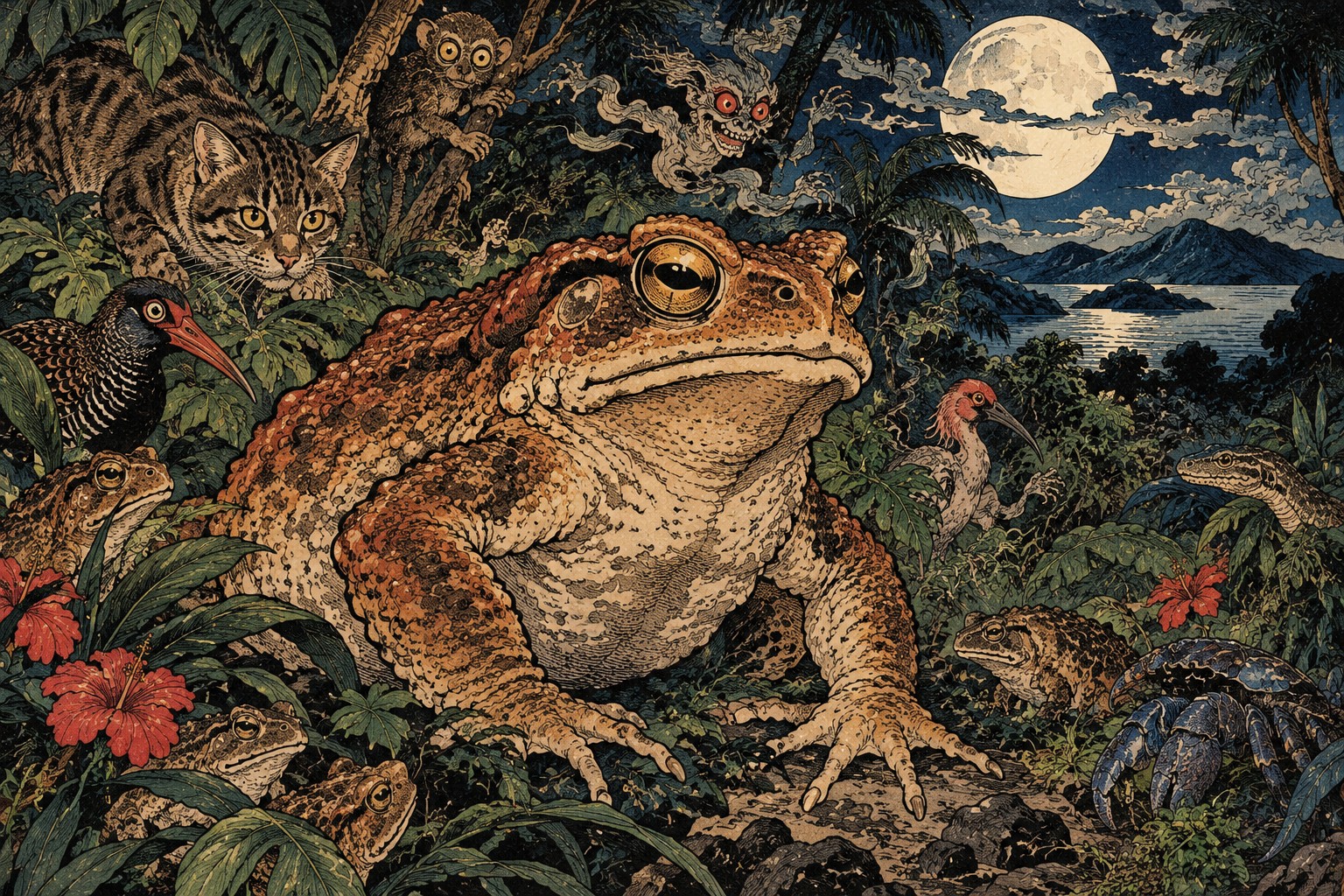
A genetic clue is not proof of immunity. For an island still free of an established population, prevention remains essential.
A danger that can arrive in a shipment
The threat to Iriomote Island does not need to swim across the sea. Invasive cane toads can travel inadvertently with materials carried from nearby Ishigaki, where the species is established. Japan’s environment ministry has documented repeated detections and removals on Iriomote, including a capture in May 2022. There is no confirmed established cane-toad population on Iriomote. That distinction changes the story: the immediate objective is prevention, not a claim that the island is already overwhelmed.
The October study and its deliberately limited answer
On October 27, Kyoto University and the University of the Ryukyus publicized research led by Alisa Tobe and colleagues, published in Genes on October 15. They screened public genetic information for native terrestrial vertebrates from Ishigaki and Iriomote, asking whether particular protein variations might offer clues to resistance against cane-toad toxins. The work does not demonstrate that the threatened animals are resistant, nor does it document a new wave of poisoning deaths. It creates a prioritized map of what scientists need to test.
The numbers: 185 species, but sequences for only 96
The researchers examined a roster of 185 native terrestrial vertebrate species. Suitable sequence information was available for 96. This is not a finding that the other 89 lack resistance; those species could not be assessed with the necessary genetic material. Reptiles and amphibians were particularly affected by the uneven availability of data. The missing information matters because a conservation program that sees mainly the species with readily available genomes risks overlooking others.
The toad that was supposed to help farmers
Native to the Americas, the cane toad was transported around the world in campaigns against crop pests. It reached Ishigaki in the late 1970s for sugarcane pest control and subsequently established itself. The episode belongs to a longer history of biological control measures whose consequences spread beyond the intended target. Australia, too, has documented deaths of native predators after they swallowed toxic cane toads. That history justifies concern, but Australian outcomes cannot be used as direct measurements of mortality among Iriomote’s wildlife.
Why the poison can disrupt life itself
Cane toads have prominent glands behind their heads that release defensive secretions containing cardiotonic steroids. These compounds can interfere with sodium-potassium ATPase, a protein pump that helps cells maintain the ion gradients required for electrical signaling and basic physiological function. Animals eating a toad may ingest a dangerous dose. The risk depends not simply on whether an animal is big or small, but on chemistry, physiology, behavior and the quantity encountered.
Two molecular positions become conservation clues
The scientists focused in part on the ATP1A1 gene, associated with the alpha-1 component of the sodium-potassium pump. Prior research has linked amino-acid substitutions at positions 111 and 122 to changes in sensitivity to cardiotonic steroids in some organisms. Those associations are not universal rules. Protein context and other mechanisms can affect the outcome. The researchers therefore treated the sequences as flags for follow-up work, not a diagnostic blood test that could assign each species a survival score.
The Iriomote wildcat and the danger of overstatement
The endangered Iriomote wildcat is a compelling part of the story precisely because its vulnerability is still uncertain. The screen found ancestral-type sequences at the highlighted sites in the wildcat and many other species. That finding does not prove susceptibility. Nor was the study an experiment in feeding toxic toads to wildcats or a record of wildcats dying from cane-toad poisoning. The conservation question remains urgent because the cats can eat frogs and are confined to a singular island habitat.
Three birds point scientists toward the next experiments
Three bird species—crested serpent eagle, grey-faced buzzard and black-faced spoonbill—showed substitutions considered potentially relevant to toxin resistance. Earlier work had identified the eagle as a species of interest; the latest broad screen also highlights the buzzard and spoonbill for functional testing. It would be premature to label them immune. The substitutions may or may not confer meaningful tolerance in living animals. That gap between genetic suggestion and demonstrated outcome is a central result of the paper.
One cannot sequence away ecological exposure
Molecular susceptibility is only part of ecological risk. A predator that frequently encounters toads, grabs them and swallows them may experience more exposure than an animal with a similar sequence that avoids them. Differences in body size, prey choice and local behavior could matter. Conversely, a potentially sensitive animal may rarely meet a toad at all. Credible risk assessment must combine genomic signals with ecology, physiological experiments and monitoring rather than sorting the island’s animals into safe and doomed categories.
The overlooked role of ports and construction yards
Japan’s environment ministry has developed prevention guidance because frogs can hide in transported materials and equipment. Ports, construction storage areas and shipments between islands are potential pathways for accidental movement. Its 2021–2031 Yaeyama control plan addresses surveillance and population management across the islands. Inspection can sound less exciting than a laboratory discovery, but for an island without an established population, careful logistics may be the decisive conservation technology.
A World Heritage forest with little margin for error
Iriomote was included in the UNESCO World Natural Heritage property encompassing Amami-Oshima, Tokunoshima, northern Okinawa and Iriomote in 2021. The recognition draws attention to the exceptional diversity and endemism shaped by island isolation. That same separation can make ecological disturbances difficult to reverse. Conservation must protect habitats and the interactions among species, not merely preserve the names of rare animals on a list. Local monitoring is therefore part of the island’s wider ecological stewardship.
What the paper leaves unanswered
The next essential questions are experimental: Do the identified substitutions change the pump’s behavior in relevant species? How do the effects vary with toxin dose? Which predators encounter or consume the toads in the field? How much genomic data can be generated for the unassessed animals? And can authorities identify accidental arrivals before reproduction begins? None of these questions can be settled from the public sequences alone. Their unresolved status does not diminish the value of a systematic starting point.
A warning rooted in uncertainty, not sensationalism
The study is a research development, not proof of a catastrophe that has already occurred. On Ishigaki, an introduced animal is established; on Iriomote, prevention has so far kept an established population unconfirmed. Genetics now offers a way to direct future tests, while rangers and communities confront the practical challenge of preventing transport. The essential lesson is not that scientists have found which animals will die. It is that conservation cannot afford to wait for that answer after an invasive predator has spread.
Sources and verification
Based on university research announcements, the peer-reviewed paper citation, and environment ministry and Okinawa sources; no original interviews or independent toxin experiments.