- A slow machine for an unforgiving destination
- The difference between finding water and finding a resource
- Two countries, one integrated spacecraft
- Why a lunar rover needs more than good wheels
- Seven instruments and the challenge of measuring ice
- Japan’s path from orbiting the Moon to exploring its surface
- India brings its own history of lunar discovery
- From exploration to a possible lunar economy
A slow machine for an unforgiving destination
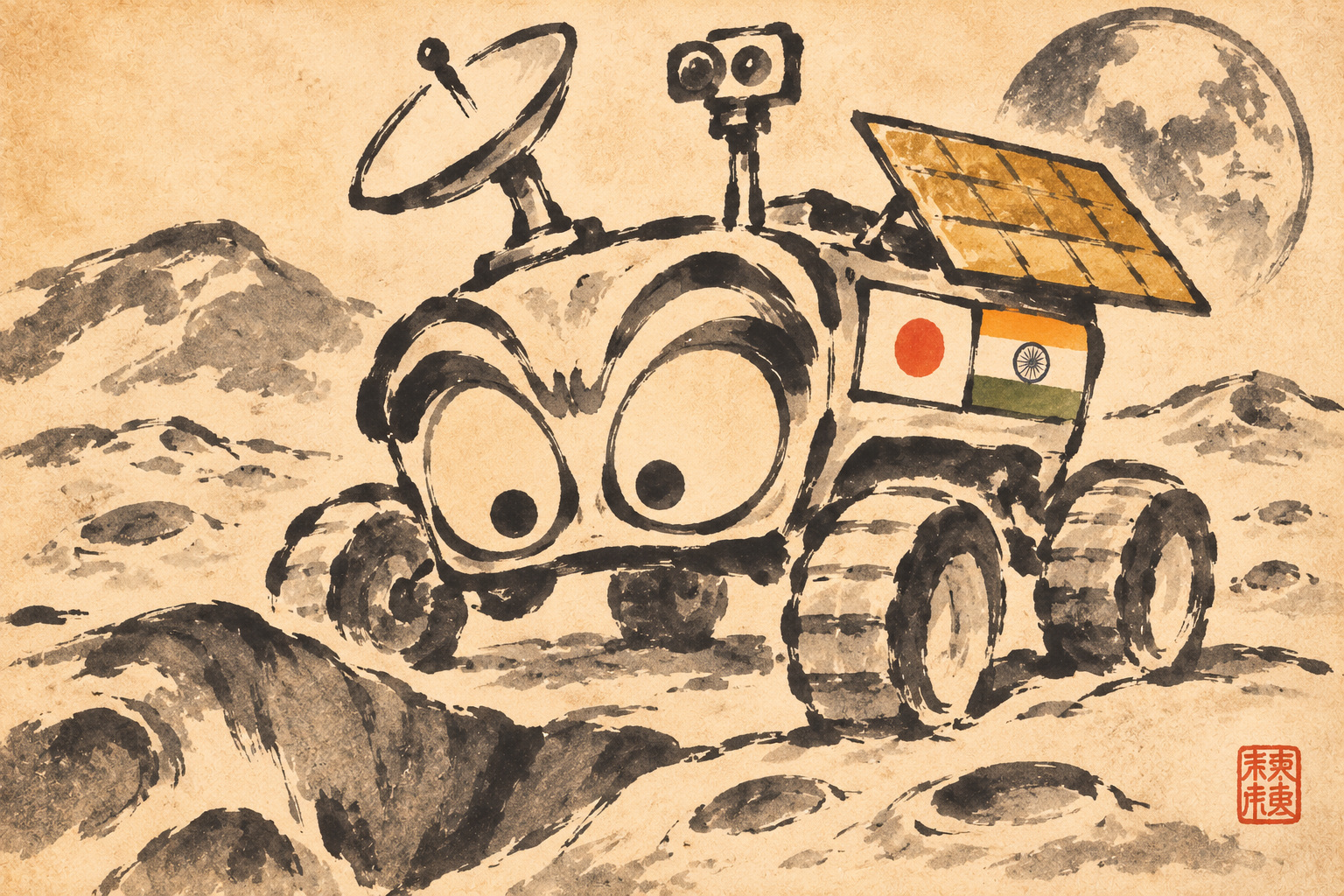
At JAXA's Chofu Aerospace Center in western Tokyo on November 25, a full-scale ground-test rover negotiated a course of crushed stone, rocks and simulated depressions. The pace was deliberately modest: around three centimeters per second, according to Japanese news reports. Yomiuri reported a demonstration run of approximately 40 meters. Four tracked assemblies carried the machine across the course.
The vehicle is a development model for Lunar Polar Exploration, or LUPEX, a joint Japanese-Indian mission intended to investigate water in the Moon's southern polar region. The significance of the demonstration is not speed. Every successful traverse gives engineers an opportunity to study traction, stability and the relationship between mobility and scientific operations.
This is not yet a lunar-ready performance certificate. An Earth-based course cannot reproduce the combination of vacuum, reduced gravity, abrasive dust, temperature extremes and long-duration operation encountered on another world. But it provides a tangible view of a mission that must turn a stationary landing into a mobile scientific expedition.
The difference between finding water and finding a resource
For much of the twentieth century, lunar exploration focused on the Moon's geology and the history recorded in its rocks. The modern interest in polar water adds a practical question: might materials already on the Moon reduce the burden of supplying future expeditions from Earth?
Near the poles, the Sun remains low above the horizon. Some crater interiors receive no direct sunlight. Their cold conditions can preserve volatile compounds over long periods. In 2009 NASA's LCROSS mission struck Cabeus crater and examined the resulting plume, establishing evidence of water ice at that location.
Yet the existence of ice is not the same as an inventory of accessible reserves. Deposits may be patchy, buried, mixed with mineral grains or difficult to extract. Even a promising orbital signature may not identify a suitable mining location. LUPEX is designed to bridge the gap between remote observations and measurements made on the surface. Its results could also inform scientific questions about how water arrived on the Moon and migrated across its surface.
Two countries, one integrated spacecraft
The partnership began with joint work in 2017. An implementation arrangement was exchanged during the August 29, 2025 Japan-India summit. Japan is responsible principally for the rover and launch, while the Indian Space Research Organisation (ISRO) is developing the lander. Both contribute scientific equipment.
JAXA's current mission page specifies a launch in Japanese fiscal 2028 aboard an H3 rocket from Tanegashima Space Center. The planned rover weighs 420 kilograms including scientific instruments. With its solar array deployed, the published dimensions are approximately two meters long, 1.8 meters wide and 3.3 meters high. The nominal surface mission is around 100 days, with a possible extension to one year.
Those numbers describe a planned system, not a completed flight configuration. International cooperation requires teams to reconcile interfaces, mechanical loads, deployment geometry, power and command protocols. A rover that works in isolation is insufficient: it must survive launch and landing, leave the Indian lander safely, and operate as part of a coordinated scientific mission.
Why a lunar rover needs more than good wheels
Lunar regolith is a product of repeated impacts and weathering in an airless environment. Its fine, angular grains can abrade moving components. A polar rover must also contend with steep slopes and poorly illuminated terrain. The four tracked assemblies seen in Chofu are an approach to negotiating those conditions and distributing contact loads.
A vehicle's weight on the Moon is roughly one-sixth of its weight on Earth, but its mass and inertia do not change. That difference affects traction, the response to steering and the risk of slipping. Soil simulants and numerical models help engineers explore those problems, although no single ground test captures every feature of the actual surface.
The low Sun creates long shadows that complicate optical navigation. Communications also cannot be instantaneous over the Earth-Moon distance. A rover must therefore be able to halt safely when conditions are uncertain, monitor energy reserves and avoid routes from which it cannot recover. Its scientific value depends on arriving at a useful sampling site with enough power and time to investigate it.
Seven instruments and the challenge of measuring ice
Rather than relying on one detector, the mission combines several complementary measurements. A neutron spectrometer can help identify hydrogen-rich material beneath the surface; the Japanese WaSSPeR ground-penetrating radar examines subsurface structure. Hydrogen signatures alone do not establish the exact form or abundance of water.
The Japanese Resource Investigation Water Analyzer, REIWA, is designed to examine collected samples. Its thermogravimetric analyzer monitors mass changes during heating; its mass spectrometer examines released gases, and its optical moisture detector measures water and hydrogen isotopes. India's ISAP package contributes Raman spectroscopy. Together, these measurements can help distinguish water-bearing material and characterize its properties.
JAXA lists drilling beyond one meter and depth-selective sampling at a resolution finer than three centimeters among its technical objectives. Sampling at different depths and sites is important because temperature and illumination may influence where volatiles survive. A precise laboratory measurement of a single sample, however, cannot by itself establish the size or uniformity of a regional deposit. The value lies in combining chemistry, geology and location.
Japan’s path from orbiting the Moon to exploring its surface
Japan's lunar program began with Hiten in 1990, an early effort to develop lunar flight and orbital techniques. The 2007 Kaguya mission, also known as SELENE, advanced the country's scientific exploration of the Moon through orbital observations of its terrain and physical properties.
A different challenge was addressed by the Smart Lander for Investigating Moon (SLIM), which achieved Japan's first lunar soft landing on January 20, 2024. JAXA subsequently assessed the landing error as around ten meters or less from the intended target. The spacecraft also operated after three lunar nights, exceeding its original expectations in that respect.
LUPEX moves the emphasis from arrival to sustained surface operations. It must select destinations, travel across varying ground, collect material and analyze it without bringing samples back to an Earth laboratory. These are complementary capabilities rather than a simple progression in spacecraft size. The accumulated experience could inform later Japanese projects, including mobility systems for human explorers.
India brings its own history of lunar discovery
India's Chandrayaan-1, launched in October 2008, carried instruments developed by Indian and international research teams. Its observations helped reshape understanding of water and hydroxyl on the lunar surface. The mission demonstrated the scientific reach of a space program whose ambitions had expanded well beyond domestic satellite applications.
Chandrayaan-2 followed in 2019. Its lander did not complete a successful soft landing, but the orbiter continued to provide observations. On August 23, 2023, Chandrayaan-3 achieved a soft landing at a southern high-latitude site. That accomplishment should not be confused with landing at the geographical south pole itself.
Japan and India therefore bring different but complementary experience to LUPEX. A shared mission also offers opportunities for researchers to compare instrument readings, develop common operational procedures and jointly interpret results. The scientific partnership matters as much as the hardware division: consistent calibration and shared data analysis will determine how much knowledge can be extracted from the measurements.
From exploration to a possible lunar economy
The attraction of local water is straightforward. Purified water might support crews; electrolysis could provide oxygen and hydrogen for life support or propulsion. Transporting less material from Earth could eventually change the economics of missions. But each of those possibilities requires infrastructure that does not yet exist at operational scale on the Moon.
Mining cold regolith, heating it, capturing vapor, purifying the product and storing it would require equipment, energy and maintenance. The coldest locations may be scientifically attractive but poor places to rely on direct solar power. JAXA's planned solar tower, thermal insulation and high-energy-density batteries address the immediate problem of keeping a rover functioning, including periods without sunlight.
For an eventual resource operation, the relevant measures would include recovered water per unit of energy, machinery lifetime, maintenance requirements and the cost of transporting equivalent supplies from Earth. Resource extraction also raises questions about coordination between missions and protection of scientifically valuable sites. These are matters for later engineering and international discussion, not outcomes of the November test.
LUPEX will not build a lunar fuel station. Its contribution is more fundamental: acquiring measurements that could show whether such concepts deserve further investment. The slow-moving machine in Chofu represents an effort to replace assumptions with evidence, one carefully chosen sampling site at a time.
Primary sources and references
- JAXA November 25 press briefing listing
- Kyodo News, November 25 demonstration
- JAXA mission specifications
- JAXA rover and instrument technology
- JAXA lunar polar exploration project
- Japanese Foreign Ministry, August 2025 summit and agreements
- NASA LCROSS mission
- NASA lunar south pole environment
- JAXA SLIM mission completion
- ISRO Chandrayaan-1
- ISRO Chandrayaan-3
- ISRO Chandrayaan-2 FAQ
- Jiji Press, November 25 rover report
- Yomiuri Shimbun, full-scale test report
- JAXA LUPEX mission timeline