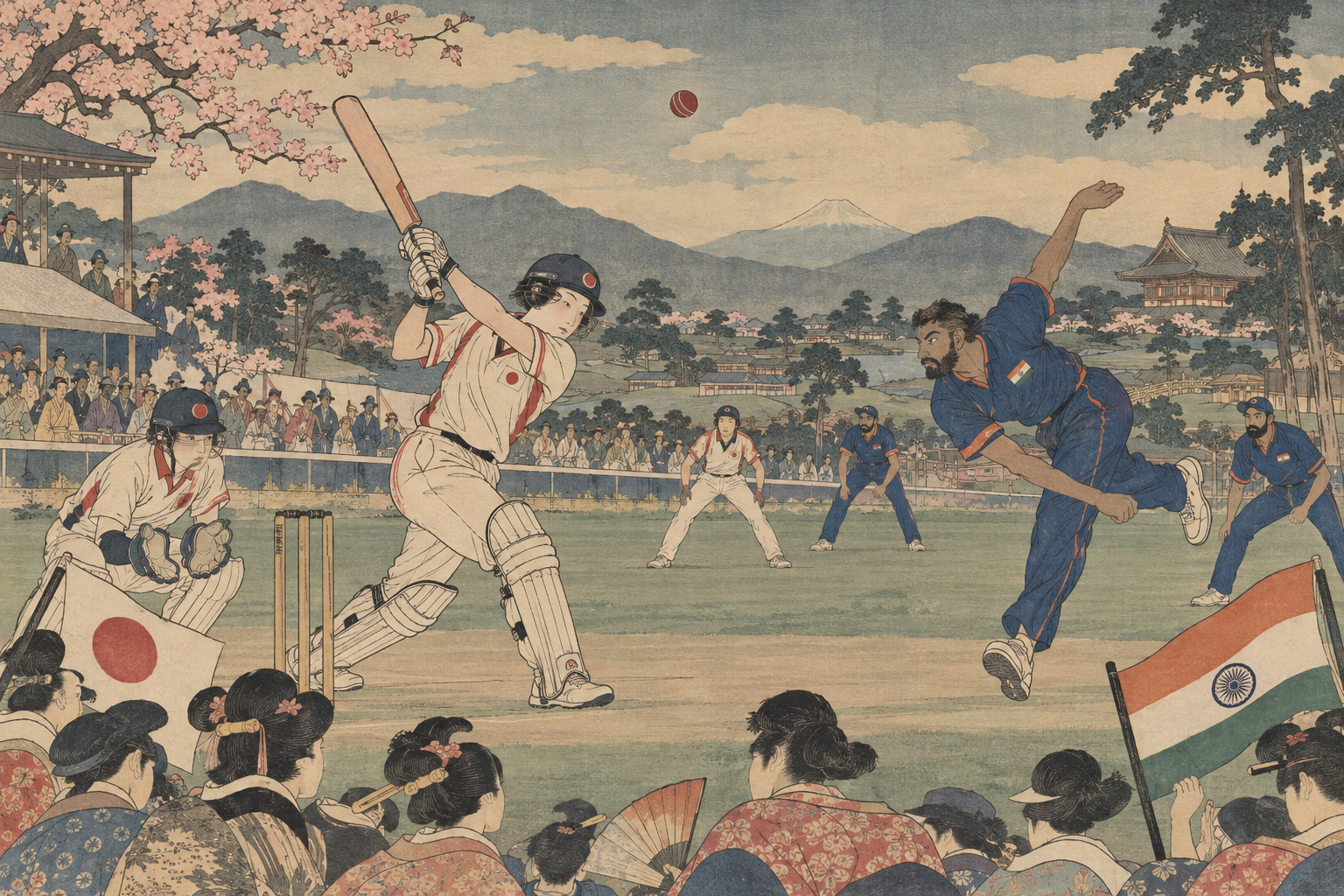
Cricket has been played in Japan since 1863. It has had clubs, university teams, national sides, World Cup qualifiers and a dedicated home in Sano. What it has not had is this: the reigning men’s world champions arriving on Japanese cricket’s own ground to play Japan in a recognized senior international.
On September 22, India and Japan will meet at Sano International Cricket Ground in Tochigi Prefecture in a one-off men’s T20 International. The Japan Cricket Association calls the Suzuki Cup the largest international friendly match in Japanese cricket history. Reuters describes another first: it will be Japan men’s first international against a Full Member of the International Cricket Council. [1][17]
The sporting imbalance is part of the point. India won the 2026 Men’s T20 World Cup in March, becoming the first side to retain the title and the first to win it three times. The ICC’s May annual ranking update kept India at No. 1 in men’s T20Is. [8][9] Japan is an Associate nation with a much smaller player base, but it arrives with evidence of progress: a first victory over Papua New Guinea in May and an Asian Games campaign beginning only two days after India comes to Sano. [10]
That makes September 22 unusually dense with meaning. It is a competitive benchmark, an Asian Games rehearsal, the opening event of a bilateral sports initiative, and the biggest stress test yet of Sano’s long attempt to make cricket part of a Japanese city rather than an expatriate curiosity.
Tuesday, September 22, 2026. Gates open at 11:00 a.m.; the match is scheduled to begin at 1:00 p.m. at Sano International Cricket Ground, 300-1 Tochimoto-cho, Sano, Tochigi. The fixture is a men’s T20I between Japan and India. JCA says tickets are advance-sale only, with sales scheduled through 11:00 p.m. September 20 unless the allocation is exhausted earlier. There is no general spectator parking at the ground. [2]
India compresses the gap into 120 legal balls
A Twenty20 innings ordinarily lasts no more than 20 overs. Each over contains six legal deliveries. That creates a basic ceiling of 120 legal balls for a batting side—and makes every short passage unusually expensive. A loose over can change a match in six deliveries; two misfields can turn pressure into a boundary sequence.
India arrives with the authority of the format’s dominant team. In the 2026 World Cup final, India defeated New Zealand by 96 runs to secure a record third title. [8] In the ICC’s May update, India remained first in the men’s T20I rankings on 275 points. [9]
For Japan, the useful measurements go beyond the romance of an upset. How long can the new-ball bowlers deny boundary options? Can the top order process international pace without losing shape? Can Japan’s spinners force India to hit against the field rather than into preferred zones? Does one dropped chance become a 20-run swing? Against a world champion, abstract gaps in standard become visible as timing, distance and decision.
One match cannot close the gap to the world’s No. 1 side. It can reveal, at full speed, exactly where that gap begins.
India’s Asian Games squad is known; the Sano XI is not
The Board of Control for Cricket in India has published its updated 15-man squad for the Asian Games. Shreyas Iyer is captain, with Abhishek Sharma, Sanju Samson, Ishan Kishan, Tilak Varma, Shivam Dube, Axar Patel, Washington Sundar, Varun Chakaravarthy, Ravi Bishnoi, Jasprit Bumrah, Arshdeep Singh, Vaibhav Sooryavanshi and others. On September 10, Yash Thakur replaced the injured Harshit Rana. [7]
Those names matter because the Suzuki Cup is framed as preparation for India’s Asian Games campaign. But they should not be silently converted into a confirmed Sano lineup. The BCCI and ICC confirm that India will play the T20I in Sano; at Japan.co.jp’s reporting cutoff, the BCCI had not separately published a Suzuki Cup squad or playing XI. [5][6]
India’s Asian Games squad is official. India’s final eleven for Sano is not yet published in the primary sources reviewed here. The article therefore does not promise that any individual Indian player will take the field on September 22.
Japan deliberately chose one squad for India and the Games
Japan’s selection is much more explicit. The same 15 players will face India and then move into the Asian Games. The ICC says selectors left out players who were eligible for T20Is but did not meet Asian Games eligibility, choosing continuity over assembling a one-day exhibition side. [3]
Kendel Kadowaki-Fleming captains the team and is identified by the ICC as Japan’s all-time leading men’s T20I run-scorer. Ibrahim Takahashi and Declan Suzuki-McComb are the other two members with more than 50 T20Is. Jake Kusuda-Nairn earns his first Japan selection after strong domestic performances, while Tsuyoshi Takada brings an international history stretching back to the 2013 East Asia-Pacific Twenty20 Championship. [3]
Wataru Miyauchi and Makoto Taniyama came through Japanese school cricket club programs. Taniyama, a leg-spinner, studied Shane Warne’s action through video and wears No. 23 in tribute to him. Charlie Hara-Hinze was part of Japan’s 2026 Under-19 World Cup side that defeated Tanzania. The pathways are revealing: school clubs, domestic cricket, mixed cultural backgrounds and long regional service are all feeding a national team in a country without a mass cricket pipeline.
| Player | Official-source context |
|---|---|
| Kendel Kadowaki-Fleming | 主将。ICCは日本男子T20I歴代最多得点者と紹介 |
| Charlie Hara-Hinze | 2026年U19ワールドカップ代表 |
| Benjamin Ito-Davis | オフスピン。負傷から復帰 |
| Wataru Miyauchi | ウィケットキーパー/打者 |
| Reo Sakurano-Thomas | 打者/ミディアムペース |
| Alex Shirai-Patmore | ウィケットキーパー/打者 |
| Shoma Sugaya-Slater | 代表15人 |
| Declan Suzuki-McComb | T20I出場50試合超 |
| Ibrahim Takahashi | T20I出場50試合超 |
| Makoto Taniyama | レッグスピン。学校部活動出身 |
| Lachlan Yamamoto-Lake | 代表15人 |
| Kohei Kubota | 代表15人 |
| Tsuyoshi Takada | 2013年のEAP大会から代表歴 |
| Jake Kusuda-Nairn | 日本代表初選出 |
| Alester Kadowaki-Fleming | 代表15人 |
Five matches in eight days
The India fixture cannot be isolated from Japan’s calendar. Japan hosts Hong Kong for T20Is on September 19 and 20, plays India on September 22, then opens its Asian Games group against Afghanistan on September 24 and faces Nepal on September 26. The ICC schedule therefore gives Japan five matches in eight days. [3]
That creates a classic preparation problem. India offers a level of speed and pressure Japan cannot easily simulate in training. But exposure has a cost: bowlers carry workloads, batters accumulate fatigue, small injuries become more consequential and there is only one rest day between each of the final three games.
The Asian Games result is not ceremonial. Japan must finish in the top two of its group to reach the quarter-finals. The same 15 players who discover a weakness against India must decide quickly whether it is fixable before Afghanistan arrives. The most valuable lesson from Sano may therefore be one that survives only 48 hours before being tested again.
May gave Japan a different kind of historic day in Sano
Japan has already produced its strongest modern result on the same ground. On May 18, it beat Papua New Guinea by 26 runs in the East Asia-Pacific pathway for the 2028 Men’s T20 World Cup. Japan made 121 for seven and held PNG to 95 for eight. Kadowaki-Fleming scored 45 from 33 balls. JCA called it Japan’s first win over PNG and its best result since the rankings began. [10][20]
The celebration came with a qualification lesson. Japan and PNG finished level on points, but PNG remained ahead on net run rate. The ICC says Japan remains alive in the 2028 World Cup pathway. [3] A landmark result did not erase the consequences of earlier margins.
That is useful context for India. A brilliant spell, one famous wicket or a fearless innings could become a defining Japanese cricket memory. Development, however, is measured by how often those moments can be reproduced against different opponents.
Sano did not become a cricket city overnight
The venue matters almost as much as the opponent. Sano has spent years making cricket a piece of local identity. The city promotes itself as “City of Cricket Sano,” running community events and school experiences alongside domestic and international competition. [13]
The present Sano International Cricket Ground was established at the former Tochigi Prefectural Tanuma High School site and opened in its rebuilt form in 2018. Sano describes it as Japan’s first purpose-built field meeting international cricket standards, with natural-grass main and sub grounds, practice facilities and 500 spectator seats. [14]
The JCA’s head office is at the same Tochimoto-cho address. [11] That concentration matters in an emerging sport. National-team work, competitions, schools, coaches, local volunteers and city promotion can reinforce one another rather than exist as disconnected projects.
India is the largest operational test Sano has faced. Transport, crowd management, first-time spectators, overseas fans, sponsors and media all arrive together. JCA’s ticket notice tells spectators there is no general parking at the ground, recommends the roughly 20-minute walk from Tobu Railway’s Tanuma Station and plans a free shuttle from Sano Premium Outlets for motorists. [2] Those details are mundane, but becoming a spectator sport depends on mundane things working.
Cricket in Japan is older than its public profile suggests
The game did not arrive with this event. JCA educational material dates Japan’s first cricket match to 1863 in Yokohama, between local merchants and the British Royal Navy, and the Yokohama Cricket Club to 1868. [16] The ICC tells the same broad story: cricket was played in Japan before the Meiji Restoration, but unlike baseball it remained largely within expatriate communities for generations. [15]
The Japan Cricket Association was established in 1984. Its current institutional page lists ICC membership from 1995 and, for 2025, about 7,300 players and 14,000 annual participants. [11]
Those numbers explain the unusual historical shape of September 22. Cricket is not “arriving” in Japan. It has been present for more than a century and a half. What is new is the ability of the Japanese game to attract the sport’s biggest national market and strongest current men’s team to its own home ground.
The Suzuki Cup is almost a literal test of JCA’s “Bloom” strategy
JCA named its 2023–2027 five-year strategy “Bloom.” The stated vision is for Japanese cricket to attract more participants, fans and partners through international performance, expanded reach, social value and professionalisation. It specifically emphasizes achievements and events that create attention and positive experiences. [12]
The Suzuki Cup is the most conspicuous version of that strategy yet. Suzuki is title partner; Mitsui Knowledge Industry and Tata Consultancy Services Japan are major partners; MUFG Bank and the City of Cricket Sano Supporter Club are official partners. The Ministry of Foreign Affairs, Embassy of India in Japan and Sano City are listed as supporters or cooperating bodies. [1]
But sponsorship is an input, not proof of growth. The harder metrics arrive later: how many first-time spectators return for a Japanese domestic match, how many children join a school or club, how many coaches and umpires are trained, and whether commercial partners still see value after the Indian team leaves.
JCA chief executive Naoki Alex Miyaji made a similar point in an interview with Reuters, saying one match will not suddenly make cricket as popular as baseball or football in Japan; he described it instead as the first page of a new era. [17] That is a useful way to read Sano. A breakthrough event matters most if it changes what can happen next.
The 75th anniversary is in 2027, not 2026
The event title can invite a calendar misunderstanding. Japan and India will mark the 75th anniversary of diplomatic relations in 2027. Japan’s Ministry of Foreign Affairs is already organizing the anniversary program for that year. [18]
The BCCI describes the September 2026 match as the launch of those celebrations and the first step of “Sport 75,” a sports-exchange initiative stemming from an agreement reached at a summit between Japanese Prime Minister Sanae Takaichi and Indian Prime Minister Narendra Modi. Its stated aim is to expand people-to-people exchange and sports cooperation. [6]
That political and diplomatic framing should be distinguished from the sporting contest. Government support helps explain why a fixture that would once have been commercially and logistically improbable became possible. Once play starts, however, diplomatic symbolism does not alter the playing conditions. A dropped catch remains a dropped catch; a boundary still counts six.
The Olympic return adds urgency—but Sano is not an Olympic qualifier
Cricket returns to the Olympic Games at Los Angeles 2028 after 128 years, with six-team men’s and women’s T20 competitions. The ICC’s June qualification framework gives the men’s automatic regional places through rankings at the end of 2026, subject to top-15 eligibility, with another place available through a 2027 Olympic qualifier. [19]
Hosting India does not give Japan an Olympic berth. Neither does hosting Asian Games cricket. That distinction matters because major-event language can make development sound faster than it is.
The Olympic return still changes the strategic environment. A sport that Japanese schools, cities and sponsors once saw as peripheral now has an Olympic pathway, an Asian Games presence and a home match against India in the same period. The opportunity is larger—but so is the need to build coaching, grounds, domestic competition and a national audience that survive beyond event cycles.
For many Japanese spectators, the first contest is with the rules
India’s supporters do not need to be persuaded that cricket can fill an afternoon. Many Japanese spectators do. The familiar bat-and-ball silhouette can be deceptive: overs, wickets, Powerplays, field restrictions, wides, no-balls and boundary rules create a rhythm very different from baseball.
That makes explanation part of the product. Stadium graphics, commentary, social media, beginner guides, children’s activities and a clear route from “I enjoyed that” to “where can I play?” can matter almost as much as a close score. A huge crowd assembled for India is not automatically a Japanese cricket audience.
JCA’s own strategy is built around converting visibility into participants, fans and partners. [12] September 22 is therefore not only a test of the national side’s technique. It is a test of whether the sport can make itself legible and welcoming to people who did not grow up with it.
History is guaranteed; legacy is not
The first Japan–India men’s international will be historic before the toss. Japan’s first men’s meeting with an ICC Full Member will be historic. A reigning world champion playing at a 500-seat dedicated ground in inland Tochigi will be difficult to duplicate.
The more consequential questions begin after the final ball. Does a child who watches Jasprit Bumrah—or whoever ultimately takes the field for India—try bowling the next week? Do spectators return for Japan when the opponent is not India? Does the Japanese team carry a lesson from the 22nd into its Asian Games opener on the 24th? Do sponsors and local institutions keep investing after the anniversary banners come down?
For Japan, that is the biggest test in Sano. The scoreboard will measure 120 balls at a time. The future of the sport will be measured in what those balls leave behind.
Sources and references
- Japan Cricket Association: Suzuki Cup special sponsorship partners announced (Sept. 14, 2026)
- Japan Cricket Association: Suzuki Cup tickets, match information and access (Sept. 9, 2026)
- International Cricket Council: Japan name squad for historic India T20I in Sano (Sept. 8, 2026)
- Japan Cricket Association: Men’s national team named for the 2026 Asian Games (Aug. 6, 2026)
- International Cricket Council: India-Japan set to play historic T20I in Sano (Sept. 4, 2026)
- Board of Control for Cricket in India: India to play Japan in historic T20I in Sano (Sept. 4, 2026)
- BCCI: Yash Thakur replaces Harshit Rana in India’s Afghanistan T20I and Asian Games squads (Sept. 10, 2026)
- ICC: India’s record third Men’s T20 World Cup title in 2026
- ICC: India retain top spot in Men’s T20I Team Rankings (May 5, 2026)
- Japan Cricket Association: Japan earn historic first win over Papua New Guinea (May 18, 2026)
- Japan Cricket Association: About JCA — history and 2025 participation figures
- Japan Cricket Association: 2023–2027 strategy, “Bloom”
- Sano City: City of Cricket Sano
- Sano City: Sano International Cricket Ground facilities and access
- ICC: Japan cricket history — first match in 1863 and Yokohama Cricket Club in 1868
- Japan Cricket Association: introductory cricket history — 1863 Yokohama match and 1868 club
- Reuters: Japan activates diplomacy to help cricket blossom (Sept. 15, 2026)
- Ministry of Foreign Affairs of Japan: 2027 75th anniversary of Japan–India diplomatic relations
- ICC: LA28 cricket qualification pathway (June 29, 2026)
- Japan Cricket Association: Japan Earn Historic Win Over PNG (May 18, 2026)
Evidence reviewed in the early hours of September 16, 2026, Japan time. JCA primary material controls the fixture, venue, ticket/access details, sponsors and Japanese squad names. ICC sources support the international status, Japan selection rationale, India’s championship and ranking context; BCCI confirms the fixture and India’s updated Asian Games squad. The description of this as Japan men’s first match against an ICC Full Member is attributed to Reuters’ September 15 reporting. BCCI had not separately published a Suzuki Cup squad or playing XI by the reporting cutoff, so the Asian Games squad is not presented as a guaranteed Sano lineup. Japan’s Ministry of Foreign Affairs confirms that the actual 75th anniversary of diplomatic relations is in 2027. Analysis is Japan.co.jp’s unless otherwise attributed.