After check-in, report to the forest
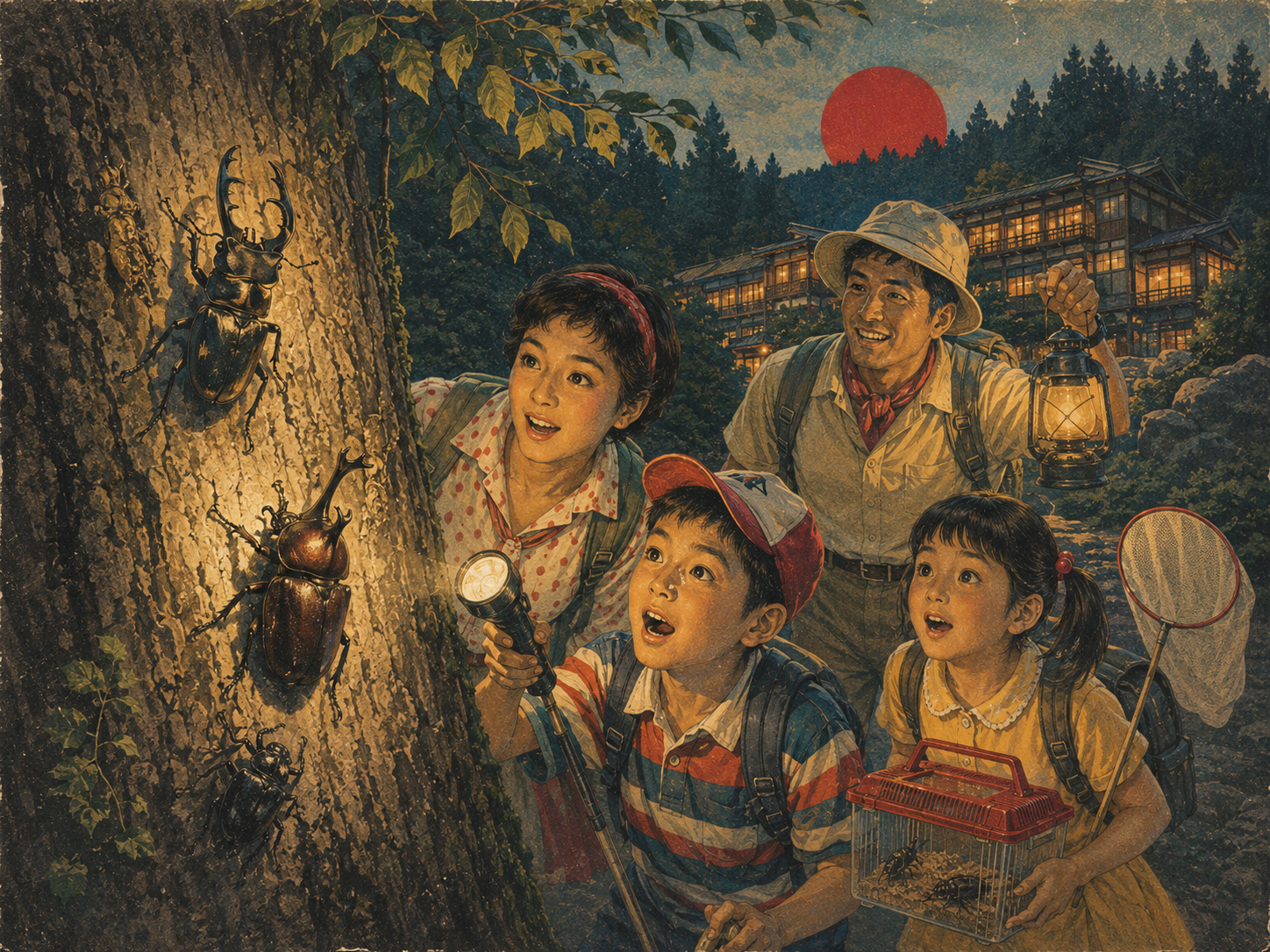
Before dinner, families gather in the hotel lobby and check their nets, insect cages and walking shoes. Their destination is not a theme park. It is the forest of Kannabe Highland as daylight weakens and tree trunks begin to disappear into shadow.
Fairfield by Marriott Hyogo Kannabe Highland scheduled an “Insect Hunting Experience” for July 18, 19, 24 and 25, 2026. The one-hour sessions run from 5:00 to 6:00 p.m. in cooperation with a local nature organization, taking parents and children into the landscape around the hotel.
This is not a guaranteed animal performance. Weather, temperature, sap flow, timing and luck determine what appears. The possibility that the star attraction may ignore the reservation is precisely what makes it real nature.
Why a hotel sells bug hunting
Regional Japanese hotels increasingly compete not only through rooms but through experiences that cannot be detached from place. A property without a giant amusement park or luxury spa may already possess a night forest, river, rice field, starry sky and agricultural community.
Kannabe Highland lies in mountainous Toyooka, Hyogo Prefecture, with volcanic terrain, ski slopes, campsites, forests and rural scenery. Summer tourism must turn the landscape into a reason to stay after the snow has gone. Beetle hunting requires modest infrastructure, gives children a strong mission and turns local ecological knowledge into economic value.
It also sells memory to parents. The net, plastic cage, early-morning woods and smell of tree sap belong to the remembered architecture of Japanese summer vacation.
Japan loved insects before it loved rhinoceros beetles
Japan’s insect culture is much older than the plastic beetle cage. Web Japan traces organized appreciation to the Nara period, when aristocrats enjoyed listening to crickets and other singing insects. Their sounds became markers of season and emotional language in poetry.
In The Tale of Genji and later literature, insects signify autumn, longing, loneliness and transience. Japanese describes insects as “singing” or “crying,” recognizing distinct voices where other cultures may hear undifferentiated noise.
By the Edo period, insect appreciation had become urban commerce. Merchants sold bell crickets and other prized singers in cages. Firefly-viewing boats offered seasonal entertainment. City residents bought a portable piece of nature and placed summer or autumn inside the home.
Utamaro put a rhinoceros beetle into a book in 1788
Kitagawa Utamaro’s Ehon mushi erami, or Picture Book of Crawling Creatures, was published in 1788. Its woodblock pages paired exquisitely observed insects and plants with comic poetry. One surviving page held by the Metropolitan Museum of Art includes a kabutomushi.
The point is not that Edo children hunted beetles exactly as children do now. It is that insects were already worthy of close artistic attention—objects of poetry, pattern, color and form rather than merely agricultural pests.
When kabutomushi and kuwagata became kings of summer
Rhinoceros beetles and stag beetles became especially popular with children from the 1960s, according to Web Japan. Their visual power made them ideal postwar icons.
The male rhinoceros beetle’s horn resembles a warrior’s helmet. A stag beetle’s mandibles look like weapons. Hard wing cases and mechanical joints fit an era fascinated by cars, robots, machines and television heroes.
Urbanization also changed the hobby. As neighborhood woodland disappeared, catching beetles became a special adventure associated with summer visits to grandparents or rural travel. Scarcity strengthened nostalgia.
The nocturnal tavern of tree sap
Japanese rhinoceros beetles are mainly nocturnal. In summer they gather at sap flowing from wounded oak trunks, joined by stag beetles, flower chafers, moths, butterflies, wasps and predators. Japanese nature educators often call these trees “sap taverns.”
Male rhinoceros beetles use their horns to lift rivals from feeding places and access to females, producing the famous image of beetle sumo. Females lay eggs in humus, compost or decaying vegetation. Larvae feed on organic matter and nutrients released from wood by fungi.
An adult beetle therefore represents an entire ecological system: broadleaf trees, wounds that release sap, fallen leaves, decayed wood, fungi and soft soil. A hotel’s one-hour walk can become an entrance to the workings of satoyama.
| Target | Where and when to look | Cultural image |
|---|---|---|
| Rhinoceros beetle | Summer night or dawn; oak sap and artificial light | Horn, helmet, strength, beetle sumo, king of summer |
| Stag beetle | Sap, tree hollows, fallen wood, nighttime | Mandibles, rarity, collecting by species and size |
| Cicada | Tree trunks by day; shells on low branches and walls | The sound of high summer, brief life, school projects |
| Dragonfly | Rice fields, ponds and rivers in daylight | Autumn’s approach, countryside and the victorious insect |
| Firefly | Clean streams and wetlands at night in early summer | Light, romance, spirits and impermanence |
The insect cage entered the national retail system
As wild beetles became harder to find in cities, retail expanded. Every summer, home centers, supermarkets, pet shops and department stores created beetle sections with live insects, clear cases, soil substrate, wood, misting bottles and cups of insect jelly.
A living animal became a seasonal product. Prices range from inexpensive native rhinoceros beetles to costly exotic species valued for size, lineage and rarity. A childhood science project became a serious adult breeding market.
The hotel forest walk reverses this retail journey. It takes the packaged animal out of the display case and asks where, when and why it lives.
Pokémon grew from the memory of bug catching
Pokémon creator Satoshi Tajiri famously connected the franchise’s premise to childhood insect collecting. Catching, identifying, raising, exchanging and comparing creatures reproduce the structure of the bug hunt in digital form.
Beetles later became heroes in Mushiking, Kamen Rider, Super Sentai, Digimon and other entertainment. Horns and mandibles communicate power instantly.
Tokyo’s 2026 beetle exhibition combines live exotic beetles with an augmented-reality insect-hunting game. Forest, cage and smartphone are no longer rival worlds; they are connected stages in the same cultural experience.
What taking one beetle home teaches
Many native adult rhinoceros beetles live through only a short part of summer. A child replaces jelly, moistens substrate, hears movement at night and eventually encounters death. A small, manageable pet teaches care, life cycle, metamorphosis and impermanence.
But capture is not automatically education. Responsible practice means taking no more than necessary, observing and releasing native animals where appropriate, avoiding injured specimens and respecting private property and protected-area rules.
Why “setting it free” can become ecological harm
Releasing an exotic rhinoceros or stag beetle into a neighborhood forest may look compassionate. It can introduce competition, hybridization, parasites or pathogens. Purchased and captive-bred exotic insects must never be released outdoors.
Researchers have warned that Japan’s large stag-beetle market can encourage overharvesting and smuggling in source countries, especially when rarity creates higher prices. A child’s small cage may sit at the end of a global wildlife supply chain.
- Follow landowner, hotel, municipal and protected-area rules.
- Do not collect more animals than you can properly care for.
- For observation, return native insects to the same location.
- Do not damage bark or leave large amounts of bait behind.
- Prepare for wasps, ticks, darkness, slopes and heat illness.
- Never release imported or purchased insects into the wild.
- Measure success by behavior and habitat observed, not the number captured.
Without satoyama, the collecting culture disappears
Beetle-rich land is not necessarily untouched wilderness. Satoyama woodland historically managed for fuel, leaf litter and farming created a mosaic of bright forest, decaying wood, humus, grassland and water supporting diverse insects.
When fossil fuels reduced demand for firewood, some coppice forests became dark and overgrown. Housing, abandoned farmland, pesticides, engineered rivers and climate change further altered insect communities. When children cannot find insects, the first problem may be habitat rather than technique.
A hotel program matters most when tourism revenue and attention return to the guides, farmers, forest owners and residents who maintain the living landscape.
Can a hotel become a doorway into the forest?
Hotels traditionally protect guests from the outdoors: air conditioning, bright corridors, clean floors and insect-free rooms signal quality. Beetle hunting reverses that logic for one hour, sending guests into darkness, humidity and uncertainty.
No guide can promise a wild rhinoceros beetle. A good guide can instead reveal sap scars, leaf mold, cicada emergence, moth camouflage and forest sound. Even an unsuccessful hunt teaches that nature is not an attraction operating to a timetable.
From hunting insects to protecting the place where insects live
Japanese summer collecting has often been measured by quantity. The future of nature tourism must change the score: How many species were observed? Which trees supported them? Why was sap flowing? Who maintains the woodland?
A family leaving the Kannabe hotel may find one rhinoceros beetle. It may find none. But the circle of a flashlight reveals that countless small lives continue beyond its edge.
The hotel is not truly selling a beetle. It is selling the courage to enter a dark forest, the patience to study one tree trunk, an hour when parent and child search for the same thing—and the realization that summer, like the beetle, is brief.
Sources and further reading
- Fairfield by Marriott Hyogo Kannabe Highland: 2026 dates, times and local partnership.
- Web Japan, “Catching and Raising Insects”: Nara-period insect listening, Edo insect sellers and the post-1960 beetle boom.
- Tama Zoological Park: nocturnal behavior, tree sap, fighting and life cycle.
- Suntory Natural Water Sanctuary: sap communities, fungi, decayed wood and satoyama ecology.
- Metropolitan Museum of Art: Utamaro’s 1788 rhinoceros-beetle page from Picture Book of Crawling Creatures.
- Associated Press, August 8, 2025: insect pets, education and exhibitions in modern Japan.
- Tournant et al., 2012: Japan’s stag-beetle market and rarity-driven overexploitation.
- Koichi Goka, “Biological Invasion Caused by Commercialization of Stag Beetles”: imports and ecological risk.