The day adults dive headfirst into a rice field
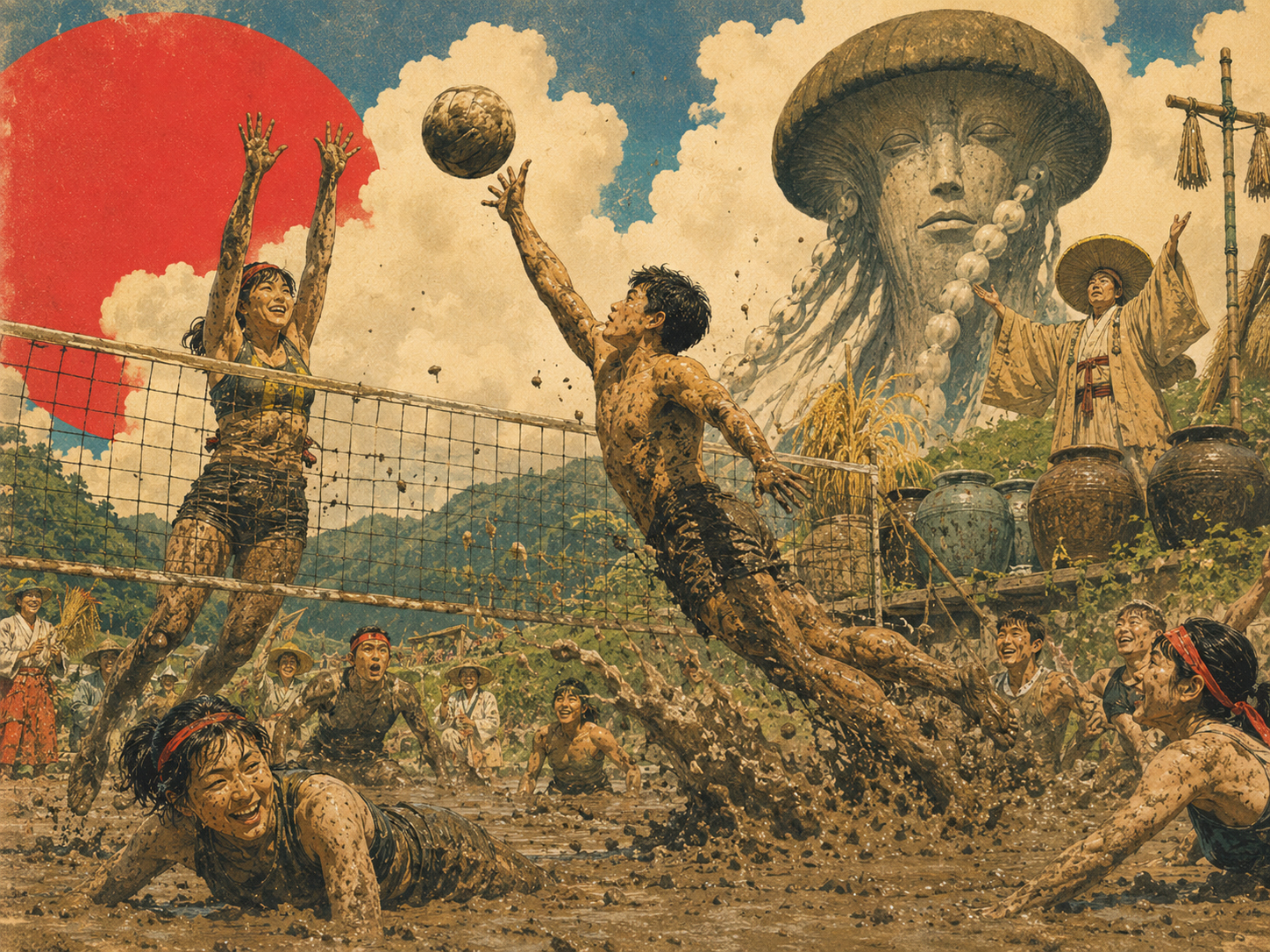
On the morning of August 8, competitors in Gujo, Gifu Prefecture, will enter a court with no polished floor, no clean boundary lines and almost no reliable footing. The court is a flooded rice field. Every step sinks. A running approach disappears. A graceful spike becomes a brown explosion.
The event is the “Mud Volleyball Tournament in HOLY FUNGUS,” held at the Motai Organic Farm and experiential campground operated by Japanese organic-skincare company Neo Natural. Organizers say the tournament revives a local Motai-area event after an absence of roughly nine years.
Eight to ten mixed-gender teams were planned, each with four to seven members. Play is scheduled from morning through late afternoon. The winning prize is not cash but 20 kilograms of Motai rice. Lunch comes with a boxed meal and hot tonjiru pork-and-vegetable soup. The event’s logic is complete: fall into the earth that grows the rice, then eat from the landscape that covered you.
What exactly is HOLY FUNGUS?
The name sounds like a forgotten psychedelic album, a rural cult or a particularly enthusiastic mushroom society. In practice, HOLY FUNGUS is a campsite and retreat space on Neo Natural’s organic farm near the meeting of the Kurisu and Takanasu rivers. A shrine connected to Hakusan mountain worship stands nearby, adding a genuine sacred-landscape layer to the deliberately memorable name.
Neo Natural says the farm began about 18 years ago when it reclaimed approximately 8,000 square meters of abandoned agricultural land through machinery and manual labor. The goal was practical: grow loofah, herbs, rice and other materials used in the company’s skincare products, beginning with the soil rather than purchasing every ingredient elsewhere.
The farm gradually became an experience center offering rice planting, harvesting, loofah-water collection, satoyama yoga and agricultural workshops. HOLY FUNGUS later expanded the concept into camping and retreat tourism. The site no longer merely produces cosmetic ingredients; it turns the story of those ingredients into a place visitors can physically enter.
The “beauty bacteria” claim—and where science ends
The tournament’s irresistible hook is the claim that the farm’s rich soil contains “beauty bacteria,” or bihada-kin. Neo Natural describes research suggesting that microorganisms associated with healthy skin are abundant at the farm and frames contact with the landscape as part of a broader philosophy connecting nature, stress relief and skincare.
The phrase needs careful handling. “Beauty bacteria” is not the formal scientific name of one miraculous species. In Japanese consumer wellness language, it generally refers to beneficial members of the skin microbiome—the bacteria, fungi, viruses and other microorganisms living on human skin and interacting with its barrier, acidity and immune system.
The skin microbiome is a genuine field of research. Its composition is associated with skin condition, and disruption can accompany disease. That does not establish that coating the body in one particular rice field’s mud produces a cosmetic benefit. Soil microbiomes and skin microbiomes are not interchangeable, and direct therapeutic claims would require much stronger evidence.
The reasonable reading is experiential rather than medical: outdoor activity, laughter, social connection and escape from ordinary stress may make people feel better. The mud is part of the theater. It should not be treated as a clinically proven facial treatment.
- “Beauty bacteria” is the organizer’s wellness and marketing language, not a guaranteed medical outcome.
- Healthy skin does support a complex microbiome, and that ecosystem is an active field of scientific study.
- There is no established proof that immersion in this specific mud improves skin.
- Open wounds, eyes, mouth, heat, slips and post-event washing matter more than romantic claims about “good” microbes.
Rice paddies were among Japan’s oldest cooperative institutions
Mud sports feel unusually at home in Japan because the rice paddy was never just a field. Wet-rice cultivation reached northern Kyushu roughly 3,000 years ago and spread across the archipelago. It required coordinated irrigation, maintained embankments, shared labor and seasonal timing.
The paddy linked food production to village organization, harvest prayer, festivals and reciprocal work. Mud was not playful. It was labor. Turning that labor environment into a sports arena reverses the old relationship: the place once associated with obligation becomes a temporary zone of deliberate uselessness and joy.
Across Japan, communities have used paddies and fallow fields for mud volleyball, mud soccer, flag races, tug-of-war and rice-field rugby. Such events attract visitors, create intergenerational contact and give idle farmland a public role—at least for one weekend.
Mud volleyball has no single creation myth
Japan’s mud-volleyball tradition is not one standardized national sport with an official founding date. It is better understood as a family of local inventions. Municipal offices, youth groups, agricultural organizations, chambers of commerce and volunteer committees independently adapted volleyball to paddies before planting or to unused fields.
In Takasaki, Miyakonojo, Miyazaki Prefecture, an annual mud-volleyball festival reached its 30th edition in June 2026. The event, tied to regional revitalization and prayers for a good harvest, drew 26 teams and 145 players. Similar events have appeared in Kobe and other regions, often using fallow paddies and returning after interruptions caused by the pandemic or declining local capacity.
The Motai tournament belonged to this broad rural-event culture before disappearing for roughly nine years. Its 2026 return is not a simple restoration. It has been rebuilt around a modern combination of organic skincare, campground tourism, microbiome language and corporate storytelling.
| Period | How paddies became public stages |
|---|---|
| Ancient to early modern Japan | Rice fields organized irrigation, collective labor, harvest rites and village life. |
| Postwar growth era | Mechanization and migration reduced agricultural labor and weakened many local traditions. |
| From the 1990s | Rice-paddy art and participatory farm festivals reframed agriculture as tourism and cultural display. |
| 2010s | Mud sports and rice-field rugby spread as playful forms of rural revitalization. |
| 2026 | Motai’s tournament returns after about nine years inside a farm-retreat and skincare narrative. |
Why mud makes everyone equal
Ordinary volleyball rewards jumping, acceleration and precise footwork. Mud sabotages all three. Tall players sink. Experienced players slide. Beginners produce accidental miracles. A rally becomes slapstick choreography.
That instability is the social power of mud sport. Skill differences shrink. Failure becomes communal entertainment. Once everyone is covered, clothing, appearance and self-consciousness lose importance. The game turns humiliation into solidarity.
The organizer asks a simple question: when was the last time, as an adult, you played until you were completely covered in mud? It is effective advertising because many people cannot remember.
The deeper Motai story: from abandoned land to experience economy
Gujo is known for mountain water, Gujo Odori dancing, forestry and rural settlements. Motai is not a mass-tourism district built around giant hotels. That makes HOLY FUNGUS representative of a different model of regional tourism.
Instead of constructing an attraction disconnected from place, the project converts existing assets—fields, rivers, a shrine landscape, farming work and recovered land—into participation. Guests do not simply photograph the countryside. They plant, harvest, camp, sweat and fall into it.
This also raises legitimate questions. When a company incorporates local memory into a brand, who benefits? Does the event strengthen local participation or merely borrow rural imagery? Is the land maintained after the publicity passes? The tournament’s long-term success will depend on whether it becomes a durable community occasion rather than a one-season marketing spectacle.
Why the prize has to be rice
A cash prize would miss the point. Twenty kilograms of Motai rice tells the entire story in one object.
The mud is not waste. It is the medium that produces food. The field serving as a chaotic court remains agricultural ground. The winning team carries away the finished value of the landscape it has just rolled through.
The boxed lunch, tonjiru and evening gathering perform the same function. Washing off, warming up and eating together are not secondary amenities. They complete the social ritual.
Safety: a living landscape is not automatically a harmless one
Natural soil contains enormous biological diversity, not a clean division between “good” and “bad” organisms. Microbes harmless on intact skin may cause trouble through an open wound or mucous membrane. Stones, plant debris, insects, heat stress, dehydration and falls are more immediate concerns than the romantic language of beneficial bacteria.
Participants should avoid entering with open cuts, protect eyes and mouth, wash thoroughly afterward, hydrate and disclose health problems. The event is scheduled to proceed in light rain but not severe weather. Celebrating nature should not require pretending nature is sterile.
Why this wonderfully strange event matters
From a distance, mud volleyball looks like an easy “weird Japan” photograph. Look closer and the field contains many of contemporary Japan’s pressures: abandoned farmland, shrinking villages, interrupted traditions, corporate rural investment, wellness marketing, microbiome fascination, experience tourism and renewed anxiety about rice.
HOLY FUNGUS compresses them into one brown rectangle. A skincare company restores farmland, adopts microbial language, revives a local tournament and invites adults to dive into the soil. It is absurd, but the absurdity has roots.
On August 8, one team may leave with 20 kilograms of rice. The real prize may be rarer: several hours in which falling down is not failure, everyone looks ridiculous and the entire field laughs together.
Sources and further reading
- Neo Natural official tournament page: event concept, conditions and prize.
- Neo Natural farm bulletin, April 22, 2026: schedule and revival after roughly nine years.
- Neo Natural press release, April 22, 2026: local history and HOLY FUNGUS setting.
- Neo Natural farm history: reclamation of roughly 8,000 square meters of abandoned farmland.
- SoraNews24, May 6, 2026: English-language introduction to the tournament.
- Television Miyazaki, June 14, 2026: the 30th Takasaki mud-volleyball festival.
- Plenus Rice Culture Research Institute: history of wet-rice cultivation in Japan.