- The medical promise of a connection that survives disruption
- Why geography still matters in a country with advanced medicine
- Half a century of Japanese experiments in medicine at a distance
- Two constellations, not just a faster internet connection
- Designing resilience and measuring the cost of failure
- What a remote surgeon is — and is not — being asked to do
- A role in disaster medicine — with important limits
- The evidence that would make this more than a demonstration
The medical promise of a connection that survives disruption
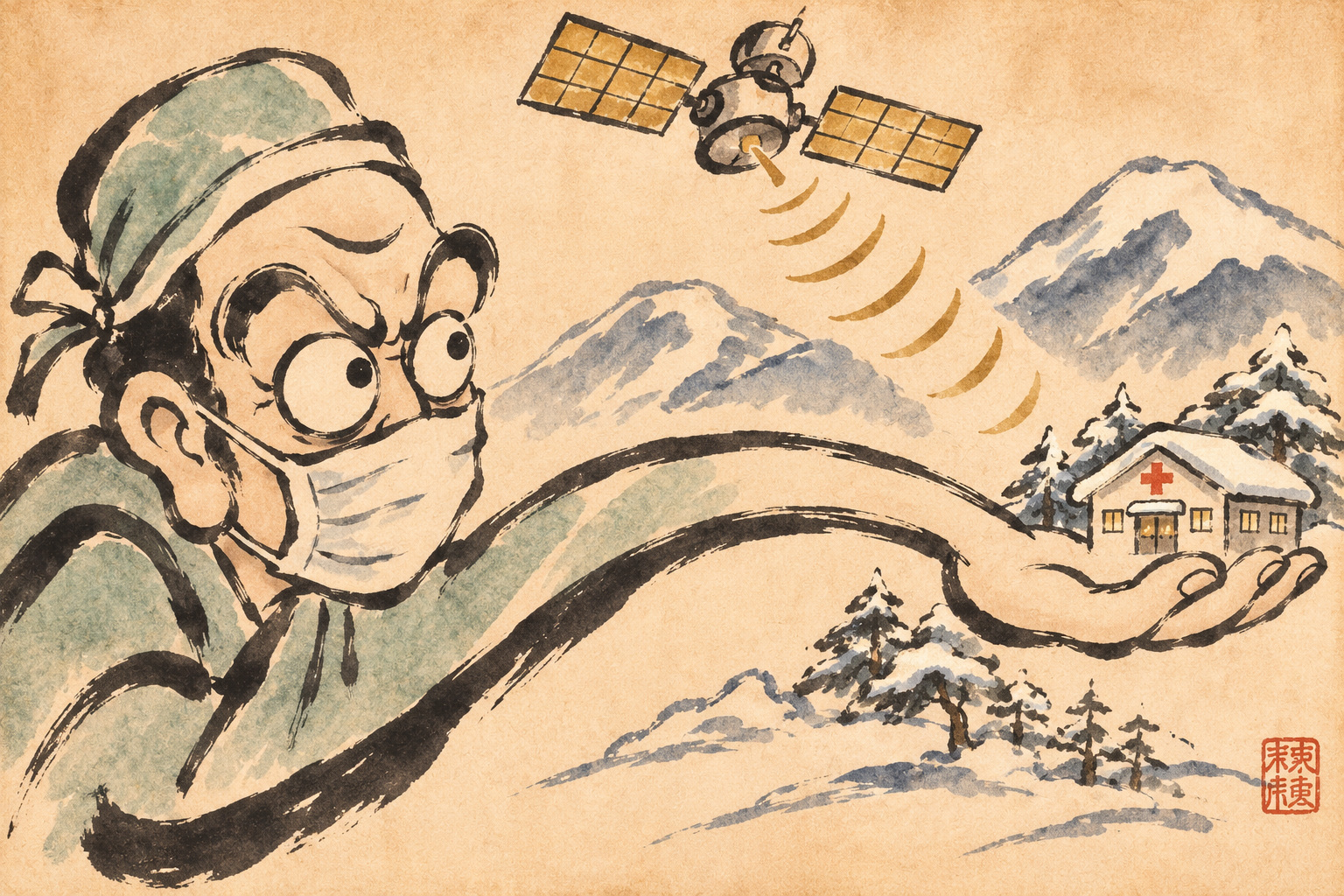
A surgeon in a regional hospital may have the equipment and training to perform an operation but still need help with a difficult stage. Bringing in a specialist can mean travel, rescheduling or transferring a patient. What if the specialist could assist from another hospital even where the local terrestrial communications network is unavailable?
On November 25, Hokkaido University and its partners announced a research demonstration linking facilities in Sapporo and Fukuoka, roughly 1,400 kilometers apart according to the project announcement. The Japan Surgical Society leads the collaboration with Kyushu University, Hokkaido University, surgical robotics developer Riverfield and telecommunications company SoftBank. The experiment is supported by a fiscal 2026 regional digital transformation program of Japan’s Ministry of Internal Affairs and Communications.
The design is deliberately asymmetric: the Kyushu end uses a wired connection, while the Hokkaido end uses two satellite services. The objective is to establish whether a second network can mitigate interruptions during robotic assistance. The announcement contains no clinical outcome or completed patient operation. This is a study of the conditions that might make such care feasible. Positive results would be a starting point for further evaluation, not permission to begin treating patients.
Why geography still matters in a country with advanced medicine
Japan’s healthcare challenge is not simply a shortage of technology. Advanced hospitals and specialist teams are distributed unevenly, and a long journey to a referral center may be especially difficult for older residents, people living on islands and families in sparsely populated areas. Hokkaido’s vast territory makes the contrast between access in major cities and remote communities particularly relevant.
A Ministry of Health, Labour and Welfare survey released in July 2026 counted 575 doctorless districts with 134,753 residents as of the end of October 2025. The previous survey in 2022 counted 557 districts and 122,206 residents. The figures describe a specific administrative category, not the number of communities lacking a surgeon or a measure of unmet surgical demand. They nevertheless illustrate that access remains an enduring problem.
A satellite-enabled surgical service would not directly turn every such district into a treatment center. An operating room must already possess the staff and facilities to care for a patient. A more realistic initial benefit would be connecting an equipped regional hospital to a specialist who can contribute expertise without having to be physically present for every case. The same infrastructure might also support training or consultations, subject to appropriate safeguards.
Half a century of Japanese experiments in medicine at a distance
Japan’s telemedicine history predates the commercial internet. The Japanese Telemedicine and Telecare Association records a 1971 experiment in Wakayama involving transmission of electrocardiograms. In the following decades, pathology and radiology became important applications: a specialist could interpret a specimen image or scan without the originating facility having every specialty on site. Satellite relay technology was already being explored for high-definition pathology images by 1991.
Hokkaido itself has a substantial institutional history in the field. Asahikawa Medical University began remote medical work in 1994 and opened its dedicated telemedicine center in 1999. Its network later moved from ISDN to optical broadband in 2005, illustrating how improvements in communications changed the quality and usefulness of remote images.
A 1997 health ministry notice clarified the relationship between remote medical consultation and rules governing medical examination. That historical step did not authorize all forms of surgery at a distance. Internationally, a landmark 2001 report in Nature described transatlantic robot-assisted surgery; a subsequent feasibility paper documented the dedicated communications technology behind it. The enduring lesson is that the robot and the network must be considered as one clinical system. The new Japanese project shifts attention toward communications resilience where terrestrial connectivity cannot be assumed.
Two constellations, not just a faster internet connection
The project combines SpaceX’s Starlink Business with Eutelsat’s OneWeb low Earth orbit constellation. According to the project announcement, Starlink satellites in the relevant description orbit at approximately 550 kilometers, while OneWeb operates at about 1,200 kilometers. Both are far closer than conventional geostationary communications satellites, at roughly 36,000 kilometers above Earth.
Shorter propagation paths can reduce signal travel time. Yet satellite altitude alone does not predict the time between a surgeon’s movement and the appearance of the resulting image on a display. A working connection can traverse gateways, terrestrial links and network equipment. Encoding, decoding and robot controllers add processing time. The image channel and command channel may behave differently under load.
For a video meeting, a brief interruption might cause participants to repeat a sentence. For a surgical team, changes in the timing of feedback can have a different consequence: the displayed image may no longer accurately represent the immediate physical state of an instrument. That is why the researchers plan to measure round-trip latency, variations in latency, packet loss, bandwidth use and interruptions. These are related but distinct characteristics. A fast download speed by itself is not a sufficient measure of medical suitability.
Designing resilience and measuring the cost of failure
Starlink is designated the primary link and OneWeb the secondary link. The team plans to combine their paths using the bonding capabilities of a software-defined wide-area network (SD-WAN) router and compare this arrangement with a single connection. The announced architecture also incorporates protected networking and encryption.
The engineering question is whether separate satellite networks experience sufficiently independent interruptions for the combined system to improve continuity. A brief loss of one connection might be less consequential if the other remains available. But redundant contracts are not the same as a fully redundant system. A shared power supply, router, local antenna environment or upstream facility could still present common failure points. Severe weather and blocked views of the sky can also complicate deployment.
The relevant comparison is therefore not simply the average speed of the two links. It includes the duration of degraded service, how quickly communications recover, and whether a clinician can recognize and respond to a disruption. A robust evaluation should also account for exceptional conditions rather than just normal performance. Those considerations explain why a demonstration in a controlled environment is an important stage before clinical deployment.
What a remote surgeon is — and is not — being asked to do
The Japan Surgical Society’s second-edition guidelines, announced in December 2025, distinguish three forms of participation: telementoring, telesurgical support and full telesurgery. Telementoring means that a distant expert advises a local surgeon through communications technology. Telesurgical support can include a remote specialist manipulating robotic instruments as part of a team with a local operator. Full telesurgery, where no surgeon capable of performing the operation is present locally, is not permitted under the current guideline framework.
Riverfield’s Saroa surgical system uses pneumatic actuation and provides force feedback, according to its product documentation. A surgeon can receive information about forces applied by instruments; this is different from simply seeing magnified images. The joint announcement states that Saroa has domestic regulatory approval but that operations between geographically separated facilities using communications networks are outside that approval.
The researchers plan to begin with dry-box training exercises and subsequently evaluate performance using donated human bodies in a simulated setting. They will compare clinicians’ assessments with recorded communications behavior. These are not patient procedures. A demonstration of successful instrument movement is not equivalent to evidence of safe clinical outcomes, and a guideline is not a substitute for medical-device authorization.
A role in disaster medicine — with important limits
When a disaster damages a fiber connection or disrupts transport, a portable satellite terminal could help restore communication between a regional hospital and a medical center. A network designed in advance for clinical use might support specialist advice, coordination or other medical information exchange even before robotic assistance becomes a practical option.
However, a terminal cannot replace an operating team, anesthetic care, sterile supplies, a reliable electricity source or postoperative monitoring. Nor can it create a functioning operating room in a damaged building. The value of remote assistance depends on the readiness of both medical facilities and on contingency arrangements for interrupted communication. A local team capable of protecting the patient remains essential.
Medical data also require protection. Encrypted transport is one component, but access control, maintenance, audit records and clear allocation of responsibilities matter just as much. Japanese health ministry guidance on online care and medical information security provides part of the institutional context. The economics of maintaining these capabilities during normal periods, when they may be used relatively infrequently, will also influence their usefulness during emergencies.
The evidence that would make this more than a demonstration
The most valuable results will show whether using both links reduces the frequency and duration of clinically relevant disruptions compared with using either one alone. Published distributions of latency and interruptions, alongside clinicians’ assessments and an explanation of test conditions, would allow other researchers to understand how much confidence the architecture deserves. A single successful trial cannot establish that performance is reliable across seasons, locations and operating conditions.
The next questions would be medical and economic. Which procedures could benefit from remote participation? Which hospitals already have the staff, equipment and emergency arrangements needed to use it? How would the system be maintained, and how would specialists allocate their time? Any clinical evaluation would need appropriate approvals and a design capable of assessing patient safety and outcomes. Potential savings in travel and transfers should be compared with equipment, connectivity and staffing costs rather than assumed in advance.
The project is important because it treats the connection as part of the healthcare system, not a separate consumer convenience. If the research establishes dependable conditions for remote collaboration, its value could extend beyond Hokkaido to island nations and sparsely populated regions elsewhere. The test is ultimately whether it helps a local medical team provide care safely, not whether a satellite can simply transmit an impressive video of a robot moving.
Primary sources and references
- Kyushu University Hospital — joint announcement, November 25
- Hokkaido University — November announcements
- Japan Surgical Society — project announcement
- Japan Surgical Society — telesurgery guidelines, second edition
- MHLW — 2025 survey of doctorless districts
- MHLW — 2022 survey
- Japanese Telemedicine and Telecare Association — historical chronology
- Health ministry — historical 1997 telemedicine notice
- Asahikawa Medical University Hospital — telemedicine center
- Asahikawa Medical University — center history
- Marescaux et al., Nature (2001), transatlantic telesurgery
- Riverfield — Saroa product information
- Eutelsat — OneWeb constellation
- MHLW — online care and medical information security guidance
- Marescaux et al., Annals of Surgery (2002), feasibility study