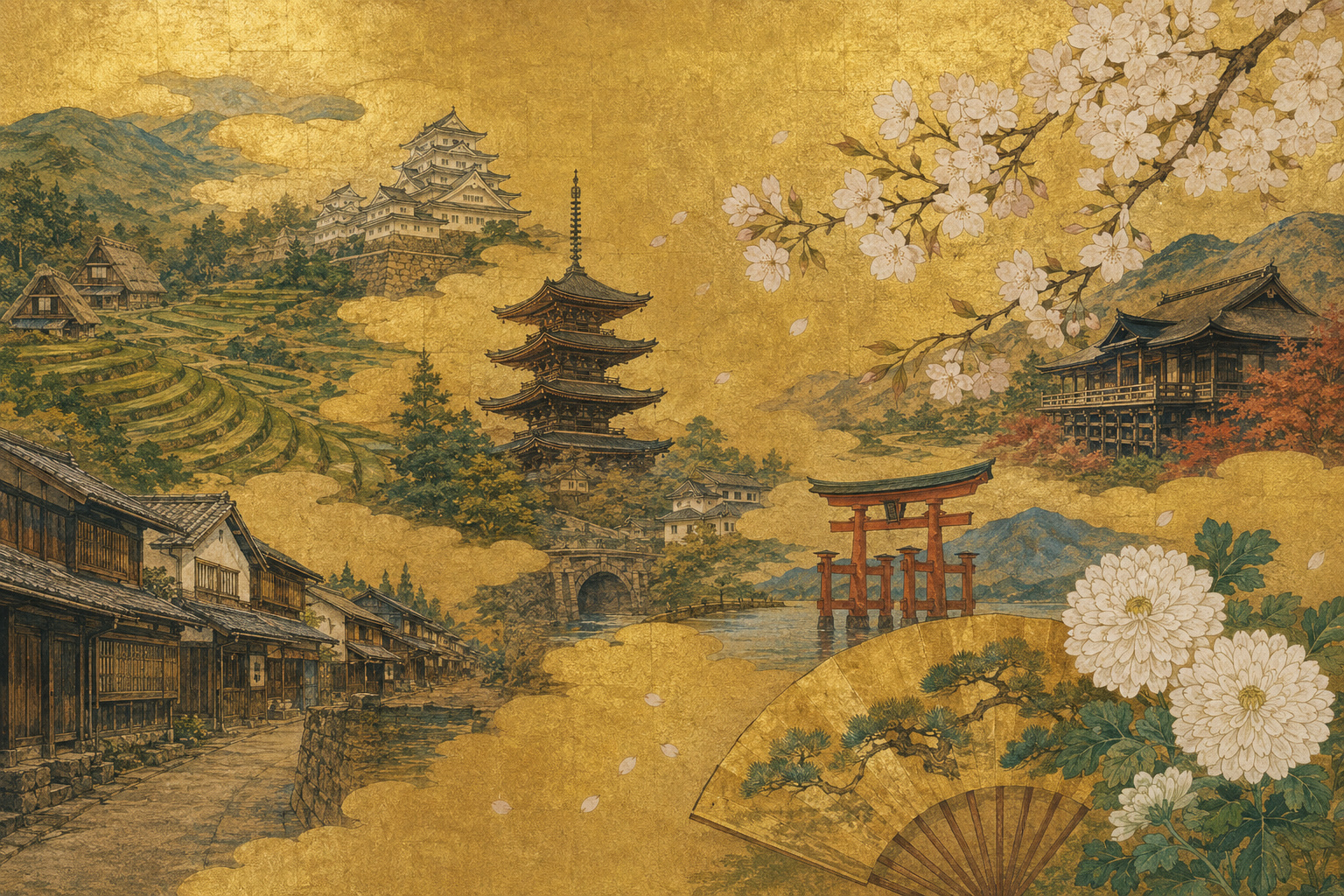
When Japan Heritage began in 2015, the headline was recognition: which local story had won the national label? The September 1, 2026 review shows how far the system has moved. Of the 21 stories recognized in 2020, one was postponed because of the 2026 Kumamoto earthquake. The other 20 were divided into four Priority Support Areas, ten straightforward continuations and six cases sent back for re-examination. Japan Heritage is becoming less like a permanent badge and more like a periodically tested operating license for cultural storytelling and regional development.
Four stories move into priority support
The four selected for Priority Support are deliberately diverse: the crystal-and-craft landscape of Mitake Shōsenkyō in Yamanashi; Shizuoka’s travel culture built around Yaji-san and Kita-san; the Lake Biwa Canal linking Kyoto and Ōtsu; and the medieval cultural landscape of Masuda in Shimane.
There is no single type of monument tying them together. One is a gorge tied to quartz, jewelry and technology; one turns Edo travel literature into a route; one is a Meiji engineering system; one tells the story of a medieval regional city. That diversity explains what Japan Heritage is meant to evaluate: not which object is “most important,” but whether a region can turn multiple cultural resources into an intelligible and usable story.
| No. | Region | Story |
|---|---|---|
| 91 | Yamanashi: Kōfu / Kai | Origins of Kōshū Craftsmanship — Mitake Shōsenkyō |
| 94 | Shizuoka: Fujieda / Shizuoka | Yaji-san and Kita-san and Japan’s first “travel boom” |
| 95 | Kyoto / Shiga: Kyoto / Ōtsu | The Lake Biwa Canal, a waterway of hope linking Kyoto and Ōtsu |
| 100 | Shimane: Masuda | Taste a Masterpiece of Medieval Japan — Masuda |
Priority areas receive enhanced support, including higher subsidy rates. The system also allows regions selected for priority support twice in succession to move toward Special Priority Support, or “Japan Heritage Premium,” as model cases. The point is therefore not simply to reward past performance, but to invest in examples that can be replicated elsewhere.
Ten continue—but continuation is not exemption from future testing
The ten ordinary continuation decisions range from Japanese wine and the paired ceramics centers of Kasama and Mashiko to Mt. Takao, Tokamachi’s snow-country culture, the Obasute moon landscape, sacred landscapes in Ueda, the sake histories of Itami and Nada, the Tatsuta road and Kamenose, Katsuragi Shugendō, and the volcanic/industrial history of Ōda.
| No. | Region | Story |
|---|---|---|
| 86 | Ibaraki / Yamanashi | 140 Years of Japanese Wine |
| 87 | Ibaraki / Tochigi | Kasamashiko — a ceramics story of sibling production centers |
| 88 | Tokyo: Hachiōji | Mt. Takao — prayer and the story of the “Silk City” |
| 89 | Niigata: Tokamachi | The Ultimate Snow Country, Tokamachi |
| 92 | Nagano: Chikuma | City of the Moon — Chikuma and the Obasute rice terraces |
| 93 | Nagano: Ueda | A sacred landscape linked by ley lines |
| 97 | Hyogo | Itami Morohaku and Nada no Ki-ippon — sake country |
| 98 | Nara / Osaka | Tatsuta Ancient Road and Kamenose |
| 99 | Wakayama / Osaka / Nara | Katsuragi Shugendō |
| 101 | Shimane: Ōda | The enduring history told by Iwami’s volcanoes |
Continuation is not immunity. Under the 2026 policy, regions must keep operating through new revitalization plans, measure outcomes and prepare for future reviews. The program is explicitly designed as a feedback loop rather than a one-time award.
Six stories go back under the microscope
Re-examination covers the “Sacred Salmon” story around the Nemuro Strait, the lacquer tradition of northern Iwate, the cross-sea railway story linking Fukui and Shiga, the women-associated sacred sites known as Nyonin Kōya, Bitchū Fukiya’s “Japan Red,” and the Sugar Road running across Nagasaki, Saga and Fukuoka.
| No. | Region | Story |
|---|---|---|
| 84 | Hokkaido: Nemuro Strait area | The Story of the “Sacred Salmon” |
| 85 | Iwate: Ninohe / Hachimantai | The Lacquer Story of Oku-Nanbu |
| 90 | Fukui / Shiga | The Railway That Crossed the Sea |
| 96 | Osaka / Nara / Wakayama | Nyonin Kōya — sacred places living with women |
| 102 | Okayama: Takahashi | Birthplace of “Japan Red” — Fukiya |
| 103 | Nagasaki / Saga / Fukuoka | The Nagasaki Kaidō and the Sugar Road |
The Agency’s short September 1 webpage does not reduce each re-examination decision to a single public reason, and Japan.co.jp does not invent one. What can be stated is procedural: these six did not clear ordinary continuation and will receive further field investigation and review.
Recent precedent is important. In the 2025 review cycle, six re-examination cases eventually produced four normal continuations and two conditional continuations. Re-examination is therefore best understood as a formal warning and evidence-gathering stage, not a verdict that a story has no cultural value.
Yatsushiro was postponed, not failed
The remaining 2020 story, No. 104, “The Path of the Stonemasons Who Shaped Yatsushiro,” was not given a score. The Agency postponed its review until a later fiscal year because of the 2026 Kumamoto earthquake.
That distinction matters. Japan Heritage is an “use and activation” policy. When a disaster damages heritage or the communities around it, recovery and preservation logically precede a normal performance review.
Japan Heritage is not a smaller version of UNESCO World Heritage
The Agency for Cultural Affairs defines Japan Heritage as recognition of a story that conveys Japanese culture and traditions through a region’s history and characteristics. A story may combine buildings, archaeological sites, landscapes, festivals, foodways, crafts and industrial heritage.
World Heritage and Japan’s designated Cultural Properties systems assign and protect the value of particular heritage. Japan Heritage explicitly does not create new preservation regulations. Its purpose is to use existing heritage “as an area,” connect it through a story and turn that story into regional branding, tourism, civic identity and economic activity.
That is why a weak continuation review does not mean the underlying shrine, canal, railway structure or craft has lost its cultural importance. The review is judging the Japan Heritage program around it.
In 2015, the system was built partly for the tourism surge expected around Tokyo 2020
Japan Heritage began in FY2015. The official portal says the concept was created with the Tokyo 2020 Olympic and Paralympic Games in mind so that Japan Heritage regions could become destinations able to receive and disperse visitors.
The first phase was expansion. From FY2015 through FY2020, the Agency recognized 104 stories. The 2020 round alone received 69 applications and added 21 stories. Ordinary new recognition was then paused.
The cohort reviewed in 2026 is therefore historically important: it is the final large intake of the original expansion era.
By the end of 2020, the government acknowledged a quality problem
In December 2020, the Japan Heritage Follow-up Committee said levels of activity varied considerably among recognized regions. Once 104 stories shared a single national brand, a weak or dormant story could affect the credibility of the whole label.
From FY2021, the Agency introduced comprehensive evaluation and continuation review. Existing regions had to review what they had actually accomplished and submit the next revitalization plan. A separate “candidate region” stage was created for places seeking future recognition.
The program thereby changed from “recognize stories” to “manage a portfolio of recognized stories.”
In 2024, Japan Heritage added a mechanism that can actually change the membership
The system tightened again in FY2024 with a numerical scoring process. Conditional regions and candidates can be assessed for eligibility, and the Agency’s official flow includes cancellation as a possible outcome.
The same period produced a top tier, Special Priority Support Area / Japan Heritage Premium, for especially strong model regions. The architecture now has upward and downward movement: ordinary recognition, priority, premium, re-examination, conditional recognition and ultimately possible cancellation.
The 2026 rules move beyond “Did you make a brochure?”
The Japan Heritage Evaluation Committee’s February 2026 document is unusually candid about the problems found in the first decade. Some regions still lacked sufficient visitor interpretation, including explanation of the story and multilingual information at component properties. Others lacked tourism businesses designed to generate revenue and the organizations needed to operate them.
The new emphasis is therefore on the experience of the story. A region should not simply list activities. It should explain how a visitor encounters the narrative through guides, interpretation, craft experiences, viewing, food and other sensory experiences—and what added value the story provides.
The committee also points to accommodation, cafés and rest points, transportation, products and tours that encourage circulation through the entire story area.
The Agency now spells out five results it wants
The February framework translates “regional revitalization” into five outcomes: people inside and outside the region should experience and understand the story; residents should feel pride in it; Japan Heritage activity should generate economic effects; the story and its component heritage should be preserved and used sustainably; and benefits should spread more widely through the region.
The combination of economic impact and preservation is intentional. Japan Heritage is not supposed to be tourism income detached from conservation, nor conservation detached from a living local economy. The intended loop is cultural experience → economic/social value → continued preservation and transmission.
What Japan Heritage is increasingly expected to prove
| Area | Why old activity counts are insufficient | 2026 direction |
|---|---|---|
| Story experience | Brochures and isolated labels do not make a narrative understandable | Guides, interpretation, food, craft and viewing integrated into experience |
| Circulation & stay | A one-stop visit creates little area-wide benefit | Transport, lodging, rest points and routes connecting multiple assets |
| Revenue | Projects can disappear when subsidies end | Tour/product models capable of continuing financially |
| Organization | Municipal staff transfers can erase know-how | DMOs, business, community coordinators and public-private management |
| Reinvestment | Tourism and conservation can remain institutionally separate | Return economic and social benefits to cultural transmission |
“Self-sustaining” has become a cultural-policy term
The committee defines short-term self-sustainability as having a mechanism capable of continuing story experiences. That may mean direct revenue, or it may mean proving enough local economic or social benefit that governments and businesses continue to support the activity.
Longer term, the goal is a system in which private operators repeatedly generate activity themselves. The Agency says tourism organizations such as DMOs and businesses—including commerce, agriculture, forestry and fisheries—should play central roles alongside cultural specialists.
That is a major shift away from treating Japan Heritage as a municipal culture-office project. It also creates a policy tension: places with immense cultural value but weak commercial markets may need support precisely because they cannot easily become self-financing.
The reviewers themselves are now expected to go to the sites
From FY2026, field investigation by members of the Japan Heritage Evaluation Committee is to be the rule, combined with discussion with local councils. The annual review load is being narrowed to roughly twenty cases.
The committee also changed the timetable. Rather than continuing to run first reviews in the sixth year and second reviews in the ninth year at the same time, it will prioritize completing the first-cycle reviews before returning to second cycles.
That makes the 2020 cohort the first group reviewed under a more field-oriented era. A paper report can list visitor numbers. A site visit can reveal whether signs make sense, whether a multi-city story feels coherent, whether visitors can travel between components and whether local businesses know what the Japan Heritage story is supposed to be.
The candidate track shows that recognition has become competitive too
The September announcement also covered two existing candidate stories. “Nokogiriyama — Human Endeavor Carved in Stone,” proposed by Futtsu and Kyonan in Chiba, advances to the scoring process this autumn. Kyoto City’s “Culture of Kyoto’s Hanamachi Passed Down Through Generations” remains a candidate.
One new candidate application was submitted in FY2026, but the Agency selected no new candidate region this year. The system is plainly no longer in its early expansion mode.
Even the application form is being rewritten
The Agency says revitalization-plan forms will be revised for submissions beginning next fiscal year, with the new format to be published in autumn or winter 2026. The stated aim is to rationalize key points and reduce unnecessary length.
Seen alongside the February policy document, the direction is clear: fewer pages listing events, more clarity about who the visitor is, what experience is being sold or delivered, how it is measured, how it continues and how the benefits return to culture.
2015: Japan Heritage launches, packaging regional cultural assets into stories for revitalization and tourism.
2015–2020: 104 stories are recognized; ordinary new recruitment is paused after FY2020.
December 2020: Follow-up committee identifies uneven levels of activity among recognized regions.
2021: Comprehensive/continuation review and the candidate-region system begin.
2024: Numerical scoring and the Special Priority Support / Japan Heritage Premium tier are introduced.
February 2026: Review reform emphasizes story experience, revenue, sustainability, coordinators and field visits.
September 2026: The 2020 cohort is divided into four priority, ten continuation and six re-examination cases.
What Japan Heritage is trying to preserve is also a relationship
World Heritage and designated cultural properties focus strongly on the value and protection of things and places. Japan Heritage works at another layer: the relationship among a temple and a festival, a mountain and a craft, a road and a food culture, industrial infrastructure and the community around it.
If the local program weakens, those assets do not become historically worthless. But the story can become weak as a living Japan Heritage system.
The 2026 results show the Agency trying to prevent the national label from becoming a museum of old certificates. Strong regions receive more support. Adequate ones continue. Uncertain ones return to examination. Disaster-hit Yatsushiro is deferred. Candidate regions compete for entry.
That can look severe for a cultural program. The alternative is a label that never changes after recognition and slowly loses meaning.
The next decade of Japan Heritage will be judged less by elegant application prose than by everyday evidence: Can a visitor actually follow the story? Do residents care about it? Can local businesses earn from it? And does some of that value help keep the culture alive?
The four-ten-six split announced on September 1 is the clearest sign yet that the government intends to keep asking.
Sources & Reporting Notes
- Agency for Cultural Affairs, FY2026 Japan Heritage comprehensive/continuation review — Primary Sept. 1, 2026 release: four Priority Support Areas, ten continuation decisions, six re-examinations and one earthquake-related postponement.
- Agency for Cultural Affairs, FY2020 cohort review-results list — Official classification and titles of the 20 reviewed Japan Heritage stories.
- Agency for Cultural Affairs, recognition and continuation-review flow — Official flow for Priority Support, Special Priority Support, re-examination, conditional recognition, scoring and possible cancellation.
- Agency for Cultural Affairs, improvements to Japan Heritage plans and reviews from FY2026 — New emphasis on visitor experience, economic impact, preservation reinvestment, self-sustaining operations, coordinators, field visits and roughly 20 reviews a year.
- Agency for Cultural Affairs, What is Japan Heritage? — Official distinction between Japan Heritage, World Heritage and protected/designated Cultural Properties.
- Japan Heritage portal, About Japan Heritage — Program origins and regional-revitalization/tourism purpose.
- Agency for Cultural Affairs, FY2020 recognition results — 104 stories recognized from FY2015 through FY2020, after which ordinary new recognition was paused.
- Agency for Cultural Affairs, 2020 follow-up review — Recognized uneven levels of activity and initiated stronger quality/brand follow-up.
- Agency for Cultural Affairs, FY2021 review system — Introduction of candidate regions and comprehensive/continuation review.
- Agency for Cultural Affairs, FY2024 review results — Introduction of the scoring process and Special Priority Support / Japan Heritage Premium framework.
- Agency for Cultural Affairs, FY2025 review results — Annualization of the scoring process and continued use of priority/re-examination categories.
- Agency for Cultural Affairs, FY2025 re-examination and scoring outcomes — Demonstrates that re-examination can end in continuation or conditional continuation rather than immediate cancellation.
- Agency for Cultural Affairs, FY2026 candidate-region results — Nokogiriyama advances to scoring; Kyoto's geiko/maiko district culture remains a candidate region.
This article was checked against public material available by 2:24 AM JST on September 3, 2026. The four Priority Support, ten continuation and six re-examination classifications and official story titles follow the Agency for Cultural Affairs’ September 1 release and attached FY2020 cohort list. No. 104, the Yatsushiro stonemason story, was postponed because of the 2026 Kumamoto earthquake and is not treated as an adverse review result. Because the short Agency webpage does not reduce each of the six re-examination decisions to a single stated failure reason, the article does not invent one. Re-examination is explained as an additional-review stage rather than immediate cancellation, based on the official flow and prior-year outcomes. The article also distinguishes Japan Heritage from UNESCO World Heritage and statutory Cultural Property protection.
Image rights: © 2026 Japan.co.jp. AI-assisted editorial illustration. Reproduction or reuse without permission is prohibited. For licensing, see the contact page.