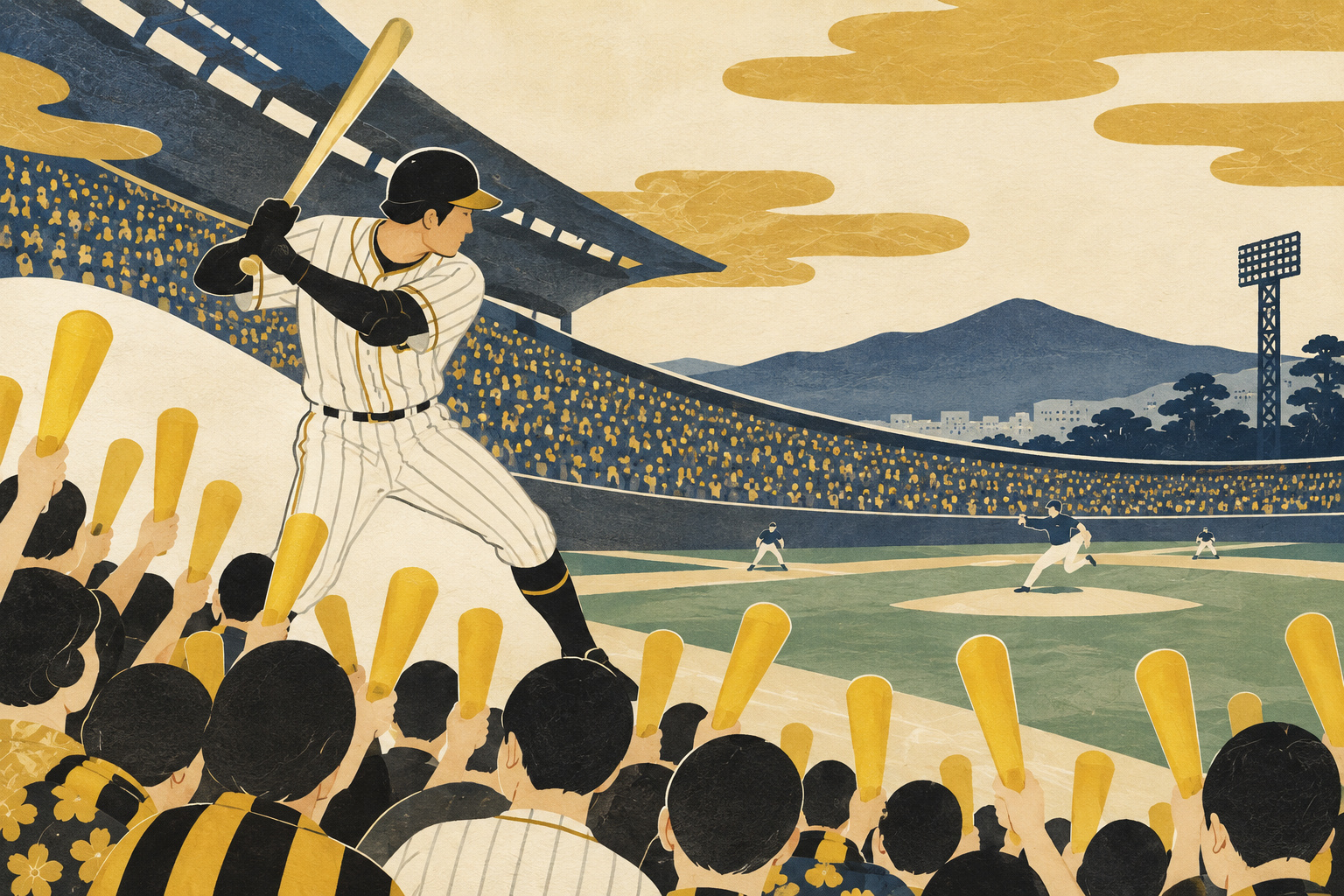
The Hanshin Tigers are first in the Central League, yet the team immediately below them is listed zero games behind. That apparent contradiction captures the difficulty of their September: they hold a lead, but almost none of the comfort that normally comes with one.
Through September 19, Hanshin stood at 71 wins, 58 losses and one draw. The Yomiuri Giants had won one more game and lost one more, with two draws. Hanshin’s slightly higher winning percentage placed it first.[1] This report uses that completed-day cutoff; it does not include results from September 20 onward.
A lead measured beyond the familiar three decimals
| Club / rank | W–L–D | Pct. | GB |
|---|---|---|---|
| 1 Hanshin | 71–58–1 | .5503 | — |
| 2 Yomiuri | 72–59–2 | .5496 | 0.0 |
| 3 DeNA | 66–64–3 | .508 | 5.5 |
Draws are excluded from the winning-percentage denominator. Hanshin’s calculation is therefore 71 divided by 129; Yomiuri’s is 72 divided by 131. Both teams have 13 more wins than losses, which produces the zero-game gap, but their percentages differ. A games-behind column and a league ranking answer different questions.
There is another asymmetry. Against a 143-game season, Hanshin has 13 games left and Yomiuri ten. Games in hand offer the Tigers more opportunities to improve their position, as well as more opportunities to damage it. They cannot be treated as wins already banked. For supporters following two scoreboards, the number of remaining games matters alongside the result of any one evening.
September’s problem: making runs arrive regularly
The most troubling recent stretch was not simply a sequence of close finishes. Counting completed games in NPB’s September results, Hanshin lost seven straight from September 5 through September 15. Across the final four games of that stretch, it scored only one run in total.[2] When production becomes that scarce, a strong pitching performance can still leave almost no room for error.
Two subsequent wins over Hiroshima offered different kinds of encouragement: 7–2 on September 17 and 2–1 the next day.[6][7] One showed the value of a cushion; the other showed that a narrow lead could survive. Neither established that the offensive difficulties had passed.
On September 19, Hiroshima won 5–1 at Koshien before 42,645 spectators. Hanshin scored in the first inning and no more. The Tigers finished with seven hits to Hiroshima’s eight, but also committed two errors.[4] The small difference in hits and much larger difference in runs illustrate why counting base hits alone is an inadequate measure of an attack.
The useful questions concern the sequence of events: whether runners are aboard when an extra-base hit arrives, whether an opportunity survives an out, and whether defensive mistakes extend the opposition’s work. Those are matters to examine in the coming games, not proof that any single lapse explains an entire pennant race.
The power is real; the responsibility is shared
Teruaki Sato’s season supplies a reason for confidence. Through September 19 he was batting .312 with 35 home runs and 95 runs batted in, following a 40-homer season in 2025.[8] Shota Morishita had 34 home runs and a .296 average; his home-run total had already surpassed last year’s 23.[9]
Those are substantial individual achievements. They do not guarantee that the lineup will score on a particular night. A pennant contender needs runners ahead of its strongest hitters and productive plate appearances after opponents pitch around them. The stars can change a game with one swing, but they cannot make every part of an inning happen themselves.
The same distinction applies to the pitching staff. Shoki Murakami had a 1.92 earned-run average but a 10–9 record through the cutoff.[10] In the September 19 defeat, he allowed two runs, one earned, over five innings.[5] His season’s win-loss record should not be used as a complete verdict on how well he has pitched.
Nor can those numbers alone establish why each of his losses occurred. They do, however, make the practical issue clear: restricting opponents and winning games are connected by the work of the entire team. In a close race, converting a good start into a victory can matter as much as producing an outstanding start.
The run-in extends beyond the Giants
October 1 stands out on the calendar: Yomiuri visits Koshien.[3] It is easy to imagine that meeting as the occasion that will explain everything. The preceding games may have changed the question before the Giants arrive.
The published schedule sends Hanshin through repeated meetings with DeNA and Yakult in late September. These selected fixtures show the shape of the run-in; the table is not a complete inventory of every remaining game. Times are Japan Standard Time, and supporters should check official announcements before travelling.[2][3]
| Date | Opponent / venue | JST |
|---|---|---|
| Sep 20 / 21 | DeNA / Koshien | 18:00 / 14:00 |
| Sep 22 / 23 | Yakult / Jingu | 18:00 / 14:00 |
| Sep 25 / 26 | DeNA / Yokohama | 18:00 / 14:00 |
| Sep 29 / 30 | Yakult / Koshien | 18:00 both |
| Oct 1 | Yomiuri / Koshien | 18:00 |
| Oct 3 | Hiroshima / Mazda | 14:00 |
| Oct 4 | DeNA / Yokohama | 18:00 |
For the coaching staff, that pattern creates a familiar but demanding choice. The reliever best suited to protecting tonight’s lead may also be the one most needed tomorrow. Using him now can preserve a win; repeated use can narrow the options later. Travel adds another consideration when deciding how much work to ask of the same players.
A manager has to assess the next matchup without allowing the standings to turn every inning into an emergency. The best choice for one game may carry a cost in the next. That makes the quieter fixtures part of the same strategic problem as the most emotionally charged rivalry.
The historical warning in a zero-game margin
Hanshin’s own record book supplies a particularly relevant precedent. In 2021 the Tigers finished second at 77–56–10, with the gap to first recorded as 0.0 games. League championships followed in 2023 and 2025.[11] That history combines the memory of missing out by a fine distinction with the confidence of recent success.
It does not predict the outcome in 2026. It explains why a fraction on a standings page can carry weight beyond its size. Supporters who have followed those seasons need no reminder that “close” and “champion” are different entries in the record book. Equally, the defending champions have a recent example of finishing the job. Neither memory can win the next game for them.
For supporters, October remains conditional
The uncertainty has practical consequences as well as emotional ones. The club’s postseason ticket announcement sets out different Koshien arrangements depending on its final position: a first-stage Climax Series beginning October 10 if Hanshin finishes second, or a final stage beginning October 14 if it finishes first.[12] Preparing to host is not confirmation of where the team will finish.
That distinction matters for anyone arranging leave, travel or another trip to the ballpark. It also captures the experience of following this race: looking ahead while knowing that the next result may change the plan. For those following the race night after night, an ordinary league fixture can therefore carry two stakes: the result itself and the October possibilities it opens or closes.
The clearest way to judge Hanshin’s closing stretch is to watch three things: whether the scoring becomes sustained rather than occasional, whether pitching and defence preserve competitive games, and whether victories arrive against opponents other than Yomiuri. A dramatic head-to-head meeting may dominate the conversation. The less celebrated innings on either side of it can decide how much that meeting ultimately matters.
At the September 19 cutoff, Hanshin has a lead worth defending and work still to do. The task is to turn the next opportunity into a win—and to make a narrow numerical advantage endure.