A pennant celebration with unfinished business
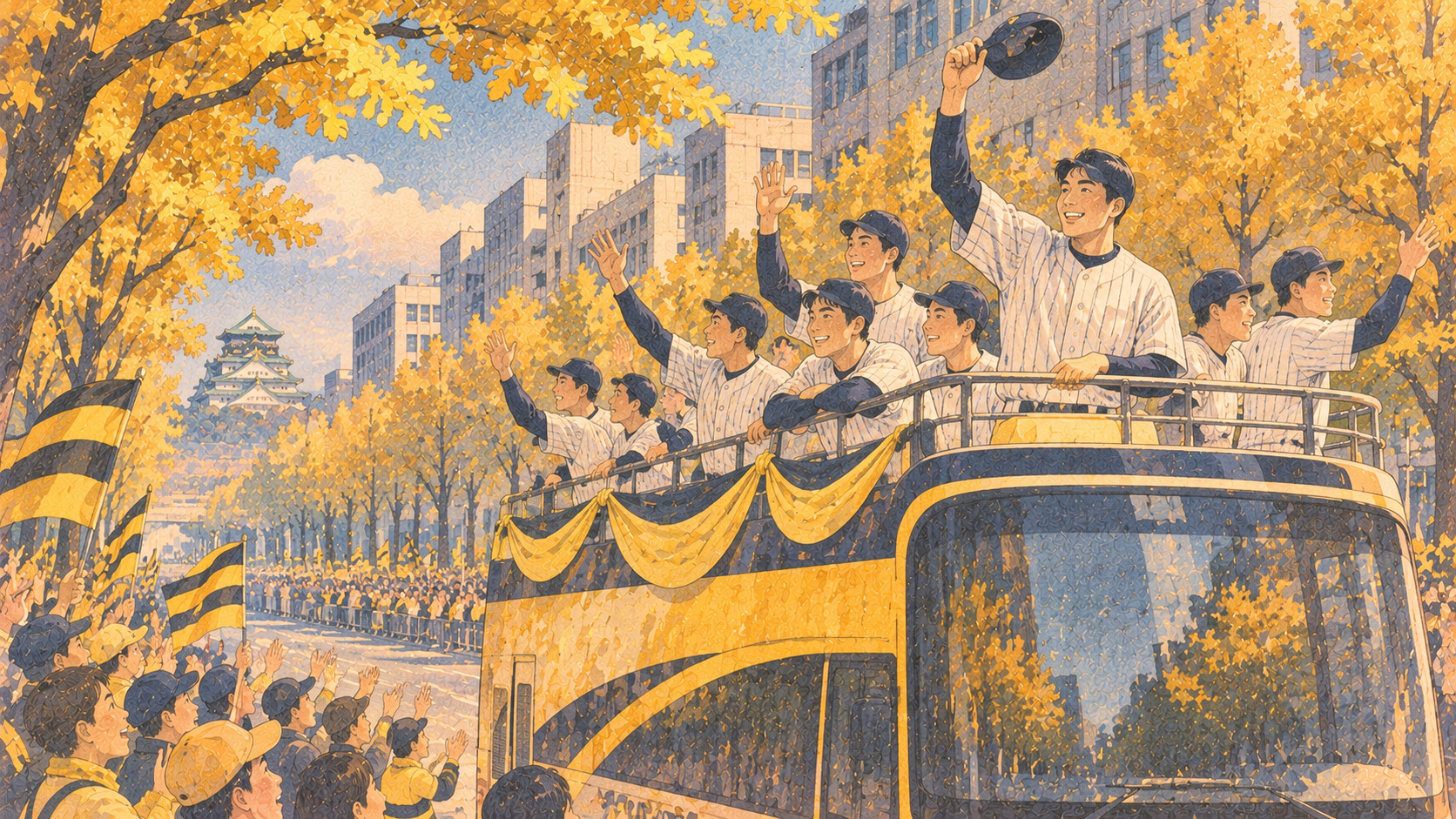
On November 23, Osaka turned part of its principal boulevard into a public celebration of sporting achievement. The Hanshin Tigers, represented by 35 members of their playing and coaching staff, traveled in two vehicles along roughly 1.2 kilometers of Midosuji. Local broadcaster Sun TV reported that the procession took approximately half an hour.[3]
The team appeared as part of Midosuji Runway 2026, an event designed to showcase the city rather than a baseball-only gathering. The distinction matters: professional sport was placed alongside other forms of urban entertainment and public participation.[4][15]
For international readers, the celebration may seem surprising because Hanshin did not win the Japan Series. It had instead accomplished something unprecedented in its Central League history: winning the regular-season pennant in successive years. That achievement and the disappointment that followed it are both essential to understanding the afternoon.
A club older than the Central League
Hanshin began life as the Osaka Baseball Club on December 10, 1935. Known as the Osaka Tigers, it joined the professional competition the following year. The early team won the autumn 1937 and spring 1938 championships, when the competition had a different seasonal structure.[5]
This is why the modern claim of a first repeat championship needs a qualifier. Japan established the Central and Pacific leagues in 1950; the 2025–26 repeat is Hanshin’s first in the Central League, not its first experience of consecutive titles under every historical format. The club took its current name in 1961.[2]
The Tigers’ modern league-title years are 1962, 1964, 1985, 2003, 2005, 2023, 2025 and 2026. The gaps in that list help explain the emotional importance of consecutive pennants. Even an established team with a large following cannot take championships for granted.
Why 1985 and 2023 still matter
The two national championships in Hanshin’s record occupy a special place in its history. The 1985 team, associated with Randy Bass, Masayuki Kakefu and Akinobu Okada, became a reference point for subsequent generations of supporters. Pennants in 2003 and 2005 brought renewed success without another national title.[6]
The 2023 Japan Series victory ended the 38-year wait for a second national championship. Official NPB records separate those two Japan Series triumphs from the club’s eight Central League pennants.[2]
For a franchise that has endured long stretches without a title, the appeal of a parade is not merely seeing famous athletes. It offers a public occasion for people with very different memories of the team to celebrate the same result. This is a cultural interpretation of the event, not a claim that all supporters experience it in the same way.
The harder road to a repeat
Hanshin’s first season under Fujikawa in 2025 ended with 85 wins against 54 defeats and four ties. In 2026 the Tigers finished 79–62 with two ties and a .560 winning percentage, only 2.5 games ahead of the Giants.[2][7]
The title became official on October 3 even though Hanshin lost its own game against Hiroshima, 6–4: the second-place Giants also lost, removing the possibility of catching the leaders. NPB’s season review describes a race involving Yakult early in the year and the Giants later, with Hanshin holding first place from August 11 onward.[1][8]
A repeat title under these circumstances is not simply a continuation of the previous season’s dominance. It demonstrates how a team can finish first under a different competitive balance. Over 143 games, availability, depth and the ability to recover from losses can be as important as a spectacular individual performance.
The players behind the pennant
Teruaki Sato delivered an exceptional season, leading the league in batting average (.306), home runs (39) and runs batted in (106). His 165 hits also led the league. Shota Morishita posted a .394 on-base percentage, while Yusuke Oyama drove in 85 runs.[8][13]
The pitching staff offered a complementary strength. Haruto Takahashi won 16 games, Shoki Murakami recorded a 1.85 earned-run average, and Hiroto Saiki struck out 175 batters. Younger relievers also earned responsibilities as the club worked to stabilize its bullpen.[8]
These numbers illuminate the structure of a championship team. Batters need teammates who reach base, and starting pitchers depend on relief pitching and defense. Individual awards tell important parts of the story, but neither a triple crown nor a leading pitching statistic can explain every win. The repeat was a collective accomplishment.
From the bullpen to the dugout
Manager Kyuji Fujikawa was born in Kochi on July 21, 1980. His professional path took him from Hanshin to the Chicago Cubs and Texas Rangers, through independent baseball in Japan and back to the Tigers. He concluded his playing career in 2020 and became manager in 2025.[9]
Fujikawa amassed 243 saves in Japanese professional baseball.[10] A closer operates in a narrowly defined but highly consequential role; a manager must instead distribute responsibility across an entire roster. His background offers an interesting lens for examining bullpen management, though it does not by itself prove why a particular tactical decision worked.
NPB announced on November 9 that Fujikawa would receive the Central League’s best manager award, with the ceremony scheduled for November 25.[13] After the parade he publicly set his sights on a national title next year.[14] Two pennants are an impressive beginning, but the next challenge is different: converting regular-season success into postseason victory.
A team that belongs to more than one city
The Tigers play their home games at Koshien Stadium in Nishinomiya, Hyogo Prefecture, not in Osaka. Yet their original Osaka identity and their home in the corridor between Osaka and Kobe make them a particularly useful example of how Kansai’s sporting loyalties extend beyond municipal boundaries.[5][6]
The club song, introduced in 1936 and widely known as Rokko Oroshi, is an enduring expression of that shared identity.[5] Singing, wearing team colors and displaying a favorite player’s towel turn spectators into active participants. A parade takes those habits outside the stadium and into a civic space where people need not purchase a game ticket to join the occasion.
The Midosuji event is supported by government, business and tourism organizations.[15] Bringing visitors to central Osaka can create opportunities for shops and restaurants, but it also requires transport planning and crowd management. No independently verified economic-impact estimate specific to this parade was available. Its cultural significance should not be confused with a proven financial return.
What a pennant does—and does not—guarantee
For readers familiar with American baseball, a Japanese league championship is a regular-season distinction. The top three clubs in each league proceed to the Climax Series, and the winner of its final stage advances to the Japan Series. Rules were revised for 2026, including conditional changes to the advantage awarded to the first-place team.[11]
Hanshin lost its final-stage series to the Yokohama DeNA BayStars. The Fukuoka SoftBank Hawks subsequently secured the national championship.[8][12] The Tigers therefore enter the winter as Central League champions, not Japan Series champions.
The two truths can coexist. Winning the league twice represents sustained performance over hundreds of games; the postseason tests a team in a shorter and different competitive setting. Neither a third pennant nor a national title can be promised. What the parade made visible was a community willing to celebrate what had been achieved while continuing to hope for what comes next.
Sources and further reading
- NPB: October 3 title clincher
- NPB: franchise records
- Sun TV: parade report
- Osaka Prefecture: event program
- Tigers: founding history
- Tigers: 90-year history
- NPB: 2026 Central League standings
- NPB: season review
- Tigers: Fujikawa profile
- NPB: career saves
- NPB: playoff rules
- NPB: Pacific League review
- NPB: November 9 award announcement
- Nikkan Sports: manager after parade
- Osaka Prefecture: organizing committee and objectives
- NPB: 2025 title clincher